
Sunday, January 11, 2026
Home Blog Page 4741

Chronicles of The Farm Woman

0
farm woman

The Farm Woman


Two hundred and forty-nine boys and girls received diplomas at the eight grade commencement Saturday morning.  A group of quiet, alert youngsters, every one well dressed.  Girls all had their hair curled.  The boys wore white shoes.

It was “ad astra per aspera”1 for many of the children and parents in that audience.  In order to be in our seats at 9:15 as the directions stated it meant those in the far corners of the county must leave home at 8 o’clock.  Farmers must allow time for a flat tire or adjustment of the distribu-tor.

Eighth graders like to plan, and they should probably be given more voice in household manage-ment.  One young graduate proposed that a good many things could be done on FridaySaturday’s baking was combined with Friday cleaning.  Small brothers and sisters were scrubbed and shampooed.  She work-ed hard and faithfully.  Friday night it seemed that everything was working smoothly.  The first thing Saturday morning a younger brother came down stairs in his best bib and tucker, expecting to slop the pigs and feed the calves in that garb.   He was quickly dispatched back upstairs, mumbling.  The little kids who had no definite outdoor chores sallied forth in the dewy morn.  All that bathing to do over.  It was too much for the sweet girl graduate.  She wept.

Experience, that wonder-ful teacher, has taught her that farmers had best get right out of the wash tub into their best duds.

We overheard a youngster in the audience remark, “Mother, there are lots of babies here.”  There were lots of babies there.  The next crop of rural school children – the hope of America.  It is to rural America that cities must look for leadership.

The speaker of the morning echoed our philosophy when he said that every one hundredth anniversary of the founding of the common school by Horace Mann – the man who dreamed of a literate America.  A wave of humility and gratitude comes when one thinks of the vision and courage of the founder of our common schools.

One of these graduates may not one day be president but it is to be hoped that each will cling to the heritage of freedom of speech and worship, to the right to trial by jury and to the right to private property.  This the birth-right of every American child. 
Camouflage on a a shoestring

0
Steve Gilliland
Steve Gilliland

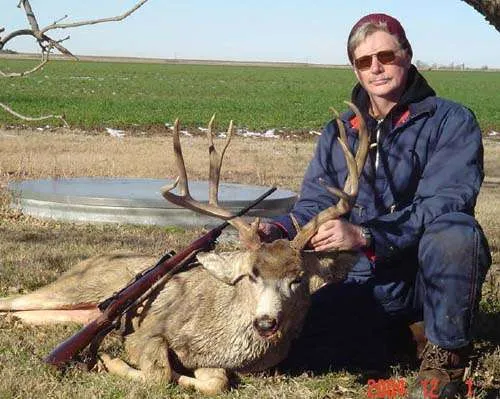
Webster’s dictionary describes camouflage as “A disguise; a deception; to disguise in order to

conceal.” Anyone who has priced camouflage clothing at sporting goods stores or even Wal-Mart knows

there’s hardly a limit to the amount of money one can spend on camouflage clothing and gear. My way

around that is to buy or otherwise procure military surplus camo. This is hardly a secret and possibly

many of you have already gone this route too, but maybe I can pass on to you a few things I’ve learned

about military camouflage clothing.

Having spent twenty years in the Army National Guard, I’ve found that not all military camo is

created equal. During my service we sported the BDU’s (battle dress uniforms) that were all shades of

green, black and dark brown and the pattern was comprised of large blotches. This is great stuff for later

spring turkey hunting when all of nature is adorned in its brand new green foliage, but for fall and winter

when most of our hunting takes place it’s too green to look natural. We have recently fallen in love with

the pattern worn by the army for several years now known as ACU Digital. This pattern is comprised

of smaller square and rectangular shapes that looks much like a jigsaw puzzle, but contains more off-
whites, grays and drab greens. It’s a much better fit for year-round use and is also good for winter.

Two of the obvious pros of military camo are the availability and the price. Besides local surplus

stores, the internet and eBay teem with sites and sellers peddling military camo clothing and gear.

It’s also commonly found at garage sales where people have scarfed it up when their term of military

service ended thinking it was cool, but then found they had no real use for it and are willing to part with

it for a song. In a recent internet search, we even found a site called www.magnafabrics.com that sells

military camo fabric in about a dozen different patterns at very reasonable prices, so for those of you

who sew or our married to a capable seamstress, that is another route to consider.

In my book, another big plus to military camo is its construction. Aside from the cockamamie

button flies on the older pants, the military makes quality garments. Things like Velcro tabs that allow

you to pull sleeves tight around your wrist, draw strings at the bottom of pants legs to help keep out the

cold wind or the ticks, and tabs that let you tighten waists all help make them handy and user friendly.

And then there’s the pockets, especially on the pants. Having too many pockets is like having too many

goose decoys or too many walleye fillets in the freezer, it just ain’t gonna’ happen, and military camo

garments have lots of big handy pockets. The new shirts and pants come in different styles, but my

new ACU shirt has six pockets; two on each sleeve and one on each side at chest height, all held shut

by Velcro, and the pants all have those great cargo pockets on each side of the legs plus the usual four

found on all pants. My shirt has a zipper instead of buttons, which I think is cool, and an expansion panel

on the back of each shoulder that flexes when you extend your arms or bend over. The only downside

I’ve found with this new camo is all the Velcro. Velcro’s great but kind of noisy when the woods are

Sporting goods stores are full of good quality camouflage clothing for every occasion and

situation. Heck, some companies were founded and exist today entirely for the design and production of

camoflage clothing and gear. So if you insist on name brand camo clothing, I understand. But if you, like

me, love a bargain and feel good when you can spend less on your outdoor clothing and gear and still

get just what you need, try surplus military camo, and especially the new army ACU stuff. It’ll help you

continue to Explore Kansas Outdoors for less.

Steve can be contacted by email at [email protected].

Green fields

0

By John Schlageck, Kansas Farm Bureau

This year Kansas has green fields, kissed by the sun. There are blue skies with white clouds high above. There are even valleys where rivers run. Heck, there’s even water standing in terrace channels.

It’s been at least five years since the pastures have been this green in the eastern half of the state and even in some of the drier areas of western Kansas the grass is showing signs of life.

If you’ve traveled anywhere in the state this summer, you can see what a little moisture can do, especially with the nurturing hands of our Kansas farmers.

Corn crops tower above the ground. Ten-feet tall is not unusual. Some farmers say some of their crops are 11 and 12-foot tall.

In Decatur County, far northwestern Kansas, farmers are hoping to harvest 90 to 100 bushel dry-land corn.

Grain sorghum fields sport huge heads nine, 10 and even 12 inches long. These heads are heavy filled with plump red and green berries.

Soybean leaves are the size of footballs. Pods weigh down the plants.

Calves graze in grass that nearly tickles their bellies. Even in the short-grass country of western Kansas, the buffalo grass is green and full of protein. Low spots and  buffalo wallows are filled with life sustaining water. It’s a stark contrast to so many years when the grass has already turned brown, parched by the sun.

The Sunflower State has been truly blessed with moisture during the summer of 2014. Rainfall has been plentiful in many areas of our state.

Timely rains keep falling. In some areas of Kansas, farmers have stopped irrigating and are anxious for their fall crops to dry down. They’re ready to harvest.

The May family has farmed and ranched in Decatur County since 1887. Roger and Susan May are fourth-generation producers and they’re thankful for the moisture in 2014.

“It’s been a great year,” Roger says. “The cattle are looking good and in great shape. It’s been several years since our grass has been this green this late in the (growing) season.”

Plenty of showers, moisture from 35 to 60 hundreds of an inch, have been sure and steady throughout the summer, the Decatur County farmer/rancher says. They’ve also enjoyed a couple of more abundant rainfall events that totaled a couple inches. So far this year, nearly nine inches of rain has fallen on their land.

On this early September morning, temperatures hovered in the low 70s. Barn swallows bobbed and weaved in the sky searching for insects. Many of the insects are pesky black flies that pester the cattle and calves.

These insects don’t like to fly on such cool, early mornings. As the cattle kick them up from the ground, the swallows snatch them from the sky, eat them or carry them home to feed their hungry offspring.

Looking out the pickup window at his herd, Roger says he’d rank them at near the top on a scale of one to five. The plentiful moisture, good grass and plenty of milk for the calves has been a real asset this summer.

“They’re in top condition – they’re fleshy and their coats are sleek and shiny,” Roger says. “With these cows in such fine shape, they’ll raise a better, healthier calf this coming winter.”

The Mays manage a 350 head cow/calf operation as part of their farm and ranch operaton. Most years they feed the calves out to finish.

The cornerstone of his livestock operation has always involved making sure they have good feed, good nutrition and the proper health care. He likened his cattle to his family.

Each and every day the Decatur County stockman drives out to look at their herd. Once in the pasture, he meanders slowly through his stock, checking carefully for any sick cows or calves. Roger also checks to see if the cattle have water, mineral and salt.

Another important part of this daily routine is to count the stock and make sure they’re all inside the fence. The Decatur County stockman likes to keep his stock in his pastures.

“If you can keep livestock in, off your neighbor’s property and off the road, that’s a real accomplishment,” May says. “Every cattleman must keep track of his fences – make sure they’re in top repair.”

Like the poem by Frost says, “good fences make good neighbors.”

Yes sir, out here on the May place cattle have always been a major part of their operation. The better they take care of their livestock, the better the cattle will take care of them.

That’s the way it was with his dad and his grandfather before him. As a matter of fact, that’s the way Roger believes it will always be.

John Schlageck is a leading commentator on agriculture and rural Kansas. Born and raised on a diversified farm in northwestern Kansas, his writing reflects a lifetime of experience, knowledge and passion.      


– See more at: http://www.kfb.org/news/insight/index.html#sthash.JhODSWBP.dpu

Cougar Volleyball comes up short at Wyo-Braska Tourney

0

Playing out of state has not been kind for the Barton Community College volleyball team as the Cougars dropped four matches at the Wyo-Braska Tournament.    Barton limps home with a 3-16 record on the season after going 0-12 in three out-of-state tournaments this season.  The Cougars, 2-3 in conference play, will wrap up its 21-day away schedule on Tuesday in El Dorado, Kansas, in a 6:30 p.m. conference match against the 1-3 and 7-8 Butler Community College Grizzlies.   Barton will return to the friendly confines of the Barton Gym on Wednesday in a non-conference match with Marshalltown Community College.

Barton opened the two-day tournament on Friday in Scottsbluff, Nebraska, dropping a pair of matches with the first coming against Laramie County Community College.  The Cougars took the first set 25-23 but the Golden Eagles won the next two sets 25-22 and 25-15 to take a set lead in the match.  Barton battled back in the fourth earning a hard fought 25-23 win to force a fifth set but the Cougars came out on the short end of a 15-12 score.

The Cougars second match of the day didn’t fare as well as Barton lost in straight sets to No. 5 and host Western Nebraska Community College 25-15, 25-17, and 25-14.

Traveling the short distance to Torrington, Wyoming, for Saturday’s action, the Cougars dropped the first set to Central Wyoming Community College 25-14.  Barton bounced back for a 24-19 win in the second only to have the Rustlers gain the match advantage earning a 28-26 victory.  In an almost carbon copy of Friday’s first match, the Cougars clawed back in the fourth to win 25-22 to force its second five-set match in the last twenty-four hours.  Holding a slim 13-12 lead, the Cougars went scoreless the rest of the fifth falling 15-13.

Less than an hour later Barton returned to the hard court to wrap up play in the tournament with a rematch against a Sheridan College team that defeated the Cougars 3-1 seven days prior at the NJC Pizza Hut Invitational.  After losing the first set 25-22 Barton stormed back for a 25-19 win but that was all the Cougars could muster in losing the remaining sets 25-19 and 25-18.

UNL dedicates statues of former Secretaries of Agriculture

0

LINCOLN, Neb. — On a day when four former U.S. secretaries of agriculture from Nebraska were honored in bronze on the University of Nebraska-Lincoln’s East Campus, Ronnie Green already was looking ahead to the need to make room for a fifth and sixth – who knows how many? – statues.


Green, Harlan vice chancellor of the University of Nebraska’s Institute of Agriculture and Natural Resources, led the dedication Saturday afternoon of statues of J. Sterling Morton, Clifford Hardin, Clayton Yeutter and Mike Johanns.


Only Iowa claims more secretaries of agriculture, with five, but Green assured the crowd Nebraska isn’t done.


“When the next secretary of agriculture from Nebraska is appointed, we’ll start working on that next statue,” he said.


Yeutter’s statue is in the Jeanne Yeutter garden, while the other three are placed in an area bound by the East Union, Thompson Library and Filley Hall. With planned renovations to the library and the union, Green said, this Legacy Plaza will become a major focal point on East Campus, where the statues will serve to educate future generations of students about “these four distinguished Nebraskans who have served our country greatly.”


Green said the idea for the statues was born during the celebration two years ago of the 150th anniversary of the Morrill Act, which created the land-grant university system. Yeutter and Johanns were among four former ag secretaries who participated in a panel-discussion Heuermann Lecture that fall.


The statues, privately funded, were sculpted by Matthew Placzek of Omaha, who expressed his joy in getting to know the four men’s families over the last couple of years. “To me, to be a part of this wonderful campus is truly an honor,” Placzek said.


Yeutter and Johanns expressed appreciation. “I’ve been a Cornhusker all my life,” said Yeutter, a Dawson County native.


Johanns, a former governor now finishing his service in the U.S. Senate, said he too was honored.


“You can’t be a senator or governor and not have a very deep, passionate appreciation of what the University of Nebraska means to this state,” he said.


Many members of Hardin’s family also were present Saturday, including three daughters who accepted the honor on behalf of the family.

Writer: Dan Moser, IANR News Service