Tuesday, January 20, 2026
Home Blog Page 126

Tall fescue adds to heat stress in cattle

0

Cattle rid their bodies of heat in three ways: radiation, convection and evaporation. “If your cattle can’t use all three methods, they’ll overheat fast,” says University of Missouri Extension state beef nutrition specialist Eric Bailey.

Summer heat knocks weight off calves and pounds off milk, Bailey says. Losses come in the form of less gain, weaker fertility and other health issues. “Heat stress costs real money,” he says.

Producers can reduce heat stress by providing adequate shade, proper fly control, access to water and the right choice of pasture grass.

Tall fescue pastures turn up the heat

Cattle grazing on tall fescue grass when temperatures rise is a recipe for disaster.

Toxic endophytes in fescue can turn up the cattle’s body heat. Their efforts to keep cool can melt profits. But there are practical fixes that keep weight and profits steady, Bailey says.

Most fescue pastures in the Fescue Belt carry endophytes that make toxic ergot alkaloids, which mess with your cattle’s ability to stay cool, he says.

These toxins tighten blood vessels, cut blood flow to the skin and prevent heat from escaping. They make it hard for cattle to sweat and pant, essential tasks to rid their bodies of heat. Third, ergot alkaloids delay shedding by lowering prolactin. This leaves cattle with shaggy coats that trap summer heat.

Summer temperatures, especially heat waves, make cattle on fescue vulnerable to problems. Normally, cattle can tolerate temperatures of 31 C or 88 F. Cows likely consume enough ergovaline by Memorial Day to make heat stress worse during the summer.

Small amounts cause big losses

Even ingesting small amounts of ergot alkaloids can result in reduced weight gain and smaller calves, less milk, lower fertility and lighter wallets, says Bailey. He offers these suggestions on avoiding losses from heat stress:

• Rotate toxic tall fescues with other grasses such as clover, or interseed pastures with nontoxic novel-endophyte fescue to dilute.

• Consider investing in full pasture renovation on the worst fields. See the Alliance for Grassland Renewal website for information on renovating tall fescue pastures.

• Provide supplemental feed in the range of 0.5% to 1.0% of bodyweight per day to dilute ergovaline in the diet.

Maintain good fly control

If you have cows on tall fescue, pay special attention to fly control.

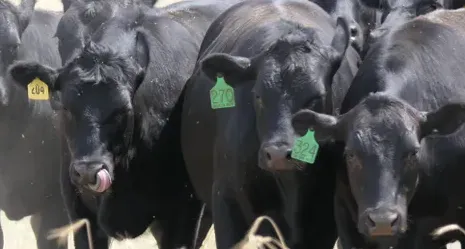
“If your cattle are on toxic tall fescue and they are crowding together to dodge flies, the deck is stacked against them,” says Bailey.

Cattle tend to bunch up to avoid flies, especially stable flies that attack their legs. They congregate in the middle of the pasture and avoid the field edges where flies gather most.

Bunching traps heat, cuts radiation and convection in half, and raises humidity significantly. “In severe cases, cows quit radiating heat and actually begin to heat up even in the shade,” says Bailey.

Here’s the fix:

• Drag pastures to break up manure, which is a breeding ground for flies.

• Use fly tags, traps or parasitic wasps to cut fly numbers.

• Finally, rotate pastures to break fly life cycles.

Give your herd shade

Bailey gives guidelines to discourage bunching and encourage cattle to space out in pastures:

• Provide 20-30 square feet of shade per cow.

• Provide portable shade structures that allow airflow.

• Place water troughs 50-100 feet apart to encourage animals to spread out.

Finally, radiation and convection need cool surroundings and airflow to work, says Bailey. “They fail when it’s hot and crowded. Evaporation is the last line of defense in a heat wave, but humidity and fescue toxins can cripple it,” he says.

For more information, see the MU Extension publication “Tall Fescue Toxicosis” (G4669), which is available for free download.
From bison to ticks, these are the 12 deadliest animals found in Kansas

0

Potentially deadly Kansas creatures range in size from as big as a bison to as tiny as a tick.

The WorldAtlas website spotlights a dozen such animals in an entry titled, “The 12 Deadliest Animals in Kansas.”

The site focuses on 12 animals, at least two of which it doesn’t document as having caused any human deaths.

American bison

The American bison appears tame at first glance but can be “unpredictably dangerous,” said the WorldAtlas site.

The bison since 1955 has been the state animal of Kansas. It is the largest mammal in North America, yet is capable of running as fast as 35 mph, the WorldAtlas site said.

A bison gored its owner to death in August 2022 in central Kansas.

That animal subsequently threw an Ellsworth County sheriff’s deputy 10 to 12 feet into the air, and appeared to be charging at him when it was fatally shot by another deputy. The downed deputy survived.

Snakes on the plains

Four venomous snakes indigenous to Kansas are among the 12 types of creatures highlighted on the WorldAtlas site.

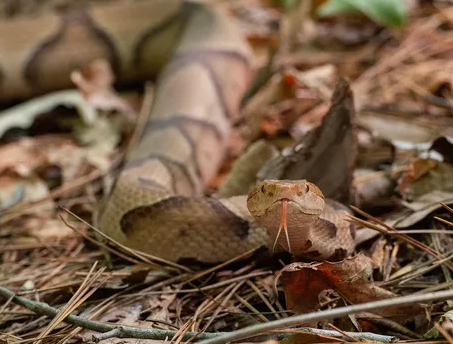
Those are the prairie rattlesnake, the timber rattlesnake, the massasauga rattlesnake and the copperhead snake.

All venomous snakes found in Kansas are pit vipers, meaning they have heat-sensitive pits in front of each eye to help locate prey, according to the website of the Kansas Department of Wildlife and Parks.

It said the timber rattler can be found in the eastern fourth of Kansas, the prairie rattler in the western half of the state, the massasauga rattler in the eastern two-thirds of the state;and the copperhead in the state’s eastern third.

Deaths from snake bites in Kansas are rare, according to a “A Pocket Guide to Kansas Snakes” — written by Joseph T. Collins, Suzanne L. Collins and Travis W. Taggart — which is on its sixth edition after initially being published in 2011.

“There is only one documented fatality in Kansas since 1950,” it said.

Kansas has two types of poisonous spiders

The poisonous black widow and brown recluse spiders are two others among the 12 potentially deadly Kansas creatures listed on the WorldAtlas site.

“A black widow spider bite is rarely fatal but may harbor a neurotoxic venom that causes severe muscle cramping, nausea, localized pain, vomiting, headaches, sweating, and trembling,” it said. “In rare cases, these bites may induce tremors, convulsions, breathing difficulties, or suffocation.”

The WorldAtlas site added, “Though a majority of reported bites from a brown recluse often cause little to no symptoms, a human reaction to a bite from a brown recluse spider can vary depending on the amount of venom injected in the victim and the victim’s sensitivity to the spider’s venom.”

Bites from the brown recluse almost never cause death in humans, said the website healthline.com.

List includes two types of ticks found in Kansas

The lone star tick and black-legged, or deer, tick are two others among the 12 potentially deadly Kansas creatures listed on the WorldAtlas site.

Ticks are slow-crawling, wingless parasites that attach themselves to hosts and feed on their blood.

Exposure to ticks puts humans and animals at risk of becoming infected by various diseases.

A tick-borne disease in May 2022 killed a Topeka family’s cat.

Black-legged or deer ticks are said to be the primary species that transmit Lyme disease in Kansas, the WorldAtlas website said.

Lone star ticks, which get their name from the single white dot often seen on the back of the female, can also transmit that disease, it said.

Lyme disease can be fatal but rarely kills humans, according to the Medical News Today website. Between 1985 and 2019, 11 people worldwide died due to the related heart condition Lyme carditis, it said.

‘Kissing bug’ can cause a potentially fatal disease

Triatominae, also known as the “kissing bug,” got that name because it was initially thought that it often bites the face of its victims, though it can actually can target any part of a victim’s body, said the WorldAtlas site.

Kissing bugs may carry a parasite that that causes Chagas disease, a potentially deadly inflammatory and infectious disease that can cause heart or digestive issues if left untreated.

“It is estimated that about 50% of kissing bugs carry the disease, though the number of infected insects varies by location,” the WorldAtlas site said.

Common snapping turtle

The snapping turtle, a semi-aquatic and omnivorous freshwater turtle species, tends to be short-tempered and stand its ground when provoked, the World Atlas site said.

Snapping turtles, when disturbed, may also emit a foul-smelling musk, the site said.

“They can be vicious if removed from the water,” it said. “As the name suggests, snapping turtles may inflict painful bites, albeit uncommonly.”

The WorldAtlas site didn’t document any human deaths caused by snapping turtles.

‘Velvet ant’ is actually a wasp

The “velvet ant,” a furry-bodied insect that is actually part of the wasp family, is another Kansas creature mentioned on WorldAtlas.

Velvet ants are not aggressive but females will sting if they are being held or stepped on, that site said.

“The sting of a velvet ant is excruciatingly more painful than a bee sting,” it said. “Its sting is so painful that the wasp is referred to as the ‘cow killer!’ While the venom is not very toxic, individuals ought to avoid handling velvet ants to prevent getting a jab of their painful sting.”

The WorldAtlas site didn’t document any human deaths caused by velvet ants.

As reported in the Topeka Capital Journal

The Kansas River used to be a dumping ground. These kayakers are helping clean it

0

The Kansas River is cleaner today than half a century ago, but pollution and trash remain problems. Kayakers and others who love this river are helping the river’s sandbars by hauling away tons of garbage.

Dawn Buehler spent her childhood helping out on the family farm in De Soto, next to the Kansas River.

But when her chores were done, the river beckoned. She and her family would canoe and fish. Sometimes they would camp on a sandbar.

“You felt like you were in the last wild place in Kansas,” she said. “You could go out to the sandbar in the middle of the river and be away from everything.”

With memories like that, it’s not hard to understand why she is so motivated to clean up the decades-old trash sites in the river.

Buehler is the executive director of Friends of the Kaw, a nonprofit group focused on protecting a watershed that drains part of Colorado and Nebraska and about half of Kansas.

This basin is, according to the U.S. Army Corps of Engineers, the world’s longest prairie-based river.

By some measures, water quality has improved greatly in recent decades because of the 1972 Clean Water Act that regulated what cities and most industries can dump into waterways.

But the Kansas River, like other bodies of water in the U.S., still faces a host of challenges that range from fertilizer running off of farms and lawns to invasive species squeezing out native wildlife.

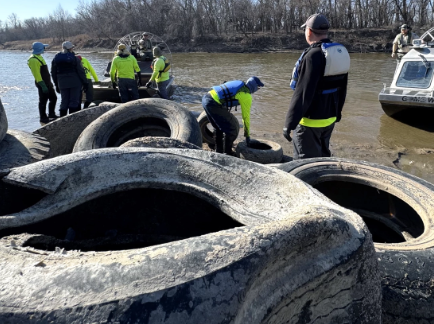
Another challenge: Tires and other garbage have stayed for decades at some sites along the river, slowly releasing chemicals and marring the beautiful, golden sandbars that endear it to fishermen, canoers, birdwatchers and others.

This is my home and it’s the home of people before me and people after me,” kayaker and retired geology teacher Lynne Beatty said. “And I want to make sure it’s something that they can come out and enjoy.”

Beatty used to bring her Johnson County Community College students to the river to learn about sandbar geology and watersheds firsthand.

Over the past decade, these are the kind of people — with a strong connection to the Kansas River — who have set about cleaning up sites that have long needed attention.

Volunteers for Friends of the Kaw — many of them skilled kayakers — monitor the river year-round and keep a detailed list of these sites.

With help from hunting and fishing groups, college students, Rotary clubs, construction crews, county governments and other hands on deck, they’ve made real progress toward a 2030 goal to work through every site on their list.

In July’s episode of the Kansas News Service podcast Up From Dust, hear the history and the ongoing challenges — and meet some of the kayakers, game wardens, construction workers and others putting muscle into saving the Kansas River from literal tons of garbage.

“It feels like we’re helping out the wildlife, the fish — getting the chemical levels to reduce,” said Malik Nash, a worker with Garney Construction.

Yet even as they remove tires and vehicle battery cases by the thousands, a different source of pollution has gotten worse.

A relentless supply of plastic items — such as water bottles and candy wrappers – is washing off the streets of each city in the watershed. This trash accumulates in pockets of the river called eddies.

In recent years, Friends of the Kaw has added cleaning up these eddies to its list of daunting tasks. The group is determined to reduce the amount of garbage making the journey to the Gulf of Mexico, which is already awash in microplastics.

As word spreads, the group’s cleanup events have started attracting crowds that number as much as a few hundred people willing to help pick up litter in or near the river.

“Our goal is to make sure that Kansas sends as little as possible downstream,” Buehler said. “We’d like to take care of our own trash here in our own space, but we really need the public’s help to do it.”

Kansas invited amateur archaeologists to dig out ruins from the state’s ‘bloody’ past

0

The Kansas Historical Society’s archaeological field school this year gave volunteers a chance to dig into the state’s territorial history at the site of an 1850s-era mansion near Lecompton.

Just a few stone walls remain of what was once a stately, three-story stone mansion on the bluffs of the Kansas River near Lecompton, Kansas.

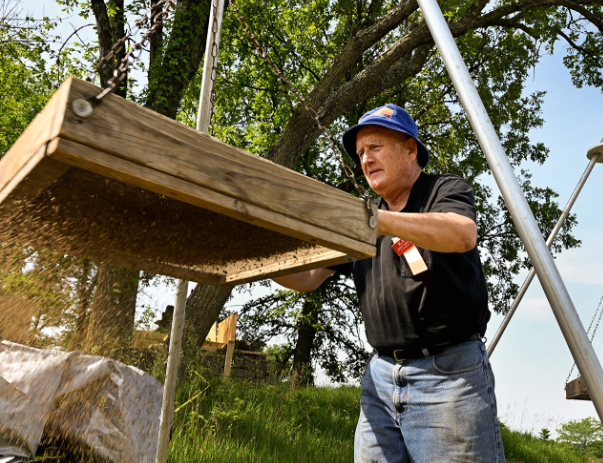
Among the ruins, amateur archeologist Debi Aaron is hunched over a dry-screening tripod carefully sifting the dirt and rock she collected from the site of a pre-Civil War home.

“Anything that stays in the screen is collected,” said Aaron, a 911 operator. “If you do it long enough, you may have an artifact left in the screen that you couldn’t see otherwise because it was covered with dirt.”

Since 2009, Aaron’s been a regular fixture at the Kansas Historical Society’s archaeological field school. The Hebron, Nebraska, resident has traveled south to work more than a dozen digs, and has learned some days are more productive than others.

“So far, above the 30 centimeter level, the most exciting thing is probably a couple of square nails and a very tiny ceramic fragment that had, like, a glaze on top,” Aaron said.

In June, around 100 students and volunteers worked side-by-side with professionals to piece together history from the ruins of the home, built during the violent clashes of Bloody Kansas.

The 10-day field school, started five decades ago by the historical society and the Kansas Anthropological Association, is a chance to do real science. Attendees assist archeologists surveying sites, excavating relics, and cleaning and cataloging artifacts.

“It’s my passion. It’s my hobby. I love it, and it’s not just the archeology, it’s all the people that I meet,” she said. “You just come back year after year, and some of the same old people come back because it’s what they love to do.”

At the Mount Aeolia mansion, Aaron and other volunteers are slowly digging around was once the home of Frederick P. Stanton, who served two brief stints as acting governor of the Kansas territory in 1857, before it became a state. Stanton’s structure was so tall, visitors to its roof could see Lawrence, 15 miles east, and Topeka, 19 miles west.

At the time it was built, it was one of the most expensive houses in Kansas. Wood for the interior was purchased from Pennsylvania and was brought by steam boat from St. Louis, according to the Lecompton Historical Society. Doors, mantles and paneling in each room were carved from walnut.

Assistant site supervisor Angelo Ruiz, a historical society vice president, helps new students get to work.

“We have really experienced people who’ve been doing this for decades — we have that extreme — all the way to the brand new person who just is (a) little interested in history and wants to come see how that process is,” Ruiz explained.

The school has received national recognition for excellence in public education. The Society for American Archaeology lauded the June digs in 2015 for “creating a community of citizens who appreciate and advocate for archaeology.”

“Our goal is to teach people about what archeologists do when they’re doing excavation, so that hopefully they take that back with them and support archeology, support history, support saving these sites from just being destroyed,” Ruiz said. “Because once that information is gone, it’s gone forever.”

In another corner of the ruins, Liam Bevitt, from Oskaloosa, Kansas, scraped into the soil around a large piece of corrugated metal.

“Right now we’re just digging through the rubble of the house, trying to get down to the floor to see what the floor was made of,” Bevitt said. “It’s definitely a little bit more challenging with all the rocks and bricks.”

Bevitt, a history major at Washburn University in Topeka, is 22 and has been coming to the field school since he was 12.

“Bleeding Kansas is my favorite time period in U.S. history, and so I knew this was going to be a pretty fun one since the guy who built this house was the territorial governor.” Bevitt said.

Nearby, Lindsborg, Kansas, volunteer Mike Wallen uncovered a handful of glass and what he suspects might be a broken chicken bone.

“This may seem insignificant when you first look at it, but even little pieces of window glass can be something that we can use for diagnostics,” Wallen said. “Because of the thickness of the glass, this might be telling us this is something from the 1850s to 1870s.”

Before each artifact is carefully bagged and catalogued for the historical society’s permanent collection, they’re delivered to a lab for analysis, where Mary Conrad supervises the cleaning.

She’s seen thousands come through the program since attending her first dig, almost 40 years ago at El Cuartelejo, built in the 1600s by the Taos Indians. The site is the northeasternmost pueblo known in North America and the only one in the state, according to the Kansas Historical Society.

“Some people just try it once, then they find out, ‘This isn’t exactly what we thought it would be,’” Conrad said. It’s dirty, time-consuming work, and once you’ve answered some puzzles, others tend to pop up.

“Other researchers — five years from now, 25 years from now — may have other questions,” she said.

Despite Conrad getting hooked on archeology from that first day back in 1987, she admits it’s not for everyone.

“Archeology can be tedious,” she said. “You may dig a whole square, 10 centimeters down, and not find a whole heck of a lot.”

Kansas News Service

3 tips to pick out a sweet watermelon By Mary Leigh Meyer │ Texas A&M AgriLife June 30, 2025

0

A ripe, juicy watermelon can be a mouthwatering snack on a hot summer day.

Looking for the perfect summer snack? A ripe, sweet watermelon is hard to beat — if you know how to pick a good one.

This season, Texas watermelons are high quality and prices are lower for shoppers. So now is a great time to enjoy this refreshing, healthy fruit. An expert shares how watermelon sweetness is measured and how to spot the best one at the store or farmers market.

Sweetness that is off the charts

Watermelon sweetness is measured using the Brix scale, which indicates the sugar content. On this scale, 10 is considered standard, while 11-12 means a melon is extra sweet.

This year, Juan Anciso, Ph.D., a Texas A&M AgriLife Extension Service vegetable specialist, Weslaco, and associate head of the Department of Horticultural Sciences in the Texas A&M College of Agriculture and Life Sciences, said Texas watermelon producers are reporting exceptional quality and consistently finding fruit with 11 Brix.

Here are three tips from Anciso to choose the best fresh watermelon.

Tip 1: Find the yellow belly, or the field spot

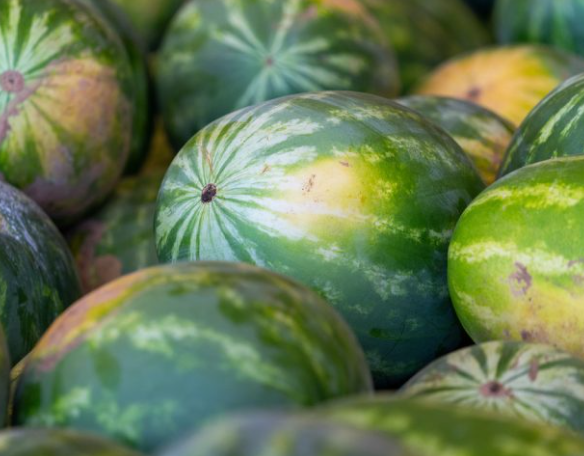
Other than cutting open a watermelon to see the inside, the field spot may be the best sign of ripeness. This spot shows where a melon was lying on the ground while attached to the vine.

If the watermelon is ripe, the field spot should be a large yellow patch on one side. The color should be a creamy, almost butter-like yellow. The bigger the yellow belly and the creamier the color, the more time the melon ripened on the vine. However, if the spot is small or looks more white than yellow, the melon may not be ripe.

Tip 2: Tap the underbelly and listen for a deep sound

Another way to find a ripe watermelon is to knock on the outside with your knuckles gently. A ripe melon will have a deeper sound, as opposed to an overripe one. A hollow thud, paired with an oversized yellow spot, indicates a melon may be mealy and overripe.

Tip 3: Look for a dull color and heavy watermelon

Although they may not be the prettiest or the easiest to carry to your car, the best watermelons are dull in color and heavy.

A shiny melon means the insides are underripe. Also, the best melon of the bunch will most likely be the heaviest one. A heavier melon likely holds more water. On average, a watermelon is 92% water, which is what makes it so juicy.