

Lettuce Eat Local: Some Squeaks Are Not Ideal
Amanda Miller
Columnist
Lettuce Eat Local
Instantly I think of that incomparable sound of a mouse chirp, as it skitters along inside the wall or darts across the driveway — a rodent squeak that often elicits a human squeak in response. A similarly disconcerting squeak might be coming from an unidentified source in the vicinity of the car engine or pipes under the sink. A bicycle chain or a screen door might squeak in its plea for a good oiling, as might a rusty wagon wheel. My daughter has a pretty good squeak-squawk in response to her brother pestering her.
Some squeaks, however, are just right. While they’re hard to categorize, lots of the squeaky sounds my kids make when they see kittens, cousins, or Daddy are the kind you want to bottle up and save forever. While the squeak I’m segueing to is technically of a less endearing nature, it is hard to hear it and not feel a tremor of happiness.
It’s the cheese squeak! If you’ve never had squeaky cheese, you’re missing out. It literally squeaks in your mouth as you chew, which can be quite unnerving if you aren’t expecting it but equally somehow very endearing. Cheese with this audible personality is not a specific type, but rather has certain age and pH characteristics: lower in age and acidity.
Most people probably associate squeakiness with cheese curds, which is an ambiguous category in itself, since almost all cheeses start off as curds. What’s marketed as “cheese curds” typically refers to small, nubby pieces of any type of unaged/baby cheddar — so renowned for their distinctive sound that they are also known colloquially simply as squeaky cheese.
The sound is actually a working scientific collaboration between your teeth and the molecular structure of the cheese. According to Wisconsin Cheese, “cheese curds are made up of proteins that are bound together with calcium. When you bite into a cheese curd, this protein and calcium structure rubs against the enamel on your teeth, making a squeaking sound.” After a few days, cheese loses the ability to squeak as the protein-calcium bonds break; it tastes the same, just doesn’t sound the same.
Other cheeses that have a similar protein structure might also provide a squeak-symphony. Fresh mozzarella, bread cheese (juustoleipӓ), panela, and halloumi are a few options from around the globe. Fortunately, “squeak” seems to be pretty relatable in any language, and we don’t even have to traverse the globe to experience it ourselves. I was catering a Mediterranean islands themed workshop recently, and may have squeaked in preemptive excitement at the excuse to make some halloumi, a Cypriot culinary all-star and “marvel of the cheese world.” One of its most distinctive qualities is its ability to withstand high heat without melting, and in fact grilling or pan-frying halloumi are some of the most common ways to enjoy it — its caramelized, crispy exterior and warm, squeaky center is wonderful.
Halloumi has a long history, mentioned in literature from the 1500s but likely with centuries of usage before then. Authentic halloumi was traditionally made exclusively with sheep and goat milk (since those animals could traverse the island’s mountains better than bovines), and now has Protected Designation of Origin, meaning it has to be made in a certain part of Cyprus. So what I made in my kitchen in Kansas with all cow milk wasn’t “real,” but it was very tasty, and very squeaky.
Now if I could just get Kiah to see a chicken and her grandma at the same time as she chews on some halloumi, we might have squeaky perfection.
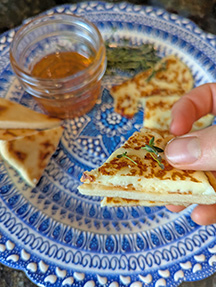
Halloumi Grilled Cheese-adilla
A cheese squeak has no language, so I can mix Spanish and Greek, right? Although quesadilla means “little cheese,” so I guess it is inappropriate since the cheese is not little here. Normal grilled cheeses with the cheese in between bread is good and all, but I figured if you can grill halloumi it might as well be the one to sandwich the bread! The texture of the halloumi when raw could be considered rubbery, but at least to me in a positive way; when warm and pan-fried, it might still be a bit rubber-esque, yet now with that beguiling squeak. Thyme honey is a common pairing with all sorts of cheeses in Cyprus, deliciously blending the line between savory and sweet.
Prep tips: I can’t include the recipe for halloumi here since it is too involved, but you should be able to find either halloumi or similar “bread cheese” at a larger grocery store or Aldi.
halloumi, sliced about ¼” thick
coarse salt
soft pita
local honey
fresh thyme
Heat a skillet over medium heat, then lay in a couple pieces of halloumi with enough space so they don’t touch. Sprinkle them with salt, and sear until they start caramelizing in spots; flip and sear the other side. Warm the pita, drizzle with honey, and sprinkle with thyme. Cut in pieces to match the halloumi if you can, then sandwich it between the pieces of fried, squeaky cheese. Eat right away.
Horticulture 2025 Newsletter No. 10

1712 Claflin, 2021 Throckmorton Plant Science Center
Manhattan, KS 66506 (785) 532-6173
Access Online: https://hnr.k-state.edu/extension/horticulture-resource-center/horticulture-newsletter/
Video of the Week: Native and Ornamental Grasses of Kansas
(June 2025 K-State Garden Hour Webinar Recording)
Explore native and ornamental grasses and learn species that thrive in the KS climate.
ANNOUNCEMENTS
Kansas Turf & Ornamentals Field Day
The Kansas Turf & Ornamentals Field Day will be held on Thursday, August 7, 2025 at the Rocky Ford Turfgrass Research Center in Manhattan.
This Field Day program is designed for all segments of the turf & ornamentals industry — lawn care, athletic fields, golf courses, sod farms, landscape, nursery, and grounds maintenance. Included on the program are research presentations, problem diagnosis, commercial exhibits, and equipment displays. There will be time to see current research, talk to the experts, and get the answers to your questions.
For more information and to register online, go to: www.kansasturfgrassfoundation.com
-
- We hope to see you on August 7 in Manhattan!
Commemorating Dr. Chuck Marr
Dr. Chuck Marr served as a Vegetable Crop Specialist for K-State Research and Extension for 36 years. He was an active member of the community and supported gardeners in many capacities throughout his retirement as well.Chuck passed away in December of 2024. To honor the legacy of Chuck, many of his friends are coming together to designate a special area in the Kansas State University Gardens in his name. The Riley County Extension Master Gardeners and the Manhattan Watercolor Group are leading this meaningful tribute and warmly invite others to participate.
Chuck was a strong advocate for the Gardens on campus. We envision dedicating the main vegetable growing bed in the Gardens in Chuck’s honor. This space, where he spent so much time nurturing plants and educating others, would be a fitting tribute.
The sponsorship level for this area is $15,000. We hope to raise the total amount collected by July 15 to ensure recognition in the Gardens. If you would like to contribute, donations can be made to Kansas State University Foundation in the following ways:
Online: Donation · Kansas State University · GiveCampus
By phone: 785-775-2400
By mail: Send checks payable to:
Kansas State University Foundation
1800 Kimball Ave., Suite 200
Manhattan, KS 66502 Please include Fund # M47497 (Chuck Marr) in the memo
Thank you for considering this request in memory of Dr. Chuck Marr. If you have any questions or would like additional information, please feel free to reach out to Riley County Extension Agent, Gregg Eyestone at 785-410-5336 or [email protected].GARDEN TO-DO
- Remove sucker growth from fruit trees
- Stop harvesting asparagus so plant can store energy for next year
- Remove dead foliage from spring flowering bulbs
- Remove tree stakes that have been in place for at least one year
- Turn compost pile after it cools
- flowers
- Remove flower stalks from peonies and iris
- Fertilize warm-season lawns such as zoysia, Bermuda and buffalo
- Monitor plants regularly for signs of pests
GARDEN SPOTLIGHT
With 50 years of gardening experience, Mark shares his best practices for success including how to preserve a surplus of crops to eliminate waste.Read Mark’s garden story here. Advice from a Lifelong Gardener
VEGETABLES
New Potatoes
New potatoes are harvested about 6-8 weeks after planting while they are still small and immature. Gently remove the soil from the base of the plant to check the size. When the potatoes reach the size of a walnut, carefully dig the entire plant without damaging the tubers. Allow them to dry, out of the sun, for a day or more to toughen the skin. Next, move the potatoes to a cold (below 40 degrees F), dark location for storage. Check on the potatoes occasionally for signs of rotting.Fertilizing Tomatoes
Too much nitrogen for tomato plants may result in vigorous plant growth without much fruit. Plants should be side-dressed with nitrogen three times during the growing season.The first application should be applied one to two weeks prior to fruit ripening. Two weeks after ripening, it’s time for the second application. The third round of fertilizer should be applied one month after the second. Basically, there should be one month of time between each application.
Common sources of nitrogen-only fertilizers include nitrate of soda, urea and ammonium sulfate. Blood meal contains primarily nitrogen but has other elements as well.
Apply one of the following fertilizers at the rate provided:
- Nitrate of soda (16-0-0): 2/3-pound (1.5 cups) fertilizer per 30 feet of row
- Blood meal (12-1.5-.6): 14 ounces (1.75 cups) fertilizer per 30 feet of row
- Urea (46-0-0): 4 ounces (1/2 cup) fertilizer per 30 feet of row
- Ammonium Sulfate (21-0-0): 0.5 pounds (1 cup) fertilizer per 30 feet of row
- Alternatively, lawn fertilizer, free of weed killer/preventer, can be used at a rate of 1/3 pound (3/4 cup) fertilizer per 30 feet of row. Choose a fertilizer that is about 30% nitrogen (the first number in the set of three).
FRUIT
Fruit Reminders
- We hope to see you on August 7 in Manhattan!
For the best harvest this year here is some fruit tree maintenance to complete.
-
- Thin fruit on apple and peach trees. Fruit should be 6-8 inches apart.
Remove suckers from the base of fruit trees and grape vines. - Water as needed. During hot weather, 1-inch of water per week is the recommendation.
- Comb (position) grapevine shoots to prevent tangling and promote more uniform sun exposure.
- Follow disease and pest management protocol. For more information about fruit sprays see our KSRE Publication: Spray Guide for Growing Stone Fruit at Home.
- FLOWERS
Rust on Hollyhock Flowers
Description: Hollyhock rust is a fungal disease that is most prevalent on hollyhocks, but other members of the mallow family are also susceptible. The fungus is introduced by infected plants. Fungal spores can travel by wind and splashing water as well. Warm, humid weather supports the fungal growth. The fungus can overwinter on infected plant debris and spread to new plants in the spring.Symptoms: Orange-yellow spots develop on the lower leaves and sometimes brown spots will appear on stems. Raised bumps that are reddish-brown later develop on the undersides of leaves beneath the orange-yellow spots. These are the reproductive structures of the fungus. The infected leaves may develop holes and eventually die back.
Control: Prevention is the best approach against hollyhock rust. Begin with healthy plants each year and remove all plant debris from the previous growing season. Allow adequate spacing between plants so the fungus is less likely to spread if one plant is infected. Water at the soil level and avoid splashing on the plant.
If a plant develops rust, remove the infected leaves immediately and dispose of them. Plants that have a history of infection may benefit from a preventative fungicide when the weather is warm and humid. Spray every two weeks until the weather is dry. Sulfur and myclobutanil (Immunox, Monterey Fungi-Max, F-Stop Lawn & Garden Fungicide) are recommended. If the temperature rises above 85 degrees F within 24 hours of application the sulfur treatment may cause damage to treated leaves.
Rose Trouble
Several counties are reporting problems with their roses. One of those problems is rose rosette virus. The classic symptoms that may appear include:
Rapid elongation of a new shoot
“Witches’ broom” (clustering of small branches)
Branches develop excessive thorns
Small, deformed, reddish-purple leaves
Certain varieties may develop streaks or blotches of reddish-purple on stems and petioles
- Thin fruit on apple and peach trees. Fruit should be 6-8 inches apart.
Plant death
Infected plants, including the roots, should be removed and destroyed. Garden tools that come in contact with the plant need to be sterilized to avoid spreading the virus.
Rose blackspot has also been reported. Blackspot is a fungal disease that can cause these symptoms:
Dark, circular lesions with feathery edges on top surface of leaves (usually lower leaves are infected first)
Raised, purple spots on young canes
Yellowing between spots on infected leaves
Leaf drop
Prevention is the best approach for controlling blackspot. Purchase resistant cultivars of roses. Use drip irrigation to avoid splashing water on the leaves. Ensure roses are planted in the sun with good air movement. Don’t crowd plants together in a planting. Diseased leaves should be removed from the ground and infected plant parts should be pruned out of the plant.
If you choose to apply fungicide you can treat on a 10–14-day schedule. Some recommended fungicides include tebuconazole (Bayer Disease Control for Roses, Flowers and Shrubs), myclobutanil (Immunox, Immunox Plus), triticonazole (Ortho Rose & Flower Disease Control) and chlorothalonil (Broad Spectrum Fungicide, Garden Disease Control). As always, follow all label instructions carefully.
Deadheading Flowers
Deadheading is a method of pruning out old flowers. This practice allows plants to direct their energy to new growth and producing new flowers rather than creating seed. The frequency this needs to be done depends on the plant variety and the environmental conditions. Some plants do not require deadheading at all. Lobelia, Impatiens, Hibiscus and Oxalis are examples of plants that are “self-cleaning” (do not require deadheading).
For plants that benefit from deadheading, use sharp, sterile pruners and cut the stem below the spent bloom just above the next node. The node is the area of the stem where the leaves extend. For plants such as Gerbera daisies that have a bloom atop a long stem, cut the stem down to the base of the plant. Some plants can be deadheaded using just your forefinger and thumb to remove the old flowers. Petunias are one example of this.
In the fall you may consider leaving blooms intact to allow plants to set seed and feed the birds.
TURF
Thatch Control in Warm-Season Lawns
Ornamental plants need to be cleaned up periodically as leaves and blooms die back. The same is true for grass. As grass plants grow, older plant material falls away to the soil level and can build up. This is called thatch and it can become problematic if it is thicker than ½ inch.
A thick layer of thatch can restrict water infiltration and reduce the efficacy of pesticide/herbicide treatments. When thatch accumulates, grass plants tend to root into this layer instead of deeper into the soil. Since thatch dries quickly, the lawn will suffer from drought stress. Kentucky bluegrass, zoysiagrass, bermudagrass and creeping bentgrass are the varieties of turf most likely to be affected by thatch buildup.
Power-raking and core-aerating are the best strategies for preventing thatch buildup. For warm-season grasses, it is best to do this in June or July when the lawn is actively growing and can recover from thinning more efficiently. If the thatch is ½ to ¾-inches thick, core aerating can be done. Repeat passes with the aerator until the holes are about 2-inches apart.
If thatch is thicker than ¾-inches, it will need to be power-raked. Set the blades of the rake only deep enough to remove the thatch so the lawn is not severely damaged.
Thatch can be prevented by fertilizing properly and avoiding excessive nitrogen applications. Water to the root zone and only as needed. Mow at the recommended height.
Brown Patch on Tall Fescue
As summer weather sets, we are experiencing warmer nights and more humidity. These conditions extend the amount of time grass blades stay wet making the lawn more susceptible to the disease, brown patch.
Brown patch is primarily a leaf pathogen, but with a severe outbreak, the fungus can spread down into the crown and cause plant death. However, depending on the weather, typically the turfgrass recovers within two to three weeks.
Symptoms can be similar to those of drought, but look closer at the grass plants around the edge of the symptomatic area. If you notice tan spots with a dark halo similar to the photo here you likely have brown patch.
Brown patch persists in the soil. It cannot be eliminated from a lawn, but is also not carried from one lawn to another. You can, however, provide proper care to reduce your lawn’s susceptibility to brown patch.
Water in the early morning rather than the evening and only as needed. This decreases the number of hours the grass blades stay wet.
Fertilize according to recommendations for your lawn. Don’t fertilize when brown patch is active.
When seeding, follow recommended rates.
Grass growing beneath trees does not dry as quickly. Use a mulch ring around trees so grass isn’t growing beneath the canopy.
Fungicides can be effective to prevent brown patch though the most commonly used products are expensive and typically only available in large quantities. Preventative fungicides are recommended if you want a blemish-free lawn, beginning in mid-June through August, but this does get expensive.
MISCELLANEOUS
Mushrooms after Rain
Mushrooms are the fruiting structures produced by various fungi. The appearance of the mushrooms varies depending on the fungi species. The fungi are present beneath the soil surface all along, but when conditions are right, they are able to set fruit. The result is mushrooms popping up in the landscape.
Warm, moist conditions tend to favor mushroom development. Beneath the soil the fungus feeds on decaying organic matter. Rainy weather speeds up the decay which gives a boost of nutrients to the fungus allowing it to have proper nutrition for fruiting. Therefore, the appearance of mushrooms is often an indicator that the soil is healthy and has a good level of organic matter.
Though many of the mushrooms are harmless to our plants, some can cause or indicate problems. Fungi mycelium grow underground from a center point outward in a circular pattern. When the conditions are favorable, mushrooms appear on the outer edge of the ring above the soil surface in an arc or circular shape. In lawns this is called a fairy ring. This can cause problems in the lawn as the mycelium can form a dense mat that decomposes organic matter and releases nitrates into the soil. The lawn in the outer area of the circle grows more rapidly and turns a darker green color than other areas of the lawn. The mycelium mat can also reduce water infiltration and there may be some turf dieback in this area.
Fairy rings are difficult to control. You can sometimes eliminate the ring by digging to a depth of 6 to 12 inches by 12 inches wide inside and outside of the ring, refilling the hole with non-infested soil. Those in commercial businesses will sometimes use a fungicide to control fairy rings but these products are not available to homeowners. See
http://www.ksre.ksu.edu/bookstore/pubs/EP155.pdf for more information on these fungicides.
Mushrooms will disappear as the weather dries out again or when it gets colder. The fungi remain beneath the surface ready to send up fruit once conditions are favorable again. Because most mushrooms are harmless to the landscape there is little need to try to control or prevent them.
Effects of too much Rain
After multiple heavy rains across many parts of Kansas, gardeners are likely to assume watering won’t be needed for quite some time. However, watering may be needed much sooner than you expect.
Excessive rain can drive oxygen out of the soil and drown the roots. As the weather gets hotter and drier the plants with damaged root systems may be poorly suited to take in water and shows symptoms of drought. Monitor your plants for signs of wilting and leaf scorching and water as needed.
Usually, supplemental water is needed once per week depending on the weather. Plants should be watered deeply and soil should be moist but not waterlogged.
QUESTION of the WEEK
Bagworm Help
Is it time to treat for bagworms now?
Bagworms are showing up. Though right now they are small and hard to see they are also much easier to control. Bagworms overwinter as eggs inside the dead female’s bag. Larvae hatch and emerge from the bags mid to late-May in Kansas. The young larvae begin feeding on their host plants right away. It’s recommended to wait to spray for bagworms until mid-June to ensure most of the eggs have hatched.
Young bagworms look just like the adult version only much smaller. If you see empty bags on your trees/shrubs, that is evidence of bagworms from the previous year and there are likely young bagworms on the plant this year as well.
Insecticides commonly used for controlling bagworms include:
- Acephate (Orthene) Permethrin (38 Plus Turf, Termite & Ornamental Insect Spray; Eight Vegetable, Fruit & Flower Concentrate; Garden and Farm Insect Control)
- Bifenthrin (Bug Blaster II, Bug-B-Gon Max Lawn and Garden Insect Killer)
- Lambda-cyhalothrin (Spectracide Triazicide, Bonide Caterpillar Killer)
- Spinosad (Conserve; Natural Guard Spinosad; and Captain Jack’s Dead Bug Brew). Spinosad is a very effective organic control for bagworms.
Thorough coverage of the plant material is essential for good control of bagworms regardless of which product you choose.
Contributors:
Cynthia Domenghini, Instructor and Horticulture Extension Specialist
KState Plant Pathology
K-State Turf and Landscape Blog
Kansas Garden GuideDivision of Horticulture
1712 Claflin, 2021 Throckmorton
Manhattan, KS 66506
(785) 532-6173For questions or further information, contact: [email protected].
This newsletter is also available online at:
http://hnr.k-state.edu/extension/info-center/newsletters/index.htmlThe web version includes color images that illustrate subjects discussed. To subscribe to this newsletter electronically, send an e-mail message to [email protected].
Brand names appearing in this newsletter are for product identification purposes only. No endorsement is intended, nor is criticism implied of similar products not mentioned.
K-State Research and Extension is committed to making its services, activities and programs accessible to all participants. If you have special requirements due to a physical, vision or hearing disability, or a dietary restriction please contact Extension Horticulture at (785) 532-6173.
Cynthia Domenghini, Ph.D.
Instructor; Horticulture Extension Specialist
Department of Horticulture and Natural Resources
Kansas State University
1712 Claflin Rd.
Manhattan, KS 66503
785-340-3013
[email protected]
Squash bugs are a devastating pest

With vegetable gardening comes insect issues. Sometimes bug problems are high and sometimes they are low, depending on the year. One thing is for certain, squash bugs always find me! Squash bugs are a devastating pest that uses its piercing-sucking mouthparts to feed on many varieties of cucurbits including squash, pumpkin, watermelon and cantaloupe. Damage from these pests can cause wilt and even death to the host plant.
Adult squash bugs are greyish-brown and have wings that lay flat over the back. They have orange-brown stripes on the underside of the body. Nymphs are small and greenish with black legs but turn greyish-brown as they develop. Nymphs do not have wings but wing development may be noticeable as they age.
Unmated adults overwinter in plant debris. From late April through May the adults emerge, mate and find a host plant. Female adults lay clusters of brownish-red eggs over several weeks on the underside of leaves. Within two weeks the eggs hatch and nymphs begin to feed on their host plant. Nymphs reach maturity in 4 to 6 weeks when they mate and begin a second generation during the same growing season. Adults from this generation will overwinter to lay eggs the following year.
The hard body of the adult squash bug is difficult to penetrate making control during the nymph stage essential. Regularly monitor plants for signs of squash bugs. Remove plant debris to disrupt overwintering habitats. General use insecticides such as permethrin (Bug-B-Gon Multi-Purpose Garden Dust; Green Thumb Multipurpose Garden and Pet Dust; Bug-No-More Yard and Garden Insect Spray; Eight Vegetable, Fruit and Flower Concentrate; Garden and Farm Insect Control; Lawn & Garden Insect Killer), malathion, and methoxychlor provide control if a direct application is made to young, soft-bodied squash bugs. Contact with the nymphs is required for control so be sure to spray the undersides of the leaves.
“Pain Science: Rethinking How We Experience Pain”

Pain is a universal human experience, yet it remains one of the most misunderstood aspects of health. Traditional views often equate pain directly with physical injury, but modern pain science challenges this simplistic understanding. Pain is a multifaceted phenomenon involving sensory, emotional, and cognitive factors. This perspective advocates for a holistic approach to pain management, emphasizing the nervous system’s role and empowering individuals to retrain their pain response.
Pain and Injury Are Not Always the Same
Most of us can think of a time when we had an injury but no pain. Maybe you noticed blood on your body when out gardening, only to see a significant cut on your arm, or waking up and noticing a large bruise on your body, and you don’t recall what caused it. Sometimes, pain may have emerged after you saw the cut or bruise, but not when the injury happened. The opposite side further exemplifies the disconnect between pain and actual tissue damage: we can use the example of phantom limb pain, where individuals experience pain in a limb that no longer exists. These examples highlight that pain is not always a direct indicator of physical damage. In the first situation, we have injury and no pain; in the second, we have pain with no injury.
Pain as a Complex, Multidimensional Experience
Pain is not a simple signal proportional to the extent of tissue damage. The pathway of sensory information from the body travels to multiple areas of the nervous system, including the somatosensory cortex (for location and sensation) and the limbic system (for emotional processing). This interconnectedness underscores the sensory and emotional components of pain, making it a complex experience.
The Brain’s Role in Predicting and Protecting
The brain plays a crucial role in interpreting signals and predicting potential threats, which can influence the experience of pain. For instance, gently stretching your finger backwards can cause discomfort before actual tissue damage occurs – a protective mechanism. Chronic pain often results from an oversensitive or overprotective nervous system, where the brain’s predictions sensitize the pain response. People are not faking pain, and the pain is not made up in their head; the nervous system actually changes to make it more sensitive. Think of it like the motion detection lights outside your house, the sensitivity dial has been ramped up, a leaf falls off your neighbor’s tree, and your lights go on, it is overprotective. Your brain also uses more than just sensory information to process pain or potential threats. Psychological factors (for example trauma, fear, thoughts, and emotions) and sociological factors (such as environment, stress, and lifestyle) interact with biological factors (immune and endocrine systems) to shape an individual’s pain experience.
Understanding Pain is Crucial for Recovery
Understanding that pain doesn’t always mean your body is damaged and that your sensitive nervous system can be retrained empowers individuals to challenge limiting beliefs and actively participate in their pain management. It involves a holistic approach, including improving lifestyle factors (diet, exercise, quitting smoking, etc.), addressing psychological factors (decreasing stress, reframing negative thoughts, and more), and promoting movement and daily activities.
Understanding the complex nature of pain empowers individuals to actively participate in retraining their nervous system to reduce the impact of chronic pain and improve overall well-being.
Kory Zimney, PT, DPT, PhD is a professor at the University of South Dakota, School of Health Sciences Physical Therapy Department and director of the PhD in Health Science program. He received his Master of Physical Therapy from the University of North Dakota in 1994. He completed his post-professional Doctorate of Physical Therapy from Des Moines University in 2010 and graduated with a PhD in Physical Therapy from Nova Southeastern University in 2020. Dr. Zimney is part of the Center for Brain and Behavioral Research at the University of South Dakota and the Therapeutic Neuroscience Research Group conducting research specifically in the areas of pain science and therapeutic alliance. Understanding Pain and What to do about it | Kory Zimney | TEDxUSD. Follow The Prairie Doc® at www.prairiedoc.org, and on social media. Watch On Call with the Prairie Doc, most Thursday’s at 7PM streaming on Facebook and listen to Prairie Doc Radio Sunday’s at 6am and 1pm on SDPB Radio.
