Thursday, January 29, 2026
Home Blog Page 256

“Doctor Chekhov, Physician & Writer”

0

Literature classes worldwide study Anton Chekhov (1860-1904), a great innovator of the short story. He wrote closely observed and deeply empathic slices-of-life with a great sense of humor — but the Russian-Lit-class-version of Dr. Chekhov often overlooks the vitality of his work in the theater. Theater-people like me know him as a playwright, the creative counterpart to the acting teacher Konstantin Stanislavsky, who directed and starred in Chekhov’s breakthrough play, The Seagull. Together with the other artists of Moscow Art Theater, Chekhov and Stanislavsky pioneered a new style of ensemble performance, focusing on the whole society, rather than one “main character.”

So if the literature-people under-appreciate his brilliance as a playwright, and theater-people undervalue his excellence in prose, both groups could stand to note his life-long dedication to medicine. Even after he became a famous writer, Dr. Chekhov never stopped seeing patients, and at the height of his literary career, he traveled nearly 6000 miles from Moscow to a notorious prison on Sakhalin Island to study the failures of the island-prison’s health care system. After his trip, Chekhov wrote a carefully reported book-length argument for prison health care reform, a work of investigative medical journalism. He once wrote in a letter: “Medicine is my lawful wife, and literature is my mistress.”

My Dad was the great Dr. Rick Holm, whose mind was also rich with a multiplicity of passions and talents. I sometimes think that the way Chekhov’s devotion to medicine was overshadowed by his success as an artist is an inversion of the way my Dad’s devotion to art was overshadowed by his success as a doctor. He was well-known as a singer and a choral conductor, founding the (still ongoing) Hopeful Spirit Chorale, but his other artistic pursuits were less well-known: he was a fine amateur painter, a long-time member of the board of Prairie Repertory Theater, a talented draftsman (his book Life’s Final Season includes his own anatomical drawings), and when he died, he was writing historical fiction — a novella set in in the twelfth century in Salerno, Italy, about the first Western medical school.

I think Dr. Chekhov’s perspective as a physician sharpened his observational powers as an artist. His plays and stories are full of people who suffer from habits of mind that they can’t understand; the good doctor seems, with his careful, diagnostic observation, to identify problems with his characters ’mental health (obsessions, depressions, manias, addictions) years before the vocabulary for such mental health disorders had been developed. Like Shakespeare, Dr. Chekhov writes honestly about both the very poor and the very rich, treating servant characters with as much detail and dignity as the owners of the estate. Though the good doctor’s ‘slice-of-life ’literary style is deeply rooted in reality, his work is paradoxical, both traditional and unconventional at once, using a physician’s skill-set and a prescient fascination with the health-of-the-mind to create literary, theatrical, and journalistic work that was, thrillingly, ahead of its time.

Eric Holm is an artist and teacher working mostly in performance, film, and music. He trained in Minneapolis and New York and is a founding member (with fellow Brookings-person Katie Melby) of the BREAD Arts Collective. Now based in Houston, Texas, Eric is an adjunct theater and film professor at the University of Houston, Galveston College, and Lone Star College, and is working on self-producing his second album. Follow The Prairie Doc® at www.prairiedoc.org, Facebook, Instagram, Youtube and Threads. Prairie Doc Programming includes On Call with the Prairie Doc®, a medical Q&A show (most Thursdays at 7pm streaming on Facebook), 2 podcasts, and a Radio program (on SDPB), providing health information based on science, built on trust.


KU News: KU chancellor elected to serve as vice chair of AAU board of directors

0

From the Office of Public Affairs | http://www.news.ku.edu


Headlines


Contact: Joe Monaco, Office of Public Affairs, 785-864-7100, [email protected], @UnivOfKansas

KU chancellor elected to serve as vice chair of AAU board of directors


LAWRENCE — The University of Kansas’ top official will continue to help lead the association of the nation’s top research universities.


University of Kansas Chancellor Douglas A. Girod has been elected vice chair of the board of directors of the Association of American Universities, the organization announced last week.


As vice chair, Girod will serve alongside board chair Christopher Eisgruber, president of Princeton University, help guide AAU’s work and serve as a representative for the association, particularly on federal policy issues affecting research universities. Girod will also represent AAU in discussions with lawmakers, help develop national policy positions and play a significant role in determining the association’s agenda during the coming year.


Girod has served on the AAU board of directors since October 2021.


“I’m honored to serve in this capacity and to have the opportunity to partner with colleagues from across the nation on issues that impact research at our universities,” Girod said. “America’s leading research universities are vital to our nation’s prosperity, health and security, and AAU plays a crucial role in advocating on their behalf and helping them work together.”


The University of Kansas is one of just 71 research universities — only 38 of them public institutions — in the Association of American Universities. KU was invited to join the AAU in 1909, just nine years after the organization was founded.


“KU can be proud of our longstanding membership in the AAU, and we will continue to prioritize research and discovery that enhances our position among the nation’s leading institutions,” Girod said. “The advantage of being a member, beyond being recognized as one of the top research programs nationally, is that we have greater opportunities to grow federal funding for research that improves public health, addresses national challenges and strengthens the nation. In addition, KU derives great benefit from the AAU’s advocacy efforts in Washington, D.C., for research and higher education funding and for policy and regulatory issues that affect research universities.”


-30-

————————————————————————


KU News Service

1450 Jayhawk Blvd.

Lawrence KS 66045

[email protected]

http://www.news.ku.edu


Erinn Barcomb-Peterson, director of news and media relations, [email protected]


Today’s News is a free service from the Office of Public Affairs


KU media advisory: Media invited to KU EARTH Center ceremonial launch on Nov. 7

0

From the Office of Public Affairs | http://www.news.ku.edu

Headlines

Contact: Cody Howard, School of Engineering, 785-864-2936, [email protected], @kuengineering

Media invited to KU EARTH Center ceremonial launch on Nov. 7


LAWRENCE — U.S. Sen. Jerry Moran, Kansas Department of Commerce Deputy Secretary of Business Development Joshua Jefferson, U.S. National Science Foundation Director Sethuraman Panchanathan and other leaders will join the University of Kansas on Thursday, Nov. 7, for the ceremonial launch of KU’s NSF Engineering Research Center (ERC) – Environmentally Applied Refrigerant Technology Hub (EARTH).


The event begins at 9 a.m. at the Burge Union, 1565 Irving Hill Road. Moran, Jefferson and Panchanathan are scheduled to make presentations, as are Chancellor Douglas A. Girod and EARTH ERC Director Mark Shiflett.


Members of the media are invited to attend the official ceremony at 9 a.m. A Q&A session will follow with availability from those speaking at the welcome ceremony. Media planning to attend are asked to RSVP by emailing Cody Howard, KU School of Engineering director of external relations, by noon Tuesday, Nov. 5.


Media with valid KU parking passes are advised to park in lot 72 to the east of the Burge Union, or lot 54 at the northwest corner of Irving Hill Road and Naismith Drive. Media needing a parking permit for this event should contact Erinn Barcomb-Peterson, KU director of news and media relations.


The EARTH ERC is based at the KU School of Engineering and works to tackle climate change through creation of a sustainable and circular refrigerant economy. The NSF announced in August that KU’s EARTH ERC was awarded a five-year, $26 million grant to conduct research to solve the technical, environmental and economic challenges required to create a sustainable refrigerant lifecycle that will benefit Kansans, the nation and the world.


-30-

————————————————————————


KU News Service

1450 Jayhawk Blvd.

Lawrence KS 66045

[email protected]

http://www.news.ku.edu


Erinn Barcomb-Peterson, director of news and media relations, [email protected]


Today’s News is a free service from the Office of Public Affairs


John Deere 70 Joins Fleet Of Tractors

0

Richard E. Shank
([email protected])

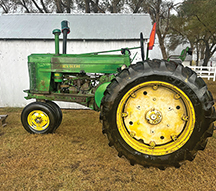
Adding a John Deere 70 to the fleet of tractors at the Shank farm was not a part of the annual goals entering 2024, but fate intervened and there is one parked in a shed awaiting a makeover or what “tractor buffs” might call a restoration.
I guess one cannot go wrong owning a John Deere, a company that saw its origin in Grand Detour, Illinois, in 1837 with the invention of a new-fangled plow. In 1848, Deere moved his growing company to Moline, Illinois, and the business took off.
As tractors go, the John Deere 70 had a short three-year run from 1953-56. Still, more than 43,000 70s were manufactured and sold worldwide before being replaced by the Model 720. As the old-timers would say, it would take a three- bottom plow sailing across a field powered by its diesel or gasoline engine.
Across the nation, particularly in the mid-west, a few John Deere 70s are visible in fence rows or abandoned farmsteads. It makes one wonder why those tractor owners did not sell their old tractors for junk and market their farmsteads at the same time.
Collecting antique tractors has been dubbed everything from a hobby to a disease, and, perhaps, either term could apply.
My first antique tractor purchase was made in 1984, for a then 41-year-old Farmall H for what then seemed like a hefty sum of $875. The old Farmall is still a member of the Shank family of tractors and thanks to a paint job in 2023, it looks like it may have been on the showroom floor. These days, the H is still used for hauling tree limbs to spring toothing the garden. As my dad, who was a Farmall owner himself, used to say, “you can’t wear out a Farmall if you tried to.”
Following my first antique tractor purchase, I vowed it would be my last. As of today, I have added eight more to the collection, not counting the John Deere 70.
The latest acquisition does have some history worth repeating. Bill Riordan, a lifelong friend and high school classmate, spent a career employed by the Social Security Administration, and enjoyed working on the family’s farm in his spare time. Approximately 25 years ago, he purchased the John Deere 70 for use clearing brush and other duties on the Riordan farm.
Bill passed away in 2023 and his four children, who do not reside in the area, offered to sell me their dad’s old tractor. It goes without saying that I did not need another tractor, but still thought it might be fun to have one more to make the collection an even 10.
After using every known method to coax the 70 to run, my brother-in-law who was helping me, suggested we hook it up to his truck and tow it to the Shank farm.
The nine-mile trip to the farm was like something I had not done in a long time. As passing motorists gawked, they may have thought “what is that guy up to sitting atop an old John Deere tractor while being pulled across Saline County?”
Getting the tractor to start is a work in progress, but I am hopeful that a carburetor rebuild and a new ignition switch will do the job.
A friend asked me the other day how one finds parts for a seven decades old tractor and the answer is “very easily. ”Prairieland Partners can order practically any part one needs for a John Deere 70, from a seat cushion to an ignition switch.
Also, the antique collection hobby has produced a new industry of companies that offer after-market parts, including Steiner Tractor, headquartered in Lennon, Michigan.
Steiner is so appreciative of their customers that, each year, they send out a 732-page catalog of parts available for nine different tractor makes including everything from John Deere to Oliver, a defunct company whose last tractor rolled off the assembly line a half century ago. Calls to Steiner will result in quick service with sales representatives who seem more knowledgeable about my tractors than I do.
An ad on the back cover of the Steiner catalog states it’s motto: “Restore your old iron.”
After the tractor is running and receives a much-needed power washing to remove 70 years of dirt and grime, it will be driven up the road for a new paint job, before returning to the Shank farm.
Like most 70-year-olds, the John Deere 70 will never do another day’s work, but will be used for what we call “tinkering jobs,” a part of all farms.


Lettuce Eat Local: Quark The Herald Angel Sings?

0

Amanda Miller
Columnist
Lettuce Eat Local

You can never be sure what mood Benson will be in as he comes galloping, stomping, or sneaking up the stairs in the morning. Some mornings he’s already on overdrive, and that three-year-old brain is spilling over with ingenuity and energy. Some mornings are magical, and his little blond self is full of snuggles and sweetness. And some mornings, well, they’re the other thing. 

Since we hit December though, we can be assured there’s a secondary mood attached, and that is the holiday spirit.

The first words out of Benson’s mouth each morning are something to the extent of, “Is it Christmas now?” He’s having a hard time distinguishing between the Christmas season and Christmas Day itself. Yes we have decorations up, we’re playing Advent music and doing nativity crafts and reading holiday books, and it is Christmas…and also it’s not. 

You may be shocked to learn that Brian does not pepper me with similar questions and enthusiasm. He’s not a Scrooge — in fact Benson is the one who says “Bah humbug!” thanks to his cousin’s tutelage — but he’s very invested in dairy farming projects right now, and doesn’t spend a lot of time pondering potential cookie shapes or must-watch holiday movies. 

To be fair, I don’t either, but I do love Christmas, the season and the day, and having a son who’s old enough to be so enthusiastic about it is delightful. 

Brian made the error of bringing the Christmas tree down from the attic before he had time to hang up the lights: a rookie mistake that landed him lots of badgering from Benson until he had to give in to save everyone’s sanity. It worked out fine for me, since Benson was well diverted multiple times then hanging up and taking down our motley smattering of ornaments before it even mattered at all. 

I have very fond memories as a child of getting the Christmas decorations out with my mom, and seeing the house transform into cozy, cheerful reds and greens, with twinkling candles and lights. I think that was more like a whole-day kind of project, whereas my decorating takes at least half an hour…but it’s just the right amount of stuff for me. Although I might need more eventually if Benson keeps pilfering pieces for his room downstairs. 

We need to start working on holiday baking here soon, but I’m not a big cookie person, so my motivation is less than my son’s here as well. Get me started on other forms of Christmas treats, though, and I’m more inclined. I don’t know how traditional it actually is for holidays, but I’m looking at a German-style cheesecake — partially because it looks lovely but honestly mostly because it uses a very fortuitous ingredient that I just so happen to have made recently. Quark!

Because what would you make for Q week? Just not a lot of options here: we don’t want a quilt or a queen, and that basically leaves us with quail or Qatari food. But I happily remembered quark, a type of Eastern European creamy cheese. It has a wide variety of uses, and can be eaten plain, with fruit, used in baking, cooked with, or however. I have rarely seen it available to buy, but the good news is that it couldn’t barely be easier to make. Turn up the Christmas carols while you prep it, and you might soon be humming along with quark the herald angels sing. 

Homemade Quark

Fresh soured cheese might seem like an oxymoron, and it definitely is a bit paradigmatic — especially since quark isn’t considered a “true” cheese, but it’s hard to know what else to call it. It goes by different names and can mean different things in different regions, but the good news is that you don’t have to understand all of it to enjoy it. My father-in-law had just been given a small container of quark at a dairy meeting, and it was good, but my biased opinion is that homemade is better. We enjoyed that one with hot pepper jam, but it’s good treated like cream cheese or cottage cheese or yogurt! 

Prep tips: if you don’t have a yogurt strainer, cheesecloth stretched over a bowl works too, just is messy.

1 quart cultured buttermilk

½ cup cream

Whisk the buttermilk and cream. Crockpot on warm for 8-12 hours, or bake at 200° for 2 hours. Drain; and if desired, salt and/or whip until smooth.