Thursday, February 5, 2026
Home Blog Page 360

Kansas nursing home owners say they can’t afford to hire more staff. Advocates say it’s essential

0

A landmark federal staffing mandate has prompted fierce disagreement between resident advocates and the nursing home industry.

The call came late on a cold night in February, from the Overland Park, Kansas, nursing home where Georann Whitman’s mom was living.

“They said that they found her on the floor,” Whitman said. “She had gotten up in the middle of the night, and had fallen.”

Whitman’s 86-year-old mom, Ann Collins, had dementia. She had moved into the memory care facility a month prior after the cost of round-the-clock care by home health aides became untenable.

She broke her left hip in the fall. After surgery, her doctors ordered that she not put weight on it while it healed. But Collins kept forgetting. And despite the facility’s relatively typical staffing levels, Whitman alleges it didn’t have sufficient staffing to properly supervise her.

“They expected her to push the call button if she needed anything,” Whitman recalled from her home in Spring Hill, Kansas. “Well, she didn’t remember to push the call button. She didn’t remember how the call button works.”

Whitman hopes experiences like her family’s will become less common due to a landmark new federal mandate that establishes the first national staffing minimum for nursing homes. But the new rules, slated to take effect over the next few years, have spurred widespread disagreement. Nursing home owners describe them as extreme, warning they could force some facilities out of business. And, even though advocates welcomed the new mandate, they say it’s far more lenient than they wanted.

A week after Collins’ first fall, she fell again — this time, breaking her right hip. Doctors performed another surgery and reiterated that she needed to stay in bed. Back at the nursing home, Whitman said she pleaded with the facility’s administrators to do more to prevent her from falling.

But a few weeks later, Collins fell a third time. Then a fourth time, and then a fifth. During the last fall, she hit her head and was rushed to the emergency room. With each subsequent fall — all within a two-month stretch — Whitman said her mom’s physical and cognitive decline accelerated.

She hesitated to file a formal complaint against the nursing home because she feared staff might retaliate against her mother.

“But after she busted her head open, I called the state,” Whitman said. “I didn’t know what else to do.”

She said she filed a second complaint after she witnessed a staff member — in a rush and apparently unaware of the doctors’ orders — force her mom to walk to another room, despite Whitman’s urging to check her medical chart.

“She argued with me, ‘I don’t have time to check the chart. Why don’t you let me do my job?’” Whitman said.

“When my mom came back, she was in tears.”

State regulators investigated and determined that the facility failed to ensure Collins maintained her non-weight-bearing status, putting her at risk for injury and pain.

The nursing home’s administrators did not respond to requests for comment. The Kansas News Service is not naming the home because Collins’ experience is relatively commonplace in Kansas, and because the facility’s current staffing ratios would exceed the new federal minimums.

After the incident, Whitman said, her mother’s condition quickly deteriorated. Collins was moved in May to a hospice facility, where she soon died.

“You’re sacrificing financially so that somebody else can be the caregiver,” Whitman said of the nursing home system. “At the very least, you should expect that they’re going to be safe.”

Nursing home operators resist

The Biden administration finalized its new federal staffing mandate this spring. Once it takes effect, nursing homes must provide at least 3.48 hours of daily nursing care for each resident — nearly double the current minimum set by Kansas regulators. They must have a registered nurse on duty 24/7. Facilities in urban areas have two years to comply; those in rural areas have three.

Fewer than 40% of Kansas nursing homes currently meet the new requirements, according to an analysis by the health research organization KFF.

There’s been fierce pushback: from politicians, like U.S. Sens. Roger Marshall and Jerry Moran, Kansas Republicans who are fighting the mandate in Congress, and the state’s Democratic Gov. Laura Kelly, who urged federal officials to delay its implementation.

But the response has been fiercest from the nursing home industry, which is seeking to block the new mandate in court. In a federal lawsuit, the American Health Care Association describes regulators’ actions as “a baffling and unexplained departure” from the past, and the new standards as “impossible” to meet.

In Kansas, nursing home operators say the problem is rooted in an acute lack of health care workers.

“We have had severe workforce shortages in long-term care for well over a decade. This mandate does not magically make that not true,” said Rachel Monger, president of the not-for-profit trade group LeadingAge Kansas. The group’s national affiliate has joined the federal lawsuit challenging the rules.

“We do not have the people — and the money to pay people — in our system, currently, to meet the mandate,” she added.

As part of the mandate, facilities in areas with workforce shortages can ask for exemptions, and federal officials predict around a fourth of facilities will receive them. The Biden administration has also pledged to invest $75 million in getting more nurses into nursing homes.

But industry groups say it’s insufficient.

Linda MowBray, president and CEO of the Kansas Health Care Association, said the mandate could force homes to shutter or reduce how many residents they accept.

“That’s where residents could be put at risk,” she said. “They would not have a bed to go to if they were needing this type of care.”

Critics of the new rules also say they could hit rural facilities particularly hard, making it even more difficult for rural communities to access long-term care close to home. It’s unclear how true that is. A recent national analysis found rural homes are actually slightly more likely than their urban counterparts to staff at levels that would meet the new requirements.

‘Invisible people’

Advocates say understaffing frequently translates into neglect, and the new mandate falls short of what many had called for. They hoped the minimum of 3.48 daily care hours would be set closer to the 4.1 — the amount determined to be needed in a seminal 2001 study funded by the Centers for Medicare & Medicaid Services.

Camille Russell, who was the Kansas long-term care ombudsman for three years until she departed earlier this month, said she’s lost count of the number of times she’s heard from families about nursing home residents falling due to scarce supervision.

“It is, in large part, due to a lack of staffing,” Russell said.

And it’s not just falls — research has repeatedly shown that low staffing levels are associated with a host of problems endemic to nursing homes, including infections, pressure ulcers and the overuse of antipsychotic drugs.

In a recent survey studying the human costs of understaffing by the advocacy group National Consumer Voice, 87% of residents polled said understaffing affects them every day or several times per week. Over half said staff are frequently too busy to administer their medications and meals on time.

“I call us ‘the invisible people,’ because that’s what it feels like,” Sharon Wallace, a nursing home resident in New York, said in a panel organized by the advocacy group. “We’re stuck in our rooms. We’re out of sight, out of mind.”

Advocates have long called for more stringent and better-enforced rules for the nursing home industry, which they describe as an underregulated “wild west” of the health care sector. Nursing home owners have, largely, fought their proposals, including an attempt in Kansas last year to reduce involuntary discharges of residents.

“We have people who have become literal billionaires in this industry,” Russell said. “Of course they don’t want to shell out more of their profits on labor.”

Russell worries some facilities could try to reduce the financial cost of the new rules by reducing their housekeeping staff and asking medical staff to take on more housekeeping duties.

Sam Brooks, director of public policy for National Consumer Voice, said the industry’s workforce issues are rooted in low wages and difficult working conditions that steer many would-be employees to other parts of the health care system.

“It’s not necessarily a lack of people to do the jobs,” Brooks said. “It’s the job quality itself.”

Financial questions

The debate has revealed diverging economic narratives.

Nursing home operators say hiring to the required level will devastate an industry that already operates under razor-thin margins. Nationally, around half of nursing homes claim to lose money each year in annual reports to regulators.

Kansas industry groups point to a report by LeadingAge Kansas that says at least 57 of the state’s long-term care facilities have closed or reduced their services since the start of the pandemic. The report estimates the new staffing mandate will cost facilities an extra $35.72 in labor expenditures per resident, per day.

But some economists and advocates say there’s more to the story. In recent years, private equity investors have increasingly bought up nursing homes across the country. Their ownership is associated with lower staffing and poorer quality, and in Kansas, their facilities are more likely to be flagged by regulators for persistent compliance problems.

“There’s a reason why this group of people are coming in and buying facilities,” said Dan Goodman, president of the advocacy group Kansas Advocates for Better Care. “They’re seeing an opportunity here.”

Three of the country’s largest nursing home chains have paid out nearly $650 million to their executives and shareholders in combined dividends, stock buybacks and salaries in recent years, according to a group of Democratic lawmakers criticizing opposition to the new mandate.

One analysis of Illinois data found nursing homes there have hidden around two-thirds of their profits from state regulators by “tunneling” money through commonly owned businesses.

For instance, a nursing home’s owners might sell the facility’s building to a real estate company that they also own — and then charge the nursing home an exorbitantly high rent. The nursing home could then tell regulators they’re losing money due to skyrocketing rent costs, even if its owners are pocketing the money.

“The industry line has been that nursing homes are extremely unprofitable, with an average profit margin somewhere in the 0.5% range,” said Andrew Olenski, an assistant professor at Lehigh University who co-authored the paper. “What our study shows is that, actually, the average profit margin is quite a bit higher than that.”

Olenski said profits vary significantly from facility to facility, and it’s possible that many homes lose money without engaging in tunneling. Still, he said, the practice makes it difficult for regulators to accurately gauge the industry’s financial circumstances.

Political uncertainty

Advocates say the new staffing mandate won’t solve the problem of nursing home neglect, but it could force the worst offenders to improve their quality — or close their doors.

Russell, the former Kansas ombudsman, said it shouldn’t be controversial to require facilities entrusted with caring for the state’s most vulnerable people to meet minimum standards. If a nursing home has repeatedly endangered residents, she said it might be preferable for it to close.

“We’d be better off to quit making false promises to people,” she said.

Still, there’s mounting uncertainty about whether the staffing mandate will take effect as scheduled. Some experts say the industry groups challenging the requirement may be buoyed by a recent U.S. Supreme Court decision upending the Chevron deference legal precedent, which curtails the power of federal regulators. Others say it’s unclear if the mandate will hold if Republicans gain control of the White House or U.S. Senate this fall.

Rose Conlon reports on health for KMUW and the Kansas News Service. ksnewsservice.org.

Protecting your home from wasps

0

K-State entomologist explains how to safely remove wasp nests

A common problem many homeowners face is wasps taking up residence outside their homes. Kansas State University entomologist Raymond Cloyd says, however, that not all wasps are harmful.

“Wasps are beneficial and they are part of the ecosystem,” Cloyd said. “They are predators of many caterpillar pests and are docile overall. They will usually only sting if disturbed or agitated.”

Mud daubers and paper wasps are commonly seen around homes and will generally not attack people. However, yellow jackets will actually attack people.

Despite the beneficial role of wasps, many people may want to remove wasp nests to avoid the possibility of getting stung when outdoors. When considering removing wasp nests, Cloyd advises determining whether the nest is new or mature.

“If the home has a history of wasps building nests, such as in late spring or early summer, physically remove the nest when you see the nest being initially built,” Cloyd said.

New nests can be removed with minimal risk of being stung because there are usually fewer wasps present inside the new nest. Wasps generally do not rebuild nests in the same location, so physically removing the nest will avoid having to deal with nests in the future.

Spraying nests with an insecticide should be done at night when the wasps are inside the nest, Cloyd said.

If the nest is large, mature, and has been around for some time, Cloyd recommends contacting a pest management professional.

“In order to avoid getting stung, it is best to contact a pest management professional,” he said.

Cloyd said that it is important to correctly identify the wasp that is creating the nest. He recommends contacting your local K-State Research and Extension office and either describing the insect over the phone or sending pictures via email.

Is rained-on hay still good?

0

Rain is always a wild card when deciding the right time to mow hay.

“Pop-up showers and storms are a risk this time of the year,” says University of Missouri Extension agronomist Hunter Lovewell. This unpredictability makes it important to keep an eye on weather forecasts and understand how rainfall affects forage that is drying down but not yet baled, he says.

And not all rains are created equal, says Lovewell. Quick, short rains cause less damage than prolonged, slow rains.

Rained-on hay likely is less digestible with lower yields, respiration and microbial breakdown of the plant tissue.

Lower yields and lower digestibility

Wet hay requires more mechanical handling to dry, which results in leaf shatter. This reduces digestibility when leaves fall and tougher stems remain. Fewer leaves also mean less mass and lower yields, according to research from several universities. When this happens, livestock owners should consider supplementing hay with nutrients, says Lovewell.

Since rain affects grasses and legumes differently, growers should also consider what type of hay they have. Forage legumes such as bird’s-foot trefoil and red clover do not lose as much dry matter as alfalfa does. Most studies agree that crude protein in alfalfa is not greatly affected by rainfall on a mowed crop.

Leaching and respiration

Leaching is the movement and loss of soluble components of the mowed plant. A large portion of the leached out dry matter is soluble carbohydrates, along with lipids, minerals and soluble nitrogen.

Rained-on hay also allows microorganisms such as fungi and molds to develop. Respiration is the process of plant enzymes breaking down soluble carbohydrates. This process occurs whether the forage is rained on or not. It is normal for a small percentage of the total dry matter to be lost through respiration until moisture dries down to around 30%.

Rainfall intensity, length matters

If the total amount of rain is the same, a lower-intensity rain will result in worse quality and lower yield compared to higher-intensity rainfall.

Some research shows that leaching of carbohydrates, vitamins and minerals is usually highest when hay has partially dried and then there is a prolonged rain. Rainfall right after cutting usually results in less leaching of nutrients.

Lovewell says rained-on hay will be better in quality if:

  • Rainfall occurs soon after mowing.
  • Rainfall is higher in intensity, assuming the rainfall amount is the same.
  • Forage is rewetted only once rather than multiple times.

To know the true quality of rained-on hay, or hay in general, submit a forage sample to a lab for testing. “A hay test is the only way to truly know the quality of hay,” says Lovewell.

The analysis from the lab will help in the development of a supplementation program to replace nutrients in the hay.

Lovewell recommends these resources:

Much of Kansas is at ‘high risk’ of West Nile virus. Here’s why and how to stay safe

0

Keep your distance from mosquitoes if you’re in Kansas in the near future.

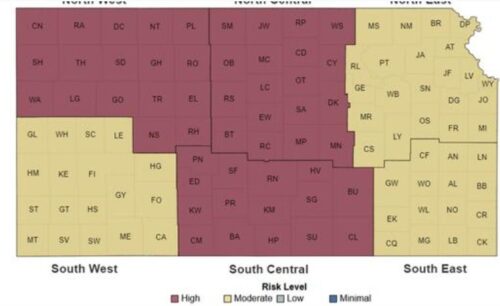
The Kansas Department of Health and Environment has issued high-risk and moderate warnings for West Nile virus across the state. Johnson and Wyandotte counties, located in the northeast region, are in moderate-risk areas, while Wichita, found in the south-central region, is in a high-risk area.

About half of Kansas is considered high-risk areas because there are a high number of mosquitoes in those regions, and that increases the chances of residents being bitten by a mosquito carrying the virus, according to the state health department. A moderate risk area means there is a moderate possibility of being bitten by a mosquito carrying the virus.

There have only been two reported cases of West Nile virus in Kansas in 2024 so far. There were 66 total cases and four deaths reported in 2023.

No matter what region you live in, here’s what to know about West Nile virus and mosquitoes.

What is West Nile virus?

The West Nile virus causes an illness with flu-like symptoms. Those can include fever, headache, muscle and joint aches, nausea and fatigue.

It’s the most common mosquito-borne disease in the United States. The virus does not spread from person to person, according to the U.S. Centers for Disease Control and Prevention , just from mosquito to humans and other mammals.

Around 1 in 5 people who are infected develop a fever and other fever-related symptoms, and about 1 out of 150 infected people develop swelling of the brain or brain tissue. In extreme cases, the virus can be fatal.

There is no vaccine or specific medication to treat the virus, but if you’ve had it before, you’re immune to it.

When are mosquitoes the most active?

You are more likely to see a mosquito in the day time through July and September, according to KDHE. They’re most active from dusk to dawn.

Mosquitoes are attracted to water, so remember to empty any standing water that may be sitting there from any rainfall. Clear out water from buckets, old tires, tarps, garden beds, kiddie pools or other spots with rainwater. The KDHE recommends to use larvicide in low-lying areas where water cannot be removed.

How does Kansas determine the risk of West Nile virus?

The Kansas health department determines the risk level based on:

  • The temperature, because mosquitoes breed more in hot weather
  • The number of mosquitoes in the area
  • The number of people infected with West Nile virus historically.

How do I stay safe from mosquitoes and West Nile virus?

The Kansas health department recommends the following prevention measures:

  • If you go outside, use insect repellent. Officials recommend using a repellent with an EPA-registered active ingredient on skin and clothing, which includes DEET, picaridin or lemon or eucalyptus oil.
  • Mosquitoes are most active at dusk and dawn hours, so keep the insect repellent on you during these hours. People with weakened immune systems should consider limiting how long they’re outside during these times.
  • Make sure you have good screens on your windows and doors to keep mosquitoes out.
  • Get rid of mosquito breeding sites by emptying standing water from flower pots, buckets, barrels and pet dishes that are left outside. You should also replace the water in your bird baths once a week if you have one.
  • Keep the water out of swinging tire holes by drilling holes in them.
  • If they’re not in use, keep kiddie pools empty and on their sides.

    Check the Kansas Department of Health and Environment’s West Nile virus tracker to learn about your community’s current risk level.

Lovina Enjoys Summer Days with Family

0

Today daughter Loretta and sons Denzel and Byron came here after my husband Joe and sons left for work. Daughter Verena left last night; she went to daughter Susan and Ervin’s house. She will stay with their five oldest children today while Susan will go help prepare for Ervin’s brother Steven’s wedding, which is Thursday. 

I’m still trying to get used to not having daughter Lovina home in the mornings. We miss her here, but I am happy for her and Daniel. It seems different seeing her sit with the women in church instead of with the young girls. 

Denzel is snuggled up with Loretta on the loveseat. He looks tired but is looking over here watching me pen this column. Byron is in the pack and play crib, talking to himself. He will probably talk himself to sleep. Denzel will be two years old tomorrow (July 10). He is a busybody, and he’s started his terrible twos early. Ha ha! He’s a sweetie, though, and can act so innocent when he does something wrong.

Yesterday son Benjamin came home from work and buttered some bread to make himself a grilled cheese sandwich. He walked away to go do something else, and when he came back, his one piece of bread was gone. Denzel had spotted the buttered bread and figured it would be a good snack. He loves bread with butter (and sometimes jelly). We had to laugh about Benjamin’s disappearing bread. 

Sunday church services were held at our neighbors’ house. Our family, along with sister Emma and son Jacob, nephew Benjamin and Crystal and son, came here after lunch. They all ended up staying for supper. The men grilled chicken, and along with that we had mashed potatoes, noodles, corn, cheese, homemade bread, butter and strawberry jam, ice cream, and cookies. It was an enjoyable afternoon and evening spent together. Everyone ate outside on our big L-shaped porch. Many meals have been eaten on this porch. I love my porch!

Our zucchini is really doing well out in the garden. Last night I fried sliced zucchini, green beans, onions, and peppers together in olive oil. It was delicious!

Our banana peppers are doing well, too, and we had our first meal of them stuffed with cream cheese and shredded cheese, then wrapped with bacon. We put them on the grill to cook. Our sweet corn should be ready to eat soon. Green beans, peas, and all those garden goodies make meal planning much easier. 

Last week, on July 3, Ervin and Susan invited our family and Mose’s family to gather at the graveyard when they put a gravestone on Mose’s grave. Our whole family, Mose’s parents, and three of his brothers and families attended. It brought back many memories of that sad day in December 2020 when Mose lost his life due to injuries from a traffic accident on his way to work. Rest in peace, Mose! You will always have great memories in our hearts.  

I invited everyone here for hot dog sandwiches and snacks afterwards, but Mose’s family couldn’t come. Our family all came, and once again that big porch was used to eat on. I have been leaving the extra tables and chairs on there, so when they all come home everyone has enough room to sit and eat. On warm summer days it’s also nice to feel the breeze on the porch. 

On the evening of July 4, Joe and I went out on the lake with Dustin, Loretta, and sons. They took their pontoon. It was so enjoyable, and the little boys loved it, too. Joe helped Denzel fish, but he seemed too scared to hold the fish. We grilled ribs and bacon-wrapped peppers, along with other picnic food. It was so relaxing, and before we knew it, it was 11:30 p.m. already. We could sleep in the next morning, though. Joe had off three days last week for the holiday. I have not been doing much extra work beside gardening and the daily chores since the wedding. It felt good to get extra rest after a busy few months.

God’s blessings to all!

Here is a recipe for the pudding we served at Lovina’s wedding.

Caramel Pudding

6 ounces Nestlé La Lechera milk-based caramel

2 (16-ounce) containers whipped topping

Caramel baking chips

Caramel sundae syrup

Whip together the milk-based caramel and whipped topping. Garnish with caramel baking chips and caramel sundae syrup. Leftover pudding will freeze well. The amount of milk-based caramel can be adjusted to your preference. 


Lovina’s Amish Kitchen is written by Lovina Eicher, Old Order Amish writer, cook, wife, and mother of eight. Her three cookbooks, The Cherished Table, The Essential Amish Cookbook, and Amish Family Recipes, are available wherever books are sold. Readers can write to Eicher at Lovina’s Amish Kitchen, PO Box 234, Sturgis, MI 49091 (please include a self-addressed stamped envelope for a reply); or email [email protected] and your message will be passed on to her to read. She does not personally respond to emails.