Friday, February 13, 2026
Home Blog Page 450

KU News: KU Law competition teams repeat as national champions

0

From the Office of Public Affairs | http://www.news.ku.edu

Headlines

Contact: Emma Herrman, School of Law, [email protected], @kulawschool

KU Law competition teams repeat as national champions

LAWRENCE — In 2023, University of Kansas School of Law teams were top performers during the National Native American Law Students Association (NNALSA) Moot Court Competition and the UCLA Transactional Law Meet. This year, they saw continued success with back-to-back wins.

For the fourth consecutive year, a KU Law team won first place at the NNALSA Moot Court Competition on Feb. 23-24 at the University of Montana. The competition featured 51 teams from law schools from across the country. In a simulated appellate-level proceeding, teams make arguments to a panel of judges and answer questions. Judges assess the quality of legal reasoning, oral advocacy and knowledge of case law.

KU Law was represented by three teams: Jade Kearney, third-year law student, and Justin Shock, third-year law student; Skylee James, second-year law student, and Lauren Bretz, second-year law student; and Alex Nelson, first-year law student, and Cody White, first-year law student. James and Bretz advanced to the quarterfinals, where they took home the award for second-best brief. Kearney and Shock took it all the way to the final round, where they clinched the win. Kearney also took home the best speaker award.

“It is such an incredible honor to have won the NNALSA competition this year,” Kearney said. “I am so grateful for the support of the KU Law community and moot court program for making competitions like NNALSA a priority. I can’t wait to keep the legacy going in future years.”

It’s not just the hard work of the champions that results in such success, but also the work of those behind the scenes helping the KU Law students to prepare.

“KU’s success at this tournament year after year is the result of dedicated alumni and professors giving their time to support our students,” said Nancy Musick, coach of the KU Law teams.

This year, the NNALSA moot court team received alumni support from Dan Kopp, 2019 law graduate; Zach Kelsay, 2021 law graduate, and Maria Drouhard, 2019 law graduate. Three-peat champion Emily DePew, 2023 law graduate, also provided support by traveling with the teams and supporting them in person.

“Our success was a testament to the power of teamwork and collaboration,” Shock said. “Our victory would not have been possible without our coaches, Nancy Musick and Sarah Otto. Everyone in the competition contributed countless hours to aid us. This spirit of collaboration is something we hope to continue as we aspire to return the favor in future years by assisting incoming NNALSA competitors.”

KU Law students also traveled to California for the UCLA Transactional Law Competition on Feb. 23 at the UCLA School of Law.

KU Law was represented by two teams that competed against 20 others from around the country. The Gold Team included Violet Brull, second-year law student; Sydney Hoffman, second-year law student; Cayden Sears, third-year law student; and Kathleen Siderchuk, second-year law student, and was coached by Alex Reed, 2022 law graduate. The Blue Team included Liam Bigbee, second-year law student; Alex Falk, second-year law student; Brooke Flucke, third-year law student; and Gabby Phillips, second-year law student, and was coached by Eric Mikkelson, 1994 law graduate. After a long competition, the Gold Team won best overall for the second year in a row.

“I’m proud of our team’s work,” Brull said. “Each of our team members made invaluable contributions to the effort, as did our team’s coach, Alex Reed. I hope to compete for KU Law again next year, either at this or another transactional competition.”

In this competition, teams draft and negotiate sophisticated business acquisition agreements and compete in three distinct phases: preparation of the agreement on either the buyer or seller’s side, preparing markups for the opposing side’s draft agreement and meeting to negotiate the final contours of the deal.

Both Gold and Blue teams were supported by the Polsinelli Transactional Law Center housed at KU Law. Attorneys with Polsinelli and other law firms donate their time to support and prepare KU Law students for transactional law competitions.

“It was great to see KU Team Gold’s hard work pay off in Los Angeles by winning best overall,” said Reed, associate at Lathrop GPM. “The team put in many hours over the last few months and did an outstanding job representing KU Law on a national stage.”

Learn more about the moot court and transactional law programs at KU Law.

-30-

————————————————————————


KU News Service

1450 Jayhawk Blvd.

Lawrence KS 66045

Phone: 785-864-3256

Fax: 785-864-3339

[email protected]

http://www.news.ku.edu


Erinn Barcomb-Peterson, director of news and media relations, [email protected]


Today’s News is a free service from the Office of Public Affairs
Cattle Chat: Selecting a replacement female for the herd

0

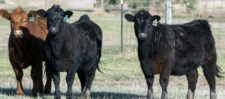
K-State beef cattle experts share the pros and cons of retaining heifer calves born to first-calf heifers

Working in agriculture often involves a series of decisions, including which crops should be planted in a rotation, what inputs are most economical, and — in the case of rebuilding the cow herd — should replacement females that were born to first-calf heifers be retained?

This was the question that the Kansas State University Beef Cattle Institute experts addressed on a recent Cattle Chat podcast episode.

“There are a lot of factors that go into that decision as to whether or not keeping heifers born to heifers is a good idea, and it depends on the goal of the breeding program,” said K-State veterinarian Brad White.

White said with proper planning, beef producers can make retaining heifers born to heifers work for a herd. He said that if producers plan to do that, they need to plan and select sires that are adequate for calving ease but also offer maternal traits that are beneficial.

“I like to keep heifers born to first-calf heifers if they are born early in the breeding season and they are born to a mating that was genetically planned to create replacement females,” White said.

K-State veterinarian Bob Larson agreed, adding, “there are some AI (artificial insemination) sires that have good maternal traits while being adequate for calving ease that can make females worth considering as replacements.”

K-State nutritionist Phillip Lancaster sees one other genetic advantage of keeping replacement females born to first-calf heifers.

“I am going to boost the genetic progress of the herd overall much quicker by keeping the daughters of the youngest females in the herd,” Lancaster said.

However, Lancaster also said that it is important to look at the performance of the cow family that these potential replacement heifers are born from when making this decision.

“Take a look at the records and if that heifer is born to a proven cow line in terms of longevity and reproductive performance, that will help you make the decision about keeping the heifer calf that was born from a heifer in the herd,” Lancaster said.

Another factor to consider is the frame size of the replacement female being considered, said K-State veterinarian Brian Lubbers. The size concern relates to the pelvic size of the calf when she matures and is bred to calve her first calf.

“Some daughters born to calving ease sires may be predisposed to future calving difficulty due to their smaller frame size,” Larson said.

Lubbers also said the timing of when they were born as compared to the rest of the herd is something that should factor into the decision of keeping or selling that heifer calf.

“If the heifer calf was born late in the breeding season and she is small framed, then I would recommend producers do not retain them in the herd.”

To hear the full discussion, listen to Cattle Chat on your preferred streaming platform.

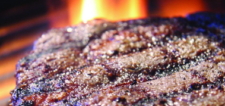
5 Basic Steps for Sizzling Steak

0

A sizzling steak is a surefire sound of summer, and the flavors achieved from one that’s perfectly grilled are hard to match.

Before you fire up your grill, consider these five basics for cooking a chef-worthy steak:

Prepare Your Cut

Taste preferences (and prices) may differ among sirloins, ribeyes, T-bones and more, but the way you prepare steaks likely won’t change much from cut to cut. You’ll want to trim the thickness down to 1/2-1 inch for proper cooking, and setting the meat out ahead of time allows it to warm to room temperature before hitting the grill. Placing a refrigerator-cool slab on hot grates works against you in two ways: first, the cold meat instantly chills your previously warm grill, and second, the inner portion of the steak will take longer to grill.

Add Some Salt

Feel free to add any spices that you prefer, but remember a good steak typically doesn’t require fancy seasoning – a pinch of salt works just fine. Add your salt anywhere between 30 minutes to a few hours before grilling time to help retain moisture and improve flavor.

Aim for High Heat

Grilling a steak correctly actually isn’t just about maintaining a sweltering flame. A two-zone fire is usually the way to go – one side of the grill should be hot (using direct heat) with the other side not quite as warm (indirect heat). This allows you to create a sear over direct heat before finishing cooking through – without burning – over indirect heat.

Sear and Slide

Speaking of searing: Cooking your steak over direct heat 1-2 minutes on each side is normally about right for creating a proper sear. At this point, depending on the thickness of your steak, you’ll want to check for doneness. If it’s not quite to the temperature you’re looking to achieve, simply slide it over to the indirect heat for a finishing touch.

Keep in mind these general guidelines for doneness: 120-125 F is rare, 130-135 F is medium-rare, 140-145 F is medium, 150-155 F is medium-well and 160-175 F is well done.

Let Rest

Finally, as hungry as you may be at this point, resting steaks is an important last step before diving in. Giving your steaks 5-10 minutes (foil or no foil) allows flavors to redistribute and moisture to be retained in the meat.

Beef industry gets partial labeling victory

0

Beef and agriculture groups generally welcomed a March 11 announcement by Secretary of Agriculture Tom Vilsack approving voluntary “Product of USA” labels.

Vilsack made the announcement that the U.S. Department of Agriculture had finalized a rule regarding the labels’ use at the National Farmers Union Annual Convention in Scottsdale, Arizona. Labels are restricted to beef, poultry and egg products in which every step of production occurred inside the United States. The USDA said the policy “align[s] the voluntary ‘Product of USA’ label claim with consumer understanding of what the claim means.”

Partial victory

The National Cattlemen’s Beef Association said in response, “NCBA has been committed to finding solutions to this problem ever since a producer-led NCBA working group raised the alarm, years ago, that imported beef could be mislabeled as a Product of the USA incorrectly at the end of the supply chain. We appreciate USDA’s effort to address this loophole. During the implementation period, NCBA’s focus will remain on ensuring that these changes result in the opportunity for producer premiums while remaining trade compliant.”

Because the label program is voluntary and not mandatory, as some cattle groups have been urging, reaction was mixed. Some groups said the move was only a positive first step toward the “mandatory country of origin labeling” they want. Bill Bullard, CEO of R-CALF, said, “While this is an important step in the right direction, Congress needs to pass MCOOL as quickly as possible to require all beef sold in grocery stores to be labeled as to where the animal from which the beef was derived was born, raised and slaughtered. Only then will consumers be informed as to which beef was produced by American cattle farmers and ranchers and which beef was produced under some foreign country’s food safety regime.”

The USDA’s final labeling rule allows the voluntary “Product of USA” or “Made in the USA” label claim to be used on meat, poultry and egg products only when they are derived from animals born, raised, slaughtered and processed in the U.S.  The labeling move was supported by petitions, thousands of comments from stakeholders and data from a nationwide consumer survey.

Processors don’t need prior approval but must maintain documentation supporting their claims. Businesses seeking to use the label must comply with the rule by Jan. 1, 2026.

Public comments

The final rule also allows other voluntary U.S. origin claims on meat, poultry and egg products, but those claims will need to be supported on the labels and in documentation. The USDA has published updated labeling guidance, which will be open for public comment for 60 days after publishing in the Federal Register. Public comments can be submitted at www.regulations.gov.

“Today’s announcement is a vital step toward consumer protection and builds on the Biden-Harris Administration’s work to bolster trust and fairness in the marketplace where smaller processors can compete,” Vilsack said. “This final rule will ensure that when consumers see ‘Product of USA’ they can trust the authenticity of that label and know that every step involved, from birth to processing, was done here in America.”

As reported in the High Plains Journal

Public Health Advisories for Kansas Lakes Due to Blue-Green Algae

0

The Kansas Department of Health and Environment (KDHE) and the Kansas Department of Wildlife and Parks (KDWP) have issued the state’s first public health advisory in 2024 due to blue-green algae.

A harmful algal bloom (HAB) may look like foam, scum or paint floating on the water and be colored blue, bright green, brown or red. Blooms can develop rapidly; if the water appears suspicious or there is decaying algae on the shore, avoid contact and keep pets away. These toxins can be absorbed by ingestion, inhalation of aerosols and even skin contact. Symptoms vary depending upon the type of exposure (e.g. direct contact, ingestion, inhalation) but can include rash, vomiting, diarrhea, fever, sore throat and headache. If you, or your pets, come into contact with algae, rinse the area with clean, fresh water. Suspected HAB-related health incidents, whether human or animal, regardless of season, should be reported at KDHE Algal Bloom Incident Report.

Active Advisories Warning

Harvey County East Lake, Harvey County (Added April 4)

Hazard status indicates that a harmful algal bloom is present, and extreme conditions exist.

  • Signage should be posted at all public access locations.
  • It is recommended that either a portion of the lake, or the entire lake or zone, be closed to the public.
  • In some cases, the adjacent land should be closed as well. Actual setback distances will be determined on a site-specific basis, if necessary.
  • When partial closures (i.e., beach or cove) are issued, the remaining lake or zone area will carry a warning status.

Warning status indicates that conditions are unsafe for human and pet exposure. Contact with the waterbody should be avoided.

  • When a warning is issued, KDHE recommends the following precautions be taken:
  • Signage should be posted at all public access locations.
  • Inhalation of spray or aerosols may be harmful.
  • Lake water is not safe to drink for pets or livestock.
  • Lake water, regardless of blue-green algae status, should never be consumed by humans.
  • Water contact should be avoided.
  • Fish may be eaten if they are rinsed with clean water and only the fillet portion is consumed, while all other parts are discarded.
  • Do not allow pets to eat dried algae.
  • If lake water contacts skin, wash with clean water as soon as possible.
  • Avoid areas of visible algae accumulation.

Watch status means that blue-green algae have been detected and a harmful algal bloom is present or likely to develop. People are encouraged to avoid areas of algae accumulation and keep pets and livestock away from the water.

During the watch status, KDHE recommends the following precautions be taken:

  • Signage should be posted at all public access locations.
  • Water may be unsafe for humans/animals.
  • Avoid areas of algae accumulation, and do not let people/pets eat dried algae or drink contaminated water.
  • Swimming, wading, skiing and jet skiing are discouraged near visible blooms.
  • Boating and fishing are safe. However, inhalation of the spray may affect some individuals. Avoid direct contact with water, and wash with clean water after any contact.
  • Clean fish thoroughly with potable water and eat fillet portion only.

Advisories are Lifted when cell densities and toxin concentrations dissipate to levels below the Watch thresholds.

KDHE investigates publicly accessible bodies of water for blue-green algae when the agency receives reports of potential algae blooms in Kansas lakes. Based on credible field observation and sampling results, KDHE reports on potentially harmful conditions.

If you observe a scum or paint-like surface on the water, small floating blue-green clumps or filaments in the water, or if the water is an opaque green, avoid contact and keep pets away. These are indications that a harmful bloom may be present. Pet owners should be aware that animals that swim in or drink water affected by a harmful algal bloom or eat dried algae along the shore may become seriously ill or die.

For information on blue-green algae and reporting potential harmful algal blooms, please visit KDHE’s HAB Page and check out our interactive story and informative video.