K-State horticulture expert offers tips for buying, caring for seed
In case cabin fever has Kansas gardeners longing for warmer days, there’s good news: January marks an early opportunity to get some vegetables and flowers started.
“January is often a cold and dreary month for many gardeners,” said Cynthia Domenghini, a horticulture expert with Kansas State University Research and Extension. “But planning for and starting vegetables and flower transplants from seed can make this a much more interesting time of year.”
Domenghini outlined the steps needed to purchase and plant seeds indoors in a recent issue of the Horticulture Newsletter, a weekly publication from Kansas State University that is available online and by email.
Her recommendations include:
• Purchase recommended, quality seed. The varieties recommended for Kansas are available in a publication from K-State Research and Extension. “Also, talk to your neighbors, friends and your local garden center about what has worked well for them,” Domenghini said.
• Obtain your seeds from a reputable source. These may include garden centers and seed catalogs. “If choosing seeds from a business that does not specialize in plants, pay special attention to the package date to make sure the seed was packaged for the current year,” Domenghini said. “Though most seed remains viable for about three years, germination decreases as seed ages.”
• Determine the date to seed. You should know the target date for transplanting outside and the number of weeks needed to grow the transplant indoors.
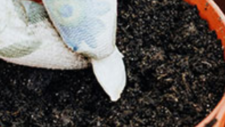
• Sowing seed. Do not use garden soil to germinate seed. It is too heavy and may contain disease organisms. Use a media made especially for seed germination.
Domenghini said additional tips include keeping seed moist and growing the seeds in appropriate lighting and temperature conditions. A little TLC also helps, she said.
“Plants react to movement,” Domenghini said. “Brushing over the plants with your hand stimulates them to become more stocky and less leggy. Try 20 brushing strokes per day. However, brushing will not compensate for a lack of light or over-crowding.”
Move plants outdoors prior to transplanting so that they will become hardened to the sun and wind. “Start about two weeks before transplanting and gradually expose the plants to outside conditions,” Domenghini said. “Increase the number of hours and degree of exposure over a two-week period.”
K-State horticulture expert shares tips for watering home landscapes.
Yards may need another shot of moisture even after recent rain and snow to alleviate stress in lawns and gardens, said Kansas State University horticulture expert Cynthia Domenghini.
“A good, deep watering with moisture reaching at least a foot down into the soil is much better than several light sprinklings that just wet the top portions of the soil,” Domenghini said. “A deep watering will ensure that the majority of roots have access to water.”
Domenghini urged homeowners to test the moisture content in their yard’s soil by pushing a metal rod or wooden dowel into the ground. “Dry soil is much harder to push through than wet,” she said. Measure how far down the implement goes to determine the amount of moisture is in the soil.
“Although all perennial plants benefit from moist soils before winter, it is especially important for newly planted or over-seeded lawns, as well as newly transplanted trees and shrubs due to their limited root systems,” Domenghini said.
“Even trees and shrubs planted within the last 2-3 years are more sensitive to drought than a well-established plant. Evergreens are more at risk because moisture is lost from the foliage.”
Domenghini shared a few tips for watering common areas of the yard:
Trees and shrubs planted within the last year. Drill a small hole in a five-gallon bucket near the bottom, then fill the bucket and let the water dribble out slowly next to the tree. Refill the bucket once so that you apply 10 gallons. Slow release bags with micropores can be purchased as an alternative to using a bucket. Larger trees planted 2-3 years prior may require more water.
Large trees. Using a soaker hose, circle the trunk one-half the distance to the dripline, or the outermost reach of branches. On smaller trees, you may need to circle the tree several times so that tree roots will be watered.
Newly established bed or foundation plantings. Hook the beginning and end of a soaker hose to a Y-adapter to equalize pressure, which encourages more uniform watering.
Fall planted or overseeded lawns. Use an overhead sprinkler. Watering to a depth of 12 inches is more difficult; try to reach at least six inches deep.
Domenghini said watering once a month if conditions are dry and warm should be enough to help landscapes through the winter.
Domenghini and her colleagues in K-State’s Department of Horticulture and Natural Resources produce a weekly Horticulture Newsletter with tips for maintaining home landscapes and gardens. The newsletter is available to view online or can be delivered by email each week.
I was born and raised in hamburger heaven. Four hours away was Lodi, California, where the oldest restaurant chain in America was founded by two guys named Allen and Wright, hence the name A & W. Supposedly, they were also the first chain to introduce car hops and root beer served in frosted mugs that came straight from the freezer. In 1926 the chain evolved into a franchise operation and in the same year they invented the bacon double cheeseburger. For that I think we can all be eternally grateful. They were also the first, I’m pretty sure, to open a franchise in Bangladesh! Really.
The small town where I grew up was two hours north of Los Angeles, and its many environs, where fast food was born. In 1937 the precursor to McDonalds was opened in Monrovia, by Patrick McDonald and his sons Richard and Maurice. It was called the “Airdrome” and its success led to their opening of a restaurant named McDonald’s along Route 66 in San Bernardino, California in 1940. After finding that hamburgers were 80% of their business they concentrated on burgers when they introduced the first fast food in 1948 which included burgers that were cooked and served in one minute.
A salesman of milk shake machines noticed that one restaurant was sending in orders for an inordinate number of machines and it piqued the salesman’s interest. That salesman was Ray Kroc who would eventually become CEO of McDonalds and he expanded the chain and its first mascot, a hamburger-faced “Speedee”, across America. Their first hamburgers cost 15 cents and their fabulous fries were 12 cents. Interestingly, Kroc supposedly copied the franchise system from the Singer Sewing Machine Corporation.
McDonald’s success fostered a slew of competitors and copy cats and soon the average American was eating three burgers per week. After coming to California to see the secret to McDonald’s success two guys from Miami went home and started their first store in 1954 under the Insta-Burger King name, which later became Burger King.
Bob’s Big Boy was started in 1936 in Glendale, California, and would become famous, among other things, for introducing the first double deck cheeseburger. Jack In The Box was started in San Diego, with a giant clown perched on its roof and customers in their cars ordered by talking to a clown that had an intercom for guts. Interestingly, Jack in The Box had a clown for a mascot before Ronald McDonald came along.
Other chains that had their start in California included Foster Freeze in 1946 in Inglewood, Hot Dog on A Stick in Santa Monica in 1946 (originally called Party Puffs) and Carl’s Jr. also in 1956 in Anaheim that originally was a hot dog stand. Again, all these places were within two hours of my home but my mother never let us eat at a single one of them because she thought fast food was the handiwork of the devil.
One of my favorite chains that used a lot of beef but didn’t sell hamburgers was Taco Bell which was started in 1962 in another suburb of LA: Downey. Taco Bell was an immediate success and it gave rise to Del Taco two years later in Yermo, California. Taco Bell got its name from the founder’s last name which was Bell.
Glen Bell and his wife gave encouragement and the name to the owner of Weinerschnitzil which also started in California and eventually became the largest hot dog chain in the world. Another chain started in California that didn’t serve hamburgers but did sell beef was Panda Express that went into business in 1972 in Glendale with its rendition of American Chinese food.
Perhaps not since McDonalds has a California chain caused so much commotion as In-N-Out Burger. This chain began with a single restaurant in Baldwin Park (not far from McDonald’s original location) and soon its drive up windows were overwhelmed by customers who wanted their Cheeseburger Double-Doubles. In-N-Out is the anti-McDonalds with all its burgers made from whole muscle cuts that are fresh, never frozen. Although it’s been mostly a California phenomenon until now, they’ve begun their march eastward.
Heaven forbid, if you ever tired of plain burgers there were other California beef delights developed in the Golden State like French Dip sandwiches and Chili burgers. For dessert you could go to other California-founded chains like Baskin Robbins, IHOP or Orange Julius.
In western Kansas, seas of corn and wheat stretch out across the plains, but a huge portion of those fields used to be native grassland. To conserve what’s left, a new program will work with ranchers, and it’s backed by some of the biggest beef buyers like Burger King.
HASKELL COUNTY, Kansas – Kelly Anthony, a cattle rancher in southwest Kansas, drives through his pasture, blaring a siren he uses to get the attention of the herd. As he flicks it on and off, the cattle surround the truck.
Cattle ranching has been Anthony’s way of life for 25 years. Cattle ranches fuel the beef industry and the western Kansas economy. People like him also own much of the remaining native grasslands that once covered 71million acresof the southern High Plains.
Now, 80%of those native grasslands in Kansas are lost, and cattle ranchers like Anthony could be the key to saving what’s left. A new program backed by conservation groups and the beef industry hopes to work with ranchers to conserve and restore more land.
“I really think that ranchers as a whole are the best stewards of the land, because the capital requirement to be in the cattle business is so high, the biggest portion of that is land,” Anthony said.
The native grasslands lost out to profitable fields of corn and other crops, while also being crowded out by invasive species.
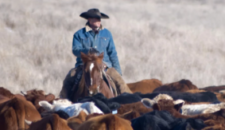
Anthony hops on his horse and rides in front of sloping hills to count his cattle. Just past the hills are acres of untouched native grasses vital for a variety of species, like pronghorn deer and grassland birds including the lesser prairie chicken.
Last year, The Nature Conservancy started the Southern High Plains Initiative, backed by big brands connected to beef like Burger King and Cargill, which each contributed $5 million. Ultimately, the program so far has $42 million invested across five states to preserve or restore nearly 30 million acres of intact grasslands.
The program is using market-based incentives, basically payments, to ranchers who will preserve grassland or convert crops back to grass. Agreements could last up to 15 years in some cases with annual payments of $45 per acre.
But success will mean convincing ranchers in Kansas and elsewhere to get on board. Some, like Anthony, are a little skeptical. Ranchers are often careful who they support and protective of their lands. Sometimes, conservation groups also come with negative connotations.
Matt Bain is the Southern High Plains Grassland project manager for The Nature Conservancy. He said overcoming that skepticism will be key to making this work.
“Part of this process is to identify the barriers and to quantify them in a way that really hasn’t been done,” Bain said.
The southern high plains cover parts of Kansas, Colorado, New Mexico, Texas and Oklahoma.
Bain has a long history with these grasslands. He was a rancher in the area for 12 years before taking over this initiative.
He calls grasslands the most imperiled native ecosystem on Earth. Part of the reason is because they are often overlooked, but they provide a lot of benefits including clean air, carbon storage, habitats for prairie species and food supply.
Some environmentalists believe ranching on grassland with conservation in mind could produce beef with less of an environmental impact.
“Ranchers are the reason we still have grassland in a very basic sense,” Bain said.
Bain has won over some ranchers. Bob Winderlin, a former full-time rancher in Scott County, is one of the people now participating in the program so his land will see potentially less impacts from drought and water loss. Grasslands help reduce water runoff and filter water into river basins. They also help keep soils cooler and keep more moisture in the ground.
He said conservation is key to preserving grasslands and the rural ranching lifestyle.
“I guess we’re smart enough to realize that we got to conserve what we have or we end up with nothing,” Winderlin said.
Other ranchers in the program, like Mark Smith in Wallace County, have been practicing conservation for generations. He said both his father and grandfather participated.
“I’ve got land we haven’t tilled in over 20 years. We want cooler temperatures in the soil. We need to retain that moisture when it snows,” Smith said.
Smith is a history buff. Even more than conserving the land, he wants to conserve what the land represents. Large parts of grassland in northwest Kansas have historical significance to the Sioux and Cheyenne tribes.
“It’s important to me that this grassland stays grassland, because there is a lot of history out here in this land,” Smith said.
Despite conservation efforts, there is still a negative connotation to cattle ranching from environmental advocates.
The beef industry leaves a huge impact on the environment by consuming a lot of grain that is produced in ways that contribute to water loss and soil pollution. The cattle and process release a lot ofgreenhouse gasses.
That’s why some major beef purchasers like Burger King, with its 1900 restaurants, are investing.
Deborah Fleischer is president of Green Impact, a consulting firm that helps businesses with green initiatives. She said when large companies invest in green projects, they might also be prompted by benefits like improving their public image.
“I think it’s beyond philanthropy for some of these bigger companies now and just part of their carbon reduction strategy,” Fleischer said.
Most of these companies have public goals of reducing carbon emissions by 2030 or sooner, and efforts like saving grasslands can help.
Whether it’s securing their beef supply or reducing carbon emissions, the investments from large companies can help conservation efforts.
Fleischer said beyond that, the companies also earn benefits like attracting younger employees.
“More and more employees, especially younger employees, are looking to work at companies that actually have a responsible ethic,” Fleischer said.
Calen Moore covers western Kansas for High Plains Public Radio and the Kansas News Service. You can email him at [email protected].
Here are some answers to frequently asked questions about filing your income taxes this year.
Can I get my ducks in a row before Jan. 29?
Taxpayers who wish to get an early start may take steps toward doing that now, the IRS says.
Most online services allow taxpayers filing electronically to input all of their information before Jan. 29, then have the service submit that to the IRS that day.
The same is typically true when using tax preparers. They can complete the return ahead of time and send the prepared ones to the IRS once it opens Jan. 29.
Are you eligible for IRS Free File?
Anyone may file taxes free of charge using the IRS’ Free File Fillable Forms accessible on the IRS website. All of the necessary forms on that site must be filled out manually by the taxpayer.
Free guided tax preparation is available to taxpayers whose adjusted gross income is $79,000 or less. The IRS works with eight trusted partners, or online services, to do that. Each partner has different eligibility requirements based on average gross income. Some partners also offer free filings on state tax returns.
More information about the trusted partners and the rules each has in place can be found on the IRS website.
Taxpayers must access one of the eight partners through the IRS website. Taxpayers won’t receive the free benefits if they visit the partner website directly.
Are you eligible for TurboTax Free Edition?
TurboTax, an online service not covered by IRS Free File, offers its “Turbe Tax Free Edition” to taxpayers filing a Form 1040 return with limited credits.
The TurboTax website says the service is available to taxpayers with an IRS standard deduction, Earned Income Tax Credit, Child Tax Credit or student loan interest deduction, and W-2 income, interest or dividends that don’t require a Schedule B filing. About 37% of taxpayers will be eligible, the site says.
The program is not available to taxpayers with itemized deductions claimed on a Schedule A filing, unemployment income reported in a 1099-G, business income, stock sales, rental property incomes, and credits, deductions and income reported on other schedules or forms.
How soon will you receive a tax refund?
If you file a return electronically and everything goes smoothly, expect a refund (if you’re entitled to one) in less than 21 calendar days. If mailing a physical return in the mail, getting a refund may take four weeks or more.
If claiming the Earned Income Tax Credit or Additional Child Tax Credit, a refund may take a bit longer than that to be processed and delivered. According to the IRS website, EITC and ACTC refunds cannot be issues before mid-February.
How can you check the status of a tax refund?
To check on the status of a refund, use the IRS Where’s My Refund tool online or call the refund hotline at 800-829-1954. Statuses can be checked 24 hours after an electronic filing and four weeks after a physical mailed filing.
When is the last day to file taxes?
The final day to file tax returns is Monday, April 15.