Wednesday, February 18, 2026
Home Blog Page 525

Use weed clues to dig up fertility, soil compaction and moisture issues

0

As reported in High Plains Journal, winter is a good time to make garden plans, and one constant issue gardeners face every growing season is weeds. While weeds can be frustrating, they can also be saying more about a yard than you think.

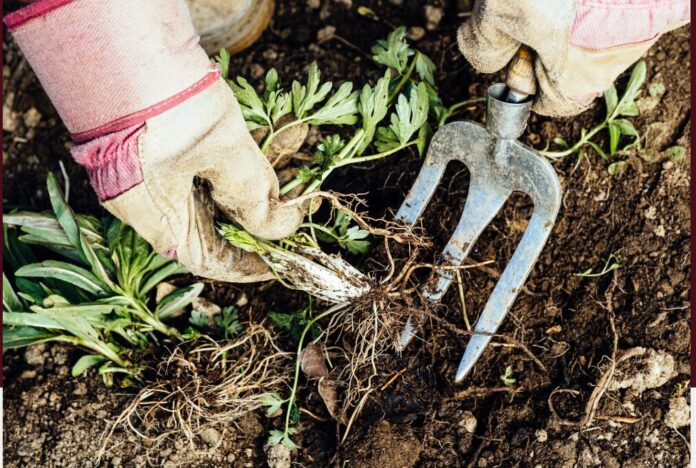
Weeds can be found in a wide range of locations. Some weedy plants are more likely to be found in specific environmental conditions. These plants are sometimes called indicator species because their presence provides clues about the existing environmental conditions, such as soil compaction, acidic soil, excess moisture, dry soils, low light, and low fertility. While indicator plants can grow in other conditions, their presence might be a sign for you to investigate soil and environmental conditions.

There are two main strategies to reduce weed infestations. The first is ensuring the right plant is in the right conditions to thrive. The second is to amend the soil or conditions to create a less favorable environment for weed growth.

It is essential to identify weeds so they can be correctly controlled. Once the weed is identified, some research will provide information on its life cycle to help determine the best methods to discourage growth.

Low Fertility

Plants such as the common mullein (Verbascum thapsus), plantain (Plantago spp.), and white clover (Trifolium repens) can be indicators of low fertility. A soil test is an excellent way to verify this. Low-fertility soil can be modified by adding organic matter through cover crops, compost, or organic fertilizers such as bone or fish meal.

Another option is to select plants that thrive in low fertility conditions to out-compete the weeds.

Perennials

  • Coreopsis (Coreopsis spp.)
  • Globe thistle (Echinops ritro)
  • Goldenrod, sweet (Solidago odora)
  • Ornamental sage (Salvia spp.)
  • Blanket flower (Gaillardia x grandiflora)
  • Rattlesnake master (Eryngium yuccifolium)
  • Yarrow (Achillea spp.)

Shrubs

  • American filbert (Corylus americana)
  • Fragrant sumac (Rhus aromatica ‘Gro-Low’)
  • Ninebark (Physocarpus opulifolius)

Wet Soils

Certain weed species indicate excess moisture. Species such as annual bluegrass (Poa annua), common chickweed (Stellaria media), Pennsylvania smartweed (Polygonum pensylvanicum), and yellow nutsedge (Cyperus esculentus) hint at too much moisture in that area.

These areas can be a good spot to add native water-loving plants for a natural rain garden. Rain gardens give water a place to infiltrate the soil, which also cleans the water and reduces runoff. These plants thrive in wet conditions:

  • Blue flag iris (Iris versicolor)
  • Cardinal flower (Lobelia cardinalis)
  • Dogwood (Swida spp.)
  • Joe Pye weed (Eutrochium purpureum)
  • River birch (Betula nigra)
  • Pussy willow (Salix discolor)
  • Swamp milkweed (Asclepias incarnata)
  • White turtlehead (Chelone glabra)

Soils that dry quickly

Soils prone to drought do not retain as much water as other soils, creating a favorable environment for weedy species such as crabgrass (Digitaria spp.), plantain (Plantago spp.), prostrate knotweed (Polygonum aviculare), and woodsorrel (Oxalis stricta).

Improve soil health using soil-friendly garden practices and add organic matter to help the soil better hold onto water. Control erosion by leaving plants or mulch on the soil. Use soil tests to monitor soil fertility, paying close attention to potassium levels, which can be low in drought-prone soils.

Compacted Soils

Bindweed (Convolvulus arvensis), broadleaf plantain (Plantago major), chicory (Cichorium intybus), dandelion (Taraxacum officinale), and prostrate knotweed (Polygonum aviculare) can be indicators of soil compaction. Reduce compaction by adding organic matter, redirecting foot traffic, or core aerating the soil to make a less favorable environment for these species.

Plants can adapt to a range of conditions, and it is important to note that some species can thrive in more than one environment, so using weeds as indicators of conditions is just one way to read the hints a garden is giving. Use the clues to dig deeper and create a less favorable environment for weedy invaders. This approach is not foolproof, but it is a place to start to reduce weed infestations.

Nicole Flowers-Kimmerle is an Illinois Extension horticulture educator for Fulton, Mason, Peoria, and Tazewell countiesGardeners Corner is a quarterly newsletter from gardening experts around the state. Each issue highlights best practices that will make your houseplants, landscape, or garden shine in any season. Join the Gardener’s Corner email list at go.illinois.edu/GCsubscribe for direct access to timely tips.

Daylight Savings Time 2024 starts soon: Details, future dates

0

Daylight Saving Time, a sure sign winter is nearing its end, returns March 10, 2024. Clocks will spring forward an hour at 2 a.m. that Sunday. As a result, March 10 will be a 23-hour day in the United States and several other countries around the globe.

The change, one of the earliest days possible for Daylight Saving Time to begin, is part of the longstanding practice to gain an extra hour of daylight at the end of the day.

Sunset will continue to fall about a minute later each day into the first week of July, according to the U.S. Naval Observatory.

Daylight Saving Time 2024 will end Sunday, Nov. 3. At 2 a.m. that day, clocks will fall back an hour. As a result, that day will last 25 hours.

Daylight Saving Time was initiated as an energy-saving measure in World War I and then again in World War II. Permanent daylight-saving time was briefly enacted by President Richard Nixon in 1974 following the 1973 oil embargo crisis.

The time change is fixed in federal law now, starting the second Sunday in March and ending the first Sunday in November.

In 2025, it will start March 9 and end Nov. 2. In 2026 it will start March 8 and end Nov. 1, the earliest dates it can start and end. In d027 it will begin March 14 and end Nov. 7, the latest dates it can start and end.

Critics question whether changing the clocks effectively saves any energy. Health experts suggest that switching back and forth can disrupt sleep schedules and affect individual health.

poll conducted in 2020 by the American Academy of Sleep Medicine found that 63% of Americans favor ending seasonal time changes.

Two states, Hawaii and Arizona, already have done that, opting out of switching clocks to Daylight Saving Time.

The U.S. Senate unanimously approved the Sunshine Protection Act in March 2022 that would have made Daylight Saving Time permanent. The legislation died in the U.S. House.

Sen. Marco Rubio, a Florida Republican and advocate of eliminating Daylight Saving Time, introduced new legislation in March 2023.

“This ritual of changing time twice a year is stupid,” Rubio said then in a statement. “It’s time to end it.”

Similar legislation was introduced in the U.S. House. Both bills are pending in committees.

In Ohio, meanwhile, legislators in the Ohio House voted last fall to urge the federal government to end the clock changing practiceThat bill is pending in the Ohio Senate.

Rep. Rodney Creech, a West Alexandria Republican, told cleveland.com then that Ohioans just want Congress to pick one or the other.

“I can tell you in our community, people say, ‘We just don’t want to change our clocks. We’re OK with Daylight Savings Time, we’re OK with standard time, we just don’t want to change our clocks,’” he said.


When cold coal froze, wind farms helped Evergy power Kansas through winter weather

1

Evergy maintained “normal operating conditions for extreme weather,” despite coal freezing, thanks in part to high winds powering wind farms through the recent blustery conditions.

“The bottom line is we had enough power over the last week or so and in particular through the weekend when we had the coldest weather to meet demands,” said Chuck Caisley, an Evergy executive, about the previous weekend.

He added that with a midweek warming, “I think we are out of the biggest danger of not having adequate supplies.”

Caisley told the House Energy, Utilities and Telecommunications Committee on Tuesday that “the system has held up” and contrasted the current wintry weather with what happened in February 2021 with winter storm Uri.

Cold coal froze in Kansas winter

“Probably the biggest difference for us in this storm versus Uri was about a week to 10 days prior to this event, you’ll recall, we had sleet, ice, snow and even rain in some parts of the service territory,” Caisley said. “And what that means is even though we put sealant on our coal piles, we had a lot of frozen coal — both that’s operating within our coal plants but also just lying on the ground, which makes running those coal power plants a lot more difficult.

“For all the great technology that we have when it comes to combating frozen coal and just frozen equipment in general, it’s really pretty caveman-type implements that we use. We use fire. We use blow torches. We use jackhammers. We use sledgehammers. We use Bobcats. And we just simply try and break it up.

“But what happens is sometimes it does freeze in the hoppers and in the coal bins. We can’t pulverize it. And either we have to take a unit offline, heat that coal up and then get it going again, or we take what’s called a derate, which means it’s not running at full capacity. You can’t get the same amount of power out of it. And that happened periodically to some of our coal plants.”

Wind farms benefited from the wind chills

While people who had to be outside may not have enjoyed the sub-zero wind chills, that windy weather helped keep the lights on inside.

“The good news is that unlike Uri where it was really, really calm, the wind has been blowing like blue blazes, which means we have been getting thousands of megawatts from our wind production facilities across Kansas,” Caisley said. “The only problem with that is it fluctuates.”

The significant fluctuations in wind production means a need for “dispatchable power in order to pick it up, or the lights go out and you can’t make things anymore, people lose heat and it’s a bad situation.”

Natural gas price spikes weren’t as high

While natural gas saw price spikes during this storm, they were nowhere near the skyrocketed prices from Uri that resulted in alleged price gouging lawsuits.

“From a natural gas perspective,” Caisley said, “we didn’t see the fuel spikes that we saw in Uri, and we able to procure for natural gas for a significant amount of our generation that uses it ahead of time.”

Wolf Creek nuclear power plant ‘cruised’ in winter weather

“Our nuclear plant Wolf Creek, 80 miles from here, cruised through this whole event,” Caisley said.

Transmission and distribution saw small outages

Caisley said the distribution system has operated normally with occasional outages affecting a relatively small number of people.

“That’s when a line drops because it starts galloping in the wind or it has some kind of an electromechanical failure,” he said. “What happens is ice gets in some of these moving parts and expands and just breaks things. So that’s expected. We’ve had that on and off. Usually, those are about 1-2 hour outages.”

There was a bigger outage across the state line near the Truman Sports Complex. It happened during the Kansas City Chiefs playoff game against the Miami Dolphins.

“We actually had a cable between two transformers in one of the substations that serves Arrowhead Stadium burn up,” Caisley said. “Fortunately, it was not one of the transformers that serve Arrowhead. Unfortunately, we lost a lot of capacity to distribute power in that area and it took about 3 hours to get about 11,500 Missouri customers up.”

Importing and exporting electricity

The worst of the winter weather affected a narrower slice of the Midwest at a time than Uri did.

“We were able to import power from our neighbors to the east, which was unavailable in winter storm Uri,” Caisley said. “So MISO, which is the regional transmission organization immediately to our east and going up into the northern parts of the Midwest, we actually imported, both SPP and Evergy, imported some power from them over the last several days.

Now, as this system moves east, we expect that we will return the favor and the Southwest Power Pool and Evergy will offload electricity and sell to them.”

Will the winter storm cost ratepayers?

Caisley said “it’s too early to tell” if ratepayers will see a bump in their electric bill as a result of the winter weather.

Uri resulted in increased electric bills for Evergy Kansas Central customers, which includes Topeka, but decreased bills for Evergy Kansas Metro customers due to cost savings from exporting power to other utilities.

“Because we don’t know what MISO is going to ask for yet, and because we don’t have the bill tabulated for last three or four days, I can’t tell you how that’s going to wash out,” Caisley said. “But I would say we’re in a very good position, particularly if the wind keeps blowing, to export power to our neighbors. Hopefully that offsets some or completely or maybe even puts us in a beneficial position over the coming two or three, four days.”

Kansas faces elevated reliability risks

But Caisely’s presentation wasn’t all sunshine and rainbows, advising legislators that federal regulators have the Southwest Power Pool at elevated risk in both a winter reliability assessment and a long-term reliability assessment. Those reports warn of a potential for insufficient reserves during extreme weather conditions.

For Evergy Kansas, the excess capacity is about 400 megawatts — which is equivalent to about four wind farms or about half a coal power plant. But that excess is expected to evaporate by the end of the decade due to various factors, including new large customers like Panasonic and the scheduled retirement of a Lawrence coal unit.

That Lawrence facility is slated to close in 2028, but Evergy would likely keep it open “as long as that is a viable plant from a cost perspective and as long as we need the generation,” Caisley said. But Environmental Protection Agency requirements that are being litigated could requires “hundreds of millions of dollars” worth of environmental controls to that plant, making it not “financially viable to operate anymore.”

More generation is needed before 2030, Caisley said. Evergy wants to build combined cycle natural gas plants.

“Right now, coal is not viable to build,” he said. “Natural gas is.”

Evergy wants to have renewables and fossil fuels

While he said fossils fuels are under “duress,” particularly from the federal government, he also said “our federal government is a reflection of our society at the end of the day, and so we’ve got a lot of customers that don’t like fossil fuels either.”

“And at the end of the day, it is also true that a diverse generation mix is helpful,” Caisley said. “So I mean, our wind over the last week has played a significant role in keeping the lights on. Now, it fluctuates so much that it’s good to have baseload dispatchable generation underneath it. And by and large, that is fossil fuel derived right now.”

As reported in the Topeka Capital Journal

Lettuce Eat Local: This Weather Is So Ex-Cider-Ing

0

“When Will It Be Spring?” asks the title of a blue-spined kids’ book on our shelf. I find myself often asking the same question, knowing full well it will be a long time yet but still needing to wonder. If these inhuman temperatures persist, I will cease to wonder and begin to desperately beseech any and all within earshot: when will it be spring?! 

I don’t have any reason to complain. Though our house is old, the heat works great. The doors and windows are not all airtight — we have to slide a barricade along the base of the garage-side door to stop the full flow of cold air, and the windows are often so iced over we can barely see out — but it’s comfortably warm inside anyway. 

Which is good, because outside it’s NOT. Benson typically likes to tag along while I do my chores, to roar at the chickens while I collect the eggs or carry Grandma’s mail over to the barn desk; these last couple weeks, however, he’s only come a few times, and usually cries to go in before I’m done. 

Not like I have a lot of eggs to collect. I don’t know if they’re freezing inside the hens or what, but I’ll go days without a single egg — and if there is one, it’s probably frozen solid in the brooder box anyway. Chickens are remarkably resilient to the cold weather with their insulating feathers, but I’m sure the hens are still wondering when it will be spring, too. 

Recently I discovered a benefit of the cold, though. I hardboiled a few eggs (from a friend whose flock apparently loves her more than mine does me), and had the genius idea of sticking the pan outside in the snow to cool off quickly. Not surprisingly, it worked. Perhaps too efficiently, since I’m afraid they were very hard (i.e. frozen) by the time I remembered what I had done, but at least that’s something I can’t do in the spring. 

Speaking of frozen hard, I had a bag of mandarin oranges sitting in the garage. I had room in the fridge, so I have a hard time articulating my reasoning for leaving them out except that it seemed ecologically appropriate to utilize the naturally chilling environment. The day I backed the van out and heard the distinct crack of wheels unfreezing from the cement was the day I realized my garage was no longer a fridge but a freezer. Of course some fruits are great to freeze, but whole oranges rarely fit on that list. However, thanks to arctic temperatures, we learned that blending a bunch of mandarin oranges makes orange juice (expected) that’s so full of natural pectin that it gels in the fridge like a magical creamsicle (unexpected). 

I’m now more judiciously utilizing the everpresent chill available to us. I’ve been making batches of broth in my multicooker, and while I love the end product, I do not love its pervasive aroma as it cools — which I have been saved from by a freezing cold garage that does the cooling for me. Out there, the pot of yogurt was set on the counter to chill, the lemon cake was stored out of the two-year-old’s line of sight, the hot pudding was cooled quickly. Thank you, Winter.

That’s nice and all, but still, when will it be spring?


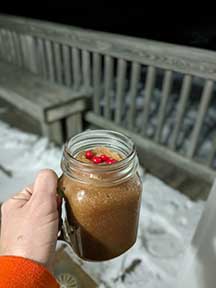
Cider Slushie

Let’s keep pretending this cold is good for something! Here we do have a handy, fun way to make a cheerful cold drink; it comes with the caveat that you might need to pair it with a hot beverage, so save the other half of the cider to heat up and counteract the chill from the slush. Remember that this is mostly cider, so use a brand that you like. 

Prep tips: obviously if it isn’t freezing outside, this won’t work so well, but I consider that a win. If you still want a cider slushie, just make space in your freezer and proceed, or blend the ingredients with some ice.

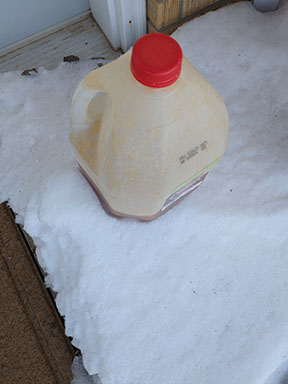
a plastic gallon jug of cider, half full

a handful of cinnamon red hot candies

¼ cup maple syrup, or to taste

2-3 tablespoons cinnamon

2 teaspoons allspice or cloves

optional: ¼ cup powdered chai mix

Add all the ingredients into the jug of cider, shake vigorously to combine, and set it outside in the snow when temperatures are below freezing. Shake it every few hours until it’s frozen to slushy consistency. Serve, garnished with extra red hots and cinnamon sticks as straws if you want.