Sheridan Wimmer
Kansas Living Magazine
Real quick – check the tag on your shirt. No, I won’t respond with the classic pick-up line claiming you’re made in heaven (but that checks out too). Rather, look at the ingredients of the shirt. How much of it is polyester? Rayon? What about cotton percentage?
We often forget about the composition of our clothing but talk to a Kansas cotton farmer and they’ll likely remind you of the importance of checking for cotton in your clothing or bed sheets.
“I bet the shirt you’re wearing isn’t 100 percent cotton,” Talan Shinn, a cotton grower and custom cotton harvester says as he harvests a client’s cotton field in Harper County. “Companies started using polyester more often because it’s a cheaper option. But it’s synthetic and much less sustainable than cotton.”
Cotton production in Kansas
While we associate cotton with southern states like Texas, Georgia and Arkansas, Kansas cotton acres have grown exponentially in the past several years.
According to the Kansas Department of Agriculture, cotton acres in Kansas grew from 33,000 acres in 2016 to 195,000 in 2020. That’s nearly six times as many acres.
Shinn is now on his 16th season of raising and harvesting cotton on his farm in Sumner County, and his family was one of the first to bring cotton to the area.
“We were definitely on the front end of growing cotton around here,” Shinn says. “My dad and grandpa actually raised a cotton crop back in the early- to mid-‘90s, but there was no infrastructure in Kansas at that point. They went away from cotton for about 10 to 15 years, then we picked it back up when I was a senior in high school.”
Growing cotton
Cotton in Kansas is planted in May and harvested from November through December. Cotton is used by farmers in Kansas as part of a rotation management system with corn or other crops to improve soil fertility. Most cotton growers in Kansas elect for a variety of cotton resistant to 2,4-D, an herbicide used to kill broadleaf weeds in other crop fields. PhytoGen® cotton with the Enlist® cotton trait protects cotton from 2,4-D.
“The majority of growers in Kansas have gone to the Enlist system because cotton is so sensitive to 2,4-D,” Shinn says. “It can be sprayed two miles away and you could lose a couple hundred pounds of yield in your cotton fields. Even though farmers are careful with their spraying practices, the slightest drift can still impact cotton. But with the Enlist, cotton is protected from 2,4-D drift.”
To grow cotton, weather conditions should reach certain heat units for optimal growth. The National Cotton Council has a set formula to determine growing conditions and plant progress. There’s an average amount of days and heat units a cotton plant needs to thrive. The heat units increase as the cotton plant matures and the southern third part of Kansas can meet that average.
“Highway 54 used to be the dividing line of where cotton was grown,” Shinn says. “But it has crept north about 30 or 40 miles now. Any more north of that and you run out of heat units.”
Cotton is also particular about humidity levels when it’s time to harvest.
“You can’t get out here in the morning when it’s still dewy and you have to stop in the evenings,” Shinn says. “We aren’t able to be out here all evening like a lot of other crop harvest crews can be. We really try to aim for about 60 percent humidity and lower.”
Everyone along the supply chain in cotton production doesn’t want a wet bale, which could become moldy or even catch fire. If a gin gets wet bales, it can cause issues in the spindles of the machines.
“If cotton is too high in moisture content, it will form wads that could eventually damage our gins,” David Lingle, general manager at Next GINeration Cotton Gin west of Pratt, says. “We do have dryers at our gin to make sure that problem doesn’t happen, but growers should still avoid it.”
Growers also take plant height into consideration for cotton harvest. For maximum yield, the cotton plant needs to reach a certain height, but not get too tall. The sweet spot for cotton depends on the variety planted, the region and the width of the rows the cotton seed is planted in, but generally, cotton shouldn’t grow taller than 40 inches.
“We don’t want cotton too tall because there’s too many nutrients going to the stem part, which isn’t the worthwhile part,” Shinn says. “It’s also hard to harvest cotton if it gets too tall.”
In addition to having a shorter growing season in Kansas, which limits how tall the plant can get naturally, growers sometimes use a growth regulator to limit the expansion of leaf and stem tissues. The chemical, mepiquat chloride, has been used in the cotton industry for more than two decades and is low in toxicity.
Drought conditions
Cotton is a less water-intensive crop compared to soybeans or corn, for instance. But it still needs moisture to maintain its fruit.
“When you walk fields that are really dry, you can see it just dropping flowers and dropping fruit,” Shinn says. “Unlike soybeans that’ll die without water, cotton will just drop its fruit and try to produce what it can. It’s a lot more hardy of a plant.”
But in 2023, when there were around 31 consecutive days without rainfall in Shinn’s area, that impacted non-irrigated fields of cotton.
“If we would have gotten even just one more inch of rain in mid-August to the end of September, we’d be sitting on a monster cotton crop,” Shinn says.
The field he was harvesting at the time was getting around 700 to 750 pounds per acre. If the area got that one inch of rain, Shinn suspects they’d have had 1,200-pound cotton. That difference adds up for the farmer and the custom harvester.
“I get paid by the pound,” he says. “The more the farmer makes, the more I make. Not to mention, we have our own acres of cotton we want to do well. But to put it into perspective, we’ll have below-average cotton because of drought, where soybean fields are total losses.”
Harvesting cotton
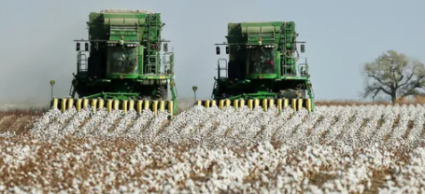
John Deere changed the game for the cotton industry when it developed the stripper round baler and picker round baler in 2015, allowing a seamless transition for farmers to convert harvested cotton straight into large round bales with the same machine.
“I imagine when farmers went from thrashing machines to combines, they felt the same way when cotton farmers went from basket strippers to baler strippers,” Shinn says. “We used to run basket strippers, and it’s amazing the efficiency improvement. We went from getting 30 acres harvested on a good day, to being able to push 100 acres now. John Deere hit a home run on the cotton stripper.”
Most cotton farmers in Kansas utilize the stripper technology for harvest. Strippers comb the plant with teeth and pull the entire boll into the machine, then another machine removes the vegetative matter. Pickers remove the cotton from the boll and can be used over the same field of cotton multiple times since the plant will reproduce its fruit. Pickers also rely on a water solution to take the cotton off the spindle, and that isn’t ideal in Kansas, where temperatures drop below freezing.
“Having a picker would mean farmers in Kansas would have to put them in a heated shed every night to prevent that water solution from freezing,” Shinn says. “Antifreeze isn’t an option either because that would stain the cotton.”
Top-quality cotton
Cotton’s quality is important for ginning and textile manufacturing, so stained cotton wouldn’t receive as high a grade.
When the gin presses the cotton for bales, small portions are cut from each bale and shipped to a United States Department of Agriculture classing office. Classers look at the sample’s color (the whiter, the better), fiber length, fiber density, strength and amount of non-cotton particles in the sample. When there’s bark or leaves in the lint, it’s difficult to remove for ginning and milling.
“Having bark in the cotton is about three cents a pound off the price a farmer would get right off the bat,” Shinn says. “So I have to find a balance with the header of my stripper so I’m not taking too much of the bark of the cotton plants, but still getting as much cotton as possible by adjusting how tight the width of my header is.”
Customers buying cotton have different requirements they’re looking for, and sometimes they don’t need the highest grade because the end use may be to stuff furniture or other uses where color may not matter as much, but the strength of the fiber does.
Cotton grades are divided by color first – white, light-spotted, spotted, tinged and yellow stained – then divided from there based on other factors.
“You get rewarded for high-quality cotton,” Shinn says. “I like that because while there are some things out of your control, there are things with cotton you can control.”
Ginning
That infrastructure missing for the Shinn family in the ‘90s has grown over the years to four gins in Kansas. The cotton gins – located in Moscow, Pratt, Anthony and Winfield – are all in the southern region of the state and close to cotton grown in Kansas. The northernmost gin, Next GINeration Cotton Gin, got its start in 2004.
“We had a slower start when we first opened, but once cotton acres picked up, we saw a lot more production around 2007,” Cassie Goyen, the office manager at Next GINeration Cotton Gin, says.
Eli Whitney’s cotton gin, developed in 1794, is still the method of ginning today – only a bit more mechanized and slightly larger. The Next GINeration Cotton Gin has four gins – and the machines involved remove moisture from the cotton, remove burs, stems and leaves, separate seeds and debris from cotton fibers and remove dust, stones or wooden particles. The cotton fibers are then pressed into bales with a hydraulic pressing machine.
In 2022, Kansas cotton production and ginning exceeded 2.4 million bales since 1996. The Next GINeration Cotton Gin had ginned approximately 2,500 bales in 2023 as of November, and they weren’t done yet considering they were still in the midst of harvest.
Cotton is marketed differently from wheat or other row crops in that you can track cotton all the way through the supply chain. From the farmer to the gin to the Kansas warehouses in Clearwater and Liberal, every bit of cotton can be traced back to the farmer who raised it.
“When a farmer comes in and has cotton, they give me all their information and I work closely with them so when harvest time comes, they can easily tell me what field the bales are coming out of,” Goyen says. “Once their cotton is ginned, I help them market.”
Cotton is sold on a per-pound basis, and Goyen says there are several marketing options farmers can utilize.
“I help them choose which marketing option works best for them,” she says. “There are several marketing pools you can get into with other farms, but you can also sell it for cash at the time of harvest on a website called The Seam. I will put a price on there the farmer wants, then that cotton receives bids. Almost like an eBay system.”
Once the cotton is sold, it’s spun for use in textiles – jeans, T-shirts, bedding, etc, then shipped to the export country that purchased it. The United States is the leading exporter of cotton based on 2022/2023 reports, exporting approximately 2.8 million metric tons of cotton. The top import country of U.S. cotton is China. Cotton’s checkoff program, Cotton Incorporated, is funded by cotton growers and provides research and marketing for cotton. The checkoff continuously researches ways to compete in the market with other fabric types.
“Polyester is easy to spin because it’s more consistent,” Lingle says. “But cotton is cooler, biodegradable, and you’re supporting farmers when you wear it.”
From cottonseed to the cotton gin, farmers in southern areas of Kansas are picking up steam on cotton. Shinn suggests farmers start small with cotton if they’re interested in growing the crop due to its unique attributes and sometimes higher inputs. But for Shinn, it’s his favorite crop.
“It’s a fun crop to learn about,” Shinn says. “We’ve got wheat down as far as farmers knowing how to grow it. Cotton is a fun crop to learn about and grow and it’s always teaching me something new. It’s really an amazing crop and a resource we can continue to grow.”
Spoiler alert: The shirt I wore to a cotton field wasn’t cotton. Officially not made in heaven, but I won’t make that mistake twice.
To learn more about cotton in Kansas, visit the Kansas Cotton Growers Association at www.kansascotton.com or the National Cotton Council at www.cotton.org.
https://kansaslivingmagazine.com/articles/2023/12/20/kansas-farmers-boost-cotton-acres