

Storing Fruit and Nut Gifts

Fruits and nuts are traditional gifts during the holiday season. Their shelf life can be extended with a few simple steps.
Nuts should be stored in the refrigerator or freezer to avoid water loss. Fats and oils in nuts can spoil and negatively change the flavor. However, even when stored in the refrigerator, the taste of nuts can be altered by strong flavors of other stored products. It is best to store nuts in a tightly sealed plastic container or quality grade resealable plastic bag.
Fruit baskets are often wrapped in cellophane. After gifting or receiving a fruit basket, remove the wrapping to prevent the trapped ethylene gas from speeding up ripening. Tree fruits such as apples, pears, oranges and grapefruit can be stored in the refrigerator or another cool location, ideally around 40 degrees F. Bananas and other tropical fruits (aside from citrus) should be stored separately.
Cynthia Domenghini, Extension Agent
What to Do With the Christmas Tree After Christmas
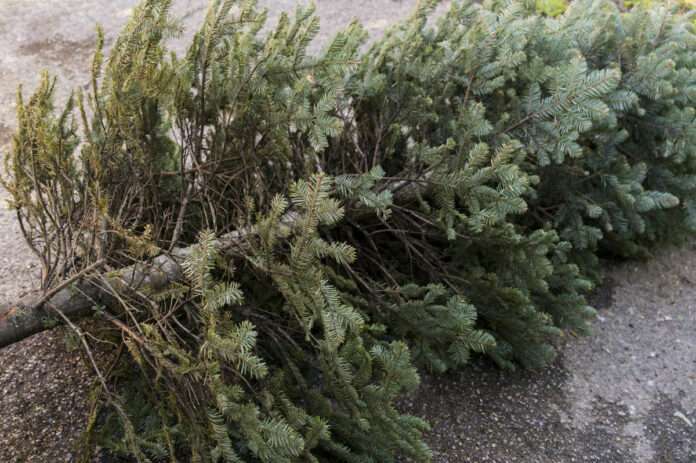
After the holidays, many municipalities allow old Christmas trees to be placed curbside. Trees are then collected and ground up for mulch or burned. If you miss the designated date, or your trash collector doesn’t accept trees, there are several options to prolong the useful life of the tree.
An old Christmas tree can be used to benefit birds, fish, and the landscape by placing it in a corner of your deck, and spreading some birdseed nearby, or tying it to a deciduous tree or post near a bird feeder. The birds benefit from having escape cover nearby when hawks or cats threaten, and the dense boughs reduce the wind chill on a cold night.
Sinking your Christmas tree in a pond is an easy way to improve fish habitat and fishing. The tree serves as a coral reef, in that the branches provide substrate for water plants to grow, and cover for minnows and other forms of small aquatic life. Larger fish are drawn by the shade and the presence of prey.
You may also cut and let the tree dry for a few weeks providing some easy lighting firewood. Just beware that most conifer species tend to spark and pop more than hardwoods, as resin pockets in the wood make tiny explosions. This can delight the youngsters, but for safety’s sake, keep an eye on the fire when burning Christmas tree logs!
Charlie Barden, Extension Agent
Where does roadkill end up in Kansas? Can I take it? What happens after you hit an animal

Last year, more than 10,000 car accidents in Kansas involved a collision with an animal, according to data from the Kansas Department of Transportation. So far this year, the state has seen just more than 8,000.
While data from KDOT indicates the majority of these crashes don’t end in the death of the animal, it’s always a possibility, especially when driving in the dark near tree lines and fields. So, what exactly happens when an animal dies due to a collision?
In an email to the Wichita Eagle, KDOT said they handle roadkill incidents in a case-by-case basis. Sometimes roadkill is taken by the agency to an offsite storage area and buried. Other times, the animal is simply moved to a ditch on the side of the road.
There is another option, however, according to Capt. Larry Hastings with the Kansas Department of Wildlife and Parks. If the roadkill is big game, turkeys or if its an animal subject to an active hunting season, people have the option to get a salvage tag and take the animal with them.
Hastings said one important thing to remember is if you do decide to get a tag, is you are then responsible for the whole animal. For example, if you just want the tag to keep antlers, it’s your responsibility to dispose of the rest of the deer.
The salvage tag can be given to you by a police officer when filing the accident report, and it allows you to take one animal. In similar cases, if you see roadkill but were not involved in the accident, you can call the sheriff’s department or an officer in the area to get a salvage tag to take that animal.
Those with a valid Kansas hunting license don’t need a salvage tag to pick up in-season animals off roadways.
Avoiding animal collisions on the road
While deer collisions are most common in October through December, animal collisions are possible year-round.
It’s important to keep a watchful eye for possible encounters while on the roads, especially if you’re driving after sunset. Here are some tips for avoiding animal collisions , from the Humane Society of the U.S.:
- Don’t speed
- Slow down when driving on a two-lane road bordered by trees or fields
- When possible, use your brights
- Dim your interior lights
- Keep a close eye on the roads and your surroundings, watching for wildlife
Give the gift of the written word. These 7 books were published by Kansas authors in 2023

Looking to buy a last-minute holiday gift for someone who loves to read? Here are seven books written by Kansas authors that were published this year. The list includes fiction, nonfiction and two children’s books.
‘KU-phoria: A collection of stories about KU traditions, KU Info and KU basketball,’ by Curtis Marsh
Curtis Marsh, known to some as “Mr. KU,” has worked since 1993 for the University of Kansas, where he is associate director of development for the KU Endowment Association. His first book, “KU-phoria,” was published in October.
A 1992 KU graduate, Marsh’s experience includes being director from 2005 to 2019 of the “KU Info” service. His 200-page book shares numerous fun facts about KU, including that its initial mascot was the bulldog, and tells stories illustrating why people are so passionate about KU.
“KU-phoria” includes about 40 photos and is published by University of Kansas Libraries. It can be purchased for $24.99 on the website of the KU Bookstore.
‘Myrtle, Means and Opportunity,’ by Elizabeth C. Bunce
“Myrtle, Means, and Opportunity,” published in October by Algonquin Young Readers, is the fifth and last book in award-winning Lenexa author Elizabeth C. Bunce’s “Myrtle Hardcastle” series aimed at readers between ages 8 and 12.
The 368-page cozy mystery follows 12-year-old, Victorian-era amateur sleuth Myrtle Hardcastle as she uncovers a string of murders on a haunted Scottish estate.
“Myrtle, Means, and Opportunity” is available for $17.99 in hardcover and $8.99 in paperback at amazon.com.
‘The Privilege of the Happy Ending: Small, Medium and Large Stories,’ by Kij Johnson
Award-winning writer Kij Johnson, a faculty member at the University of Kansas, has created three novels and more than 50 works of short fiction.
Her latest book, a 304-page collective of stories titled “The Privilege of the Happy Ending,” was published in October by Free Beer Press. The stories explore gender, animals and the nature of stories. They range in form from classically told to deeply experimental.
“The Privilege of the Happy Ending” is available from amazon.com for $18 for paperback and $28.83 for hardcover.
‘The Twelve Hours of Christmas,’ by Jenn Bailey
A big family gathers to celebrate the holidays in this children’s book by award-winning writer Jenn Bailey, which is a reinvention of the classic holiday carol, “The 12 Days of Christmas.” It celebrates the most important part of Christmas: Being together.
Bea Jackson illustrated the 32-page book, which is aimed at readers ages 4 to 8 and was published in October by Little, Brown Books for Young Readers.
‘”The Twelve Hours of Christmas” is available in hardcover for $18.99 from amazon.com.
‘Secret Kansas: A Guide to the Weird, Wonderful, and Obscure,’ by Roxie Yonkey
Roxie Yonkey, of Goodland, specializes in road tripping and has been writing about Kansas places for more than 30 years. Her latest book is titled “Secret Kansas: A Guide to the Weird, Wonderful, and Obscure.”
The book tells various stories from the Sunflower State’s past, including how Veterans Day was first observed in Emporia, how mentholatum got started in Wichita and how a Cherryvale man wrote the Pledge of Allegiance, only to lose his claim to its authorship.
“Secret Kansas” was published last April. It is available for $22.49 in paperback at amazon.com.
More:1970s Topeka is the setting for a ‘cozy mystery’ written by local author M.J. Van Buren
‘Resilient Heritage: The Episcopal Church in Topeka: The College of the Sisters of Bethany, Christ’s Hospital, Grace Cathedral, and St. David’s,’ by Don Chubb
Topeka native Don Chubb is a businessman, local historian and longtime deacon at Topeka’s Grace Episcopal Cathedral.
Chubb’s book, “Resilient Heritage,” tells the story of how important the Episcopal Church has been in the development of the city of Topeka.
The book was put out in November by Retelling and is available for $18 in paperback at amazon.com. Kaw Valley Spring. All proceeds go to Grace Cathedral.
‘The Jayhawk: The Story of the University of Kansas’s Beloved Mascot,’ by Rebecca Ozier Schulte
For more than a century, a mythical bird — the Jayhawk — has been the mascot of the University of Kansas.
Rebecca Ozier Schulte, a 1976 KU graduate and longtime university employee who served 18 years as KU’s archivist, tells the Jayhawk’s story in her 176-page book, which has more than 300 photos.
“The Jayhawk” is available for $34.95 in hardcover at the website of its publisher, University of Kansas Press.
