Friday, February 20, 2026
Home Blog Page 545

New report shows western Kansas water supply continues to decline, pushing state to act

0

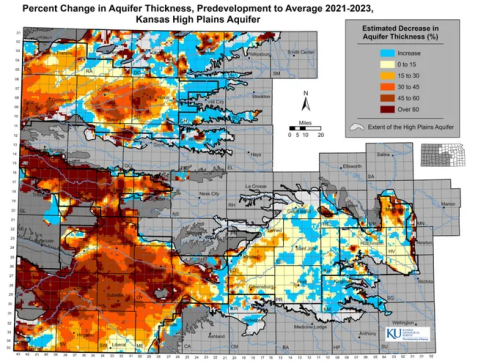
Some areas of the High Plains Aquifer are continuing a decades-long trend of depletion that could eventually dry up and economically destroy agricultural communities in the west.

The report, released last week by the Kansas Geological Survey, highlights glimmers of hope in communities that came together to manage the aquifer, the underground water system that supplies western Kansas with its water.

Depletion of the High Plains Aquifer

Kansas, like most states west of the Missouri River, follow a western model of water law that prioritizes the oldest water rights issued. The “first in time, first in right” model gives legal rights to use water based on the understanding of water systems from the early 20th century.

As the country got a better understanding of how water works, managers realized more water is being taken out of aquifers than makes it back in.

“The thought was that there was a finite amount of water that could be used and that, someday, behaviors will have to change. But that was always years off in the future,” said Brownie Wilson, one of the authors of the KGS’s latest report. “Today, we have some places in Kansas where we’ve had to change our behaviors, change how we use water because it’s becoming less available.”

Aquifers recharge when precipitation seeps back into the surface, or when water pumped up for irrigation returns. The severity of the water shortage depends on the location of a well.

Aquifers have higher and lower depths throughout the underground system, which also are affected by environmental factors. Areas with low precipitation, like the semi-arid west side of Kansas, will recharge aquifers slower than the wetter areas as you go east.

“That western third of Kansas, the recharge rates there appear to be pretty small from precipitation, but they’re also fairly consistent,” Wilson said.

Some farmers who are pulling from heavily depleted aquifers are scaling back after reaching the lower-quality water available at the bottom of aquifers.

“There are already areas that have reached that minimum threshold,” said Vijay Ramasamy, water consultant to Gov. Laura Kelly. “Folks have to make very difficult decisions on what they’re going to do.”

Kansas’ role in preserving aquifer

Kansas’s ability to conserve water uses a lot more carrots than it does sticks.

The Conservation Reserve Enhancement Program entices water right holders to permanently retire them and leave the water underground. The Water Right Transition Assistance Program similarly seeks farmers to retire water rights after it is determined to be optimally beneficial to the health of the aquifer.

Other programs are more informal, such as the Water Innovation Systems and Education Program that teaches agricultural producers about technologies and strategies that make irrigation more efficient. The state can even chip in to buy some of the improved irrigation technology through a cost-sharing program

Cooperative efforts show some success in Kansas

One success story from water reforms is the Local Enhanced Management Areas. The first established LEMA is a nearly 100-square-mile region in Sheridan County.

In 2013, it formed a LEMA after prior attempts at conserving groundwater failed, due to the surplus water being used elsewhere. In the first 10 years of the Sheridan County LEMA, it only scaled back the average irrigated area by 2.7%, but reduced the amount of water irrigated by 36%.

“It’s voluntary, it’s collective, and they came together and said, ‘We’re going to meet these specific targets to extend the life of the aquifer,’” Ramasamy said.


New dog disease not here

0

A new respiratory illness for dogs is spreading across the country, but at least right now, it isn’t in Hutchinson, according to Erica Miller, DVM with Apple Lane Animal Hospital.

“We’ve gotten phone calls,” Miller said. “I’m sure the other veterinary clinics have, too, about people hearing about it, either news, reading about it, social media. There is some sort of respiratory disease that’s been going around. Luckily, we haven’t really seen any here in Hutch, at least at our clinic. I’ve heard there was maybe a little bit in Kansas City.”

Since they don’t know the cause yet, good preventative medicine is the best you can do right now.

“Make sure your pet is up to date on vaccinations,” Miller said. “Especially around this time of the year, because everyone travels, if you’re going to be boarding your pet or taking them with you somewhere where there’s going to be a lot of other pets, really making sure that they are up to date on their vaccinations that they need for boarding is very important.”

If you don’t have to take your pet with you and can get a pet-sitter and keep them at home, that may be best, especially if they have pre-existing conditions.

“If you are finding someone to come in and watch your pets at home, do your due diligence,” Miller said. “Make sure you get some references. Talk to some people that have used that person before for pet-sitting. There’s plenty of people that do either in home pet-sitting or they go to their house.”

The symptoms of the new respiratory illness can last from six to eight weeks.

Lettuce Eat Local: The Holly and the Ivy and the Pears

1

Amanda Miller
Columnist
Lettuce Eat Local

Benson dove into the gift bag, sending tissue paper flying. He came up with a crocheted cow stuffie clutched in his hands, exclaiming joyously, “It’s just like the one we already have!”

Well, yes, that’s because it is. I am enjoying indulging my son’s passion for opening presents, and also capitalizing on his two-year-old senses. I’m definitely taking advantage of his naivety this Christmas, especially since I know it won’t last. While he is distracted somewhere, I just refill a couple gift bags under the tree every day, looking around and seeing what I can stick in. The anticipation is half the joy with this boy, and the physical act of opening the present is sometimes as good as whatever is inside. 

I suppose that’s particularly true when what’s inside isn’t that exciting. But I figure he doesn’t know any better at this point, and we’re all having fun, so it’s perfect. He gets to open a couple presents a day and I get to “regift” a pair of his shoes, a book off the shelf, a stuffie someone gave his sister. 

But I also get to delight in this reminder of childlike enthusiasm and appreciation. One day I had wrapped up a clementine out of the fruit bowl, and he looked at me with such glee: “This is just for me?!” 

It’s easy for the celebration of Christmas to be cheapened by materialism. Bigger and better presents, parties, decorations. The lights get brighter, the holiday baking gets more elaborate, the music gets louder…and the joy dissipates. I love Christmas cheer, but we just have to remember what (who!) we’re celebrating. 

Don’t get me wrong, Benson isn’t a paragon of Christmas excellence. He has a thriving inborn need for more (particularly if it’s ice cream or candy), and if you’ve been around him recently, you know that phrases like “silent night” and “peace on earth” are not how anyone could describe him these days. 

But the way he’s enamored with baby Jesus does my heart good, and we could all use a fresh perspective like his on presents. Sometimes aren’t the very best, most important gifts the smallest, most daily ones? Can you believe this sunny day, call from a friend, or homemade cookie is “just for you”? Maybe this coffee maker you use each morning or favorite pair of jeans in your dresser is “just like the one you already have,” and maybe that’s the best part. 

Benson’s been delightfully exuberant about pears this week as well, even without me popping them in a gift bag. The way he talks about cutting up a pear, you would think he was talking about something much bigger and more special than some slices of a common winter fruit. I will say, they do seem particularly tasty recently, which makes sense because they are being harvested in some regions — ‘tis the season. Finding and affording fresh fruit is a gift in itself; we don’t have to save that luxury for our Christmas stocking. Benson is currently taking a now-uncommon but so-very-necessary nap, which is his (priceless) gift to me, and he will see the beautiful golden pear waiting on the cutting board as a gift of great value as well…because that’s how he chooses to see it, even if unconsciously. Let’s have those eyes this season.
Merry Christmas!

If you can find a good pear, it really needs no elaboration — just slice and eat. I’ve had a few ones so incredible that it feels like the very essence of Pear was concentrated and distilled into each bite. But it is almost Christmas, so it doesn’t hurt to get a little fancy sometimes. A friend gifted me a jar of Chinese 5 spice last week, and while it is “just like some I already have,” I’m looking at it with new eyes and trying it random places (triple-nut five-spice banana bars, anyone?)! 

Prep tips: pears are kind of tricky to monitor for ripeness; they are somewhat hearty, but also tend to go bad from the inside out, so you can’t always see if they are getting overripe. Five-spice is a combo of cinnamon, cloves, anise, fennel, and black pepper, so if you don’t have it, throw in whatever of those spices you do.

¼ cup turbinado sugar (or demerara or brown)
1 tablespoon cinnamon
1 tablespoon Chinese 5-spice
pinch of coarse salt
optional: a couple drops of rum flavoring
a couple really good pears, any variety; unpeeled

Mix all ingredients together except pears, adjusting spice level to your taste. Slice pears and dip enthusiastically into sugar mix.

Wheat Scoop: K-State researchers lower gluten content maintain dough quality in bread wheat

0
Kansas Wheat

Contact: Marsha Boswell, [email protected]

For audio version, visit kswheat.com.

MANHATTAN, Kan. – Kansas State University researchers have reported a breakthrough in developing wheat-based foods that contain lower amounts of gluten, a discovery that may lessen the adverse effects for those with celiac or other autoimmune diseases.


Scientists from K-State’s Wheat Genetics Resource Center and the USDA’s Agricultural Research Service — in partnership with Kansas Wheat — successfully used a gene editing technique known as CRISPR-Cas9 to reduce the presence of two types of gluten-coding genes called gliadins that are known to be abundant in immunoreactive peptides – the amino acid building blocks that form proteins.

Gluten is a protein often found in wheat, barley and rye. When people with celiac disease eat gluten, their body mounts an immune response that attacks the small intestine and the small, fingerlike projections known as villi that help the body absorb nutrients properly.

According to the Celiac Disease Foundation, celiac disease affects 1 in 100 people worldwide, but only about 30% are properly diagnosed.

“We were very surprised that once we edited those genes, we reduced the immunotoxicity caused by gliadin genes in wheat by 47-fold,” said Eduard Akhunov, University Distinguished Professor in K-State’s Department of Plant Pathology and director of the Wheat Genetics Resource Center.

Akhunov leads a group of scientists applying advanced methods of genomics, genetics and genome editing to improve wheat. In this project, the editing of gluten genes was performed by postdoctoral researcher Zitong Yu.

Akhunov said gluten likely will never be completely removed from wheat since it is important for bread-making. Gluten provides the texture, flavor and moisture in such products as bread, bagels, pastries, noodles and more.

“In our edited lines, we also found that while there was a reduction in toxicity (due to lower levels of toxic gluten molecultes), we did not have any reduction in the dough quality that is important for bread-making,” Akhunov said. “That’s extremely important. We achieved these two seemingly contradictory objectives – reducing toxicity, but maintaining the ability to develop quality dough.”

Akhunov added that even though reduced levels of gluten achieved in this study won’t make wheat immediately safe for those with severe levels of celiac disease, “it is important to step forward.”

“Wheat varieties with reduced toxicity levels will help to broaden wheat-based product options for people with minor gluten-related issues,” he said. “The knowledge gained in this research could eventually pave the road for developing new varieties that will be safer for people with celiac disease.”

The very nature of scientific study and wheat breeding means varieties with reduced gluten content may not be available to consumers for many years. Aaron Harries, the vice president of research and operations for Kansas Wheat, said the trait would not be included in all new varieties and “most likely would be grown under contract with food manufacturers.”

“Wheat research is focused on developing new varieties that meet the demands of the consumer – both domestic and international,” Harries said. “Developing wheat that is safer for celiac sufferers decreases the number of consumers forced to consider wheat alternatives.”

He adds: “There are many wheat farmers and members of their families in Kansas that have celiac disease. It is ironic and unfortunate that they raise wheat for a living but can’t eat wheat foods. Most consumers would prefer not to give up wheat foods in their diet. Developing wheat varieties that are consumable by people with celiac disease would make their lives much easier.”

CRISPR-Cas9 is a genome editing tool that is faster, cheaper and more accurate than previously used methods of genome engineering. Akhunov said his research team worked with a common wheat cultivar known as Fielder, which is amenable to genome editing.

K-State’s research – which has received funding from Kansas Wheat, USDA’s National Institute for Food and Agriculture, and the Bill and Melinda Gates Foundation – is published in the Nov. 17 issue of the Plant Biotechnology Journal.

###

By Pat Melgares, K-State Research and Extension news service

Rediscovery

0
john marshal

Time for our seasonal pause to consider the fashion of man’s chronicle. Since before Christ, that history is richly indifferent. It sighs and shrugs, then moves on to the next page. It readjusts facts, knows no compassion. History dissects humanity with the indifference of a surgical instructor.

History tempts us with affectionate, anecdotal chronicles of our years here. It makes no obeisance to Tolstoy, who believed in the grand design, nor to Henry Ford, who said history is bunk.

History is not the lofty view, but the chatter of elders over their coffee cups, the student peering at newspaper clippings online or pulled from a folder at the library.

History is the wind ripping up from Texas or roaring in from Alberta, telling us that no matter what we do out here on the plains, we live and die, prosper and perish or simply exist, by Nature’s authority.

My time on this earth, 76 years, is less than a moment in astronomic time. But it is long enough to bear witness, to see fables made of facts and facts from fables, and lately a global, fanatical pursuit of “progress”. As usually defined, progress does not increase happiness, strengthen moral fiber, deepen faith, or generate brotherhood.

At this time of reflection and celebration, consider whether what we call “progress” has worked against man, made him a more efficient killer, a less spiritual being plunging blindly on toward more and more.

In the Smoky Valley and elsewhere, Christmas is for pause, to reaffirm faith, to reinforce a simple thing called heritage.

As the historians Will and Ariel Durant explained, “If progress is real despite our whining, it is not because we are born any healthier, better, or wiser than infants were in the past, but because we are born to a richer heritage, born on a higher level … in the accumulation of knowledge and art … the heritage rises, and man rises in proportion as he receives it.”

Christmas presents an opportunity to capture a small parcel out of that rich storehouse, to revive the heritage of our history, to rekindle the best in ourselves.