Friday, February 20, 2026
Home Blog Page 554

Sourdough starters

0

Everyone loves a fresh slice of warm sourdough bread. But what is the science behind that crisp and chewy baked good? The main foundation of the unique bread: a sourdough starter.

Sourdough starters begin with the colonization of yeast and bacteria that grow in a mixture of water and flour. They can be maintained by managing the developing ecosystem of microscopic yeast and bacteria (microorganisms). Several factors must be controlled for these microorganisms to survive and grow within the starter.

Factors that Influence Microorganism Growth

  • Time: Creating a sourdough starter from scratch takes several days of regular feedings (providing fresh flour as food) to establish the ecosystem of microorganisms. On average, it takes 7 to 10 days for a starter to be ready for use in baking.
  • Temperature: Starters grow best at warm temperatures, around 70 degrees Fahrenheit, a comfortable room temperature. When starters are in a cooler temperature, the growth and fermentation is slowed. When starters are in higher temperatures, growth and fermentation may occur too rapidly and may even stop, resulting in the starter going bad. Fermentation is when sugars breakdown into more-simple substances.
  • Moisture: Water is needed to help microorganisms in the starter. Follow your recipe for appropriate water measurements.
  • Bacteria: Bacteria is present from the flour, water, and container when the starter is first created. Bacteria is present from the surrounding environment, including the human bodies, air, insects, and surrounding food giving each starter its own unique microbiome. Bacteria present in the starter begins to expand while it grows, increasing the volume of the starter.
  • Yeast: Starters create their own yeast while metabolizing the flour. Yeast has an influence on the bacteria activity and the flavor of the sourdough.
  • Unwanted particles: The starter should be loosely covered to help prevent the development and growth of mold. The covering helps prevent any unwanted particles of food or bugs to get into the starter.

A healthy and happy starter will have an abundance of bubbles and have a consistency similar to muffin batter. The starter can be poured out of the container; however, it should have a slow pace leaving the jar. A starter is ready to use when a small spoonful of the starter floats in room temperature water.

A starter has gone bad when there is mold growing within and on top of the starter, a foul smell is noticeable, and discoloration appears, such as green, pink or orange spots.

Things to Consider

When working with starters, keep in mind the following:

  • Safe food handling: It is important to follow safe food handling practices at all times in the kitchen. Refresh your food safety knowledge by checking out SDSU Extensions article, Food Safety Helps You Stay Healthy.
  • Different types of flours can be used for starters: Whole-wheat flour, Buckwheat flour, All-purpose flour, Bread flour, and other flours that contain a starch component.
  • Wild yeasts: Starters create their own microbiomes with the yeasts and bacteria present in the air around them. The bacteria and yeast metabolize the flour and ferment it creating bubbles and increasing it’s volume.
  • Up-keep: Starters must be fed flour twice daily if they are being stored at room temperature, or fed once weekly, if being stored in the refrigerator. Do not store your starter in the refrigerator until it has an established microbiome (after 7-10 days).

Creating your first sourdough starter may be a trial-and-error experiment. However, once you get your starter established, if maintained, it can thrive for years.

Holiday foods: Homemade and mail order gifts are welcome

0

A Kansas State University food safety specialist provides tips.

Candy, jellies, cookies and more—some of the best holiday gifts come from our own kitchens, or from the kitchens of local specialty food companies.

If you plan to send gifts of food to family and friends this holiday season, don’t take a chance on your food going to waste. Pack it safely, mark it clearly and be sure to notify the receiver of its expected delivery date.

That’s the advice of Londa Nwadike, assistant professor of food science at Kansas State University.

“Everyone likes to get gifts of food, especially homemade or specialty food items,” said Nwadike, who is a food safety specialist with K-State Research and Extension and the University of Missouri Extension. “However, certain steps must be taken by the sender and the receiver to ensure that the food arrives in top-quality condition and is safe to eat.”

Perishable foods will stay at a safe temperature longer if frozen solid first. Once the item is completely frozen, pack your food with a cold source such as a frozen gel pack or purchased dry ice.

Check with your post office for the best method of packing your food gift to ensure safety and quality, and the recommended shipping method. Remember, perishable foods need to arrive as soon as possible, ideally overnight.

Make sure to compare shipping options with your local post office and other companies. You may need to pay extra for a quicker shipping method, such as overnight delivery.

“Although you may want the gift to be a surprise,” Nwadike said, “with perishable foods, you should notify the recipient and make sure someone will be home to take the delivery on the expected delivery date. Don’t have a perishable item delivered to an office unless you know it will arrive when someone there will be responsible to refrigerate or freeze it upon arrival, and refrigerator space is available for keeping it cold.”

For packing, use a sturdy box made of heavy foam or corrugated cardboard. Use crushed newspaper or foam “peanuts” to help cushion the item and fill empty space. Air space in the box can cause the food and cold source to thaw quicker.

Mark the package “keep refrigerated,” and list the contents on the outside of the package. Include instructions on proper temperature and storage inside the box for the recipient.

Going retail

For peace of mind or if trying to make a last-minute deadline, you may want to order through a mail order company, whose business is to ship food products quickly and safely, Nwadike said. Many Kansas and Missouri food businesses send food products through the mail, so you can also help to support local businesses by sending their products as gifts.

When ordering food gifts through catalogs, ask the company what type of cold source will be used with perishable food and how long the package will be in transit. The cold source must last long enough for the food to arrive still frozen, or firm and cold. Ideally, the item will be shipped overnight. Check that the package will be labeled with “keep refrigerated.”

“Perishables have a much better chance of surviving if properly labeled,” the specialist noted. “Ask if information on proper arrival temperature and storage will be included with the item.”

Find out approximately when the gift will arrive. Check with the recipient or someone at that address about a convenient delivery date. If no one will be home, arrange for a neighbor to receive the gift, and refrigerate or freeze it immediately.

Sweet foods like fruitcakes, candy, jams and jellies can be shipped at room temperature and seldom pose health problems, as the sugar and other preservatives usually postpone deterioration. In these cases, the main thing to watch for is torn packaging, dents or cracks in glass or ceramic containers.

Cheesecake and similar products are one exception in the dessert category. They must stay cold (below 40 degrees Fahrenheit) to prevent spoilage. Make sure they are shipped frozen solid and are refrigerated upon arrival, Nwadike said.

If you learn that your food gift arrived spoiled or damaged, call the company regarding its return and refund policy. If you shipped it yourself, and the delay was the fault of the post office or other courier, call and explain the situation and ask for a resolution.

If the quantity and quality is not what you paid for, contact your local better business bureau or the Direct Marketing Association, Consumer Affairs Department, at 1615 L Street NW, Suite 1100, Washington, DC 20036 or by email: [email protected]; explain your problem briefly by providing details on shipping dates, costs and the product ordered.

Fewer Hours On Horseback

0
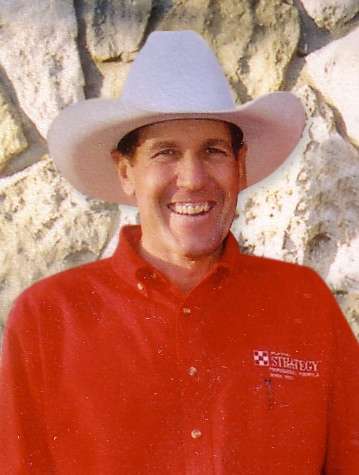
Frank J Buchman
Frank Buchman

Maturity takes its toll on a wannabe cowboy’s horseback riding enthusiasm and already limited abilities.

Never a world class horseman, ample ambition and plenty of guts brought success training young horses.

Starting untrained horses to ride for many owners throughout the Midwest kept a calendar filled more than four decades. Notable “real cowboys” bought their horses for initial breaking and spread the word about the humble service to countless others.

It must be emphasized that the horses were not “finished” show, working, or ranch horses. They were “30-day horses” requiring additional riding when owners got them home.

Key to the program was that the horses, often untouched upon arrival, were handled every day. They had to be tied solid and exposed to a rider on their back the first day. Saddling followed as the horse stood alone to become accustomed to the handler’s expectations.

Always moved slow, the saddled horse was led in a pen the next day becoming more accustomed to being worked with. Tied back in the stall, the horse was mounted and dismounted by the gentle trainer voicing compliment for calmness.

Progressing, the mounted saddled horse was asked to turn tight circles both directions inside the stall. After continuing maneuvers, the stall gate was opened, and the horse was ridden at a walk into a larger pen.

Sessions always ended by gently turning the horse in circles and then backing him straight for a few steps. A horse learns very fast with praising gentle consistent calm control.

Within a week, the horse can be urged into a slow jog trot in a large circle. He will soon be asked to speed up into a slow lope.

Ridden cautiously in the pasture at different gaits, the horse becomes accustomed to the outdoors. Riding bareback is good for the additional exposure.

The gentle, green-broke horse must continue to be ridden regularly for a year or longer to become a “broke horse.”

Exhibiting in six circuits more than 30 horseshows annually collecting numerous yearend championships, slowdown has now come. Unbroke horses are not being accepted for training.

Fewer shows are attended with less prizes being won while the goal remains to ride a horse some every day.

Reminded of Proverbs 20:29: “Youthfulness is be admired for vigor, but gray hair gives prestige to old age.”

+++ALLELUIA+++

XVII–49–12-3-2023

Pratt Cowboys Win Titles At Steer Roping Finals In Mulvane

0

The mission for gold buckle Number 2 is complete for steer roper Cole Patterson.

Patterson, who had a record-setting regular season earnings mark, took care of business to claim his second career gold buckle at the National Finals Steer Roping (NFSR) at the Kansas Star Arena, Mulvane

“This a weight lifted off my shoulders,” said Patterson, 28. “It was a heck of year and when you come in with a $25,000 lead and even though the money is so good here, you are still expected to win. That adds a little pressure to an already pressure-packed situation. That’s why I do it, to get put in these pressure situations.

“The only thing better than those pressure situations is when you execute in those situations and the feeling it gives you. This is just a relief.”

Patterson added his latest gold buckle to the first one he captured in 2021. The Pratt, Kansas, cowboy finished atop the Professional Rodeo Cowboys Association world standing $166,710.

With things getting quite interesting, Patterson slammed the door on the competition with his slick 9.9-second Round 9 winning run to clinch the coveted world title. He earned $10,160 for the round win.

“I wasn’t sure of the exact numbers going into Round 9,” Patterson said. “But I knew I had an excellent steer. I knew that steer was so good, and I knew if we went and made our run, we were going to get a good check in the round and probably seal the deal up and we did.”

Scott Snedecor finished second in the world standings with $144,452, thanks to earning an NFSR-best $51,415. Cody Lee ($132,011), Jess Tierney ($127,914) and Slade Wood ($116,655) rounded out the top five in the world standings.

Patterson placed in six rounds, including winning Round 2 (12.2 seconds) and Round 9 and left town after earning $45,195 at the NFSR. He rode his award-winning horse Tigger in Rounds 6 through 10.

“I didn’t know what to expect coming into that last run,” Patterson said. “Even when guys get off to a good start the first night sometimes the cards don’t fall their way the second night. I knew I needed day money.

“I needed to tie steers fast and my horse Tigger just has a special quality that whenever the pressure is on, he knows it and he works even better than usually does. He took care of me and set me up to tie some fast steers.”

This gold buckle was special for Patterson, since it was his first since he and his wife, Natalie, had their first child, a boy, Pruitt, who was born in June.

“As awesome as the gold buckle is, that boy is the best thing that has ever happened to me,” Patterson said. “It takes a little bit of the pressure off when you can come to the NFSR and know that no matter what happens my wife and son are going to be at home. It is not a do or die situation even though sometimes it feels like it is.”

It was truly a special night for Patterson family. Rocky, Cole’s father and four-time PRCA Steer Roping World Champion (2009-10, 2012 and 2016), won the average with 132.8 seconds on 10 head and he earned $30,349.

This was Rocky’s third average crown, as he also accomplished the feat in 1999 and 2001. Patterson was the only roper to tie down all 10 steers.

Cole and Rocky, who is 58 years old, are the first son and father to win a world championship and the average at the same NFSR.

“It’s amazing to have my dad win the average and me win the world,” Cole said. “It is the coolest rodeo moment for me to date, and I don’t know what will top it. He ropes so good, which I’m not surprised by because he does it all the time. To win it with dad and take home both saddles is the coolest thing in rodeo.”

This was Rocky’s 28th appearance at the NFSR, second only to ProRodeo Hall of Famer Guy Allen’s 33 NFSR trips.

Back in 2021, when Cole won his first world title, the Pattersons became the third father and son to win steer roping world championships. They joined John McEntire (1934) and Clark McEntire (1956-57); and Charles Good (1975) and Gary Good (1979).

The Pattersons became the fifth father and son to win the average at the NFSR when Cole won the average in 2021, joining the company of Jim Snively and Joe Snively, James Allen and Guy Allen, Charles Good and Gary Good, and Jim Davis and Bryce Davis.

Reo Lohse, who finished eighth in the world standings with $91,317, won the Dixon McGowan Award, given to the highest-ranked first-time qualifier to the NFSR. The award memorializes McGowan, who died at age 23 in an automobile accident on May 10, 1997.

Tony Reina won the PRCA Legacy Steer Roping Finals at Mulvane with 52.3 seconds on four head. Reina clinched the title at the Legacy Finals with a 12.4-second run in Round 4, the final round of the competition.

Martin Poindexter won the Legacy Steer Roping season title.

+++30+++

Wrenches in the Plan

0
Steve Gilliland
Steve Gilliland

This year’s 2023 deer firearms season opened bright and clear Wednesday beneath a beautiful full moon, and was as calm a morning as you will ever find here in Kansas, USA. That may be great stuff for the pages of a calendar, but not so much for deer hunting. And to top it off, from the time I stepped out of the pickup onto the ground, every step I took in the frozen, crusty, leftover snow, sounded as though I was walking in a giant vat of Rice Crispies. There was no way around it and nothing to do but navigate the couple-hundred yards to the blind as fast as possible. I plopped down into the chair in the blind, thinking that after all that racket, plus the magnificent calendar-worthy full moon making me gleam like an angel to a pair of deer eyes (probably my only chance at that) no self-respecting deer would now be left in the entire township. And then, because the next couple days were supposed to be well above freezing and possibly rainy, melting the crusty snow and thawing the ground beneath, making it impossible to get in to collect a downed deer, I wasn’t enjoying the beautiful morning as I should. My prayer was to harvest a deer this first day so I could relax and enjoy the rest of the week.

In the field behind the blind, terraces were being reshaped by a grader and a big scraper, but my sister estimated the guy didn’t begin each day till about 8 AM. Thinking back over the years, I felt OK with that, remembering that morning deer will probably have shown themselves by then, so the noise and presence of the big equipment shouldn’t spook them. I opened the front window of the blind and sat back to listen to Creations sounds as the day slowly unfolded. It was barely 7 AM, with just enough morning light to identify features on the ground, when a pickup pulled into the field behind and the big diesel motors of the excavation equipment fired up. They were a few hundred yards behind and to the right of the blind, but I still worried the commotion would deter the deer from taking their morning stroll past the blind. Add that to the grand entrance I made getting to the blind, and my confidence for a successful morning hunt fell into my boots.

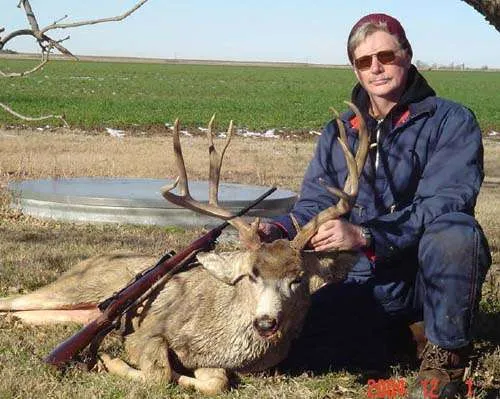
As I sat and stewed over all the apparent wrenches being thrown into my morning deer hunt, movement to my left caught my eye, and into view nonchalantly strolled, and I do mean strolled, two bucks. One was young with about a four-point rack, the other was a little bigger with a nicer, taller rack of 6 or 8 points. As

they grazed their way across in front of the blind, movement again caught my eye to my left, and a much bigger deer with a good heavy rack came into view. He moseyed along, rubbing his forehead on some tree branches and eventually joined the other two; none of them were at all concerned about the heavy equipment. I clicked off the rifle safety, and after a 15-minute wait for the big guy to give me a good, safe broadside shot, I harvested him. I drove around to about where I figured I’d shot him, but couldn’t see him amidst the tall milo stalks. I found and followed a good blood trail for 40 yards until it ended abruptly. As I stood there scratching my head, I turned to look around me and nearly fell backwards over the big buck laying in the milo stalks behind me. My sister and I have loaded many of my deer by ourselves, but we had to get the guy running the equipment to help load this one. He is the heaviest and probably oldest deer I have ever shot.

This experience gives credence to the belief that deer here in farm and ranch country are not as leary of farm equipment and vehicles as we would think. I remember my dad telling us about a deer that once stood nearby and watched him as he ran a chainsaw. So, rather than warming my seat in the deer blind on this frosty, foggy Saturday morning, stressing about things I can’t control, here I sit in my office tapping away at the computer while my deer hangs at the processor’s; it doesn’t get any better than that! Continue to Explore Kansas Outdoors!

Steve can be contacted by email at [email protected]