Monday, February 23, 2026
Home Blog Page 596

Lettuce Eat Local: The Pastry Problem

0

Amanda Miller
Columnist
Lettuce Eat Local


“When he wants something sweet, he nibbles through THREE pastries: a scone, a muffin, and a croissant.” 

Reading The Very Hungry Caterpillar Eats Breakfast with Benson brought to light a glaring lapse in his education. No, it wasn’t the numbers in this counting book he struggled with — he’s taking after his (foster) big sister, and loves counting allll the things. He had almost no trouble naming the nine colorful fruits the caterpillar likes to eat through (and to be fair, that grapefruit slice did look like an orange), and while he insists on calling the bacon (and most other meats) “ham,” he’s not entirely wrong. 

We still have some work to do, of course. He can’t always identify the numbers when written only as symbols, and he does adamantly “correct” us on multiple accounts when we come to the “Does he eat bagels for breakfast?” page. (“Yes! in fact, he tries FOUR.”). Clearly, those are doughnuts, and those are not raisins, they are candy pieces. To further imbed his faulty thinking, recently his aunt got him a doughnut with fall-colored sprinkles that matched the book’s illustration spot-on: the perfect “everything doughnut.” Whatever, child. 

No, the thing I couldn’t believe we hadn’t taught Benson yet was what a scone was. That hinges on moral failure in my book — scones are kind of My Thing, and here my very own flesh and blood has not been properly familiarized with them! 

He also didn’t know what a croissant was, but I’m not worried about that. The scone, the scone, the scone. It’s definitely not that I haven’t made any since he’s been around, but not in recent enough memory that his two-year-old brain could recall. 

There’s no time like the present, however, to fix the problem. Especially when that only requires turning on the oven and getting out the flour. 

It was serendipitous timing to uncover our educational deficiency, with the weather taking a few tentative steps into Autumn and our senses starting to call out for things warm and comforting. Scones are truly a 365-day pastry and infinitely variable as per the season, yet there’s something intrinsic that awakens this time of year in the heart — and stomach — of a baker. Plus I had friends coming over, and we needed a good fall pastry with our coffee. 

Brian and I were also just about to head to a friend’s lakehouse in Table Rock for the weekend, to get away for some time together before the baby comes as well as to celebrate our 12th anniversary. Brian really loves scones, and I really love him, so having some leftover to take along sounded like an ideal breakfast component. 

All that to say, scones are always the right idea, but they were really The right idea this week. Benson of course loved helping me make them as much as he loved eating them, so that was an unsurprising success. And now when we read about the very hungry caterpillar’s breakfast, the scone will be a source of shared joy instead of sudden horror. Even if the “ham” and “doughnuts” are still wrong. 

If only all parenting dilemmas and shortcomings were so easily remedied. Please pass the glaze. 


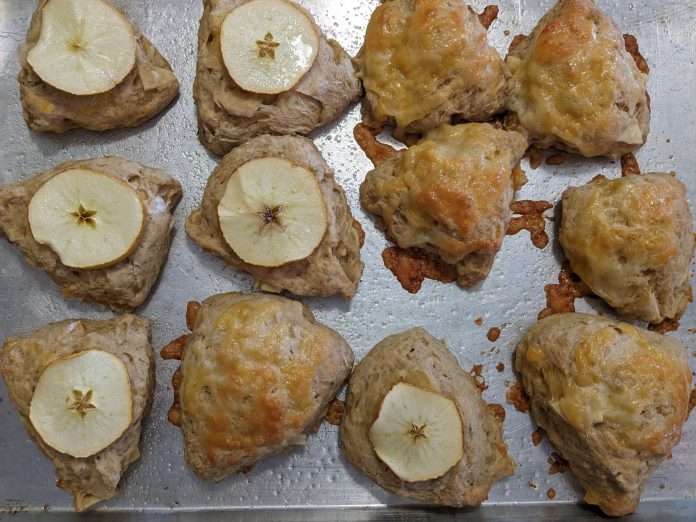
Apple Cheddar Scones

This is a flavor combo my mom loves and I’ve always been leery of, but I’ve been delving into my doubt recently and finding that in the proper situations, it’s truly delicious. The whisper of fresh rosemary pulls it all together, although sage or thyme would also be good here. This method for scones is quite different than some of my more standards ways, but it produces such soft cakey scones and is so quick and easy — which is great since Benson is on a kick of trying every single ingredient so the sooner I can get them in the oven and away from his snatching fingers, the better. (You should have seen his reaction when he stuffed a whole sprig of rosemary in his mouth.)

Prep tips: A simple glaze of powdered sugar with a pinch of salt and splash of apple cider is an unnecessary but not unwelcome finish. 

2 ¼ cups all-purpose flour

2 teaspoons baking powder

¼ teaspoon baking soda

¼ teaspoon salt

⅓ cup brown sugar

4 ounces cheddar cheese, shredded or cubed very small

6 ounces [about 1 ½ cups] peeled, diced apple

a sprig of fresh rosemary, minced

½ cup plain greek yogurt

¼ cup olive oil

¼ cup whole milk

1 egg

for topping: shredded cheese, thin apple rings, white sugar

In a mixing bowl, stir together flours, baking powder and soda, salt, and sugar. Stir in cheese, apple, and rosemary. In a separate bowl/measuring cup, whisk yogurt, oil, milk, and egg. Stir into bowl of dry ingredients. If it’s crazy sticky, add a little more flour; if not, dump it out onto a floured surface and lightly knead a few times. Divide dough in half and form into two 6-8” circles. Cut each into 6 wedges, and arrange these a couple inches apart on a lightly greased baking sheet. Top some with apple rings and some with shredded cheese, and all with a sprinkle of white sugar. Bake at 350° for 20-25 minutes, until nicely golden and cheese is browning. 

“Getting under your skin” with Varicose Veins

0


From the back of our hands to the back of our legs, pale blue blood vessels are visible just under the skin. Oftentimes these veins are flat and not painful. However when these vessels become abnormally swollen or dilated, they are called varicose veins. This swelling is caused by the valves inside the veins becoming weak and no longer sealing tightly. Varicose veins can become painful, quite large and stick out from the surface of the skin.
In order for blood to return from your feet back to the heart, the blood must be pumped up against gravity. Check valves in the veins are what keep the blood from pooling back down the legs in between heartbeats. When the heart beats (called systole), the valves open and allow the blood move upward. When the heart is paused, filling for the next beat (called diastole), the valves close and keep blood from flowing back towards the feet. As we age these valves become weak and do not fully close, then the surrounding veins become swollen with extra blood causing varicose veins to occur.
Women are also more likely to develop varicose veins than men due to hormonal changes during pregnancy and menopause. Standing or sitting in one position for long periods of time can also increase the risk of developing varicose veins since leg muscle contractions also help move the blood up against gravity. Older age, obesity, and family history are all common risk factors.
Varicose veins do not just look unsightly; they can also cause pain in the legs. They often lead to an aching or heavy feeling in the legs. Varicose veins additionally lead to burning, throbbing, itching or muscle cramping in the legs. If that is not bad enough, complications related to varicose veins can include ulcers, bleeding, or blood clots.
Unfortunately there is not a way to repair these valves once they are damaged. However, there are some things you can do to help manage varicose veins. Wearing compression stockings can help decrease swelling in the legs. Frequent movement of the legs such as pumping your ankles a few times an hour, raising your legs above the level of the heart for 15 minutes a few times each day, increasing exercise, and losing weight can all help increase blood flow.
If these measures do not give the relief you need, then it is time to talk with your doctor and discuss seeing a specialist for more advanced treatment. There are several different treatments available and they can help you find the one that is right for you. While varicose veins may be below the surface, do not let them get to the point where they really “get under your skin.”
Jill Kruse, D.O. is part of The Prairie Doc® team of physicians and currently practices as a hospitalist in Brookings, South Dakota. Follow The Prairie Doc® at www.prairiedoc.org and on Facebook and Instagram featuring On Call with the Prairie Doc®, a medical Q&A show providing health information based on science, built on trust, streaming live on Facebook most Thursdays at 7 p.m. central.


KU News: KU debaters take 3rd place at major national tournament

0

From the Office of Public Affairs | http://www.news.ku.edu

Headlines

KU debaters take 3rd place at major national tournament
LAWRENCE — The University of Kansas Debate team of sophomores John Marshall, Lawrence, and Jiyoon Park, Topeka, took third place in a major national debate tournament Sept. 30-Oct. 2 hosted by the University of Kentucky. The pair lost a close 2-1 split decision to Georgetown University in the semifinals of the J.W. Patterson Debate Tournament. Three additional KU teams qualified for the elimination round bracket with 4-2 records in the preliminary rounds, including debaters from Bucyrus, Lawrence, Pittsburg and Shawnee.

Students invited to KU Engineering High School Design Competition
LAWRENCE — The University of Kansas School of Engineering will host its annual STEM competition — High School Design: Race to Innovate — set to take place from 8 a.m. to 3 p.m. Oct. 25. Beyond engineering, competitions incorporate tasks related to geometry, mathematics, physics, entrepreneurship, design, budget, project management and presentation skills. The deadline to register for individuals or teams has been extended to Oct. 17.

KPR’s fall membership drive raises $300K but falls short of goal
LAWRENCE — Almost 1,500 people helped Kansas Public Radio raise just over $300,000 during its fall membership drive. However, KPR fell short of its $330,000 goal. After eight days of on-air fundraising, Fall Fanfare 2023 concluded with pledges from 1,488 listener-members. The membership drive began Sept. 22 with more than $228,000 raised through a direct-mail campaign and from monthly donors.

Full stories below.

————————————————————————

Contact: Scott Harris, KU Debate, 785-864-9878, [email protected], @KansasDebate
KU debaters take 3rd place at major national tournament
LAWRENCE — The University of Kansas Debate team of sophomores John Marshall, Lawrence, and Jiyoon Park, Topeka, took third place in a major national debate tournament Sept. 30-Oct. 2 hosted by the University of Kentucky. The pair lost a close 2-1 split decision to Georgetown University in the semifinals of the J.W. Patterson Debate Tournament. California State University, Long Beach, defeated Georgetown in the finals to win the tournament. The Long Beach Forensics program is directed by KU alumnus and former KU assistant coach Michael Eisenstadt.
Marshall and Park qualified for the 32-team single-elimination rounds as the 22nd seed by winning four of six debates in the preliminary rounds over two days of competition. In the preliminary rounds they defeated teams from the University of Michigan, Samford University, the University of Iowa and Wake Forest University. In the elimination rounds they defeated the 11 seed from Michigan, the 6 seed from Emory University and the 14 seed from the University of Wyoming to advance to the semifinal debate against the 2 seed from Georgetown.
Three additional KU teams qualified for the elimination round bracket with 4-2 records in the preliminary rounds. KU and Wake Forest were the only schools to have four teams advance to the elimination rounds.
The team of seniors Graham Revare, Shawnee, and Will Soper, Bucyrus, collected wins over Michigan State University, Wichita State University and two teams from the University of Minnesota and reached the elimination rounds as the 15th seed. They were knocked out of the tournament in the single-elimination rounds by George Mason University. Revare was the 16th-place individual speaker at the tournament, and Soper was 24th.
The team of junior Jacob Wilkus, Lawrence, and freshman Owen Williams, Lee’s Summit, Missouri, advanced to the elimination rounds as the 25th seed with wins over Wake Forest, Northwestern University and two teams from Michigan State. They lost to the 8 seed from Kentucky in the single elimination bracket.
The team of juniors Ethan Harris, Lawrence, and Jared Spiers, Pittsburg, notched wins over Wake Forest, the University of Georgia and two teams from Cornell College to advance to the elimination bracket as the 26th seed. They were knocked out of the tournament by the seventh seed from Dartmouth College.
“What I am most proud of is how the debaters all showed out for their teammates even after they were out of the tournament,” said Alaina Walberg, assistant coach. “The support John and Jiyoon had from the rest of the team during elimination rounds was just awesome to see and I think really speaks to the KU debate motto, ‘No one is done debating until everyone is done debating.’”
Scott Harris, the David B. Pittaway Director of Debate, said, “We are really proud of all of our teams that competed this weekend and grateful for the hard work of the assistant coaches that put them in a position to be successful.”
-30-
————————————————————————
The official university Twitter account has changed to @UnivOfKansas.
Refollow @KUNews for KU News Service stories, discoveries and experts.


————————————————————————

Contact: Cody Howard, School of Engineering, 785-864-2936, [email protected], @kuengineering
Students invited to KU Engineering High School Design Competition
LAWRENCE — High school students, start your engines! The future of engineering is revving to race as the University of Kansas School of Engineering hosts its annual STEM competition — High School Design: Race to Innovate — set to take place from 8 a.m. to 3 p.m. Oct. 25.
The deadline to register for individuals or teams has been extended to Oct. 17. Winning teams across the six disciplines will be awarded scholarships to pursue their degrees as Jayhawks.
The High School Design Engineering Competition is a cornerstone of KU’s commitment to promoting science, technology, engineering and math education and nurturing the next generation of engineers, inventors and innovators.
While the competition is for high school students, it is also an opportunity to learn about high-stakes, large-scale project management for undergraduate students in the Self Engineering Leadership Fellows (SELF) Program. These fellows plan and execute this student-led recruitment event, spending months collaborating with industry professionals and consulting with top academics to launch an inspiring introduction to the real world of engineering.
Participants will be tasked with tackling real-world engineering challenges related to speed and innovation. Beyond engineering, competitions incorporate tasks related to geometry, mathematics, physics, entrepreneurship, design, budget, project management and presentation skills. The computer science challenge also includes an onsite hack-a-thon.
Highlights include:
1. Teams will showcase their engineering solutions, which address pressing medical, industrial and environmental concerns ranging from efficient dialysis solutions to heat transfer technology developments.
2. A panel of industry experts will evaluate the projects, providing valuable feedback and insights.
3. Students, educators, parents and college advisers are welcome to meet with industry sponsors, current KU faculty and SELF Fellows to learn more about the engineering field.
SELF Program Director Corey Behrens said the event offers a great chance to learn more about the field of engineering.
“High School Design is an incredible opportunity for prospective engineers seeking to solve real-world problems,” Behrens said. “I’m so proud of the SELF Fellows and thankful for all the industry partners lending their support for the future leaders of industry and technology.”
The competition is made possible through the support of sponsors including Microsoft, ScriptPro, Burns & McDonnell, HNTB, Garmin and Argus Consulting.
For more information, please visit the competition website or contact Education Program Coordinator Stephanie Ruppen at [email protected] or 785-864-7683.
-30-
————————————————————————
Subscribe to KU Today, the campus newsletter,
for additional news about the University of Kansas.

http://www.news.ku.edu
————————————————————————

Contact: Joanna Fewins, Kansas Public Radio, 785-864-2468, [email protected], @kprnews
KPR’s fall membership drive raises $300K but falls short of goal
LAWRENCE — Almost 1,500 people helped Kansas Public Radio raise just over $300,000 during its fall membership drive. However, KPR fell short of its $330,000 goal.
After eight days of on-air fundraising, KPR ended its fall membership drive with $300,511 in pledges. As of Sept. 29, Fall Fanfare 2023 concluded with pledges from 1,488 listener-members.
The membership drive began Sept. 22 with more than $228,000 raised through a direct-mail campaign and from monthly donors. By the campaign’s end, almost $73,000 was raised on air by pledges from new and renewing members.
“We faced a few obstacles in this drive,” said Feloniz Lovato-Winston, KPR director. “There was beautiful weather as well as a couple of high-profile football games while we were fundraising. There was a lot more competition for listeners’ attention. We’ll look for alternative ways rather than on-air pledging to make up the shortfall. If listeners who haven’t pledged yet give at a level that works for them right now, we can easily meet our goal.”
The majority of KPR’s funding comes from individuals who contribute to the station in order to ensure it is properly resourced to serve the listening community. Of the total raised, more than half can be attributed to KPR Sustainers, or those who give monthly on an ongoing basis.
All donations during membership drives directly support KPR’s local and national programming, including news and talk shows from NPR, locally hosted music shows like classical music, “Trail Mix” and the “Retro Cocktail Hour,” and all of the equipment and technology that make programs on KPR possible.
The overall total does not include challenge grants, in which a company, foundation or individual will donate money if KPR can raise a certain level of funding during a specific time period. Almost $55,000 was raised through challenge grants.
Even though the on-air portion of the drive is over, listeners can donate anytime at the KPR website.

-30-
————————————————————————

KU News Service
1450 Jayhawk Blvd.
Lawrence KS 66045
Phone: 785-864-3256
Fax: 785-864-3339
[email protected]
http://www.news.ku.edu

Erinn Barcomb-Peterson, director of news and media relations, [email protected]

Today’s News is a free service from the Office of Public Affairs

KU News: America’s role in combating global poverty examined in new book

0

Today’s News from the University of Kansas

From the Office of Public Affairs | http://www.news.ku.edu

Headlines

America’s role in combating global poverty examined in new book
LAWRENCE — A new book from a University of Kansas historian titled “The Poverty of the World: Rediscovering the Poor at Home and Abroad, 1941-1968” brings together the histories of U.S. foreign relations and domestic politics to explain why, during a period of unprecedented affluence, Americans supported major policy initiatives to combat poverty. The book is published by Oxford University Press.

Conference for people with intellectual, developmental disabilities will focus on leadership, advocacy
LAWRENCE — The Kansas University Center on Developmental Disabilities and the Self-Advocacy Coalition of Kansas are working with the Heartland Self-Advocacy Network to host the SOAR Conference from Oct. 27 to 29 in Overland Park. The conference will be led by individuals with intellectual and developmental disabilities and will bring together self-advocates from across the country to learn and grow. Keynote speakers will include Phillip McGruder, a member of the Self-Advocate Coalition of Kansas, and Colin Olenick, legislative liaison for the coalition.

Full stories below.

————————————————————————

Contact: Jon Niccum, KU News Service, 785-864-7633, [email protected]
America’s role in combating global poverty examined in new book
LAWRENCE — Aristotle famously wrote, “Poverty is the parent of revolution and crime.”
But it wouldn’t be until 23 centuries later that policymakers in the world’s most powerful and prosperous country decided to address poverty as a global problem needing to be solved.
“Poverty creates more human misery than any other force on earth,” said Sheyda Jahanbani, associate professor of history at the University of Kansas.
“When people feel scarcity in a world of abundance — which since the 19th century, our world has been — they are not as able to think beyond themselves and their immediate needs. That robs us from collectively benefiting from that human creativity and energy. Seeing riches around you and not being able to access those advantages is a really serious problem facing us as a species.”
Her new book, “The Poverty of the World: Rediscovering the Poor at Home and Abroad, 1941-1968,” brings together the histories of U.S. foreign relations and domestic politics to explain why, during a period of unprecedented affluence, Americans supported major policy initiatives to combat poverty. It is published by Oxford University Press.
As a historian of U.S. foreign relations, Jahanbani wanted to combine that perspective with a story that had been contained as a domestic narrative. It meant learning two very different literatures and familiarizing herself with the relevant debates in those seemingly contrasting fields.
“The book actually winds up being a revisionist history of the Cold War,” she said.
The lives and theories of figures such as Bureau of Indian Affairs Commissioner John Collier, anthropologist Oscar Lewis and economist John Kenneth Galbraith are examined in the book. But Jahanbani was prompted to tackle this subject due to an unlikely source with a different viewpoint.
“When I was a kid, I learned about the war on poverty through the lens of hearing President Ronald Reagan say the government fought a war on poverty … and poverty won. Then when I got to grad school, I read a lot of books that basically took that as if it were true. So now we’re just comfortable thinking that there are intractable social problems when we’ve put people on the moon?” she said.
So she took an honest look at the past through “fresh eyes.”
“The contingent choices that individuals made and the choices they didn’t make helps us see how even the comforting explanations we have for things are too simple,” she said.
The title of her book takes inspiration from American sociologist W.E.B. Du Bois, who asked, “What is wrong with our civilization?” after reading about poverty in a rural Mexican village.
“He’s asking, ‘What is wrong with the way we’re doing things?’ Jahanbani said. “He’s not asking, ‘What is wrong with these Mexicans?’ That was the guiding insight I came to: Any attempt to address the problem of poverty that does not fundamentally question affluence and who benefits from it is not going to be effective because poverty is not the fault of poor people. It is a social choice and a political choice.”
A KU faculty member since 2007, Jahanbani specializes in American foreign relations in the post-1945 period. Her writing can also be found in another book published this month; her chapter “Through a Narrow Glass: Compassion, Power, and Lyndon Johnson’s Struggle to Make Sense of the Third World” appears in “LBJ’s America: The Life and Legacies of Lyndon Baines Johnson” (Cambridge University Press).
“One of the things I argue in my book is that there were people who saw poverty as an important strategic as well as moral issue, and they made arguments about why the United States should place poverty at the center of its global footprint,” Jahanbani said. “They tried to prosecute that argument and reached a very significant place of political influence … and yet they failed.”
In her conclusion, Jahanbani noted that the path America eventually favored was never a choice between “guns versus butter.”
“We tried to do guns and butter. But ultimately, at the end of the day, American policymakers had more faith in guns. And that’s what they chose to put more of their resources in. You can’t really try to save people from their poverty while also bombing them from the sky.”

-30-
————————————————————————
The official university Twitter account has changed to @UnivOfKansas.
Refollow @KUNews for KU News Service stories, discoveries and experts.


————————————————————————

Contact: Jen Humphrey, Life Span Institute, 785-864-6621, [email protected], @kulifespan
Conference for people with intellectual, developmental disabilities will focus on leadership, advocacy
LAWRENCE — “Nothing about us without us” has been a rallying cry for disability rights advocates for more than 30 years. The phrase highlights the need for people with disabilities to participate in decisions about disability research, policy and practice.
Toward this goal, the Kansas University Center on Developmental Disabilities and the Self-Advocacy Coalition of Kansas are working with the Heartland Self-Advocacy Network to host the SOAR Conference from Oct. 27 to 29 at the Marriott Kansas City in Overland Park.
SOAR stands for Seeking Opportunities for an Advocacy Revolution. The conference will be led by individuals with intellectual and developmental disabilities and will bring together self-advocates from across the country to learn and grow. Disability-led sessions will focus on mentoring, training and leadership development.
The conference also has opportunities for individuals to volunteer at the conference.
Karrie Shogren, director of Kansas University Center on Developmental Disabilities, said it was important for KU to support efforts to center and elevate the voices of people with intellectual and developmental disabilities.
“KUCDD is excited to partner with self-advocacy organizations to support the creation of spaces for disability advocates to come together, share information and lead the next generation of research, policy and practice,” Shogren said.
The conference will be as fully accessible as possible, with American Sign Language interpreters, captioners, personal care attendants on site and volunteers to support attendees. Registration is $100 per person, and hotel accommodations are available for $149 per night. The deadline to reserve a room at the conference rate is Oct. 6.
In addition to several sessions, the conference includes talks by three keynote speakers:
1. Emmanuel Jenkins, founder of the nonprofit We Stand 4 Something. Jenkins works full-time for the Delaware Developmental Disabilities Council as a community relations officer, and among many regional and national service positions, he is chair of the National Association of Councils on Developmental Disabilities Self-Advocacy Committee.
2. Phillip McGruder, a member of the Self-Advocate Coalition of Kansas and a longtime Kansas City, Kansas, resident. Passionate about advocating for autism awareness and education, McGruder works with community partners to find ways to better support people with autism and their families. McGruder will serve on the Kansas Disability Caucus starting in January 2024.
3. Colin Olenick, legislative liaison for the Self-Advocate Coalition of Kansas, where he has been employed since 2018 and is a former vice president. In his role, he tracks legislation that affects people with intellectual and developmental disabilities in Kansas. Olenick also provides testimony for proposed Kansas legislation regarding Kansans with disabilities.

-30-
————————————————————————

KU News Service
1450 Jayhawk Blvd.
Lawrence KS 66045
Phone: 785-864-3256
Fax: 785-864-3339
[email protected]
http://www.news.ku.edu

Erinn Barcomb-Peterson, director of news and media relations, [email protected]

Today’s News is a free service from the Office of Public Affairs
KU astronomers will host public observation of partial solar eclipse

0

From the Office of Public Affairs | http://www.news.ku.edu

Contact: Brendan Lynch, KU News Service, 785-864-8855, [email protected], @BrendanMLynch
Media advisory: KU astronomers will host public observation of partial solar eclipse Oct. 14
LAWRENCE — The Department of Physics & Astronomy at the University of Kansas invites the public to watch the partial solar eclipse from KU’s Lawrence campus from 11 a.m. to 1 p.m. Oct. 14.
Department telescopes will be set up for safe viewing of the partial solar eclipse just outside Malott Hall’s north side. Malott Hall is located at 1251 Wescoe Hall Drive (view here on Google Maps).
“Solar eclipses, when the moon blocks the sun’s light, are fairly rare,” said Jennifer Delgado, associate teaching professor of physics & astronomy at KU. “We’re lucky that we will have two partial eclipses within a year, both visible here in Lawrence. For a partial eclipse, it’s hard to tell that anything is going on unless you look at the sun with eclipse glasses or a solar telescope. With a telescope, you can see just how much of the sun is being blocked and even see some sunspots. We’re excited to share our telescopes on campus so everyone can safely view this pretty unique sight.”
A similar event, hosted by the Astronomy Associates of Lawrence, will take place in the grassy area near Lawrence Public Library.
“There should be plenty of opportunity for everyone to not miss this,” Delgado said.
For an interview or further information, reporters may email Delgado.

-30-
————————————————————————

KU News Service
1450 Jayhawk Blvd.
Lawrence KS 66045
Phone: 785-864-3256
Fax: 785-864-3339
[email protected]
http://www.news.ku.edu

Erinn Barcomb-Peterson, director of news and media relations, [email protected]

Today’s News is a free service from the Office of Public Affairs