Thursday, February 26, 2026
Home Blog Page 632

KU News: Spencer Museum exhibition features Kansas artists who investigate nature

0

From the Office of Public Affairs | http://www.news.ku.edu

Headlines

Contact: Elizabeth Kanost, Spencer Museum of Art, 785-864-0142, [email protected], @SpencerMuseum
Spencer Museum exhibition features Kansas artists who investigate nature
LAWRENCE — The exhibition “Reading the World,” which showcases how artists from Kansas and beyond explore forces of nature, opens Aug. 26 at the Spencer Museum of Art at the University of Kansas. Together the works displayed prompt viewers to consider their own encounters with the natural world as well as their ecological and political contexts.
Four of the featured artists are based in Kansas. Lisa Grossman’s “Floodplain Scrolls” use LiDAR (Light Detection and Ranging) map images to document the migration of the Kansas River over time. An installation of hand-dyed silk pieces by Marie Bannerot McInerney, associate professor of fiber at the Kansas City Art Institute, moves in response to airflow and visitors passing through the gallery. Lilly McElroy, assistant teaching professor in the KU School of Architecture & Design, presents a series of playful photographs that capture her ongoing struggle to control the sun. Erin Wiersma, associate professor of drawing and painting at Kansas State University, created two large-scale works by rubbing, dragging and pushing large pieces of paper on the Konza Prairie after a prescribed burn, resulting in unique portraits of the landscape.
The exhibition also includes a video work by Cannupa Hanska Luger (Mandan, Hidatsa, Arikara, Lakota) that documents his “Mirror Shield Project” at Oceti Sakowin Camp in 2016. In the video Indigenous peoples and allies protesting the Dakota Access Pipeline hold mirror shields above their heads and move in a river- or serpent-like formation.
Joey Orr, Spencer Museum curator for research, said that the artworks featured in “Reading the World” come from larger bodies of work that demonstrate the artists’ ongoing inquiries into how we understand the natural world around us.
“This exhibition does a great job of bringing together how ecological themes are navigated by regional artists in conversation with works from other national contexts, as with the work of Cannupa Hanska Luger,” Orr said.
The exhibition is inspired by a partnership between the Spencer Museum’s Arts Research Integration program and Huixuan Wu, former associate professor of aerospace engineering in KU’s School of Engineering. Like the work of the artists in the exhibition, Wu’s research addresses natural phenomena that can be difficult to interpret. Through his work in experimental fluid dynamics, Wu uses imaging technology to identify natural forces that can’t be seen by the naked eye. “Reading the World” is funded by his CAREER award from the National Science Foundation.
“The universe, our human life, everything is neither determinant nor random. There is a balance. If I have a pattern, I can try and analyze the pattern, and that tells us something about this complexity. We can see these things playing out in the sciences and the works of art in the exhibition,” Wu said.
“Reading the World” will remain on view at the Spencer Museum in the Marshall Family Balcony through Jan. 7, 2024. Admission to the Spencer Museum is free.
-30-

————————————————————————

KU News Service
1450 Jayhawk Blvd.
Lawrence KS 66045
Phone: 785-864-3256
Fax: 785-864-3339
[email protected]
http://www.news.ku.edu

Erinn Barcomb-Peterson, director of news and media relations, [email protected]

Today’s News is a free service from the Office of Public Affairs

KU News: James Webb Space Telescope survey reveals fewer supermassive black holes than presumed

0

From the Office of Public Affairs | http://www.news.ku.edu

Headlines

James Webb Space Telescope survey reveals fewer supermassive black holes than presumed
LAWRENCE — A University of Kansas survey of a swath of the cosmos using the James Webb Space Telescope has revealed active galactic nuclei — supermassive black holes that are rapidly increasing in size — are rarer than many astronomers had assumed previously. The findings, made with the JWST’s Mid-Infrared Instrument (MIRI), suggest our universe may be a bit more stable than was supposed.

Feloniz Lovato-Winston to become next director of KPR and Audio-Reader
LAWRENCE — An experienced leader with expertise in fundraising and community engagement will serve as the next director of Kansas Public Radio and Audio-Reader. Feloniz Lovato-Winston brings more than 13 years of experience in radio and reading services, most recently as the major gifts and corporate sponsorships coordinator for KPR. Her new role begins in September.

Trina Spencer named director of KU’s Juniper Gardens Children’s Project
LAWRENCE — Trina Spencer, who researches the promotion of academic language of young children with and without disabilities, will lead Juniper Gardens Children’s Project at the University of Kansas, one of 12 research subcenters at the KU Life Span Institute. Spencer brings an extensive record of federally funded research to Juniper Gardens, a center focused on children’s social well-being and academic achievement based in Kansas City, Kansas.

Full stories below.

————————————————————————

Contact: Brendan Lynch, KU News Service, 785-864-8855, [email protected], @BrendanMLynch
James Webb Space Telescope survey reveals fewer supermassive black holes than presumed

LAWRENCE — A University of Kansas survey of a swath of the cosmos using the James Webb Space Telescope has revealed active galactic nuclei — supermassive black holes that are rapidly increasing in size — are rarer than many astronomers had assumed previously.

The findings, made with the JWST’s Mid-Infrared Instrument (MIRI), suggest our universe may be a bit more stable than was supposed. The work also gives insights into observations of faint galaxies, their properties and challenges in identifying AGN.

A new paper detailing the JWST research, conducted under auspices of the Cosmic Evolution Early Release Science (CEERS) program, was made available today on arXiv in advance of formal peer review publication in the Astrophysical Journal.
The work, headed by Allison Kirkpatrick, assistant professor of physics & astronomy at KU, focused on a long-studied zone of cosmos dubbed the Extended Groth Strip, located between the Ursa Major and Boötes constellations. But previous examinations of the area relied on a less powerful generation of space telescopes.
“Our observations were taken in last June and December, and we were aiming to characterize how galaxies looked during the heyday of star formation in the universe,” Kirkpatrick said. “This is a look back in time of 7 to 10 billion years in the past. We used the mid-infrared instrument on the James Webb Space Telescope to look at dust in galaxies that are existing 10 billion years in the past, and that dust can hide ongoing star formation, and it can hide growing supermassive black holes. So I carried out the first survey to search for these lurking, supermassive black holes at the centers of these galaxies.”
While every galaxy features a supermassive black hole at the middle, AGN are more spectacular upheavals actively drawing in gases and showing a luminosity absent from typical black holes.
Kirkpatrick and many fellow astrophysicists anticipated that the higher-resolution JWST survey would locate many more AGN than a previous survey, conducted with the Spitzer Space Telescope. However, even with MIRI’s boost in power and sensitivity, few additional AGN were found in the new survey.
“The results looked completely different from what I had anticipated, leading to my first major surprise,” Kirkpatrick said. “One significant revelation was the scarcity of rapidly growing supermassive black holes. This finding was prompting questions about the whereabouts of these objects. As it turns out, these black holes are likely growing at a slower pace than previously believed, which is intriguing, considering the galaxies I examined resemble our Milky Way from the past. Earlier observations using Spitzer only allowed us to study the brightest and most massive galaxies with rapidly growing supermassive black holes, making them easy to detect.”
Kirkpatrick said an important mystery in astronomy lies in understanding how typical supermassive black holes, such as those found in galaxies like the Milky Way, grow and influence their host galaxy.
“The study’s findings suggest that these black holes are not growing rapidly, absorbing limited material, and perhaps not significantly impacting their host galaxies,” she said. “This discovery opens up a whole new perspective on black-hole growth since our current understanding is largely based on the most massive black holes in the biggest galaxies, which have significant effects on their hosts, but the smaller black holes in these galaxies likely do not.”
Another surprising outcome was the lack of dust in these galaxies, said the KU astronomer.
“By using JWST, we can identify much smaller galaxies than ever before, including those the size of the Milky Way or even smaller, which was previously impossible at these redshifts (cosmic distances),” Kirkpatrick said. “Typically, the most massive galaxies have abundant dust due to their rapid star formation rates. I had assumed that lower mass galaxies would also contain substantial amounts of dust, but they did not, defying my expectations and offering another intriguing discovery.”
According to Kirkpatrick, the work changes understanding of how galaxies grow, particularly concerning the Milky Way.
“Our black hole seems quite uneventful, not displaying much activity,” she said. “One significant question regarding the Milky Way is whether it was ever active or went through an AGN phase. If most galaxies, like ours, lack detectable AGN, it could imply that our black hole was never more active in the past. Ultimately, this knowledge will help constrain and measure black hole masses, shedding light on the origins of black holes growing, which remain an unanswered question.”
Kirkpatrick recently earned significant new time on JWST to carry out a larger survey of the Extended Groth Strip field with MIRI. Her current paper included about 400 galaxies. Her upcoming survey (MEGA: MIRI EGS Galaxy and AGN survey) will include about 5,000 galaxies. The work is planned for January 2024.
-30-
————————————————————————
The official university Twitter account has changed to @UnivOfKansas.
Refollow @KUNews for KU News Service stories, discoveries and experts.


————————————————————————

Contact: Joe Monaco, Office of Public Affairs, 785-864-7100, [email protected], @UnivOfKansas
Feloniz Lovato-Winston to become next director of KPR and Audio-Reader
LAWRENCE — An experienced leader with expertise in fundraising and community engagement will serve as the next director of Kansas Public Radio and Audio-Reader.
Feloniz Lovato-Winston has been named the next director of KPR and Audio-Reader and will begin her new role in September.
Lovato-Winston brings more than 13 years of experience in radio and reading services, most recently as the major gifts and corporate sponsorships coordinator for KPR, where she manages a portfolio of more than 300 mid-to-major donors and corporate sponsors while partnering with KPR staff to enhance the station’s connections with the community it serves. She has also served as director of development for both organizations and has been able to develop strong relationships with supporters and advocates.
“We are delighted to welcome Feloniz as the next director of KPR and Audio-Reader,” said Joe Monaco, associate vice chancellor for public affairs for the University of Kansas. “Felly’s combination of experience, talent and vision set her apart and make her a terrific fit for this role. We are excited about the future of Kansas Public Radio and Audio-Reader under her leadership.”
Lovato-Winston replaces outgoing director Dan Skinner, who is retiring after eight years as the director of KPR and Audio-Reader and 50 years in the radio industry.
“I’m incredibly honored to have been selected for this position,” Lovato-Winston said. “Kansas Public Radio and Audio-Reader provide vital access to news, information and cultural experiences. The dedication and passion of the staff and volunteers have been a source of inspiration for me over the years, and I’m excited to continue to work with such a talented group in my new role as director.”
Kansas Public Radio, a 22-time Kansas Association of Broadcasters Station of the Year, broadcasts on multiple frequencies across east, central and southeast Kansas and northwest Missouri and also operates KPR2, a news-talk station. KPR carries programs from National Public Radio – including “Morning Edition,” “All Things Considered” and “Wait…Wait…Don’t Tell Me” – as well as regional news. Listeners can also hear a diverse selection of music throughout the day, including classical during the week, jazz every evening, as well as bluegrass and the popular “Retro Cocktail Hour” every weekend. KU owns the station’s broadcasting license, granted by the Federal Communications Commission, and operates KPR as part of KU’s outreach and service mission.
The Audio-Reader Network is an audio information service for individuals who are blind, visually impaired or print disabled, serving Kansas and western Missouri. With the help of many dedicated volunteers, they provide accessible audio versions of newspapers, magazines and books on the air, over the internet, by telephone and via smart speakers, 24 hours a day. Services are free of charge to anyone who is unable to read standard printed material.

-30-
————————————————————————
Don’t miss new episodes of “When Experts Attack!,”
a KU News Service podcast hosted by Kansas Public Radio.

https://kansaspublicradio.org/when-experts-attack
————————————————————————

Contact: Jen Humphrey, Life Span Institute, 785-864-6621, [email protected], @kulifespan
Trina Spencer named director of KU’s Juniper Gardens Children’s Project
LAWRENCE — Trina Spencer, who researches the promotion of academic language of young children with and without disabilities, has been named director of the Juniper Gardens Children’s Project at the University of Kansas, one of 12 research subcenters at the KU Life Span Institute.
Spencer brings an extensive record of federally funded research to Juniper Gardens, a center focused on children’s social well-being and academic achievement based in Kansas City, Kansas.

Her work applies aspects of behavior, language, psychology and education to the development and assessment of tools that promote early literacy, language and reading comprehension.
“Dr. Spencer is a great fit for the directorship of the Juniper Gardens center,” said John Colombo, director of the Life Span Institute. “Her science is rigorous, and it readily translates to educational and clinical practice. Her focus on partnerships and collaboration make a wonderful continuation to the history of community-engaged research at Juniper Gardens.”
Spencer’s work has evaluated the feasibility, efficacy and sustainability of interventions, including Multi-tiered Systems of Support, or MTSS, models for schools. She has led creation of tools such as a language intervention curriculum called Story Champs, a multi-tiered Spanish-English curriculum for preschoolers whose primary language at home is Spanish, and an augmented and alternative communication storytelling program in South Africa, where she was a Fulbright Scholar at the University of Pretoria. There she also developed ECHO Autism – South Africa, a virtual learning network of providers offering real-time access to autism and behavioral experts.
In addition to her role as director at Juniper Gardens and senior scientist at the Life Span Institute, Spencer will hold a faculty appointment in the KU Department of Applied Behavioral Science and a courtesy appointment with the KU Department of Speech-Language-Hearing. She earned a doctorate in disability disciplines and a master’s degree in school psychology, both from Utah State University.

-30-
————————————————————————

KU News Service
1450 Jayhawk Blvd.
Lawrence KS 66045
Phone: 785-864-3256
Fax: 785-864-3339
[email protected]
http://www.news.ku.edu

Erinn Barcomb-Peterson, director of news and media relations, [email protected]

Today’s News is a free service from the Office of Public Affairs

Flint Hills Rodeo stays in the saddle

0

The oldest consecutive event of its kind in Kansas, the Flint Hills Rodeo ticks on almost constantly, like a fully wound watch. It carries on, rain or shine, and it’s a study in holding to purpose amid change.

Drops of rain splatter on wooden bleachers and gravel roads, on horse trailers, horses and people.

The drops come gently at first, then more and more abundantly. Within a minute, a downpour is encompassing Strong City. Buildings within the small community along U.S. Highway 50 in Chase County are tinged a darker shade by brief heavy rains, the result of pop-up thunderstorms feeding off late spring humidity. Dogs bark as thunder rumbles through the verdant Flint Hills.

Moody shifts in weather can’t deter townsfolk and travelers alike from setting up camp along Cottonwood Avenue, Strong City’s main drag. On this day, they’re saddling up to celebrate a time-tested Kansas tradition that’s well-known among amateur and professional cowpokes alike.

Some years it rains all three days of the Flint Hills Rodeo, according to Mike Holder, who served on the rodeo board of directors for 27 years before becoming a lifetime board member.

“We’re in the middle of the Flint Hills,” Holder says as he sits on the dance floor at the rodeo grounds on the north side of town. His voice is graveled, his blue eyes kind. “This is cattle country.”

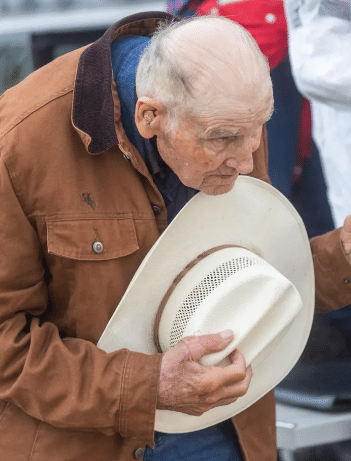
On the opening night of the Flint Hills Rodeo, Tex Junker, 86, of Roggen, Colorado, stood at attention as the national anthem was played. Junker started competing in the rodeo in 1956 and hasn’t missed one since. (Credit: Jeff Tuttle)

In the 1930s, Chase County rancher Emmett Roberts staged pasture rodeos on his farm west of Strong City. In 1937, he held his first organized rodeo event. The following year, Roberts teamed up with his son, Ken, and son-in-law Eddie Boysen, to host what they called the First Annual Chase County Rodeo. In 1939, the event was renamed the Flint Hills Rodeo.

It’s been going nearly continuously ever since. (The only year it was canceled was 2020, because of the pandemic.) Held the first weekend in June, the rodeo is still billed as “the oldest consecutive rodeo in Kansas.” The same arena and rodeo grounds that were built for the event back in 1948 remain in use today.

On the final day of the rodeo, the community celebrates with a parade leading south from town along Kansas 177 two miles to Cottonwood Falls. The liquor store, train depot and antique gas station downtown are popular spots for revelers to gather; a few rowdier participants prep water balloons for unsuspecting parade entrants.

Chase County Sheriff Jacob Welsh led this year’s parade, followed by emergency vehicles and work trucks, their passengers tossing candy as they drove by. Local Shriners performed tricks on Honda three-wheelers and squealed the tires on their tiny chopper bikes. Horses ridden by smiling and waving cowboys and cowgirls trotted down the street. More sweet treats were thrown from parade sponsor floats. Children watching roadside quickly snatched them up to add to their goody collections.

Then the onslaught began. The crowd, which banked water balloons in between games of cornhole, began using them, hurling aquatic grenades over people watching the parade. Some balloons landed with great effect, splashing against county firetrucks with a thump and a spray onto the pavement. At least one balloon careened into a car to douse its occupants.

Even chaotic merriment has rules. The rowdies knew better than to drench the driver of an immaculate 1967 Pontiac GTO. Other drivers, including some who weren’t trying to be part of the parade, didn’t get a pass.

From the skies, more water comes.

Rodeo organizer Cheryl Bailey laughed as she sought shelter from the rain for her and her ATV under the dance floor. Bailey’s grandfather helped build the bleachers that rodeogoers still sit on. Her family has been involved in the event for about 80 years.

“My dad was up here pulling ropes in the stripping chute,” Bailey says. “My mom was always helping. My grandpa always helped with stuff.”

Bailey has served on the Flint Hills Rodeo board for about 25 years.

“Her family’s been involved (in the rodeo) forever,” Holder says, “and that’s part of what helps keep an event like this going.”

Bailey, Holder and the roughly 200 other

volunteers who fan out across the rodeo grounds before, during and after the show work together every year to make sure the rodeo continues its legacy. There are no weather delays – except if there’s lightning in the area – and no rescheduling or postponing events. The rodeo carries on, rain or shine.

This year turned out to be a rainy one. Another deluge soaked the rodeo grounds as cowboys herded goats and calves into their pens ahead of the children’s competitions. The arena was mostly mud by the time the main event began. Some years, that’s just how it goes.

Holder admits that some years are better than others regarding ticket sales and attendance, but there’s a hearty core of people who attend, no matter the weather forecast. Rodeo competitors hold the event in high regard, seldom failing to mention how much fun it is to be part of a longstanding tradition.

Holder says there’s a thread of leadership embedded within the Flint Hills Rodeo, directly related to its homegrown origins.

“Leadership comes from ownership,” Holder says. “If you help build it, well, then you feel like you’re a part owner of it.”

As reported in the Kansas Leadership Center Magazine.


Mourning a Loss in the Community

0

Lovina’s Amish Kitchen
Lovina Eitcher,
Old Order Amish
Cook, Wife &
Mother of Eight


Another week has gone by, and it’s already time to write another column. Last week was very hot and humid, making for some restless nights. This week, temperatures are cooler and even chilly in the early morning hours with the mercury dropping to 50 degrees. It makes for some nice sleeping with the coolness at night. Although this morning, I lit a gas light for heat after daughter Loretta and her little ones came. Baby Byron is doing well and is a little sweetie to cuddle with. Denzel is getting adjusted to having to share his parents with his little brother. 

Friday evening, our whole family, sister Emma and sons Jacob and Steven, nephew Benjamin and wife Crystal and son, all gathered at sister Verena’s. A lot of work was done around there for her. We all took supper along. Sister Emma brought a cake, and we had a belated birthday for Verena as well. Joe grilled chicken for supper too. Verena was so glad for everything that got accomplished. 

Saturday, we had a short visit from sister Liz, Levi, and daughter Suzanne. It was good to see Liz again. We hadn’t seen each other since daughter Susan and Ervin’s wedding nine months ago. They also stopped at daughter Loretta and Dustin’s house to see little Byron. Loretta and Suzanne are the same age.

We were shocked to hear the sad news of the accident that took the life of 22-year-old Harley. He was a special friend to my great niece Sarah. Sarah’s mother Elizabeth is the daughter of brother Albert and Sarah Irene. Harley was driving in his buggy along a highway when he was rear-ended by a car. He was taken to the hospital but died later on. Harley’s mother Mary Susan (husband Chris) was in my grade in school, and we were in the same church growing up. My heart aches for the family and Sarah to lose a loved one so early in life. Sarah showed us a card Harley had in his buggy and was found in the wreck that he had signed out to her. He left her a nice memory. May God help them through this difficult trial in life and comfort them as they mourn the death of their son, brother, and special friend.

Sisters Verena and Emma, Joe, and I traveled over two hours to attend the viewing on Sunday afternoon. We stopped in at sister Liz and Levi for a while. So Liz and I got to see each other again.  

Saturday evening, daughter Tim and Elizabeth and their four children, daughter Susan and Ervin and their five children, and Joe and I were supper guests at daughter Loretta and Dustin’s house. Son Benjamin came over for supper before he left for the community building where the youth gather on Saturday evenings. 

Sunday will be baptismal services for three young souls in our church district, including son Joseph, 21, and daughter Lovina, 19. As a parent, I am so thankful that they are taking this step in accepting Jesus Christ as their savior. May God always be their guide as they travel into the unknown future.

I need to hurry now as I’m going to town to get groceries. Tomorrow, the girls and I will have a cooking and baking day. I am in the process of making another cookbook, so the photographer will come to take pictures of the dishes we prepare. It’s always a lot of work but also enjoyable to have the girls here and work with them. This cookbook should be out next year sometime. 

Until next week… God bless!


Good Goulash

1 pound hamburger

1/2 onion, chopped

2 cups macaroni

1 quart tomato juice

1 pint marinara sauce

3/4 teaspoon salt

3/4 teaspoon chili powder

1/4 cup sugar

Brown the hamburger and onion in a skillet, then drain off excess fat. While the hamburger is browning, cook the macaroni in water for 10 minutes. Drain off liquid. Combine all ingredients with macaroni and simmer for 15 to 20 minutes. Serve over mashed potatoes. 


Lovina’s Amish Kitchen is written by Lovina Eicher, Old Order Amish writer, cook, wife, and mother of eight. Her newest cookbook, Amish Family Recipes, is available wherever books are sold. Readers can write to Eicher at Lovina’s Amish Kitchen, PO Box 234, Sturgis, MI 49091 (please include a self-addressed stamped envelope for a reply); or email [email protected] and your message will be passed on to her to read. She does not personally respond to emails.

Contact: [email protected]; 1-800-245-7894

USDA: Your Top Ten Labor Day Weekend Food Safety Tips

0

When you hit the road for that one last camping trip or beach day, bring food safety along to keep foodborne illness in the rearview mirror.

Here are your Top 10 Labor Day food safety tips for travelers:

  1. Pack perishable foods directly from the refrigerator or freezer into the cooler. Meat and poultry may be packed while they are still frozen.
  2. Use an appliance thermometer in your cooler to monitor that your food stays chilled at 40 F or below.
  3. Keep raw meat and poultry wrapped separately from cooked foods or foods meant to be eaten raw, such as fruits.
  4. For long trips, take two coolers — one for the day’s immediate food needs, such as lunch, drinks or snacks, and the other for perishable foods to be used later.
  5. When you arrive at your campsite, only consume bottled water or other canned or bottled drinks. Water in streams and rivers is untreated and not safe for drinking.
  6. Use hand sanitizer or disposable moist towelettes that contain at least 60 percent alcohol.
  7. Consider buying shelf-stable food to ensure food safety.
  8. When you arrive at the beach, partially bury your cooler in the sand, cover it with blankets and shade it with a beach umbrella.
  9. Don’t eat food that has been sitting out (especially in the sun) for more than 2 hours (1 hour when the temperature is above 90 F).
  10. Always follow your four food safety steps.

Have a food safety question? Contact the USDA Meat and Poultry Hotline at 1-888-MPHotline (1-888-674-6854) to talk to a food safety specialist or chat live at ask.usda.gov from 10 a.m. to 6 p.m. Eastern Time, Monday through Friday.

By Jesus Garcia, Public Affairs Specialist, Food Safety Education Staff