Friday, February 27, 2026
Home Blog Page 642

Lettuce Eat Local: Well that’s some plum good jelly

0

Amanda Miller
Columnist
Lettuce Eat Local


We all know it’s dangerous to say we’ll “never” do something — we know the chances are very high that at some point we’ll find ourselves doing that very thing. I shouldn’t be surprised then that last week I had to eat my words (literally and figuratively) in regards to sandhill plum jelly. 

It’s been years since I decided I’m never making sandhill plum jelly. Since I’m not a Kansas native, I didn’t grow up familiar with this regional specialty, and it has no draw for me whatsoever. It’s fine and all; I definitely don’t dislike it, but the response it elicits from me is merely a noncommittal shrug. 

Heresy, I know. And here I call myself a Kansan.

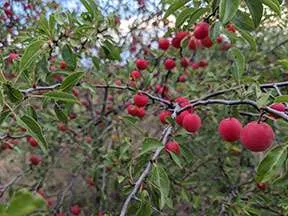
I have debated the issue with myself, so it’s not that I haven’t made an informed decision. Sandhill plum jelly comes with a whole list of pros and cons. To its defense, these native plums grow wild and are forageable here in our sometimes-disagreeable climate, which is something I deeply appreciate. As big bonuses, the bushes provide windbreaks and shade, and are very effective at erosion control. The tart little fruits, also called chickasaw plums or mountain cherries in other Midwestern regions, are bright red pops of color for our dusty prairies, and that color transfers to the jars of jelly in a distinctly gorgeous hue. 

Now for the cons. See where I said “tart little” fruits? I meant that part, and while there is some variation on the level of both qualities, often those adjectives should be more drastic. Read, “mouth-puckering, teeth-hurting itsy-bitsy teeny-weeny” fruits. We have a few bushes out by a pasture, and I’m being generous if I call them the size of a good blueberry; the minimal bits of flesh that cling to their substantial pits are as sour as a lemon. And while the branches of those soil-stabilizing bushes are loaded with plums, they are also spiky and unfriendly. 

So in addition to needing about 1000 plums for a batch, I’d also have to actually make jelly — another thing I don’t do. Technically this may have been the first time I’ve made strained jelly, because even jam and I have a relationship fraught with distrust. It’s a lot of work for something laden with sugar that we will probably never remember to eat…and with my luck (/lack of precision), it won’t set anyway. 

So for years now, I’ve been comfortable in my disregard for sandhill plum jelly. 

That all changed when a friend asked if I would do the jelly part if she picked the plums that were too big and plentiful for her to resist. I love canning so much that suddenly it was also too much for me to resist, and I (happily albeit trepidatiously) agreed. 

And what do you know, it wasn’t that hard or tedious, and the jelly set beautifully with such an appealing flavor and color. Benson and Brian both have eaten a significantly higher amount of bread recently since there’s an open jar of jelly in the fridge. The batch made more jelly than anticipated, so I have half a dozen jars for myself, and I’m thrilled about being able to share them — both with people who know and love sandhill plum jelly, and those who’ve never heard of it. I already sent a jar to my parents in Ohio, so we’ll see if their reaction is like my guys who basically race each other to finish their jelly bread so the other one can’t sneak it, or whether it’s closer to the shrugged shoulders I used to give. 

I say “used to,” because I’m having to seriously rethink my jelly convictions. Maybe, even if it’s not my jam, I’ll make sandhill plum jelly again some summer.


Sandhill Plum Jelly

I was surprised to find no sandhill recipe in my local church cookbooks, but fortunately I have other reputable sources for such things. My friend who makes it often shared her method, and I have no complaints. Except for the amount of sugar, although it must be correct, because this jelly is just right: neither too sweet nor too sour. We might be past most of sandhill plum season, but our sorry bushes still have a bunch hanging on (because no one cares to pick them…), so you might still be able to find some around. If you need more specific canning instructions, please don’t wing it — look up a credible resource or email me with questions (if you consider me credible). 

Prep tips: If you don’t want to make the jelly the same time as you pick the plums, just wash them and pop them in the freezer! I think it actually helps to break them down, and this way the work is broken up into stages and isn’t overwhelming. 

5 lb sandhill plums

4 cups water

1 box pectin

8 cups sugar

Cook plums with water in a large kettle, simmering until they are super soft and easily smushed when pressed; let cool somewhat. Drape four layers of cheesecloth in a strainer set over a bowl, and let plums drain for half an hour or so before squeezing and getting more juice out. You’ll probably need to do this in several batches, and don’t squeeze so hard that you get pulp through or the jelly will be bitter. You should get about 6 cups of liquid — if you get more than that, reserve the extra for something else. 

Heat those 6 cups of juice, and thoroughly stir in the box of pectin. Bring to a rolling boil, then thoroughly stir in the sugar. Bring back to a rolling boil, and boil for exactly 1 minute, stirring the whole time. Remove from heat, ladle into half-pint jars, and water-bath process for 6 minutes. 

New Research Could Help Breed For Less ‘Spooky’ Horses

0

In the wild, horses must be alert for predators that might attack them. This means that even domesticated horses are hardwired to be aware of danger and can scare easily.
Unfortunately, this so-called “startle response” or “spooking” is reflexive, and horses often cannot distinguish between the danger a panther might present versus a plastic bag floating by a riding arena.
Some horses react to these perceived threats by rearing, bolting, or bucking, which can create dangerous situations for owners and riders.
University of Florida researchers are working to identify genes that influence horses’ tendency to react to these “spooky” plastic bags.
Identifying these genetic traits would be a first step toward one day selecting or breeding horses for the temperament types preferred by most horse people. These research results might be a decade away.
Samantha Brooks, University of Floria professor of equine genetics, has run an experiment on several groups of young horses to better understand startle responses.
The horses wear wireless heart-rate monitors and are loose in a round pen. At set intervals, an umbrella is opened quickly within the animals’ line of sight.
Research analyzed the animals’ behavior and change in heart rate throughout and after the initial startle reaction.
“We can’t read their minds,” Brooks said. “Their heart rate tells us what is going on inside that we cannot see from reading their body language alone. It was interesting to see the stories their heart rates told us.”
Two clear groups of horses emerged from the data. The first group was startled by the umbrella opening, had a spike in heart rate, maintained a reactive or hyper-alert state including more time spent looking and moving away from the umbrella.
The second group startled much like the first group to the umbrella opening, but with a different outcome. The horses experienced a spike in heart rate but then calmed quickly and carried on with their day.
These animals perceived the stimulus and found it startling but did not go through the behavioral patterns of avoidance, fear, etc. like the first group.
“Horses have adapted over thousands of years to live with people,” Brooks said. “Some of those changes include a reduction in startle response and are really helpful to better understand the horses we work with today.”
Now that two clear groups have emerged, the team will take this information and develop a study to differentiate the genetic components that make up how horses react to fear. Blood and hair samples were taken from each horse in the study for future analysis.
Knowing how genetics weigh into behavior can help horses and owners find their right fit. Perhaps the spooky horse is not the best option for a 10-year-old 4-H’er. But a spookier, high-strung horse might be a better fit for a high-energy “job” like show jumping.
“Understanding each horse’s genetic makeup can help to understand the type of horse wanted,” Brooks said.
“If we learn early on what this animal’s natural tendencies are most likely to be, we can make educated decisions on training and future careers to give the horse the best shot to grow into their potential, rather than becoming a problem or danger.”
Additionally, understanding a horse’s reaction to uncomfortable situations can make a difference in how they are handled for medical procedures, transported, and more.
“It’s important to know these traits because it can impact how we care for horses overall,” said Barclay Powell, graduate student, working on the project. “This will be hugely important to the veterinary field as well. It’s not only helpful for the people handling the animals, but also for the horses’ welfare.”
“It doesn’t matter if the horse is a racehorse, therapy animal, or pulling a carriage, an unplanned startle response is generally a problem,” Brooks said.
“We are just beginning to scratch the surface of this. It might take us 10 years or more to really have a clear understanding, but it is worth the effort.”
+++30+++

Poison Ivy Causes Misery

0

“Be careful, that’s poison ivy on the old rotten dead tree you’re cutting down.”
Grant Carson stopped his Ford 8N tractor to advise a teenager about hazards of the green leaves encompassing the tree.
A long time ago, the community garden tiller and weekend town marshal counselled a naive tree saw operator.
The advice was never forgotten, and similar comments are heard frequently every year when people are around thriving poison ivy.
Sure enough, the next day back then there were red itchy spots all over the arms with seemingly uncontrollable scratching.
Medicated salves didn’t help one bit, but Dr. Bowers, a story himself, gave the kid a backside vaccination with red serum. The problem cleared up shortly afterward, and the same needle poke was requested on similar itchy occasions years later.
Several people in the area are now suffering from poison ivy and wonder more about the scratchy problem.
A weed specialist said poison ivy has three leaves with the middle leaf longer than the others. Edges can be smooth or coarsely toothed while the surface can be glossy or dull.
One dermatologist said about 75 percent of the population is allergic to the poison resin found in poison ivy.
An itchy rash will develop everywhere the resin touches while a person’s hand spreads it to all other body parts. Bumps, blotches, swelling and blisters can even be propagated by pets.
While a shower is advised after encountering poison ivy, only about half of the poison comes off. But it will lessen the impact.
Unfortunately, the best natural remedy for poison ivy is time. However, there are steps which can be taken to bring some relief. They include over-the-counter allergy antihistamine such as “Benadryl,” cold compresses. frequent baths, light bandaging, and no scratching
The bumps and blisters can last 14 to 21 days but severe cases may require doctor treatment. A physician’s appointment is recommended when there is a severe widespread rash, eyelid swelling, fever, chills, and infection. Topical or oral steroid is a frequent doctor treatment prescription.
Once suffering from poison ivy, symptoms will appear faster the next time exposed.
To lower risk, it is suggested to apply a precontact preventative, wear protective clothing, gloves, and shower afterward.
Reminded of Luke 9-11: “He healed those who had need of healing from the poison.”
+++ALLELUIA+++
XVII–34–8-20-2023


Media advisory: Police raid of newspaper offices flies in the face of media protections, First Amendment scholars say

0

From the Office of Public Affairs | http://www.news.ku.edu

Media advisory

Contact: Mike Krings, KU News Service, 785-864-8860, [email protected], @MikeKrings
Police raid of newspaper offices flies in the face of media protections, First Amendment scholars say
LAWRENCE — A small community newspaper in Kansas made national news over the weekend as offices and homes of the paper, publisher and reporters of the Marion County Record were raided by police and county sheriff’s personnel. University of Kansas journalism professors are available to discuss the events, their implications and aftermath.
Genelle Belmas, associate professor of journalism, can discuss the First Amendment, the protections it provides for journalists, media law, publishing and related topics.
“It is incumbent upon the judiciary and law enforcement to know and respect the federal law protecting newsrooms from raids like the one suffered by the Marion County Record,” Belmas said. “As publisher Eric Meyer correctly characterized it, this kind of Gestapo action against reporters and news organizations is the hallmark of a repressive government. Bravo to the Record staff for doing the important work of holding government and its citizens accountable.”
Belmas has written extensively on media law, including the textbook “Major Principles of Media Law,” and has published research on digital publishing, social media, legal protections for student journalists, regulation of speech and related topics.
Stephen Wolgast, Knight Chair in Audience and Community Engagement for News at KU, can discuss the raid, implications, rural publishing, news deserts and related topics. A longtime journalist who worked in newsrooms in Kansas and New Orleans as well as for The New York Times, Wolgast teaches writing and reporting and has also researched student reporting, as well as education reporting.
“While it’s true that journalists are not above the law, district attorneys and judges must apply the law fairly to everyone, including journalists. So far, Marion County officials haven’t been willing to show that they are following federal law or even Kansas law around seizing journalists’ notes,” Wolgast said.
To schedule an interview, contact Mike Krings at 785-864-8860, [email protected] or @MikeKrings.
-30-

————————————————————————

KU News Service
1450 Jayhawk Blvd.
Lawrence KS 66045
Phone: 785-864-3256
Fax: 785-864-3339
[email protected]
http://www.news.ku.edu

Erinn Barcomb-Peterson, director of news and media relations, [email protected]

Today’s News is a free service from the Office of Public Affairs

The Annual Tomato Tasting Table

0
Photo courtesy: K-State Horticulture

The Annual Tomato Tasting Table put on by K-State Research and Extension and the Harvey County Master Gardener Volunteers was conducted at the Harvey County Fair last week. Master Gardeners grow 10 varieties of test tomatoes from KSU to determine the most productive for our area, the master gardeners then conduct the Tomato Tasting Table to see what variety is most preferred!

It is always interesting to see what people prefer in their tomato preference. Some like them sweet, some spicy and some somewhere in-between. The most preferred variety this year is “Grand Marshall”!

Grand Marshall matures is about 78 days. The attractive, large to extra large, 10 to 14 ounce beefsteak-type fruits are firm, smooth shouldered, deep oblate shaped and grow in clusters of 2 or 3. Mild flavored fruits have the perfect balance of acid to sugar ratio. Bred to have good performance under hot conditions and when bacterial pressure is present. This variety matures early for a main season hot set variety. Ideal for home gardens and fresh markets. The strong, vigorous plants produce high yields.
Grand Marshall is resistant Alternaria Stem Canker, Fusarium Wilt 1, Fusarium Wilt 2, Gray Leaf Spot, Tomato Yellow Leaf Curl Virus, Verticillium Wilt 1 and Verticillium Wilt 2.