Saturday, February 28, 2026
Home Blog Page 651

KU News: KU Alumni Association invites campus, community partners to participate in Homecoming 2023

0

From the Office of Public Affairs | http://www.news.ku.edu

Headlines

Contact: Paige Freeman, KU Alumni Association, 785-864-0953, [email protected], @kualumni
KU Alumni Association invites campus, community partners to participate in Homecoming 2023
LAWRENCE — The University of Kansas will host its 111th Homecoming Oct. 23-28, culminating in the KU football game against Oklahoma on Oct. 28 in David Booth Kansas Memorial Stadium. The theme for this year’s celebration is “Rah Rah Jayhawk,” a nod to the origins of the Rock Chalk chant and Jayhawk nostalgia.
The KU Alumni Association has selected the members of its student-led Homecoming Steering Committee, who will work with Paige Freeman, the association’s director of student programs, and Ryan Edmonds, assistant director of student programs, to coordinate activities for Homecoming 2023.
Steering committee members:
1. Thanh Tan Nguyen, a senior in business analytics and supply chain management from Phu Yen, Vietnam, executive director.
2. Nana Ansere Amfo Sackey, a junior in visual communication and design from Accra, Ghana, and Lawrence, programs chair.
3. Jess Mumm, a junior in strategic communications and business from Omaha, Nebraska, programs co-chair.
4. Andy Denekas, a graduate student in business and pre-law from Omaha, Nebraska, awards chair.
5. Shayslyne Campos, a senior in marketing and psychology from Kansas City, Missouri, and Lawrence, public relations/outreach chair.
6. Anna Korn, a junior in sport management from Phoenix, Arizona, competitions chair.
7. Aria Woolsey, a junior in strategic communications and psychology from River Falls, Wisconsin, public relations/outreach co-chair.
8.
KU’s Homecoming experience aims to celebrate KU history and tradition and instill Jayhawk pride in all members of the KU community, near and far, through the engagement of students, faculty, staff, alumni and community members. To help foster engagement, the Alumni Association and Homecoming Steering Committee encourage campus and community partners to submit an event for the Homecoming calendar on behalf of your department or organization. Program submissions will be accepted until Sept. 4.

The association and steering committee will hold a virtual Homecoming Information Session from 3 to 4 p.m. Aug. 14 and invite any KU campus or Lawrence community partner interested in hosting an event to attend. Register here for the information session, which will be recorded and available later to those who register.
This year’s Homecoming celebration is sponsored by Central Bank of the Midwest, Konica Minolta, KU Bookstore, Pepsi Zero Sugar and StoneHill Hotel.
The Alumni Association will continue to update kualumni.org/homecoming as more information on the week’s activities becomes available.

-30-
————————————————————————

KU News Service
1450 Jayhawk Blvd.
Lawrence KS 66045
Phone: 785-864-3256
Fax: 785-864-3339
[email protected]
http://www.news.ku.edu

Erinn Barcomb-Peterson, director of news and media relations, [email protected]

Today’s News is a free service from the Office of Public Affairs

Horticulture 2023 Newsletter No. 31 

0

https://hnr.k-state.edu/extension/info-center/newsletters/index.html

Blog Post: http://www.ksuhortnewsletter.org

Video of the Week: Composting: Making Black Gold
https://kansashealthyyards.org/all-videos/video/composting-making-black-gold

REMINDERS
• Divide iris if needed.
• Do not fertilize the warm-season turfgrasses, buffalograss, zoysiagras and bermudagrass, past August 15. Doing so may increase the chances for winter damage.
• Check mulch layers and add additional material if needed.

VEGETABLES
Still Time for a Salad Garden
Though we’re very much still experiencing the heat of summer it’s time to make plans for fall gardening. Choose crops that tolerate the weather as it turns cooler, but also the warm soil at planting. Cool season vegetables can be started from mid-August through early September. Some leafy greens that tolerate these conditions include: green and red leaf lettuce, kale, spinach, mustard, bok choy and endive. Radishes, beets and carrots are also good fall crops that can be tossed into a salad.
Prior to planting, turn the soil and incorporate a balanced fertilizer to replenish the garden from the previous crop. (Cynthia Domenghini)

FRUIT
When Are Apples Ready to Pick?
Apples mature over a long period of time depending on variety. Some varieties such as Lodi can mature in July and others as late as October or even November. Here are some guides to help you decide when to pick your apples.
Days from bloom: The number of days from bloom is a reliable guide for general maturity time, but weather conditions will have some influence. Some kinds of apples and approximate days from bloom to maturity are Jonathan, 135, Delicious, 145, Golden Delicious, 145, and Winesap,155 days.
Flesh color: As apples mature and starches change to sugars, the flesh changes from very light green to white. When you cut a thin slice and hold it up to the light you can see the difference.
Seed color: The seeds of most apples change from light green to brown as the fruit ripens. This indicator should be combined with other changes since it is not absolute. The flavor of the apples, the change in color of the stem and calyx basins and flesh color are important in deciding if apples are ready to harvest.

Color change: As apples mature, the skin color in areas of the stem and the calyx basin at the bottom of the apple turns from an immature green to a light-yellow color. Some apples will develop a red skin color over most of the fruit before they are ripe, so this is not a reliable indication of maturity.
Flavor: This is a good guide if you are familiar with the apples, you have and know how they should taste. Even if you do not know the characteristic flavor of the kind of apple you have, you can still sample slices of a few apples and decide if they have a sweet flavor. If they are not ready to harvest, they will taste starchy or immature. If apples have already fallen and taste a bit starchy, store them for a period to see if they become sweeter. (Ward Upham)

Fertilize Strawberries
Early- to mid-August is the time to fertilize strawberries in order to increase the number of fruits produced next spring. Plenty of daylight and warm temperatures during June, July and August promotes the growth of new runner, or daughter, plants. As daylight hours dwindle and temperatures grow cooler in September and October, fruit buds for the next year’s fruit crop develop. To get a good berry crop next spring, it is important for strawberry plants to be vigorous during this period of fruit bud development. Nitrogen, applied now, will help promote fruit bud development. A general application rate is ^ to 3/4 pound of actual nitrogen per 100 feet of row. The nitrogen may be in the form of a fertilizer mixture such as ammonium phosphate or 12-12-12, or in a fertilizer containing only nitrogen such as urea or ammonium nitrate. Some specific examples would include:

Iron + (11-0-0) at 6 pounds per 100 feet of row.
12-12-12 at 5.5 pounds per 100 feet of row.
Nitrate of Soda (16-0-0) at 4 pounds per 100 feet of row.
Ammonium sulfate (21-0-0) at 3 pounds per 100 feet of row.
Urea (46-0-0) at 1.5 pounds per 100 feet of row.

Generally, each cup of fertilizer weighs ^ pound. On sandy soils, the rate may be increased by about one-half.?
After spreading the fertilizer, water the area applying at least 1/2-inch of water to move the nitrogen into the strawberry root areas. (Ward Upham)

PESTS
Mimosa Webworm on Honeylocust
Description: Larvae of Mimosa webworms are about one-inch long and light green to gray/brown with five longitudinal stripes on the body. The adult moths are silver-grey and have small black spots on the wings.
Life Cycle: There are two generations of Mimosa webworm each year. The first-generation moths emerge in early June and lay eggs on the honeylocust leaves. Caterpillars can be seen from mid-June through early July. The second generation of moths appear in mid to late July to lay another round of eggs. The larvae from this generation feed from early to late August.
Damage: Though Mimosa webworms can defoliate trees, healthy, established trees tend not to suffer greatly. Damage is primarily aesthetic as the larvae create tight webs of silk around the leaflets. Foliage in the webs turns brown and is unsightly. Additionally, the silk hanging from the trees as the larvae lower to the ground is a nuisance.

Control: Chemical control is not typically necessary. Treatment is ineffective if applied this time of year when the webs and brown leaves are already present. At the beginning of the caterpillar phase, prior to webbing, an insecticide can be used. BT (Dipel or Thuricde) or spinosad (Natural Guard Spinosad, Captain Jack’s Deadbug Brew, Bonide Colorado Potato Beetle Beater and Monterey Garden Insect Spray) can be used as well as traditional controls that contain cyfluthrin or bifenthrin. If you’re having problems with Mimosa webworms now, plan to apply treatment mid-June and possibly again in early August of next year. (Cynthia Domenghini)

MISCELLANEOUS
Plants for Late Season Bloom
Landscapes are often drab this time of year. You can add interest to your home by planting shrubs this fall or next spring that flower later in the growing season. Consider one or more of the following.
Rose of Sharon (Hibiscus syriacus) is a tall shrub that produces single or double flowers. Colors range from white to red, purple or violet, or combinations, depending on the variety.
Crapemyrtle (Lagerstroemia indica) are dwarf-to-tall shrubs or trees. They are not reliably winter hardy in Kansas and often die back to the ground. Crapemyrtle flowers on new wood, so plants pruned (or killed) to the ground while dormant in late winter or early spring will bloom later the same year. Flower color varies from white, pink, to purple or deep red on different plants.
Bluebeard (Caryopteris x clandonensis) is also known as blue-spirea, blue-mist shrub, or caryopteris. It usually is found with blue flowers, but some cultivars have a bluish-violet to violet flower color. Plants are usually cut back in late winter or early spring. Flowers are borne on the current season’s growth.
Sweet Autumn clematis (Clematis terniflora) is a vigorous vine with large masses of small, white flowers that have a wonderful fragrance. Be careful with this one; it can easily outgrow its bounds. It is often a good idea to cut it back to the ground in early spring.
Davidiana clematis (Clematis heracleifolia var. Davidiana) is a bush-type clematis with small but interesting violet-blue flowers. Female plants bear interesting fluffy seed heads into the winter. This clematis needs to be cut back to the ground each year to help maintain the shape of the plant.
PeeGee hydrangeas (Hydrangea paniculata Grandiflora) are somewhat coarse with large clusters of white flowers. They can be trained into a tree-like form. (Ward Upham)

Composting: The Science
Using compost in the landscape provides plenty of benefits for the soil including improved water holding capacity, drainage and added nutrients. Understanding the science behind composting makes it a feasible project that can turn waste into treasure.
Composting is a process that occurs naturally as organic materials breakdown in the landscape. This process can be expedited by balancing the ingredients and maintaining air circulation to create a healthy environment for bacteria, actinomycetes and fungi work to decompose different compost particles and thrive at various temperatures. Psychrophilic bacteria are most active when the temperature is around 55 degrees F. As these bacteria work, they generate some heat creating a warmer environment for the mesophilic bacteria which prefer 70 to 100 degrees F.
Thermophilic bacteria prefer even hotter temperatures and take over the decomposing work when the pile reaches between 100- and 160-degrees F. After their work is done and the temperature leaves the preferred range, the microorganisms die off.
Actinomycetes are important to the decomposition of materials such as lignin and cellulose. As the pile cools down, actinomycetes and fungi take over along with invertebrates such as earthworms and centipedes. These are considered “finishers” in the composting process.
The heating and cooling process of composting is what supports the life cycle of the microbes and expedites decomposition. Next week’s article will include details about what is needed to make a compost pile. Follow the link below for more information about compost microbes. https://calrecycle.ca.gov/organics/homecompost/microbes/ (Cynthia Domenghini)
Contributors:
Cynthia Domenghini, Instructor
Ward Upham, Extension Associate

Division of Horticulture
1712 Claflin, 2021 Throckmorton
Manhattan, KS 66506
(785) 532-6173

For questions or further information, contact: [email protected] OR [email protected]
This newsletter is also available on the World Wide Web at:
http://hnr.k-state.edu/extension/info-center/newsletters/index.html
The web version includes color images that illustrate subjects discussed. To subscribe to this newsletter electronically, send an e-mail message to [email protected] or [email protected] listing your e-mail address in the message.

Brand names appearing in this newsletter are for product identification purposes only. No endorsement is intended, nor is criticism implied of similar products not mentioned.

K-State Research and Extension is committed to making its services, activities and programs accessible to all participants. If you have special requirements due to a physical, vision or hearing disability, or a dietary restriction please contact Extension Horticulture at (785) 532-6173.

Kansas State University Agricultural Experiment Station and Cooperative Extension Service K-State Research and Extension is an equal opportunity employer. Issued in furtherance of Cooperative Extension Work, Acts of May 8 and June 30, 1914, as amended. Kansas State University, County Extension Councils, and United States Department of Agriculture Cooperating, Ernie Minton, Dean.


YOUTH RODEO WINNERS

0

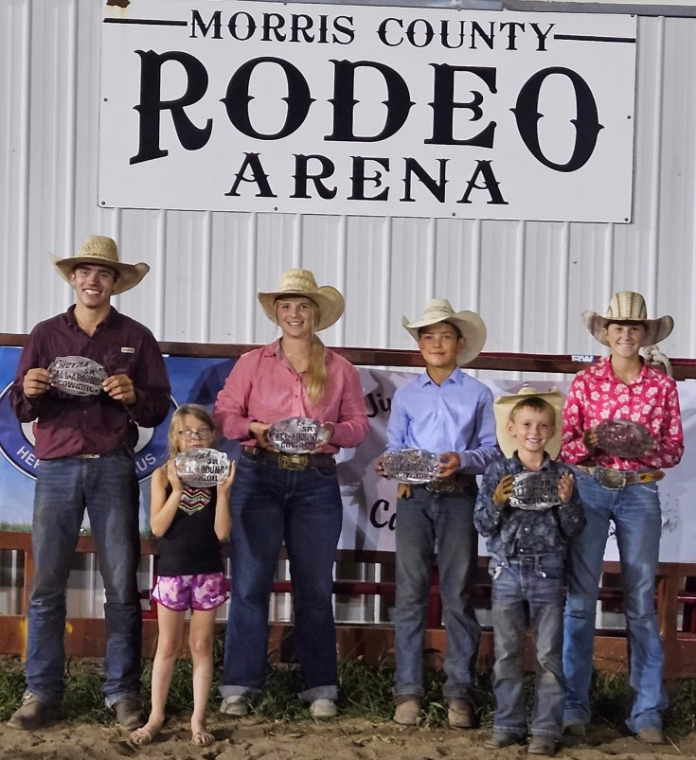
All-around award winners at the annual youth rodeo sponsored by the Morris County Youth Rodeo Association Saturday night at Council Grove were Lakoddah Downes, Council Grove, senior boy; Hazelynn Wilson, Osage City, junior girl; Sadie Bathurst, Allen, senior girl: Drew Ritchie, Olpe, intermediate boy; Newt Parkin, Miller, junior boy; and Atley Johnson, White City, intermediate girl. (Amy Allen photo)

Ah, My Little Lotus Flower!

0

Today I drove through the McPherson valley Wetlands to see if the waterlilies were blooming, or if there was even any water to support them. Evidently there is just enough water for a few of them to grow and bloom, because some of their large yellow flowers dotted what otherwise appeared to be a sea of green weeds. I remember several years ago clamoring up over the dike of one pond to be greeted by what looked like something from an exotic Chinese water garden. I’ve always called them water lilies, but the Public Lands Manager for the Kansas Dept of Wildlife and Parks who manages the entire McPherson Valley Wetlands system tells me their proper name is American Lotus, and says they are in fact native to Kansas. That reminded me of PePe Le Pew the skunk from cartoons of my generation. PePe fancied himself a ladies’ man, and his famous pickup line was “Ah, my little Lotus flower.”
The year I first discovered them was a wet year, and they filled the shallow waters in the corners of the pond like a mat of immense green leaves dotted with bold, pale, yellowish-white flowers the size of cereal bowls. Most of the time these plants are shown with their enormous leaves floating on the water, but here where the water was shallow they actually rise above the water’s surface. Most of the leaves on these plants were about a foot wide, give or take, and the flowers that were fully opened measured 6 inches across. Leaves on older American Lotus plants can reach 24 inches in diameter. An interesting phenomenon is that American Lotus leaves never get wet; water forms a droplet on them and just runs off.
Each flower has a bright, yellow, round center resembling a little double-layer cake. When the flower dies, that center swells into a seed pod 3 or 4 inches wide resembling a wasp nest with several individual seed compartments that each contain a single marble-sized seed. As it further dries the seed pod droops toward the water and the seeds eventually spill out and lay on the bottom of the pond. The seeds can lay dormant in the mud for several years before germinating, which occurs when the hard outer shell softens. The plants grow from tuberous roots called rhizomes which can become up to 50 feet long and can have dozens of plants growing from them. American Lotus plants will grow in the still water of any pond, lake or stream that is shallower than 3 feet.
Waterfowl and other wildlife will eat the seeds and tubers if they can get to them. Native Americans peeled and cooked the tubers to eat as vegetables or dried and stored them for winter food. They ate the seeds in soups and other dishes or roasted them like chestnuts. Many Great Plains tribes attributed mystic powers to the American Lotus plants. A poultice made from the pulp of the root was thought to relieve the pain of inflammatory ailments such as arthritis, and a mash made from the blossoms and leaves was said to have anti-fungal properties. Although little sound research exists concerning the medicinal properties of the American Lotus, a close cousin, the Indian or Sacred Lotus which is native to Asia and Australia has been used medicinally for generations. It is known to relieve asthma, inflammation, headache and fatigue, and is said to promote good digestion.
When I first visited Kansas over 30 years ago, I either bought or was given a decorative seed pod of some sort that was brown and hard with numerous round compartments in it, each containing a round hard seed of some sort. I was told they were called “lake nuts.” That decorative object has long since disappeared, but at the time I remember no one seemed to know what the heck it really was. Guess what; after writing this column I now know it was an American Lotus seed pod! I never cease to be amazed at the wildlife and plants which flourish here in Kansas that common sense tells me shouldn’t be here in our prairie state at all. For instance, beavers and bobcats here in Kansas, really; and now waterlillies!!! Of the American Lotus someone has said, “Whenever you doubt your self-worth, remember the lotus flower. Even though it plunges to life beneath the mud, it does not allow the dirt that surrounds it to affect its growth or beauty. Boy Howdy, can we use a heapin’ portion of that today! Continue to Explore Kansas Outdoors!
Steve can be contacted by email at [email protected].

Bar room compliments

0
Thayne Cozart
Milo Yield
A thirsty cowboy walks into a quiet bar one hot, humid late afternoon and orders a frosty mug of his favorite beer.
He takes the beer over to a table and sits down. The table has a big bowl of peanuts on it, obviously for customers to eat.
After a few sips of his beer and cracking open a few peanuts, the cowboy hears a small voice say, “Nice Dan Post python boots you’re wearing, partner.”
The cowboy looks around, but he is the only one in the bar except the bartender, who is occupied cleaning the other end of the bar.
The cowboy shrugs it off and goes back to his frosty beer. A few minutes later, another small voice says, “really nice patterned pearl button shirt your wearing.”
Again, the cowboy looks around, but can see nobody. Concerned that his mind is playing tricks on him, he is now on guard, listening for any reoccurrences.
After a few minutes, a third small voice says, “Nice tight, bun-hugging Wranglers you’re wearing and your felt Stetson hat is the perfect shape and color for you.”
This time the cowboy is sure it is not his imagination, so he goes up to the bartender, and tells him what has happened.
“Oh, yeah, that happens all the time,” says the bartender, pointing to the bowl on the guy’s table. “It’s the peanuts. They’re complimentary.”
***
A young girl visits a commercial truck garden one day and tells the farmer, “I  want to buy a b-i-i-i-g watermelon.”
“That’ll cost you $7.50 for a really big watermelon,” says the farmer, pointing to a striped beauty.
“But, I’ve only got $1,” the girl replies, with a pouty lower lip.
The sympathetic farmer then points to a very small watermelon growing nearby and says “How about that one for $1?”
“Okay, I’ll take it,” says the girl with a bright smile as she hands over the crisp $1 bill. “But leave it on the vine. I’ll be back for it in a month.”
***
If it ain’t one pest destroying living things here at Damphewmore Acres, it’s another. This year some varmint or bird has killed a few chickens. I’ve had snake encounters in the hen house. The squash bugs are decimating my zucchini plants. The bind weed and crab grass are rampant everywhere. They seem to be impervious to the ongoing drought that’s shriveling and desiccating all other plants.
The newest pest is an old one — walnut web worms. I’m used to having a little walnut tree damage every year from web worms. But, this year they are a tsunami. They absolutely stripped a 10-foot young walnut tree of every leaf. They ate 90% of the leaves from a two other 20-foot trees. They ate at least a third of the leaves from two mature walnut trees.
I have no idea why the web worm population erupted this year. Ain’t nuthin’ I can do about it except hope that they haven’t killed the trees.
***
Well, I do feel real lucky about three things I’ve got bought for our new home being build. I snuck in under the Biden-effort to ban propane hot water heaters, propane fireplaces, and propane emergency electricity generators. I got all three bought before his plans could go into effect. The hot water heater and the fireplace are installed. The emergency generator is in storage for later installment.
In spite of what our esteemed President wants, in my old age, I plan to stay warm and have hot water if the electricity ever goes out when we get moved into our new home.
***
Sadly, another of my good childhood friends has gone up the final Lonely Trail. This time it wuz K. D. Budd at Moran, Kansas. Budd and I spent wonderful years as kids playing together as students at the South Fairview one-room school and as country neighbors.
When I learned of K. D.’s passing, my memories turned to the hours and days we spent on horseback. We blatantly trespassed with our horses on many farms between Bronson, Elsmore, Moran and Uniontown. And, not once did a landowner complain.
We swam our horses in ponds and the Marmaton River. We fished. We squirrel hunted. We hunted coyote pups for their $2 bounty at the time.
We had cob fights and snowball fights, bucket calf ropings and rodeo, and got pulled on a slab of lumber behind “Old Dick,” the cantankerous brown work horse. We snuck into watermelon patches. We caught snapping turtles. We played Tarzan in hay mows. We cut pond ice to make homemade ice cream in the winter. We spent nights with his grandparents and made fudge, popped popcorn, pulled taffy and reveled in his grandpa’s pioneering stories after he stoked his evening pipe.
We had dangerous horse races across rough ground and never gave safety a second thought. When we got a big older, we hunted quail, cottontails, jackrabbits, and participated in community coyote drives.
Back in those days, we had little in the way of material goods, but we overflowed with good times and good friendship. The memories I shared with K.D. back in those “good ol’ days” are priceless and will be never forgotten. RIP, my friend. Sorry I missed your memorial.
***
Words of wisdom for the week: “If government can put a serial number to positively identify every single bill of paper money, it should be able to do the same with ballots.”
Have a good ‘un.