Monday, January 19, 2026
Home Blog Page 115

Harvest At Last

0

Richard Shank
Columnist

The 2025 wheat harvest had a later than usual start at the Shank farm, but produced a happy ending.
Shortly after noon on July 3, four John Deere combines with 40-foot headers descended on an 80-acre field in southern Ottawa County.  Barely two hours later all that remained was a couple water holes, which never dried following June rains in north central Kansas.
It was a fun harvest to view as a spectator to observe how farming has changed since my youth in these same fields.
Bill Came, Jr. farms the Shank spread and thousands of other acres for himself and a multitude of other landowners. The Came operation is flawless and fast with total efficiency and timing. We once joked that if you go inside for a few moments for a glass of ice tea, you just might miss the harvest.
Legend says a wheat crop, like a cat, has nine lives. An old-timer once admonished me to not spend the crop until it is in the bin. Another prognosticator was heard to say “looks are especially deceiving on a field of wheat.” Many years, the crop will yield better than it looks in the field. Then, on other years the opposite may be true.
The sheer weight of today’s combines is a little mind boggling. I am told the combines may weigh more than 40,000 pounds, with bins holding nearly 300 bushels of the golden grain. So, these combines with a full bin may weigh as much as 60,000 pounds as they roll across a wheat field. A drive though the old neighborhood reveals combine tracks and some are two to three feet deep in wet fields so common to this year.
Several 18-wheelers were parked along the road waiting for deliveries of wheat from the combine or from grain carts pulled by tractors who circle the fields behind the combines. Once the semi-trucks are loaded with approximately 1,000 bushels of grain it is time for a 12-mile to the Scoular Elevator, a few miles to the east of Salina. At the elevator, I did not see one pickup or a ton and a half truck hauling wheat that day. It was a sea of 18-wheelers. A sign on the scale office at the elevator alerted farmers they were open until 11 p.m.
Riding a combine these days is a slice of Heaven as compared to my growing up years. First, riding inside a fully air-conditioned cab must be called a “leap in technology” as compared to 1960. A set of gauges to the right of the steering wheel really got my attention. One gauge reported the yield at that moment and a second noted the yield of the total field. Several other gauges reported additionally aspects of the grain, including moisture content. My dad would never understand this new-fangled farming.
It was a good crop and yielded almost 60 bushels per acre, one of the best in more than a century of family ownership.
If all goes as planned, several days following the harvest, and if Mother Nature cooperates, planters will crisscross the farm planting Milo in the wheat stubbles. That process is called “double cropping” of after harvest milo.
My grandfather purchased the farm being harvested in 1913 for $9,500 or $118 per acre, a hefty sum for that era. On August 11, 1925, he purchased a quarter section across the road to the east at an auction held on the steps of the Ottawa County Courthouse in Minneapolis. I have not been told why the sale was consummated on the courthouse steps, but always found the sale location interesting. Coincidentally, an 80-and 40-acre farm was sold at the same time and the families of the purchasers have retained ownership of all three pieces of property a century later, something not uncommon to farms in north central Kansas.
As we bumped across the field sitting in a cab of the combine, I could not help but think about harvests of the past. I hauled my first load of wheat in 1962 to the Niles elevator, in a 10-year-old Ford pickup, which remains in the family. At most, the pickup hauled 90 bushels per load. If time permitted, we stopped at the blacksmith shop in Niles to buy a soft drink to tidy me over until the next load.
Then, 45 years ago in 1980, we finished harvesting close to July 10 on a day when the thermometer eclipsed 110 degrees. As we were finishing, the old Massey Harris combine breathed its last, never to cut another acre of wheat, and we towed it home behind a tractor.
In 1990, my brother and I were home to help my dad cut his last crop in advance of his retirement from 63 years in the business. This time around, another Massey Ferguson combine quit on us and we had to hire a neighbor to help finish. It was quite a finale for my dad’s last hurrah in farming.
Commenting on the state of farming, one farmer told me grain prices are not low this year, they are “pitifully low.” On the other hand, this same farmer said livestock prices are as high as they have ever been, so farmers would be wise to diversify their operation. Hopefully, our leaders in Washington are about to resolve issues regarding tariffs and the ongoing trade war resulting in more grain sales to foreign nations.
Despite the adverse news, I did not interact with one farmer who is planning to leave the business, a real testimonial to a way of life that is loved by those who live it. Speaking to all these sodbusters who help feed the “not always appreciative world,” may all your future harvests be bountiful.


 

The lead mines left Kansas and Missouri, but the health hazards remain

0

Lead exposure is a common issue in southeast Kansas and nearby parts of Missouri and Oklahoma. Health experts say there are few accessible resources for high-risk communities.

WEIR, Kansas — Johanna Schmid and her husband, Steve Hench, live in an older home in Weir, Kansas. Their lives are busy — they have five kids. Three of those kids are under the age of three. Last October, routine testing at the pediatrician revealed their three-year-old had high levels of lead in his blood. His levels were around 9 micrograms — the safety cutoff is just over 3.5.

Johanna said the news left her defeated.

“It’s hard when you do everything you can to protect your kids. And then there’s these unseen little dangers,” Schmid said “A part of me felt like I failed as a mom.”

Schmid’s experience is more common in this area. The economy of southeast Kansas was once powered by facilities like the Tri-State mines. During its peak in the 1920s, the mines were one of the nation’s leading producers of lead and zinc. Some artifacts, like the massive electric shovel Big Brutus later used for coal mining, are the visible remnants of the now lost mining industries. But the hazardous effects the mines produced persist, creating health issues for people.

Lead is especially dangerous for children. Side effects range from developmental and intellectual delays to behavioral issues and risk of childhood anemia.

With the help of the Cherokee County Health Department and the Environmental Protection Agency, Schmid found likely sources around their older home built in 1930, more than forty years before lead was banned in paint and other finishes.

“We figured that it was basically the window and the wallpaper. But our yard also tested pretty high for lead,” said Schmid.

The lead in the yard was likely residue from the Tri-State Mining industry.

Schmid said the EPA was helpful in understanding what to do next. She had to grow out her lawn so they could remediate the soil.

She knew her house was old when they bought it, but she didn’t realize it might expose her kids to harmful metals.

“When we bought the house, a lot of the stuff had been remodeled or repainted. We just didn’t really think that there was any old paint or anything like that left anywhere,” she said.

In Kansas, lead testing is highly recommended, but not required. It’s up to either the homeowner or their doctors to know if they’ve been exposed to lead.

The newest data for positive lead tests from 2018 to 2020 revealed that the percentage of Kansan children with detectable lead levels was higher than the national average at 65%. The national average is 51%.

The lead is likely residue from the Tri-State lead and zinc mine in parts of Kansas, Missouri and Oklahoma.Peyton Kessler is an administrator at the Cherokee County Health Department. She said leftover mining materials called chat are often to blame.

“They utilized that later for different projects,” she said. “Building pads for houses to be built on, or even for the roads.”

Kessler often suggests lead tests for children experiencing behavioral or developmental issues, or who are exhibiting signs of childhood anemia.

“If a child has a problem, I always say, let’s start with the easy things that we can test for,” she explained.

Lead paint was not banned for use in homes until 1978. If a home is built before then, it’s common there will be lead in the paint or other surfaces.

Kessler said part of the challenge is there’s no funding to help remove lead from places like homes.

“And so we try to educate,” she said

Families like Johanna’s are missing out on accessible information about lead exposure and how it gets into the home. They were able to get the help they needed because of their pediatrician, but not everybody is that lucky.

Kessler said funding for all-encompassing resources are dwindling.

“Each state has its form of funding to assist with those different obstacles that they have. So we get so much funding from the federal government, which is less and less as the days go on,” she added.

Organizations like the Healthy Bourbon County Action Team (HBCAT) are working to expand awareness of important health issues, including lead exposure. In collaboration with academic and community partners, HBCAT created an informational document focused on lead exposure, health effects and strategies for lead remediation.

“We’re hoping that this tool kit can raise awareness about issues with folks who can make changes — with our policymakers,” said Christina Pacheco, assistant professor at the University of Kansas Medical Center.

Pacheco was involved with creating the toolkit and said it’s designed to be a practical, community-centered resource, bridging knowledge and local priorities.

The tool kit is still waiting for approval from HBCAT’s partners, but it could be ready for release this fall. So as of now, there is no single community resource kit that has been approved by both health officials and community organizations.

The Kansas News Service ksnewsservice.org.

Let’s Look Inside With X-Ray Vision

0

Trent Loos
Columnist

Since writing this on Monday of last week the USDA changes course again July 10, 2025 shutting down imports from Mexico
The USDA has announced the phased-in opening of the Mexican border to allow cattle, bison and equine to again enter the United States. On Monday of the week (July 7, 2025), the first opening was at Douglas, AZ to be followed by Columbus and Santa Teresa, both in NM, to open in July and Del Rio, TX and Laredo, TX in August and September. I have seen zero evidence that Mexico has increased its containment of the New World Screwworm and we all agree that we do not want it back in the United States. Although I am not going to dive into that as much today as I am into yet another failed USDA policy.
For 60 years, the USDA has been participating in what is called SIT: Sterile Insect Technique. This is a mass production in lab conditions where the male fruit fly is exposed to X-rays and Irradiation to sterilize the fly. Then, by the millions, these sterile male flies have been released into the wild with the theory that the wild female will mate with the sterile male and thus control the population.
Here is the problem: the wild fruit fly that lays the larvae that become the New World Screwworm is attracted to the biggest male she can find. Extensive studies on this “birds and bees” situation shows that some species of female fruit flies don’t care but most prefer to mate with the big boys. This opens up another can of flies as the National Institute of Health has published many related studies on the topic.
From NIH in 2003:
These results support the hypothesis that intense sexual signalling indicates longer life span. We discuss the importance of age-specific behavioural studies for understanding the evolution of male life histories.
Studies suggest that factors related to the sterile male, such as reduced seminal fluid or genetic differences from wild males, may increase a female’s propensity to remate.
Another thing I find fascinating is that the fruit fly has a life span of 60 days. In that short time on earth, the female lays 2,000 eggs. The challenge to long-term control of the screwworm at any level is not going away any time soon.
In what appears to be unrelated news but I believe it is all tied together, we had Joe Esposito and KenWon Fulsom from Owasso, OK stop by the house yesterday. They have both suffered health damage from radiation and electrical magnetic fields that surround us all. In fact, I went looking for the details of how the male fruit flies are sterilized because it dawned on me that we are told human males are losing sperm quality. Have you ever had an EMF meter run through your vehicle or house to see what you are exposed to on a daily basis? Well, we have now!
It was actually quite alarming and Joe, a Marine veteran who spent most of his military life working with radar, have suffered from that exposure. The health problems he incurred inspired him to help others by showing up to test the radiation we are all exposed to a daily basis. I don’t have time to walk through all the science in this column, but I will soon.
In short, if you are like the rest of the world and have fallen prey to the convenience of having everything wireless, you are exposed to grave danger. During this conversation with Kenwon, it occurred to be that we call these devices that we pack with us at all times a “cell phone.” It is now very clear to me that DNA “cell” damage is occurring as a result.
Actually, much like the lack of evidence supporting the re-opening of the border to Mexican cattle, the evidence to show that the wireless world we live in is not causing serious human health issues is not very common. I urge you to dig deeper into this topic and start looking at ways to make your life LESS wireless and your health better!

Tomato cracking: is it preventable?

0

Choose different varieties to prevent common problem, says K-State expert.

Home gardeners face the problem of tomato cracking, or hard cracks on the upper part of the fruit, usually spanning from or around the stem.

While the cracks do not necessarily ruin the tomato, they are unsightly, said Kansas State University horticulture expert Cynthia Domenghini.

“Tomatoes have a root system that is very dense and fibrous, and is quite efficient in picking up water,” she said. “Unfortunately, the root system can become unbalanced with the top of the plant.”

Domenghini said cracking early in the season is likely related to the top growth of the tomato, which can then result in blossom-end rot when the weather turns hot and dry. Later in the season, cracking may be caused by a sudden abundance of water after a long dry spell.

How can cracking be prevented? Domenghini suggests consistent watering and mulching. Scheduled watering will prevent a quick influx of water likely to cause cracking. Additionally, mulching will help moderate moisture levels in the soil.

Some gardeners may be already following these recommendations and doing everything right, and still end up with tomato cracking. Faculty in K-State’s Department of Horticulture evaluated different tomato varieties over several years to try and come up with the most crack-resistant tomato.

“The difference seems to be the pliability of the skin rather than thickness; the more pliable the skin, the more resistance to cracking,” Domenghini said. “The old variety Jet Star has been the most crack-resistant of any we have tested, including the newer types.”

Unfortunately, Domenghini noted, Jet Star is a variety that can put out rampant, uncontrolled growth. Of the newer, more attractive varieties, Domenghini said the Mountain Spring, Mountain Pride, Mountain Fresh, Floralina, and Sun Leaper varieties had good resistance to cracking.

Domenghini and her colleagues in K-State’s Department of Horticulture and Natural Resources produce a weekly Horticulture Newsletter with tips for maintaining home landscapes and gardens. The newsletter is available to view online or can be delivered by email each week.

Interested persons can subscribe to the weekly newsletter, or submit their garden and yard-related questions, by sending email to Domenghini at [email protected], More information also is available at your local K-State Research and Extension office.

Lettuce Eat Local: An Eggstraordinary Turn Of Events

0

Amanda Miller
Columnist
Lettuce Eat Local

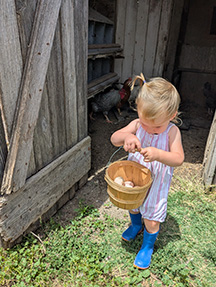
We tentatively open the rickety door to the chicken coop — and catch in our breath. 

There it is, lying right in front of us just barely a step inside, its light-colored shell in stark contrast to the dark dirt floor. An egg! A real egg! 

While it seems an unlikely surprise in a henhouse, at that point finding an egg felt like a thing of the past, something to mention wistfully with that air of nostalgia embedded in “the good old days.” Our hens approached egg-laying during the winter with a lack of intentionality, which albeit characteristic of the colder months and of molting season, still always surprises and aggravates me. I take it personally, and the longer I go without finding eggs, the more my bitterness grows. 

In fact, this year it got so bad that my petulance had some action accompany it. Instead of waiting it out like a wise farmer, I got so annoyed at continuing to feed my paltry poultry with nothing in return that I bartered part of my flock away out of spite; the day the guy came to pick up 15 or so hens (about half of them) was of course the day someone decided to lay an egg. 

The strange thing about my frequent festering grudge against the hens is that it’s extremely shallow: the instant I collect a glorious, marvelous, eggceptional egg is the instant that everything is forgiven. I completely forget about any prior angst, looking at my chickens with a mother-hen indulgence. 

But it was too late to go back on the trade, so the flock got smaller (and I got some incredible honey out of the deal so it did still work out well). It just means by default I couldn’t get many eggs whether they were laying or not.

To add to the disgruntling situation, we then discovered there was a predator on the loose. The ladies would lay eggs, and something would eat them. It didn’t seem to matter what time of day the kids and I would come collecting, for the culprit would have already come calling. I’m not sure which was more disappointing, to never find eggs or to only find broken eggshells. 

We eventually put the pieces together that it was likely a whole team of thieves. We saw a skunk slinking around outside and got some trail cam footage of a raccoon inside, whereas the constant nature of the crime suggested a traitorous hen or even an oddly guilty cat. I was only rescuing an egg or two a week, which is not the goal of keeping chickens. I had to buy eggs, the ultimate insult.

But then. After at least a month of this new nonsense, things changed. Chickens from various sources kept being delivered to our coop, and our flock grew from fewer than 10 to more than 50. 

This brought us to that magical moment of opening the coop door and finding an intact egg, of all things. But that wasn’t it, for we stepped inside and looked around, finding eggs all over the place. Benson discovered a clutch in the corner, exclaiming, “Mom! There must be a HUNDRED over here!” (There were at least five.) In that first day, we gathered more than the prior three months put together.

We call it an eggpalooza every time we collect eggs now. The hens have yet to lay a single egg in the actual laying boxes, but that just makes the egg hunt even more eggciting.


Simple Medium-Hard-Boiled Eggs

Sometimes the simplest techniques are more valuable than the most intricate recipes. And with the price of eggs (or of feeding 50 chickens…), a solid strategy is a good egg. There are more ways to hardboil an egg than hens in the coop, and I won’t say this is the Best of them all, but I don’t bother to try any other way since it just works. We all really enjoy hardboiled eggs, especially in the heat of summer; if Kiah spots any in the fridge, she starts yelling, “EGG! EGG!” and at that point you better hope they are hardboiled because they’re about to get cracked. 

Prep tips: technically eggs that aren’t so fresh are easier to peel, since the semipermeable shells let in a little air between the membrane, but the flavor is so good we don’t mind a little messier peeling job. Overcooking is what yields that sulfurous gray ring around the yolk, so I try to avoid that.

eggs, local/farm-raised if possible

salt and coarsely ground black pepper

Gently place the eggs in a single layer in a saucepan, then cover with cold water by about an inch. Bring to a boil over high heat, then remove from heat and let set for 7-10 minutes, depending on how firm you prefer. Replace the hot water with ice water and let set a few minutes to cool. They will be easiest to peel when still slightly warm — I like to use a spoon to crack along the shell then scoop it out, easier to show than describe — but they taste best fully chilled, so you decide when to peel and eat. Just don’t forget the salt and pepper; that’s all you really need.