Tuesday, January 27, 2026
Home Blog Page 228

Are frozen canned foods still safe to eat?

0
K-State food scientist says broken or unsealed cans should be discarded.

With recent cold weather and power outages come many challenges, including food safety. Kansas State University food scientist Karen Blakeslee said frozen canned or jarred foods can be a safety hazard.

“If you have canned foods, either home canned or commercially canned, in a storage location that froze, first check for broken seals or seams in metal cans or broken glass jars in both commercial or home canned foods due to expansion of the food and liquid inside the container,” Blakeslee said.

If all preservation containers are intact, they can be saved.

“Thaw (the canned food) gradually and store it at room temperature,” Blakeslee said.

She recommends discarding commercially canned foods with broken seams or canned foods with broken glass, as they can lead to contamination. This includes home canned foods that came unsealed and thawed.

“If a glass jar became unsealed but is still frozen, this can be safely used immediately or transferred to a new container and stored in the refrigerator or freezer,” Blakeslee said.

To prevent a future food crisis during cold weather, Blakeslee suggests moving containers to a warmer location or wrapping jars or cans in paper and cover with blankets to insulate them.

“Another option for vulnerable storage locations is to prop open the pantry or cupboard doors to allow warm air inside,” Blakeslee said.

Blakeslee, who also is coordinator of K-State’s Rapid Response Center for Food Science, publishes a monthly newsletter called You Asked It! that provides numerous tips on food safety.

More information is also available from local extension offices in Kansas.
House Bill 2063 Recently Introduced by Kansans for Conservation

0

Pheasants Forever and Quail Forever are proud to support House Bill 2063, introduced by Kansans for Conservation. Drafted by the coalition, this bill would establish a state conservation fund providing grant programs for conservation efforts relating to working lands, wildlife, outdoor recreation, and education. House Bill 2063 represents a historic effort of collaboration across industry and geography to provide the dedicated funding needed to support Kansas’s natural resources.

“Kansans have made it clear that conservation is a priority, and now is the time to take meaningful action,” said Erika Devore, co-chair of Kansans for Conservation. “With Kansas being one of only 15 states without a dedicated conservation fund, we risk falling further behind in addressing the critical needs of our natural resources. House Bill 2063 is our opportunity to invest in the landscapes and resources that sustain our communities, economy, and way of life. We’re eager to collaborate with lawmakers to make this vision a reality.”

One of the key resources supporting HB 2063 is a research report published by Kansas State University in December 2024. The report underscores:

• The growing urgency for conservation funding in Kansas,
• Opportunities lost due to the absence of state-backed initiatives, and
• The potential for significant return on investment through dedicated conservation efforts.
The full research report can be read here.

House Bill 2063 is expected to be referred to the House Agriculture and Natural Resources Budget Committee and will likely be heard in early February. Subscribe to the coalition’s website here for further updates.

Kansans for Conservation
Kansans for Conservation is a coalition of 41-member organizations representing agriculture, recreation, wildlife, and other natural resource interests across the state working together to support conservation funding. A list of coalition member organizations is attached.

For further inquiries, please contact Justin Cobb – [email protected], (573) 418-1498

About Pheasants Forever and Quail Forever

Pheasants Forever and Quail Forever make up the nation’s largest nonprofit organization dedicated to upland habitat conservation. This community of more than 477,000 members, supporters and partners is dedicated to the protection of our uplands through habitat improvement, public access, education and advocacy. A network of 754 local chapters spread across North America determine how 100 percent of their locally raised funds are spent — the only national conservation organization that operates through this grassroots structure. Since its creation in 1982, the organization has dedicated more than $1 billion to 580,000 habitat projects benefiting 28.8 million acres.

Kansans urged to share thoughts on coyote night vision hunting season

0

Kansans have been urged to share their thoughts with the Wildlife and Parks Commission about the state’s coyote night vision hunting season.

The Kansas Wildlife and Parks Commission says it will hold its first public meeting of 2025 on Thursday, Jan. 30, at the K-State Alumni Center in Manhattan. The meeting is expected to begin at noon and continue until all agenda items have been addressed.

The Kansas Department of Wildlife and Parks announced that the meeting would open with a report, during which commissioners would hear regulations that were currently in development. After the report, commissioners will take comments on non-agenda items, receive updates and hear a legislative briefing.

Commissioners indicated that they will seek the public’s input on Kansas’ coyote night vision hunting season. The season was introduced in 2021 and currently runs between Jan. 1 and March 31. The regulation allows hunters to use artificial light and imaging equipment at an additional cost with a permit required.

Staff said that while no changes to the season have been proposed, they would like to gather feedback to ensure it continues to meet the needs of Kansans. The regular coyote fur harvesting and hunting season in Kansas is open year-round with no limit on the number of coyotes that can be taken.

Other topics on the agenda include the 2025 Big Game Permit Program, Quail Eye-Worm research and the prohibition of trail cameras on public lands.

KDWP noted that workshop session items are expected to include deer season on military units and big game regulations. The public has been encouraged to come and share their thoughts.

For a complete agenda, click HERE. For instructions to join the meeting via Zoom, click HERE.

In The Wrong Hands (Best Of)

0
lee pitts

To me, cell phones have become a typical example of the physical and moral decay in this world of ours and I knew this was gonna happen the minute they made cell phones affordable for the common man and woman.

It used to be that you could tell by the make of their vehicle if travelers were driving like a jerk because they were intoxicated or merely talking on their cellular. When car phones first came out only people driving autos made in Germany could afford them. But now that they cost so little that hayseeds who drive old Studebaker trucks, station wagons and decrepit Winnebagos have them and this has created a dangerous driving environment for everyone.

According to one old British study people who have a cellular phone run a 34% higher risk of having an accident. This is because portable phones are now in the hands of people who were never intended to have them… like order buyers and Italian women. These are people who can’t talk on the phone without making hand gestures so they drive with their knees. Or men who do a good job talking and a fair job driving but they can’t do both at the same time.

I was riding around the other day with an order buyer and we were on a crooked, two lane road behind a string of recreational vehicles, semi trucks and sight-seers going slower than a snail on crutches. The order buyer was getting more irritated with each passing mile marker. Please keep in mind this is a man who thinks his car is broke down if his horn doesn’t work. (It was working well this day). When we hit a straight stretch the order buyer passed the entire convoy which was being led by a cowboy pulling a gooseneck. The order buyer muttered under his breath as we pulled back into line, barely missing an oncoming big dog ( a Greyhound). Once past the slow moving vehicles the order buyer got on his car phone and immediately lost track of where he was, and the fact that he was driving. Soon we were being honked at by the cowboy and being passed by recreational vehicles.

I can understand the benefit of a cell phone if you are broke down or need to order a pizza to go. But often drivers get on their cell phones because they are bored. Let me take this opportunity to inform my cellular endowed friends that I AM NOT BORED. So don’t call me if all you want is to pass the time or ask for directions. I am especially irritated by people who call and keep cutting me off, thus interrupting my dinner on five separate occasions with static and garbled chit chat.

It is because of cell phones that I probably will not get a chance to pick any grapes in the Lord’s vineyard when my time comes. You see, I was riding with an auctioneer in Texas and we were late for a sale; flying under the radar through small Texas towns. But we were slowed down when we hit a four way stop and the longest funeral procession I have ever seen pulled out in front of us. Either the deceased was the most well-liked guy in town or a politician and the home folks just wanted to make sure he was dead. Anyway, we followed the long black line doing about five miles per day, or so it seemed. Then we committed an act I am ashamed to admit. It’s the reason I probably won’t be allowed into heaven. Yes, the auctioneer began passing the grieving motorcade!!!

I gasped and said, “You are supposed to show a little respect for the dead.” So the auctioneer took off his Stetson and held it to his heart as we passed the hearse.

Sure enough, I noticed as we passed the lead car, the one with the box in back, that the undertaker was talking on his cell phone.

K-State researchers say red meat allergy from tick bites is becoming more common

0

Researchers at Kansas State University say the number of cases of an allergic reaction to red meat tied to tick bites is increasing across the state.

Priscilla Brenes, K-State Research and Extension nutrition and wellness specialist, said cases of an allergy called alpha-gal syndrome are becoming more common through more rural areas of Kansas. Alpha-gal syndrome is the term used to describe the allergic reaction to red meats and mammalian related products, most often through a tick bite.

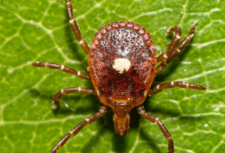
The main parasite responsible for the spread of alpha-gal syndrome is the Lone Star tick, a common variety in brushy and more heavily wooded parts of Kansas. Brenes said in a statement that she surveyed other Kansas extension agents and found there was a lack of available information about alpha-gal syndrome, and that the agents wanted more details to share within their communities.

K-State entomologist Yoonseong Park said studies indicate that less than 10% of people bitten by the Lone Star tick ever develop an allergic reaction to red meat. Symptoms of alpha-gal syndrome include hives, nausea or vomiting, severe stomach pain, dizziness, drops in blood pressure, shortness of breath and swollen lips and throat.

Park said tick activity picks up during spring months in Kansas, and every patient who develops the red meat allergy has a different level of sensitivity to it, like other allergies. In any case of possible alpha-gal syndrome, patients are encouraged to talk with their doctor immediately.

Michael Chao, K-State meat scientist, said a recent report from the Yale School of Medicine shows that the levels of antibodies which cause the reaction decline over time, giving some people the chance to consume red meat and related products again.

Chao uses mice in his research to test the reaction of various meat products, such as hot dogs and jerky. He said his hope is to use the data he gathers to help people reintroduce red meat into their diet “when they’re ready for it.”

Brenes and her colleagues are offering a survey to residents across all 105 Kansas counties as part of their effort to collect more information about alpha-gal syndrome. Brenes said those who participate in the survey may receive a financial incentive.

The survey and more information about alpha-gal syndrome can be found online and through local extension offices.