Tuesday, January 27, 2026
Home Blog Page 229

Indecent Exposure

0
lee pitts
Instead of fun and games this week I’d like to write about what I call “the outside disease” because most of the people I’ve met with skin cancer lived their life outside in the sun, like farmers, ranchers, roustabouts, roughnecks and roofers. Even though I occasionally sit at a desk I’ve always been an outside guy. Whether it be working in the oilfields as I did in my younger years, ranching, farming or running cross country, I’ve always subjected my body to the sun. Foolishly, as it turns out.
Back 60 years ago when I ran with my shirt off and never used sun screen, it wasn’t really common knowledge that such indecent exposure could cause skin cancer as one matured. Had I known then what I know now I’d have worn long sleeved shirts like real cowboys do. I’d have worn a big cowboy hat instead of a ball cap and a steel hard hat with a brim instead of a plastic one without one.
Believe it or not, I was first diagnosed with skin cancer by a dentist, not a dermatologist. I’d had this spot on my nose for over a year that would bleed on a regular basis but I attributed it to the fact that my glasses were too tight on my nose. If my dentist hadn’t advised me to see a skin doctor I’d have probably ended up like my good friend Steve who had to have his nose removed. Although Steve’s skin cancer wasn’t caused by the sun but by being frequently sprayed with Agent Orange in Vietnam which was used to defoliate the jungle.
I watched Steve courageously go through several operations and believe me, I’ve had a lot of health issues  but I’ve never experienced anything like Steve did. So when the skin doctor biopsied my nose and said it was a  cancer I was a little concerned. Luckily it was a basal cell cancer which is not nearly as bad as a melanoma, which I would end up having a few years later when the doc took a big scoop out of my back. Melanomas are not to be trifled with and I’ve known two different men who died from one.
For the carcinoma on my nose they did what they call a Mohs Surgery in which the doc removes thin layers of skin one layer at a time and examines each layer under a microscope to determine if any cancer remains. This procedure continues until only cancer-free tissue remains around the edges. Eight of us began the procedure and one by one we’d have to be numbed up every hour and then the doc would go to work with his scalpel. In my case I was given 31 shots of lidocaine over the course of my surgery and I think I felt every one!
With Mohs, if you’re lucky you might only have to see the doctor twice, once to have the skin cancer removed and another to sew you up. You go in once an hour until the doc thinks he’s got  “clean edges” and I asked my doc what’s the latest he’d ever had a patient be finished. The patient had been repeatedly numbed once every hour from eight am to eight pm! So I felt extremely lucky I only had to go back in three times. One of my fellow patients that day was a lady with a cancer ON HER EYELID and let me tell you, she was as anxious as a sore-uddered momma cow with a buck toothed calf!
After some reconstructive surgery one inch away from my eyeball I didn’t have to have another Mohs surgery until they found another basal cell carcinoma on the top of my ear. Afterwards I had to wear a large bandage that made me look like I was mocking Donald Trump after he got shot.
Now I have another cancer about half an inch from my eye and another Mohs surgery is in my near future.
Initially I tried to write about the humorous side of skin cancer but I concluded there is none. I know that 99% of you probably know about the dangers of skin cancer but for those of you who don’t… just remember my friend Steve. Believe me, skin cancer is no laughing matter and you might want to consider getting checked out.
I’ll get off my soapbox now.

Treasurer Johnson Recognizes February 1 as National Unclaimed Property Day

0

Treasurer Steven Johnson urges all residents to take part in National Unclaimed Property Day on Saturday, February 1, a day dedicated to raising awareness about billions of dollars in unclaimed property being held by state governments across the country. Whether it’s an abandoned bank account, an uncashed check, or forgotten insurance proceeds, unclaimed property can be found in nearly every community.

“On National Unclaimed Property Day, I encourage everyone to take a few moments to see if there are funds out there waiting to be claimed,” said Treasurer Johnson. “This day is a reminder that reuniting people with their money is a priority for my office. We want everyone to know that even small amounts can make a big difference.”

Unclaimed property typically includes assets from dormant bank accounts, unpaid wages, life insurance policies, utility refunds, safe deposit box contents, and more. Through the state’s unclaimed property program, Treasurer Johnson’s office works diligently to safeguard these funds until rightful owners step forward.

How to Check for Unclaimed Property:
1. Visit unclaimedproperty.ks.gov — This official website by the Kansas Treasurers Office allows you to search for unclaimed property.
2. Provide your basic information — Searches only require minimal information, typically your name and county of residence.
3. Submit a claim if a match is found — Follow the instructions for providing proof of ownership and identification.

Since unclaimed property is reported to the state by businesses and financial institutions, the amounts held can range from a few dollars to thousands. Many residents and businesses are surprised to discover they have missing or forgotten funds, so checking regularly is a wise practice.

“It only takes a few minutes to see if you or a family member might have unclaimed property,” Treasurer Johnson added. “This National Unclaimed Property Day, spread the word and help us ensure that people get back what is rightfully theirs.”

Could an aqueduct bring water to western Kansas, or is it a pipedream?

0
The Ogallala aquifer that sustains parts of western Kansas has been declining rapidly, and some farmers want to take water from the Missouri River and route it west as a solution. The aqueduct would start north of Kansas City. But critics of the idea say it isn’t practical.

GRANT COUNTY, Kansas— Nature isn’t easy on farmers in western Kansas.

On a day when the temperature reached as low as -6 degrees, the frigid cold didn’t stop farmer Clay Scott. He still needs to get out and feed the cattle as a rare snowstorm is approaching his neck of the woods.

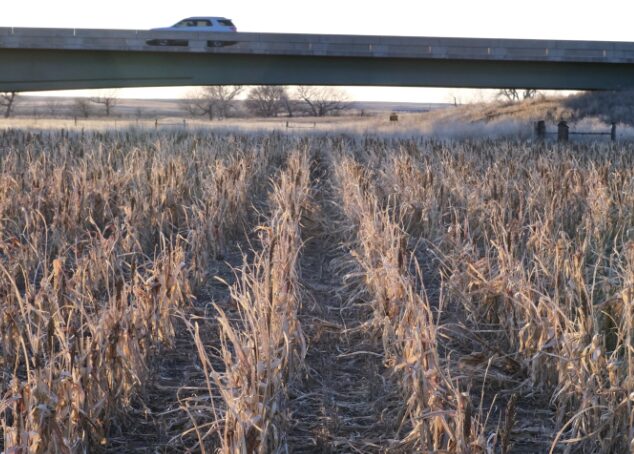
In between patches of snow lies arid land that sustains Scott and his family. Luckily, Scott farms wheat, corn and milo over the Ogallala aquifer, an underground source of water that has defined western Kansas, and supported the irrigation that turned the area into an agricultural powerhouse.

He is a multigenerational Kansan, and has spent years working the soil beneath him.

“I’ve got three boys that are coming back to the farm, and I want to give them the opportunities that I’ve had to grow and develop and prosper here on the High Plains,” Scott said.

But the only problem is, after pumping all that water for irrigation for the last 70 years, the aquifer is getting dangerously close to drying up. What’s more, there hasn’t been a lot of cohesive conservation projects pushed by the local Groundwater Management District.

A lot of individual farmers have spent thousands of dollars trying to irrigate the most efficient way, or convert some of their land to dryland farming. But the declines across the region still remain harsh.

Kansas Geological Survey hydrologist Brownie Wilson said that with a declining aquifer, there are really only two options for Kansans.

“You either got to quit taking so much water out, or you have to put more water in,” Wilson said.

Vocal leaders are more attracted to bringing in water as opposed to major structural changes to the region’s farming. They envision an aqueduct across the state that will bring water from the Missouri River. But critics of the aqueduct and similar plans say it’s not practical to bring in the water needed and is distracting people from the conservation efforts that could create a sustainable path forward.
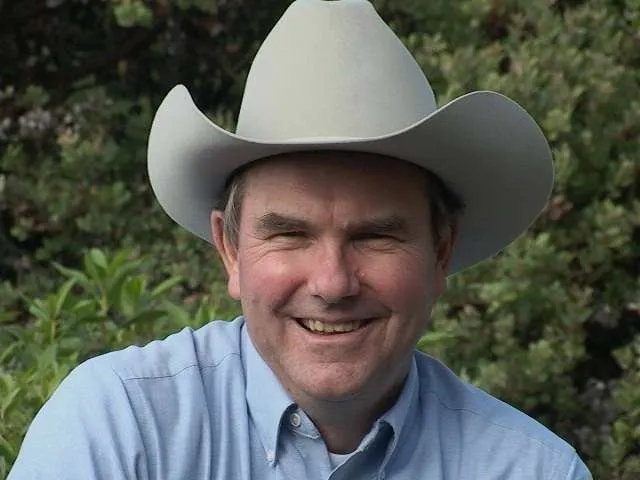
Scott is one of the leaders supporting the aqueduct, serving on the Groundwater Management District 3 board. He formed the Kansas Aqueduct Coalition, with former district director Mark Rude, Chris Wilson and David Brenn.

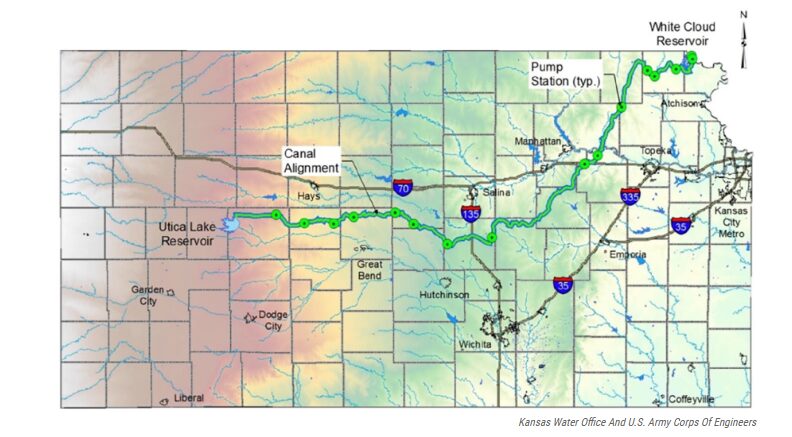
They looked into a plan to draw flood water away from the Missouri river that separates Kansas and Missouri, all the way down to a reservoir in southwest Kansas to recharge the aquifer. That could allow more flexibility with how much water they use.

“If you look at other areas in the western United States, and see what they’re doing to combat their water demands, you see water aqueducts are vastly successful,” Scott said.

The Kansas Aqueduct Project

The idea of an aqueduct has existed for decades.

In the 1950s, farmers across western Kansas obtained thousands of water rights, giving them the right to pump water for irrigation.

By the 1980s, the reality of over pumping groundwater had already reared its ugly head. Congress, through the Federal Water Resources Development Act of 1976, authorized a study on groundwater depletion and the feasibility of a project to transfer water to western Kansas.

That would eventually become the idea of the Kansas Aqueduct Project. A 375-mile project across Kansas with 16 pumping stations.

To people like Scott, the aqueduct is the next logical step that secures the area’s economic future. But to critics, it represents an era of humans trying to control nature, which some argue doesn’t work anymore.

Burke Griggs has been a loud opponent to the aqueduct. He is a professor of law at Washburn University and specializes in natural resource law. He said the aqueduct cannot be built because too many people would need to approve it.

“Biggest reason is you’re going to have to cross about 300 miles of private property. If you look at the major water projects in the West, they’ve been built on land the United States owns,” Griggs said.

The aqueduct would also require a massive public investment, one that far exceeds even the $4.4 billion construction costs of the United States’ most expensive water transport system thus far, the Central Arizona Project. The costs for the Kansas aqueduct are projected to be roughly $20 to $30 billion.

Hydrologists are also concerned with the fact that projects from the Big Dam era of the 20th century are already struggling in Kansas because they are filling with sediment due to the lack of water and need investment to maintain their function.

Despite the hurdles, it hasn’t slowed down the support of the aqueduct among southwest Kansans or similar proposals to physically transport water to the region. Just a few years ago, the district gained attention for trucking 6,000 gallons of water across the state as a proof of concept. The water was then dumped on private land in Wichita County.

At water conservation meetings held last year by Kansas State University, residents brought up a similar idea of bringing water by rail to southwest Kansas.

But that focus on getting more water instead of conservation has had consequences. Hamilton County requested to leave Groundwater Management District 3. Hamilton County officials wanted to focus more on conserving their water.

Many are looking for solutions and ways to keep their water but also keep their towns growing.

A shift in conservation

Northwest Kansas has seen a revitalized sense of water conservation in the last decade after being the first district to adopt Local Enhanced Management Areas, or LEMAs.

It’s a program where farmers collectively volunteer to cut back on their water usage with the goal of achieving sustainable levels of pumping. Last year, the district’s water levels actually increased, proving conservation could work.

Groundwater Management District 4 director Shannon Kenyon has been another vocal critic of the aqueduct. She said that to her, it has been a distraction from the real water cuts that need to be made.

“It’s total fantasy land in my opinion. All smoke and mirrors,” Kenyon said.

Kenyon believes that the inaction by southwest Kansas led to HB 2297 being enacted into law last year. It requires all Groundwater Management Districts to submit an action plan to the state and be approved by June 2026.

Southwest Kansas has seen a more active attitude toward conservation since. They have held producer meetings throughout the towns trying to hear what farmers think should be done going forward to meet their goals.

Bret Rooney, another GMD 3 board member, spoke at the last meeting to make sure everyone understood the stakes.

“We’ve got a choice to either come together, figure out a solution, work on things, do things like we’re doing today,” Rooney said, “or someone from Topeka or Manhattan is going to tell us how we’re going to do it.”

These conservation attitudes are actually bringing more hope to southwest Kansas. The district only saw less than a foot of average water declines last year, and there’s hope they can capitalize on that momentum.

Kenyon said that she can feel the difference in leadership and attitudes all the way up in northwest Kansas.

“I am seeing conservation, attitudes, beliefs and projects being kicked into higher gear,” Kenyon said.

Culture of consumption

Georg Schaefer is a sociologist at the Max Planck Institute of Geoanthropology in Germany who studies Kansas agriculture.

He said agriculture is the foundation of society in western Kansas, and people want to protect that. He observes it can be easier to believe in an aqueduct than change your entire way of farming. But conservation would have a greater impact now.

“It was not born to be a distraction. It’s very compelling to get that techno fix,” he said. “It’s just cynical to propose it, because it will just make things worse in the long run.”

In a paper titled Ad Astra per Aquam, or “To the Stars through Water,” Schaefer outlined why ideas for an aqueduct remain persistent in southwest Kansas, and why water conservation is so difficult in that area.

Schaefer has studied western Kansas for the past several years. He said that water in western Kansas holds no intrinsic value. Rather, it’s given value by farmers as a way to grow crops and grow the local economies.

“Rather than work on how humans can adapt and fit into the natural environmental makeup of the region, the idea is the natural process should fit inside a human construct,” Schaefer said.

Looking at a map of western Kansas, a lot of the agriculture industry is condensed into southwest Kansas. There are feedlots, dairies, and beef packing plants all within less than 100 miles of each other, each containing thousands of cattle. Those herds need farmers to grow food for them and raise them.

A lot of farmers in southwest Kansas just can’t see a way out of the conundrum beneath them.

“We feel powerless, like the conservation efforts don’t have a payoff. It’s overwhelming on the people,” Schaefer said.

Kansas News Service link to ksnewsservice.org.

Kansas’ tuberculosis outbreak is now the largest in the U.S. since the 1950s

0
The outbreak started last January. Kansas health officials say numbers are trending downward, but they still expect to find more cases.

A tuberculosis outbreak that started in Wyandotte County, Kansas, has grown to be the largest in the U.S. since the Centers for Disease Control and Prevention started tracking the illness in the 1950s, health officials said.

In a state Senate Committee on Public Health and Welfare meeting, Ashley Goss, a deputy secretary for the Kansas Department of Health and Environment, told committee members the outbreak is unprecedented.

She said although numbers are trending downward since the outbreak developed last year, the health department is working with two large employers to monitor for more cases.

“We do expect to find more, but we’re hoping the ‘more’ that we find is latent TB and not active, so that their lives are not disrupted,” Goss said.

Jill Bronaugh, the state health department’s communications director, confirmed this is the largest tuberculosis outbreak documented in the U.S. since the ’50s.

“This outbreak is still ongoing, which means that there could be more cases,” Bronaugh told the Kansas News Service in an email.

She said people can access updated case counts and general information on tuberculosis on the KDHE website.

What is tuberculosis? 

Tuberculosis is a respiratory disease that is not typically widespread in the U.S. However, case numbers have been on the rise since 2023. Globally, tuberculosis killed 1.25 million people in 2023, according to the World Health Organization.

A person who is symptomatic and tests positive for tuberculosis has what is called an active case. It spreads through close, repeated contact. A person who tests positive for tuberculosis but is not symptomatic has been exposed to the bacteria causing the disease but isn’t contagious.

Latent tuberculosis can become active, so it is important for a person to seek treatment for both latent and active cases. Goss told lawmakers it takes months to fully cure tuberculosis.

“It is highly contagious. … Currently, Kansas has the largest outbreak that they’ve ever had in history,” Goss said.

Bronaugh said tuberculosis typically impacts a person’s lungs.

“It spreads through the air when infected people cough, speak, or sing. While there is a very low risk of infection to the general public in these communities, KDHE is working to ensure that patients are receiving appropriate treatment, which will limit the ability to spread this disease and prevent additional cases from occurring,” Bronaugh said in a statement.

Where is the outbreak in Kansas?

The Kansas health department recorded 109 active cases of tuberculosis statewide in 2024. In 2023, the CDC recorded 46 active cases in Kansas, Bronaugh said.

Bronaugh said the state recorded 79 active and 213 latent outbreak- and non-outbreak-related tuberculosis cases in Wyandotte and Johnson counties last year. She said those numbers may be subject to change.

“Those 2024 case counts are still provisional, as they will be reviewed and confirmed officially by the CDC near the end of March 2025,” Bronaugh said.

Bronaugh said as of Jan. 24, 67 people (60 in Wyandotte County and seven in Johnson County) are being treated for active tuberculosis. She said cases associated with this outbreak were first reported in January 2024. Bronaugh said there were two deaths connected to the outbreak last year.

What are tuberculosis symptoms? 

According to the CDC, symptoms of active tuberculosis include a bad, consistent cough, coughing up phlegm with blood in it, fever, chills and weight loss. People who are immunocompromised, have conditions like AIDS, HIV or diabetes, or who drink alcohol or smoke are at a higher risk of developing tuberculosis.

The CDC recommends people get tested if they have been exposed to tuberculosis, have symptoms or are at high risk. If a person knows they’ve been exposed to another person with tuberculosis but does not have symptoms, it’s still important to get tested, as latent tuberculosis is not symptomatic.

How is the outbreak being contained?

The Wyandotte County outbreak started last year. By summer, the CDC and state health department stepped in to help contain it.

Goss told lawmakers CDC officials are still present and collaborating with state health workers to help end the outbreak.

“That’s not a negative. This is normal when there’s something unprecedented or a large outbreak of any kind,” she told lawmakers.

Bronaugh said the Kansas health department is working with and following the guidance of the CDC.

Kansas News Service ksnewsservice.org.

Positive lifestyle behaviors support a healthy immune system

0

The cold and flu season is rampant now, so how can people protect themselves? A strong immune system is the key.

A strong immune system is the body’s best natural defense mechanism against foreign substances, and leading a healthy lifestyle is the best way to support that, said Janice HermannOklahoma State University Extension nutrition specialist.

“The immune system is a network of cells, tissues and organs, including the gut. Eating right, staying physically active, getting enough sleep and managing stress can help keep your immune system in good working order,” she said. “A weakened immune system leaves the body open to infectious diseases, which raises nutrient needs but often results in reduced food intake.”

Nutrients — including protein, omega-3 fatty acids, vitamins and minerals — play a vital role in immune system maintenance and functionality. Eating a well-balanced diet is the best way to get needed nutrients.

“Consuming a steady diet of fruits, vegetables, whole grains, low-fat dairy and lean protein is key for good health and bolstering a healthy immune system,” Hermann said. “In addition to providing needed nutrients, these foods are an excellent source of phytochemicals, some of which support the immune system. These foods also contain fiber, which functions as a prebiotic supporting gut health, where much of the immune system is located.”

The best way to eat a well-balanced diet containing a variety of foods is to follow the USDA’s ChooseMyPlate model. Its website offers recipes and tips for healthy eating and follows the Dietary Guidelines for Americans.

A lack of quality sleep and dealing with stress can wear down the body and weaken the immune system. Ideally, Hermann said adults should strive to get seven to eight hours of sleep per night. Some people may need less sleep, while others require more to keep the immune system in check.

People will experience stressful times periodically, and learning how to manage that stress is important.

“Life may seem like a juggling act at times when trying to manage your work schedule, children’s school and extracurricular activities, and everything else life throws at us,” Hermann said.

Exercise is a good way to help reduce stress levels, and engaging in regular, moderate physical activity can keep the immune system strong.

The Physical Activity Guidelines for Americans recommend adults get 150 to 300 minutes of moderate activity each week. Children ages 6 to 17 should participate in at least 60 minutes of moderate physical activity each day. In addition to the direct benefits of physical activity on the immune system, being active can support immune function by helping with stress management and better sleep.

“Good health comes down to eating a healthy diet that includes adequate amounts of food from all the MyPlate food groups,” Hermann said. “But it is important to remember that a healthy diet, regular physical activity, adequate sleep and managing stress work together to promote overall health and well-being.”

For more information about healthy lifestyle choices, contact the local Extension office.