Saturday, February 7, 2026
Home Blog Page 388

It’s almost canning season: Have you thought about chocolate?

0

K-State food scientist outlines safety considerations for preserving chocolate sauces.

Chocolate sauce is not the first product home cooks think of when they are canning summer foods.

And yet, what a delicious idea, says Kansas State University food scientist Karen Blakeslee.

“Chocolate sauce is a great homemade product to give as a gift, especially for the holidays,” said Blakeslee, who is also coordinator of K-State’s Rapid Response Center for Food Science. “It’s a fun option to make instead of traditional canned foods.”

Blakeslee seems to have no problem listing the many uses of canned chocolate sauce, including toppings for such simple desserts as ice cream, cheesecake and strawberries; or dressing up a plate with a drizzle of chocolate before serving a piece of cake or pie.

However, she cautions that canning chocolate sauce safely comes with some food safety risks.

“Chocolate sauces are low acid foods, which could be a risk for botulism food poisoning,” Blakeslee said. “There are no chocolate sauce recipes that have been tested for pressure canning.”

There are also very few recipes that have been tested to be water bath canned, she said. Those that are used often contain fruit or bottled lemon juice to raise the overall acidity of the canned product.

“These also contain unsweetened cocoa powder, which has a red-brown color,” Blakeslee said. “Recipes that list cocoa powder as an ingredient use unsweetened cocoa powder.”

She advised home canners against using Dutch-process or alkalized unsweetened cocoa powder because those products lower the overall acidity, leading to an unsafe product. Never substitute hot chocolate or cocoa mixes, chocolate syrups or chocolate bars.

A safe alternative to canning chocolate sauce is freezing, according to Blakeslee. The National Center for Home Preservation provides guidelines online for a freezer chocolate fudge sauce.

“Do not can any chocolate sauce recipes that contain dairy products,” Blakeslee said. “There are no safe methods or recipes to can any dairy products. These types of chocolate sauces are best stored in the refrigerator or freezer.”

Blakeslee publishes a monthly newsletter called You Asked It! that provides numerous tips on being safe and healthy. More information is also available from local extension offices in Kansas.


IRS warns against scams targeting Kansas seniors; joins other federal agencies to recognize special awareness day

0

As part of continuing efforts to protect the senior community, the Internal Revenue Service today issued a warning about the rising threat of impersonation scams.

These scams are targeting older adults in Kansas and elsewhere across the country by pretending to be government officials, aiming to steal sensitive personal information and money. By posing as representatives from agencies such as the IRS, or other government agencies, these fraudsters use fear and deceit to exploit their victims.

“Scammers often target seniors, attempting to steal personal information through phone calls, emails or text messages by pretending to be from the IRS or other agencies or businesses,” said IRS Commissioner Danny Werfel. “Preventing these types of scams requires assistance from many different places. By partnering with other federal agencies and others in the tax community, we can reach more seniors and other taxpayers to help protect them against these terrible scams.”

This is part of a wider effort taking place this week leading up to World Elder Abuse Awareness Day (WEAAD) on Saturday, June 15. WEAAD, observed since June 15, 2006, aims to foster a better understanding of the neglect and abuse faced by millions of older adults, focusing attention on the contributing cultural, social, economic and demographic factors.

The IRS also has been engaged in long-term efforts to protect against scams and other related schemes, including identity theft. This has been an ongoing focus of the Security Summit partnership between the IRS, state tax agencies and the nation’s tax professional community since 2015.

Understanding the threats

The IRS has identified a concerning trend where fraudulent actors are increasingly targeting unsuspecting individuals, particularly senior citizens, by masquerading as IRS agents. Victims are pressured into making immediate payments through unorthodox methods such as gift cards or wire transfers under the pretense of resolving fictitious tax liabilities or securing false refunds.

These scammers deploy advanced techniques to fabricate a veneer of credibility, including the manipulation of caller IDs to appear legitimate. Here are just a few examples of their schemes:

  • Impersonation of known entities: Fraudsters often pose as representatives from government agencies — including the IRS, Social Security Administration and Medicare — others in the tax community or familiar businesses and charities. By spoofing caller IDs, scammers can deceive victims into believing they are receiving legitimate communications.
  • Claims of problems or prizes: Scammers frequently fabricate urgent scenarios, such as outstanding debts or promises of significant prize winnings. Victims may be falsely informed that they owe the IRS money, are owed a tax refund, need to verify accounts or must pay fees to claim non-existent lottery winnings.
  • Pressure for immediate action: These deceitful actors create a sense of urgency, demanding that victims take immediate action without allowing time for reflection. Common tactics include threats of arrest, deportation, license suspension or computer viruses to coerce quick compliance.
  • Specified payment methods: To complicate traceability, scammers insist on unconventional payment methods, including cryptocurrency, wire transfers, payment apps or gift cards, and often require victims to provide sensitive information like gift card numbers.

Scam precautions and reporting

If an individual receives an unexpected call from someone alleging to be from the IRS, but they have not been notified by mail about any issues with their IRS account, they should hang up immediately. The call is likely from a scammer.

Do not return the call using the number provided by the caller or the one displayed on their caller ID. If taxpayers are uncertain about the legitimacy of IRS communications, they can contact IRS customer service for verification at 800-829-1040, or for the hearing impaired, TTY/TDD 800-829-4059.

To view details about an individual’s tax account, they can set up or check their IRS individual online account on IRS.gov.

Electronic scams are also on the rise, with scammers sending malicious emails and texts posing as IRS representatives to steal personal information. The IRS reminds taxpayers that it does not initiate contact via email, text, or social media regarding tax bills or refunds.

Report the call or electronic scam by visiting the Hotline page of the Treasury Inspector General for Tax Administration and using an IRS Impersonation Scam Reporting form or by calling 800-366-4484. Forms to report different types of fraud are available on the Hotline page of Treasury Inspector General for Tax Administration website. Taxpayers can click the appropriate option under “IRS Scams and Fraud” and follow the instructions.

Key points to remember:

Individuals should understand how and when the IRS contacts taxpayers to help them verify whether any communication they receive is genuinely from an IRS employee.

Most IRS communications are initiated through regular mail delivered by the United States Postal Service. However, in certain situations, the IRS may make phone calls or visit homes or businesses. These situations include having an overdue tax bill, an unfiled tax return or missing employment tax deposit.

Additionally, an IRS employee might review assets or inspect a business as part of a collection investigation, audit or ongoing criminal investigation.

Remember the following:

  • The IRS will never demand immediate payment via prepaid debit cards, gift cards or wire transfers. Typically, if taxes are owed, the IRS will send a bill by mail first.
  • The IRS will never threaten to involve local police or other law enforcement agencies.
  • The IRS will never demand payment without allowing opportunities to dispute or appeal the amount owed.
  • The IRS will never request credit, debit or gift card numbers over the phone.

Remaining vigilant and informed about these scams can help protect taxpayers from financial loss and identity theft. The IRS and partnering federal agencies urge everyone to be cautious, especially when dealing with unsolicited communications concerning taxes.

In March 2020, the U.S. Department of Justice introduced the National Elder Fraud Hotline to address fraud targeting elderly Americans and support affected individuals. If an individual has fallen victim to elder fraud, they can contact the National Elder Fraud Hotline at 833-FRAUD-11 (833-372-8311).

The hotline operates Monday through Friday, from 10 a.m. to 6 p.m. Eastern Time, and services are available in English, Spanish, and other languages.

More information

Saucers & Aliens – Reviving a Small Town

0

There is something strange going on in a small town smack dab in
the middle of Kansas. Mind you the unusual activity hinges on a little-
known collection that the town had kept secret for over forty years.

Like so many small towns across rural America Geneseo, Kansas
(Pop. 200) is crumbling from economic decline. Downtown business is
all but gone. Consolidation had robbed the town of its schools, people
moved away, and businesses failed. Today little remains to build toward
the future. But Geneseo had that secret…

If anything could draw attention to the fading little town on the
Kansas plains it was the collection no one wanted to talk about. It all
began with Dr.. E. D. Janzen, a man with a passion for learning. He had
graduated from the Moody Bible Institute, learned ventriloquism and
brail, and obtained degrees in Chiropractic, Naturopathy, Swedish
massage, and auctioneering. Janzen loved his hometown and took up the

task of chronicling its history. He collected thousands of photographs
from local family albums and turned them into slides for programs at
churches, clubs, and schools.

But it was his passion for one special collection that branded Doc Janzen
as a crackpot. The nearly forgotten 1950’s – 70’s UFO cultural
collection procured in an uncertain era of atomic bombs and rumors of
secretive government knowledge of flying saucers was languishing on
the walls and shelves of this little-known museum in small town Kansas.

July 6, 2024 the third annual Kansas UFO Day celebrates flying
saucers, aliens, and all things outer space at the Geneseo City Museum.
The Roswell Compass adds an air of mystery. Spend a moment of
wonder contemplating the origin of the 1947 era flying saucer compass
etched into the concrete outside the museum.

Additionally, the legendary images of Gort and Klaatu from the
1951 movie The Day the Earth Stood Still are coming to Dimension G.
Gort will be installed on the grounds at a full height of eight feet
accompanied by Klaatu.

With a 40% contribution from An Attraction Development
Grant from the Tourism Division of the Kansas Department of
Commerce the museum directors have moved forward to bring Gort &
Klaatu to the UFO Capital of Kansas. The Kansas motto “To the Stars,”
takes on a new dimension within Dimension G in the middle of Kansas.

Join in the fun at Geneseo, Kansas for Kansas UFO Day, July 6,
2024.

Geneseo City Museum contacts:

Facebook @ Geneseo City Museum

Website @ geneseomuseum.com

Email @ [email protected]

Phone @ 785-531-2058

Updated drought map released for Kansas

0

Kansas Governor Laura Kelly has issued a proclamation approving updated drought declarations for the state.

The governor said in a press release that while drought conditions have improved in some areas of the state, many counties continue to be negatively impacted by the decline in water supply or strains on water resources.  She is strongly encouraging Kansas residents to continue to conserve water over the summer months.

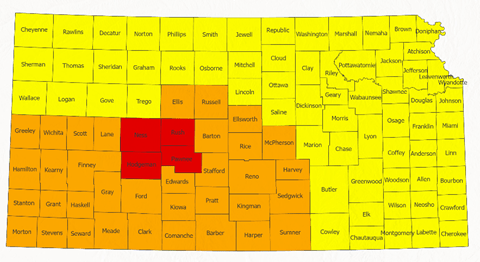
The drought declaration placed four counties into emergency status, 35 into warning status, and 66 into watch status. This action was recommended by Connie Owen, Director of the Kansas Water Office and Chair of the Governor’s Drought Response Team. While eastern Kansas has seen significant relief from drought since March, central and western Kansas has declined rapidly into Severe and, in a few counties, Extreme Drought.

The counties in emergency status are Hodgeman, Ness, Pawnee and Rush counties.

The counties under a drought warning include Sedgwick, Reno, Kingman, Harper, Harvey, Sumner, Barber, McPherson and Pratt counties.

The counties in a watch status include Butler, Cowley, Chase, Marion, Greenwood, Elk and Chautauqua counties.

Owen said in a press release, “The counties in a watch status are experiencing conditions that indicate the probability of a water shortage is rising. It is important to monitor these conditions and be mindful of water usage in these counties. Summer has arrived, and with it, higher temperatures and a decrease in precipitation. The Governor’s Drought Response Team will continue to monitor the drought conditions across Kansas and make recommendations to Governor Kelly as conditions change.”

Public invited to attend statewide meetings to discuss implementation of Kansas Water Plan

0
Registration now open for the June 23-25 Republican River basin tour in Nebraska and Colorado. Seating is limited and first-come, first-served. Interest in the tour has been running very high for the past several months, so register now. More information is at watercenter.unl.edu

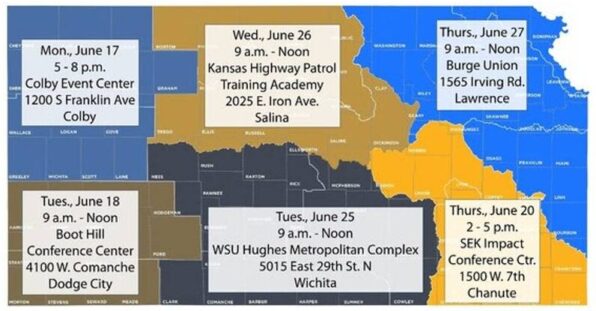
The Kansas Water Office, Kansas Department of Agriculture and Kansas Department of Health and Environment are holding a series of local consult workshops to discuss the implementation of the 2022 Kansas Water Plan.

The agencies are inviting Kansans to join the conversation and share their thoughts on:

  • Regional water needs
  • Priorities and recommendations for funding
  • Policy changes
  • Ways to improve state capacity and water management
  • Effectiveness of programs
  • Measurable goals and timelinesPeople are encouraged to attend the local consult workshop in their region of the state:
    • Monday, June 17, 5 – 8 p.m., Colby Event Center, 1200 S. Franklin Ave, Colby
    • Tuesday, June 18, 9 a.m. – noon, Boot Hill Conference Center, 4100 W. Comanche, Dodge City
    • Thursday, June 20, 2 – 5 p.m., SEK Impact Conference Center, 1500 W. 7th, Chanute
    • Tuesday, June 25, 9 a.m. – noon, WSU Hughes Metropolitan Complex, 5015 East 29th St. North, Wichita
    • Wednesday, June 26, 9 a.m. – noon, Kansas Highway Patrol Training Academy, 2025 E. Iron Ave., Salina
    • Thursday, June 27, 9 a.m. – noon, Burge Union, 1565 Irving Rd., Lawrence

    Those planning to attend can RSVP HERE.

    Questions about the workshops can be emailed to the Kansas Water Office.