Monday, February 9, 2026
Home Blog Page 410

Lettuce Eat Local: Raise an avocado toast to the baby

0

Amanda Miller
Columnist
Lettuce Eat Local


From where I’m sitting, I can see the avocado cross-stitch I made up on a shelf, the dinner table festooned with the avocado tablecloth a friend just gave me, and the knitted avocado stuffie on the floor where someone was playing with it. I have not one but two avocado-themed t-shirts, various avocado stickers here and there, and a Throw Throw Avocado party game. I’ve been given avocado-y greeting cards, recipe suggestions, and at least one kids’ book. And of course, there are almost always avocados in the fridge.

Some might say I have an avocado problem…but I like to think of it as an avocado solution. 

So it might not surprise you to hear that before she was even born, it was established that Kiah’s first food would be avocado. Many, if not the majority, of our parenting decisions and standards get modified, overhauled, or completely thrown out during the actual process of parenting; I will not even begin to assess how different a mom I was before I actually became one. 

It’s fairly clear that Kiah is not my first child — she’s my fourth kid/third baby, counting our long-term foster girls, and we started off pretty lax, so whatever few structures or rules we might have had have loosened up. 

But I did put my foot down on one thing, somewhat arbitrarily: I wanted to wait to give Kiah food until she reached six months old. That had been my goal with Benson, yet he was so desperately grabbing for food that I caved at five and a half months. Rosie did not care at all about or for food until she was older, so it didn’t matter so much for her. 

Kiah did care, especially these last few weeks, and it turned into even more into an interesting amalgamation of gymnastics + ninja skills + basic survival techniques for me to get a bite to my mouth when she was on my lap during a meal. Should I have started just giving her tastes of things? Maybe, especially since Brian was all for feeding the poor kid. Am I sad I held her off? Absolutely not. I have let go of most of my strictly rule-following younger self, but it didn’t hurt anyone for me to get to keep one rule. 

And we made it! Kiah turned six months old on May 13, and it was a big day on the calendar for us. Kiah’s First Food Day! It took all of two minutes for her to taste and be done with her ready-and-waiting avocado, but it was a fun and momentous celebration nonetheless. Yay for phone cameras to capture all the expressions as she realized the thing she crammed in her mouth this time was actually something. 

Okay for the sake of transparency, someone did sneak her whipped cream over a month ago already…but not with my approval and I’m the mom so I can say it doesn’t count. 

I think Kiah liked the avocado? Again, I’m the mom, so I’ll say she did. It was Benson’s first food too (again, with a caveat — he himself snuck chocolate before that), although with him I did the “proper” thing and waited three days in between introducing other new foods. 

With Kiah, I waited a day before giving her sweet potato…and then at least another three minutes before letting her try mango. Since then she’s gnawed on a bone-broth chicken bone, sucked on watermelon, pounded some pears, and today I’ll give her egg yolk. I feel like I opened the floodgates on feeding the baby. 

But of course, through it all we’ll keep on feeding Kiah avocado. And not just because Benson and I always selflessly help her polish off the rest of it. 


SPACE Salad

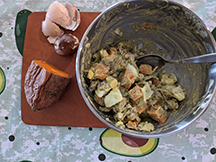
I couldn’t figure out what to call this, but fortunately Sweet Potato Avocado Chicken Egg makes a nice acronym. I had all these things prepared in the fridge for Kiah, but since she’ll eat approximately ½ teaspoon total of each, it seemed both appropriate and handy to create something for the rest of us. All the flavors and textures sounded like they’d be good together, and once I tried it, I agreed with myself. And yes, I went ahead and fed Kiah egg yolk since it was out. 

Prep tips: you don’t want to make a whole lot extra of this at a time, since the avocado will brown, but the acid of the dijon and creaminess of the mayo will delay that somewhat. My eggs were “hand-torn” since Benson was helping, but actually I do like the craggy shapes tearing eggs makes anyway. 

1 large baked sweet potato, in small cubes

2 hard-boiled eggs, diced or “torn”

½ cup cooked, shredded chicken

1 avocado

1 tablespoon dijon

1-2 tablespoons mayo

1 teaspoon maple syrup

salt and pepper to taste

Add potato, eggs, and chicken to a bowl. Dice half the avocado, and add to bowl; smash the other half with the mustard, mayo, and maple, then stir well into the other stuff. Season to taste. If you don’t have a baby eating her dress because you’re not feeding her more avocado, feel free to be cute and serve in the avocado peel halves. 

Property and taxes: a review

0
john marshal

Politicians often treat taxes as if they were rogue bacteria, ever-ready to afflict suffering and decay. This makes fine stuff for a speech or a campaign brochure but it smears reality. When administered with fairness and equity, taxes support and strengthen the welfare of communities and their citizens.

Politics these days no longer explain the issue but mangle it. Taxes are mostly discussed top down, beginning with crusty partisan squabbles in Topeka and how they play out on the farms and in the cities. Most Kansans see taxation the other way, from the home front outward where, beyond city hall and the courthouse, the matter of taxation is usually lost in a mash of storytelling and deceit.

Nonetheless, most Kansans react to the subject the same way: Impose taxes so the Other Fellow pays them, a persuasion embedded in politics for more than a century. This became law, in exaggerated form, during the dark Brownback years (2012-’17). Taxes were shifted to relieve big business and high wealth, and the Other Fellow paid handsomely and disproportionally. Brownback left office and a state treasury deep in red ink.

Although the state has recovered with healthy surpluses, Republican leaders continue to demand tax cuts to benefit the rich and squeeze the Other Fellow. Governor Kelly, a Democrat, and a thin corps of sensible lawmakers have resisted.

While the struggle continues, consider a wider look at taxes beginning with the property levy, a relic of the Pony Express days that is rarely fair. In spite of Gov. John Carlin’s successful initiatives (1986) for classification and reappraisal, property values remain difficult to assess uniformly.

The property tax is expensive to collect. It has scant relation to income produced. It often has a negative social impact because property that is poorly used is usually taxed less. In a twisted sort of way, the inefficient and those without enterprise get the rewards.

The property tax would have greater validity if it were used in relation to property and not to people. That is, taxes on farmland might be used to pay for rural roads and bridges, rural fire and water systems, law enforcement. In the towns, property taxes might well finance non-arterial streets, fire departments, storm sewers, parking and more.

*

Taxes for people functions are something else. These should be derived from incomes, sales and user fees and collected chiefly on a statewide basis.

The cost of public schools should relate not to the value of the land in a district but to the number of pupils to be educated; this is a principle of current law, but not all of it.

When he was majority leader of the Kansas Senate, Jerry Moran in 1995 proposed (without success) that local school finance be derived from sales and income taxes, and that the property tax be phased away. The numbers, accounting and logic favored this; the politics didn’t.

A state-run and state-financed educational system is logical if not popular. Indeed, social services and welfare, and public health programs should be on federal rather than state support, considering how transient our population has become.

These suggestions may run contrary to the notion that local control is better. Sometimes it is. Federal and state programs can develop costly and troublesome bureaucracies. Friends and neighbors understand better the local situations, but

today’s friends and neighbors are no longer apt to be tomorrow’s. And the price of local control can be inequitable and discriminatory taxation – with equally onerous and unfair results.

In early 1991, the House Tax Committee had restarted scrutiny of the state’s wide web of tax laws. Fresh from her election and inauguration, Gov. Joan Finney marched unannounced into the committee room and dropped a four-inch thick document on a table in front of the chairman. It was a listing of the state’s tax exemptions, loopholes and abatements. “Here’s one place to begin,” she said, and left the room.

The document quickly gathered dust.

Do you ever think about your lawn?

0

Do you ever think about your lawn? Turfgrass is so common in everyday life that people may not appreciate its value. Research continues to uncover environmental, economic, health, and safety benefits of natural turfgrass found in lawns, athletic fields, parks, and roadsides.


Healthy soil- Populations of beneficial organisms thrive within the root systems of healthy grasses, turning dead plants and organisms into healthy soils.


Water filtration- Pollutants bind tightly to the roots and thatch layer of grass systems. Microbial organisms work with the thatch layer to keep surface and groundwater clean. Grass buffer strips located in and around farm fields, streams, and waterways filter soil and remove chemicals before they enter surface and groundwater. In urban areas, grasses filter water that contains contaminants from oil, grease, and other household and industrial wastes.


Erosion control- Grass reduces soil erosion caused by water and wind. Grass develops a thick root and shoot system forming a wall that prevents soil erosion. For example with new road and home construction, sod is laid next to the curb to prevent soil erosion and act as a buffer strip. The strip filters runoff water before it enters the street and storm water drains, which lead to nearby streams and surface waters. Regular mowing increases shoot density and root mass, which improves soil stability. Grass prevents water and wind erosion by slowing down the flow of water and holding soil in place. Research shows that sediment loss from grass is negligible under normal rainfall conditions.


Noise reduction- Grasses planted along a roadside will decrease the noise level by 40 percent compared to hard surfaces.


Natural air conditioning- Urban areas with fewer grasses and landscape plants are 10 to 15 percent warmer than their rural neighbors. Water evaporates through the stomata, the tiny openings in the grass blades, cooling them and the surrounding environment. During the summer, lawns are 30 percent cooler than asphalt and 14 percent cooler than bare ground.


Reduces glare- Variation in the size, shape, and angle of individual grass blades disperses sunlight. This reduces glare and improves visibility in sunny conditions.


Pollution control- A healthy lawn produces an abundance of leaf tissue to trap dirt and dust particles and protect air quality. About 12 million tons of dust is released into the atmosphere each year in the U.S., and much of it is trapped by grass.


Emotional and physical well-being- Vegetated landscapes not only enhance the environment, but they improve mental, physical, and emotional health. Hospital patients recover faster when their rooms face areas with grass and landscape plants.


Absorbs carbon dioxide, releases oxygen- During photosynthesis, grasses remove carbon dioxide and add oxygen to the atmosphere. Healthy turf areas give off abundant oxygen, which humans need to survive. Over the course of a year, a 2,500 square-foot lawn absorbs enough carbon dioxide to produce oxygen for a family of four.


Conditions soil- Grass roots grow continuously — dying, decomposing, and regrowing. This builds humus, which keeps soil biologically active and improves physical and chemical properties. The best, most fertile soils in the world were created under grasslands.


Keeps pollen in check- Healthy lawns have few weeds, which reduces pollen levels. Regular mowing also prevents grass plants and weeds from producing pollen-bearing seedheads and flowers.


Discourages small pests- Small pests (snakes, mice, and rats) and insects (chiggers and mosquitoes) live in tall grasses. Regular mowing keeps these undesirable pests away.


Improves community health and safety- Most outdoor recreational activities take place on grass. There are fewer injuries and they tend to be less severe when athletes play on natural grass compared to synthetic turf athletic fields. Adding turf to city parks has been shown to improve community relationships and emotional well-being, and to reduce crime. Parks and golf courses provide natural habitat for plants and animals in places that would normally be used for industry or housing. Many golf courses are certified as bird and wildlife sanctuaries by the Audubon Society.

Grandma’s Asparagus

0

It’s only appropriate when you pen a column, on your birthday, you feature a recipe that reflects a part of who you are, a historical throw-back. Actually, thank goodness, I know what great dish I want to share today because for the last 3 days everything has been a bit hazy. A sinus infection hit me midweek, and everything since has just been a bit of a blur. For Mother’s Day our son, Phillip, took the lead and prepared us a wonderful chicken dish for dinner. I coached him through the lite al fredo sauce and he sailed into a wonderful meal.

Let’s pop back to circa 1964, there was only one way to prepare asparagus. Eating it slightly blanched on a salad was unheard of, not to mention asparagus soups and casseroles. We enjoyed it only ‘one’ way, the way my grandmother, Lucy Rightmire Richardson prepared the vegetable. The stalks were trimmed and steamed on top of the stove, in a small saucepan she placed milk, butter, salt and pepper. Yet in another pan she prepared hard boiled eggs. In the ‘oven’ (no toasters at the farm) she prepared 5-6 slices of bread. As everything came together, she broke the bread into small pieces, layered in pieces of asparagus poured the milk sauce over the top and lastly laid on sliced hard-boiled eggs. The whole time my grandmother was alive I never ate asparagus; I thought it was disgusting. (I enjoyed the hard-boiled eggs).

The typical sauce for asparagus was a lemony butter hollandaise sauce. My synopsis on the milk sauce was it was more ‘country’ than the fancy hollandaise sauce, and any cook could make it. The recipe I share today is made with a white sauce, which can be turned and flipped a variety of ways to make it lighter, or more like a hollandaise.

This was the only way I saw asparagus served as a very young girl. I still didn’t start eating it myself until my mid-twenties, now it is a favorite by far. When my mother, Betty was alive she had lots of myths about asparagus and how it had such a wonderful after-effect on our body functions. We both think it was the dairy, I also think it had to do with the time factor of cutting and serving times.

How do you eat asparagus? Etiquette shows us that it is very proper to cut a long stalk in half and pick it up with your fingers. I know, Ervin was surprised too!

I haven’t prepared our asparagus this way for quite some time because Phillip loves it anyway it’s presented. Last time he leaned over the platter and said this half is mine, and the rest is for everyone else!

One of my favorite breakfasts would be mushroom sherried eggs, asparagus, fruit and fresh breads, muffins, etc. The colors are vibrant and the plate is so appealing. Enjoy these days of springtime weather, pretty quickly they will be gone. Simply yours, The Covered Dish.

Old-Fashioned Asparagus

3-4 hard-boiled eggs

1 pound asparagus steamed, grilled or sauteed

3-4 pieces of toast

Salt to taste

Pepper to taste

1 1/2 cups milk

2-3 tablespoons, butter

1/2 cup your choice of cheese-usually I use American, (or not?)

Begin by trimming the tough ends off the bottom of the cleaned asparagus before steaming. Boil the eggs, remove shells and thinly slice with an egg slicer. Place the milk, butter, salt, pepper and cheese into a shallow dish to make a thickened white sauce. Pour the warm sauce over the asparagus and top with the warm sliced eggs. If you want the sauce to have more body add a little cornstarch or flour to thicken it to your desires.

Another year older, another outstanding memory, I can close my eyes and see it all over again. Memories they’re the best. Build new ones, and ‘repeat’ the old!

“Bulligerent” revenge

0
Thayne Cozart
Milo Yield

The guys at the morning Geezer Gang Gathering at the Short Stop were recently discussing some of the ins and outs of moving cattle. Their discussion awoke in my mind a “bull story” from the long-ago past, sometime in the late 1970s or early 1980s.

I have friends who ranch near Havana — Kansas, not Cuba. They raise good Angus cattle. Back in those days I had a business reason to be in their locale about once a week and I often took advantage of their hospitality to fish and hunt on their property.

Well, one hot, muggy summer morning I arrived at my friends’ ranch and got invited to help them bring into the home corral an Angus bull that they needed to cull.

The four-man crew, including me, headed out to the distant pasture — some a’horseback and some on ATVs.

When we arrived, we soon discovered that Mr. Bull had no intentions of moving from his harem of cows. He dodged, ducked and back-tracked. He tried to stay in the middle of the herd. He used every ploy in the ‘bovine book of resistance” to keep from getting separated from “his girls.”

But, eventually, the round-up crew prevailed with persistence and got Mr. Bull separated from the cows, out the pasture gate, and headed toward the home corral.

But, by this time Mr. Bull was heated up, both physically and mentally. He wuz panting and slobbering. And, as often happens with a stressed bovine brute, he sulled. He went under every shade tree he could find and belligerently stood his ground. Then he ran and stood in the middle of a muddy pond and resisted our efforts to move him.

Finally, the guys on horses drove him from the pond and headed homeward again. Just outside the home corral there wuz a small barn in disrepair. So, naturally, Mr. Bull sought sanctuary in the shade inside the barn.

Well, it so happened that the barn wuz also where my friends had stored their aluminum fishing jon boat. It wuz just resting on the ground safely out of the weather.

So, imagine his consternation, when my friend dismounted and went on-foot into the barn to drive the highly stressed Angus from his hidey-hole, and his eyes fell on this scene.

Mr. Bull was exacting his “bulligerant” revenge the extreme bovine way. He wuz squarely standing with his overheated one-ton body in the middle of the aluminum jon boat and he wuz doing his level best to fill the boat simultaneously with both urine and manure.

Mr. Bull didn’t fill the boat, but he sure made a deep depression in the bottom of the boat and it definitely needed a good cleaning before it wuz used for fishing again.

***

A rural clergyman was driving down a dusty gravel road when he came upon a group of farm boys each about 10 years of age surrounding a dog. They were quite animated. Concerned, he stopped and asked them what they were doing.
One of the boys replied, “This dog is an old neighborhood stray. We take him home with us sometimes, but only one of us can take him home. So, we’re having a contest. Whoever tells the biggest lie can take this dog home for awhile for a pet.”
Of course, the reverend was shocked! “You boys should be ashamed of yourselves. You shouldn’t have a contest telling lies!” he exclaimed. “That’s not God’s way.”

He then launched into a 10-minute sermon against lying, beginning, “Don’t you boys know it’s a sin to lie?” and ending with, “Why, when I was your age, I never told a lie.”
There was complete silence for a minute or so. Then, as the reverend smiled with satisfaction that his impromptu sermon had gotten through to them, the smallest boy gave a deep sigh and piped up, “All right, give him the dog.”

***

My recent column about coyotes and bounties paid on them back in the days of my youth, prompted my good buddy, ol’ Willie Jay, from Mt. Vernon, Mo., to respond with a couple of coyote bounty stories of his own. I will neither vouch for the veracity of either of his stories, nor suggest that he stretched the truth. You decide. But here’s his first story:

“Milo, it wuz back in the 1940s that me and my best buddy cashed in on coyote ears. Only, then in Missouri the bounty wuz $2 for pups’ ears in the spring, but the bounty rose to $10-12 if it wuz after July. So we deep froze the ears we got in the spring until July when we could thaw them out and cash in on the higher bounty. I recall that the county clerk would look at the ears to see if the ears had ticks crawling that had unfroze back too life. So, he said, ‘Yep, they’re fresh. The ticks are crawling. Here’s your bounty.’ It wuz a heck of a deal, and I hope the statute of limitations has run out on coyote bounty fraud.

***

Here’s Willie’s second story: “Milo, once in 1958 a neighbor came to the house about 6 a.m, and told me to get my gun and come with him to kill a coyote on his pond dam. So, I got my 30-cal Remington auto and loaded up 6 rounds. Sure ‘nuf. There on the pond dam stood a coyote. It wuz just over a 100 yards. I put the crosshairs on it. ‘Bang.’

“He said, ‘You missed it.’ I looked and there wuz the coyote. So, I squeezed off again. Missed again. Did it again. Missed. Five times I missed. Then, the coyote started to run across the pasture in a hurry. I put the dead eye on it’s nose, squeezed the trigger and rolled it head over heels. Took six shots. We walked down to the pond, looked over the bank. There were 5 dead half-grown pups and the mother dead out in the pasture. We froze the ears until July and got enough money to build a 6-wire, 1/4 mile fence between us. The hedge corner post is still standing. Bet it’s the only fence in Missouri built with coyote bounty money.”

***

Words of wisdom for the week: “Overweight is what happens when you live in a food’s paradise.” Have a good ‘un.