Monday, February 9, 2026
Home Blog Page 415

Immunization Requirements for School Year 2024-2025

0

Immunization requirements and recommendations for the 2024-2025 school year are based on the Advisory Committee on
Immunization Practices (ACIP) and the Centers for Disease Control and Prevention (CDC) recommendations.

The current recommended and minimum interval immunization schedules may be found on the CDC webpage. The best disease prevention
is achieved by adhering to the recommended schedule. However, if a child falls behind, the catch-up schedule is
implemented. To avoid missed opportunities, immunization providers may use a 4-day grace period, in most instances, per
age and interval between doses. In such cases, these doses may be counted as valid

K.S.A. 72 – 6261 – Kansas Statutes Related to School Immunizations Requirements and K.A.R. 28-1-20,published
July,18, 2019 in the Kansas Register, definesthe immunizationsrequired forschool and early childhood
program attendance.

• Diphtheria, Tetanus, Pertussis (DTaP/Tdap): Five doses required. Doses should be given at 2 months, 4
months, 6 months, 15-18 months, and 4-6 years (prior to kindergarten entry). The 4th dose may be given as
early as 12 months of age, if at least 6 months have elapsed since dose 3. The 5th dose is not necessary if the
4th dose was administered at age 4 years or older. A dose of Tdap is required at entry to 7th grade (11-12 years).

• Hepatitis A (Hep A): Two doses required. Doses should be given at 12-23 months with a minimum
interval of 6 months between the 1st and 2nd dose.

• Hepatitis B (Hep B): Three doses required. Doses should be given at birth, 1-2 months, and 6-18 months. Minimum age
for the final dose is 24 weeks.

• Measles, Mumps, and Rubella (MMR): Two doses required. Doses should be given at 12-15 months and
4-6 years (prior to kindergarten entry). Minimum age is 12 months and interval between doses may be as short
as 28 days.

• Meningococcal-Serogroup A,C,W,Y (MenACWY): Two doses required. Doses should be given at entry to 7th
grade (11-12 years) and 11th grade (16-18 years). For children 16-18 years, with no previous MenACWY, only
one dose is required.

• Poliomyelitis(IPV/tOPV): Four doses required. Doses should be given at 2 months, 4 months, 6-18 months, and
4-6 years (prior to kindergarten entry). Three doses are acceptable if 3rd dose was given after 4 years of age and at
least 6 months have elapsed since dose 2.

• Varicella (Chickenpox): Two doses are required. Doses should be given at 12-15 months and 4-6 years (prior to
kindergarten entry). The 2nd dose may be administered as early as 3 months after the 1st dose, however, a dose
administered after a 4-week interval is considered valid. No doses are required when student has history of
varicella disease documented by a licensed physician.

Legal alternatives to school vaccination requirements are found in K.S.A. 72-6262.
In addition, to the immunizations required for school entry the following vaccines are recommended to protect students:
• Human Papillomavirus(HPV): Two dosesrecommended at 11 years of age or three doses if the series is started after
15 years.

• Influenza and COVID-19: Annual vaccination recommended for all ages > 6 months of age.

Vaccination efforts by school and public health officials, immunization providers, and parents are key to the success of
protecting our children and communitiesfromvaccine preventable diseases

Sunn hemp can boost summer pastures

0

Frequent droughts in Missouri have livestock producers discussing more adaptable summer pasture options.

“With tall fescue as the dominant Missouri forage, there are few options to enhance those fescue fields to graze through a long, hot, dry spell,” said Tim Schnakenberg, University of Missouri Extension agronomy field specialist.

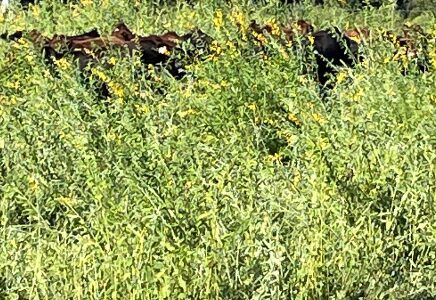
MU researchers have extensively evaluated sunn hemp as an option. Sunn hemp is a summer annual legume growing as tall as 6 feet, producing a large cluster of nutritious leaves from a single stem. Some summer annual forages will drop seed and come back the next year. But sunn hemp will not survive Missouri conditions even if it has a chance to produce seed, Schnakenberg said.

“Most of the time, we will not have enough time in our growing season to produce a seed crop, which is OK for us since the seeds are toxic to cattle,” he said. “No survivable seed means this crop must be planted each year if it is used as an ongoing forage option.”

Sunn hemp can be grown alone, combined with other summer cover crop forages in a mix or inter-seeded into tall fescue stands. Most research in Missouri has focused on inter-seeding. Compared to a legume like alfalfa, sunn hemp doesn’t require super high fertility to be established and productive. It also is a non-bloating legume with a rapid growth rate and high potential for regrowth following a grazing. It is excellent for diluting the toxicity of endophyte-infected Kentucky 31 fescue stands.

One benefit of introducing sunn hemp to complement a tall fescue stand is shade for the cool-season forage during the most brutal time of summer. In extreme situations, the fescue goes semi-dormant in drought. But with the shade of a bushy forage towering over the stand, the fescue is protected and better preserved. Cattle benefit from both the grass below and the higher-quality legume leaves above.

“The cost of the seed can be offset by the fact that it has been confirmed by Dr. Harley Naumann at the University of Missouri to produce as much as 40 pounds of usable nitrogen per acre each year for the grass crop it is growing in,” Schnakenberg said. “The protein level for the whole plant in Naumann’s studies has been as high as 17% 35 days after planting.” Naumann has found leaf samples to test as high as 25% during the same time period.

In a recent MU Extension study evaluating sunn hemp grazing by late-gestation cows, season-long sunn hemp accumulation reached 4,400 pounds per acre. Naumann and livestock specialist Chrisee Wheeler conducted the study at the MU Wurdack Extension and Education Center.

Establishing sunn hemp in tall fescue should not start early. This forage prefers to germinate in soils that are around 70 F, so it’s often established in early June in Missouri. Generally, the recommendation is to plant 25-30 pounds (pure live seed) per acre either by no-till or broadcast following a fescue hay harvest or grazing. No-till will produce the more consistent stands. Most of the growth occurs between 30 and 60 days after planting.

Once sunn hemp reaches about 1.5 to 3 feet tall, about 45 days after planting, it’s a good time to begin grazing by cattle, sheep or goats. Early grazing is important to ensure good forage quality for the season. Graze down to about 10-12 inches in the stalk before turning out of the field. Cows often will graze on their own down to about 10-12 inches minimum. Often, a 21-day rest period is the most beneficial grazing strategy for the health of the plant.

Another trait observed during sunn hemp grazing is its ability to regrow very well at the area of the stalk it was last grazed down to. Instead of the stalk growing upward like the original growth, it begins to branch at hidden axillary buds, causing a bushier plant with plenty of nutritious leaves for the next grazing.

“Naumann has also been experimenting with using sunn hemp as a late-summer hay source,” Schnakenberg said. “Traditionally, agronomists have discouraged its use for hay due to the woody stems, but Naumann has found the quality of the forage in a bale is better than expected. It’s best to make hay late in the summer or early fall so that there will be no need for high cutting for the benefit of having regrowth. There is more work planned on this.”

First frost will end the growing season of sunn hemp. Leaves will drop off and the stems will be all that is left. Pastures will look ragged by early winter due to the dead stems, but it will be just in time for the fescue below to continue building growth for winter stockpile.

For more information on using sunn hemp in a grazing system, contact your local MU Extension agronomy specialist.

Police Youth Academy coming up this summer

0

The Hutchinson Police Department is accepting applications for the 2024 Youth Academy. Spaces are limited. Applications must be submitted by June 14.

The Hutchinson Police Youth Academy is a free and fun educational opportunity by Hutchinson Police Department to allow youth in the community to interact with officers and get a chance to have some hands-on law enforcement experience.

Subjects that will be covered:

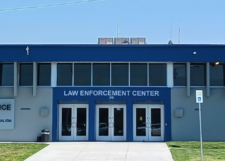
-Law Enforcement Center Tour
-Crime Scene Investigations
-Police Vehicles / Equipment / Drones
-Emergency Response Team Demo
-Firearms and Safety Demo
-K9 Demo
-Patrol Operations
-Crash Investigations
-Detectives / Investigations
-Police Records
-Animal Control
-Court Procedures

When: Thursday, July 11, 2024 from 8 a.m. until 5 p.m.
Where: Meet at the Law Enforcement Center (210 West 1st Ave)
Who: Due to limited space, we are only allowing youth who are going to be 7th graders next fall to attend.

Anyone within Reno County that meets the requirements may participate. This includes those students who are home schooled.

What: Participants will learn about Law Enforcement operations.

Lunch will be provided to all participants. This is a free event.

If your child meets the criteria and you wish for them to attend, please contact Captain Gates at 620-694-2825 for an application.

Kansas farm invites innovative experiments

0

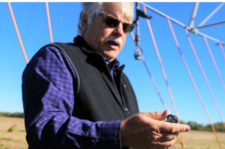
MOUNDRIDGE, Kan. — Ray Flickner knows the usual risks farmers take with weather, price volatility and personal safety. He’s also become quite comfortable facing the risks inherent in being an early adopter of unproven technology. The fifth generation farmer raises corn, soybeans, sorghum and wheat alongside research projects on the Flickner Innovation Farm, a former homestead near Moundridge in McPherson County.

Innovation has a long history at the 150-year-old farm, where the land has been used for a dairy, swine operation and commercial catfish farm. In 2019, Flickner and his wife, Susan, embarked on a journey to discover the technology that will drive agriculture forward in the 21st century through collaborations with more than a dozen university, industry and agency partnerships.

It Begins with Water

Flickner says his uncle drilled one of the first irrigation wells in the area, which has become one of the most senior water rights in the region. The only older one is owned by the city of Moundridge.

“We do have a water problem in the state of Kansas,” Flickner says. “We’ve allocated and appropriated more than what Mother Nature has provided us. I’m lucky that I have a shallow aquifer that does recharge.”
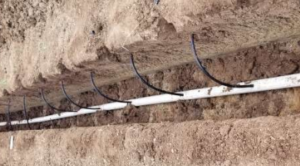
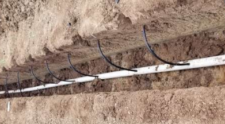
In 2001, Flickner began one of his most ambitious experiments to conserve water. He switched from the proven but resource-hungry flood irrigation to a subsurface drip irrigation system, which involved burying miles of tubing with small nozzles under a field. To date, the farm has converted more than 600 acres to the underground watering system. The conversion has proven efficient, using nearly 40 percent less water than the county average.

Center pivots are also employed on the farm, but they’ve been retrofitted with longer drop hoses, modern sprinkler heads and, in one case, a mobile drip system that places droplets directly on the soil surface. The goal is to lose less water to evaporation and have more of it reach the crops it helps grow.

“Water conservation is very near and dear to my heart,” Flickner says. “In 2023, if you had irrigation in McPherson County, you did pretty good. If you didn’t have irrigation, you did not do too well. It just made a world of difference. The fact you can water a crop is a major insurance policy in years it doesn’t rain.”

Appetite for Risk

Flickner’s willingness to accept the risk of unproven technology on his farm is part curiosity and part background. He was a teacher before he entered the banking industry, where he primarily worked with farmers and ranchers in Kansas and across the nation.

“Being on the lending desk gives you the opportunity to see different operations,” he says. “Some were very successful, and others were not so successful, financially speaking.”

Flickner took the lessons he learned from lending and has applied them not only to his farm, but his life in general.

“If you’re in the agricultural industry, you’re not risk averse,” Flickner says. “Risk comes with the territory. Now, you have to figure out how to manage that. My entire lifetime, if I hadn’t bought something through leverage, I’m not sure what we’d have. I’d be living in a little shack someplace.”

Flickner says his willingness to take chances was the subject of some deep discussions with his late wife, Susan, who didn’t have the same tolerance for debt. Flickner has always viewed leverage as a tool that can help or hurt, and he says he’s fortunate to be in a position where it’s mostly helped. It doesn’t hurt that he views borrowing money in the same way he looks at trying new technology: It’s not necessarily about getting bigger, but making the whole operation better.

“The idea of trying something new and different has always intrigued me,” he says. “Can we move the needle? Can we do things differently to help improve things?”

Innovation on the Farm

While subsurface irrigation was a big technological step for Flickner, it was just the beginning of learning how to maximize the natural resources on his farm. The ultimate goal is to grow more grain with less water, less labor, less fertilizer and fewer pesticides. With a focus on the future, Flickner also understands the past and how it’s influenced him today.

“I can’t fault my forefathers for plowing the prairie when they came here because if they hadn’t, I wouldn’t be here today,” he says. “It was a matter of survival. You use the tools and techniques available to you. Hopefully we can get away from the plow.”

Flickner’s ancestors plowed the prairie to raise many of the same crops he does today, but it came at the cost of wind and water erosion on the bare soil when crops weren’t growing. Today, Flickner employs a minimum-tillage practice that leaves the bulk of crop residue in the fields, not only to keep the soil in place but also to conserve moisture. He’s also begun experimenting with cover crops, which don’t have a cash value. Instead, they offer further protection for the soil while also allowing water to penetrate more easily, preventing runoff.

When it does rain enough for runoff to occur, the farm has installed monitoring stations that capture samples of the water that can be tested to see what else is leaving the farm with the water, like fertilizer and other nutrients. Dry conditions have hampered those tests so far.

“The initial focus was water conservation,” Flickner says. “It has grown into a much bigger situation with the cover crop concept and soil health, surface water evaluation. We’ve got to have rain, but that will happen.”

Teaching and Learning

In addition to Flickner’s experience in banking, he and his wife both had backgrounds in education. Their shared passion for teaching helped turn their farm into a classroom where they’ve hosted projects ranging from graduate student research to private companies testing products in real-world conditions.

“I’ve told the researchers this is a blank canvas,” Flickner says. “You can paint it however you think it should be painted, but I do reserve veto power. There’s been a couple of projects that I said, ‘No, we’re not going to do that.’”

Sometimes the projects find success in other areas; for example, one effort used a “drone in a box,” or an unmanned aircraft, that could take off, record crop data from above and land without any human intervention. The company ultimately pursued opportunities outside agriculture after successfully proving it worked on the Flickner Innovation Farm.

As Flickner participates in these projects and meets more researchers, he discovers there’s a lot no one knows — yet.

“The more I do this, the more questions I come up with and the fewer answers researchers can provide,” he says.

Peer Recognition

Flickner’s efforts to improve his farm have earned him numerous accolades, including the Kansas Farm Bureau Natural Resources Award in 2021 and the 2023 Kansas Leopold Conservation Award, which celebrates extraordinary achievement in voluntary conservation. Winners receive a crystal award and $10,000 for their efforts.

“It’s always humbling but rewarding to be recognized by those in the industry for what you’ve done,” Flickner says. “It’s something I’ll remember forever.”

Flickner also hosts field days at the farm, inviting others to see what projects are underway and ask questions about what’s working and what isn’t.

“I’ve heard from a number of people they’ve implemented some things they saw (at field days),” Flickner says. “You’ve got to be willing to share the data. For agriculturists, that can be a challenge. Because of my desire to make things better, I’ve been willing to share that information.”

His goal isn’t to win awards or squeeze out a little more profit, but rather to leave the farm in a better state for the next generation — and hope they continue the journey of trying to move the needle.

“You do what you think is right,” he says. “You hopefully leave it better for the grandkids.”

Learn more about the Flickner Innovation Farm at www.facebook.com/FlicknerFarms.

Celebrating Innovation

Kansas Farm Bureau’s Natural Resources Award honors members using time-honored and cutting-edge conservation practices to protect and improve our state’s natural resources. These good stewards serve as mentors for KFB members and nonmembers alike to help demonstrate innovative agricultural production and resource conservation. Learn more about the program at www.kfb.org/nra.

The Leopold Conservation Award Program recognizes and celebrates extraordinary achievement in voluntary conservation by agricultural landowners. The program shares the stories of these conservation-minded farmers, ranchers and forestland owners to inspire countless other landowners to embrace opportunities to improve soil health, water resources and wildlife habitat on their working land. Learn more about the Leopold Award at www.sandcountyfoundation.org.

Saturday night to see hundreds of millions of birds heading north, including across Kansas

0

Rising spring temperatures and weather conditions will likely push hundreds of millions of birds northward this weekend — and bird lovers in Kansas, Nebraska, Missouri and Iowa will get a front-row seat.

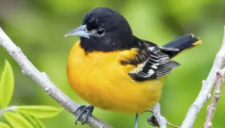
A mind-boggling variety of warblers, cuckoos, flycatchers, orioles, buntings and other travelers will largely fly under the cover of night.

But when the sun comes up, it’s time for them to feed and rest, making this a great weekend to grab binoculars or a bird song ID app and head outdoors.

“This is a big one,” said Andrew Farnsworth, a visiting scientist at the Cornell Lab of Ornithology. “You’re in the right place. The Central Flyway is the thoroughfare for spring migration.”

350 million birds are about to flap their wings northward

On Saturday night alone, Bird Cast scientists expect nearly 350 million birds to head north in the U.S. As many as 100 million or 200 million of them will take the Central Flyway over several eastern Great Plains and Midwest states.

Kansas City and surrounding areas are projected to be the hottest of hotspots.

“We’re at a period of the season when the largest numbers and the greatest diversity of birds are moving,” Farnsworth said. “Through the eastern Great Plains, you may be talking about between 100 and 200 species.”

Warm temperatures and clear skies Saturday night will spur birds on their epic journeys.

The heavy traffic might continue Sunday night, but a rain front could move in by then, putting a damper on the movement.

Farnsworth offers a birdwatching pro-tip: Night-time rainfall during peak migration is a great time to visit green spaces the next morning and check out who stopped to wait out the storm.

Spring bird migration tends to peak in the first half of May for Kansas, Missouri, Nebraska and Iowa.

Saturday night expected to see mass migration of birds across Kansas

Bird Cast tracks bird movement with radar and combines that information with weather conditions to create day-by-day migration forecasts each fall and spring.

The program is operated by the Cornell Lab, Colorado State University, the University of Massachusetts Amherst and the University of Illinois.

On any given night during spring migration, some birds are on the move. But specific nights end up seeing incredible numbers on the wing. They’re nudged by weather conditions such as rising temperatures, precipitation patterns and favorable winds.

Scientists urge people to turn off any unnecessary lights at night this time of year. Many millions of birds die each year by slamming into windows, and light pollution during migration season increases the risks.

Turn off outdoor lights and close blinds to help birds on their journey

Deciding to turn off your own outdoor lights or to close your blinds and curtains helps — even if other homeowners and businesses in your area don’t follow suit.

“It does make a difference,” Farnsworth said. “Every light off does count.”

Some cities, such as Houston, have mounted major campaigns to turn off unnecessary lights during peak migration season.