Monday, February 9, 2026
Home Blog Page 418

Cowboy Code Of Conduct

0

Some words on behavior from silver screen cowboys from decades ago may be more relevant and needed than ever.

The West is associated with honor, bravery, and the pioneer spirit heading into the unknown to make a better life. Today, the West continues to celebrate that “cowboy spirit” of adventure and entrepreneurial pursuits.

Principled behavior became codes of conduct that many cowboy heroes promoted in the early day Western movies and television shows. It’s not difficult to see how it wouldn’t be better following simple rules of polite and thoughtful deportment.

In a four-part series, the philosophies of four inspirational early day movie cowboys, unknown to many today, will be shared.
Singing cowboy songs, Gene Autry rode his famous horse named Champion in at least 93 movies and 91 television shows.

A world-renowned professional rodeo contractor, often entertaining at those rodeos, Autry also made worldwide public appearances. He and Champion performed at the Tri-County Fair in Herington which Grandma attended.
Autry made more than 640 recordings with 300 songs he wrote, including “Here Comes Santa Claus.”

War hero, rancher, baseball team owner, cowboy museum developer, radio, television, real estate proprietor, and comic book personality with signature cowboy toys, Autry was the most financially successful silver screen cowboy.
He’s the only entertainer to have five stars on the Hollywood Walk of Fame: radio, recording, motion pictures, television, and live performance/theater.

Gene Autry’s Cowboy Code of Honor

1. The cowboy must never shoot first, hit a smaller man, or take unfair advantage.
2. He must never go back on his word, or a trust confided in him.
3. He must always tell the truth.
4. He must be gentle with children, the elderly, and animals.
5. He must not advocate or possess racially or religiously intolerant ideas.
6. He must help people in distress.
7. He must be a good worker.
8. He must keep himself clean in thought, speech, action, and personal habits.
9. He must respect women, parents, and his nation’s laws.
10. The cowboy is a patriot.
Reminded of Matthew 7:7-11 “Ask and it will be given to you; seek and you will find; knock and the door will be opened to you. For everyone who asks receives; the one who seeks finds; and to the one who knocks, the door will be opened.”
+++ALLELUIA+++

KU News: Study reports new compound halting replication of COVID by targeting ‘Mac-1’ protein in cell models

0

From the Office of Public Affairs | http://www.news.ku.edu

Headlines

Contact: Brendan Lynch, KU News Service, 785-864-8855, [email protected], @BrendanMLynch

Study reports new compound halting replication of COVID by targeting ‘Mac-1’ protein in cell models

LAWRENCE — Research appearing in the Journal of Medicinal Chemistry shows for the first time SARS-CoV-2, the virus responsible for COVID-19, can be inhibited from replicating in living cell cultures using a compound that targets “Mac-1,” a protein key to defending SARS-CoV-2 against the human immune response.

University of Kansas researchers in the lab of Anthony Fehr, associate professor of molecular biosciences at KU, teamed with scientists at the University of Oulu in Finland and McDaniel College in Maryland to test a promising molecule, called “Compound 27,” that specifically inhibits the Mac-1 protein from SARS-CoV-2.

Compound 27 was isolated via a technique called high-throughput screening and then further modified by the Finnish team to target the Mac-1 protein precisely. Then, Fehr’s KU lab tested the modified agent against the virus to gauge its effectiveness.

“Our lab really has analyzed Mac-1 in many ways over the years and laid the foundation that this is a good antiviral target,” Fehr said. “If SARS-CoV-2 doesn’t have this protein, it doesn’t cause disease in mice. So, we believe compounds targeting Mac-1 should protect people from disease.”

Compound 27 appears to be particularly effective against Mac-1. As the team reports in its new paper, “Compound 27 is the first Mac-1-targeted small molecule demonstrated to inhibit coronavirus replication in a cell model.”

“When several of the high-throughput screening hits for Mac-1 inhibitors had the same core scaffold, we realized we had discovered something really promising,” said lead author Lari Lehtiö of the University of Oulu. “Experimental crystal structures showing the detailed binding mode to Mac-1 were a key for designing new analogs, but there was also a component of luck and intuition that helped us to improve the potency of Compound 27. But — the time to actually celebrate was when we got an email from Kansas that the Mac-1 inhibitor indeed repressed SARS-CoV-2 replication.”

Fehr said therapies based on Compound 27 or similar compounds with potential to inhibit Mac-1 someday could join already existing SARS-CoV-2 medications like Remdesivir. What’s more, Mac-1-based therapies could fight emerging coronaviruses beyond SARS-CoV-2.

“There’s a distinct concern within the health and virus communities that other coronaviruses could trigger future pandemics, such as Middle East respiratory syndrome coronavirus, which is a major potential threat listed among pathogens with pandemic potential,” he said. “MERS-CoV is somewhat related but distantly compared to SARS-CoV-2. Additionally, there are various coronaviruses that cause the common cold, although they’re very distantly related to SARS-CoV-2.”

Fehr said the question arises: When will one of these viruses evolve into a deadly threat?

“We’re keen on developing coronavirus inhibitors targeting the Mac-1 across multiple coronaviruses,” he said.

An additional benefit of Mac-1 targeted approaches is that coronaviruses seem to have trouble developing adequate resistance.

“It’s a good therapeutic target, because we’re finding evidence that even if it tries to develop resistance, it’s not going to be able to do so very easily,” Fehr said. “Our evidence suggests the resistant viruses would not be able to cause disease.”

For now, Fehr is eager to move the findings into additional coronaviruses to discover if Compound 27 and other related compounds targeting Mac-1 continue to show potential.

“We’re keen to begin developing inhibitors targeting the Mac-1 across multiple coronaviruses,” he said. “Furthermore, we aim to validate these inhibitors through testing in animal models. Currently, we’re validating them in ex vivo cell cultures, but transitioning to in vivo systems would provide a more comprehensive understanding of their efficacy.”

-30-

————————————————————————


KU News Service

1450 Jayhawk Blvd.

Lawrence KS 66045

Phone: 785-864-3256

Fax: 785-864-3339

[email protected]

http://www.news.ku.edu


Erinn Barcomb-Peterson, director of news and media relations, [email protected]


Today’s News is a free service from the Office of Public Affairs

Kansas Makes Historic Investment In Preserving The Ogallala Aquifer

0

Greg Doering
Kansas Living
Magazine

An appropriation of $35 million by the Kansas Legislature in 2023 was supported by several agricultural groups, including Kansas Farm Bureau (KFB). This was arguably the most significant investment in the state’s water resources in history. Prior funding for municipal, industrial and agricultural projects was supposed to total $8 million per year, but funding routinely fell short of that amount.
The extra funding comes at a critical time when declining groundwater supplies and diminished surface water storage threaten not just the farmers and ranchers who make up the backbone of the Kansas economy, but also dozens of communities who could have to invest millions in treatment facilities because of worsening water quality and more government regulation.
Legislators also added reporting requirements for each of Kansas’ five groundwater management districts (GMDs) and will require them to identify priority areas within their assigned geographies and develop plans to conserve water there.
Without intervention, the wells that sustain production agriculture in western Kansas will face problems with quality, quantity or both. Some wells have already been decommissioned because the level of the aquifer has receded or the water left isn’t suitable for growing crops. Others have less than a generation of usable water remaining under current demand. The stakes for finding solutions are high.
It’s highly likely the cream in your morning coffee, bacon on your club sandwich at lunch and your steak dinner all contain water from the aquifer. The Ogallala Aquifer supports 20 percent of the wheat, corn and cattle produced in the U.S. In Kansas, the groundwater is used to raise corn and forage that supports the dairy, pork and beef industries.
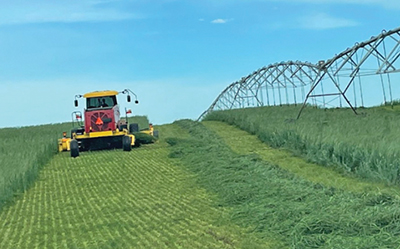
Slightly larger than California, the aquifer covers portions of eight states from South Dakota to Texas. In western Kansas, the average yearly rainfall ranges from 15 to 20 inches. That’s enough to grow some grains and forages, but not at the scale it’s done without assistance of on-demand watering from giant sprinklers called center pivots whose rotations create a patchwork of green crop circles.
First in Time
Under the Kansas Water Appropriation Act, all water in the state belongs to the people of the state, but it’s distributed by real property rights for beneficial purposes. In other words, water is a public good, and the state allows groups, both public and private, to use the water for any activity deemed beneficial.
For instance, an individual can apply for a permit to develop a well for irrigation — called an appropriation right — that creates a right to use the water but falls short of conveying ownership of the water.
The property right to use Kansas water is based on the principle of “first in time, first in right.” That means the earliest water right or permit holders have first rights to use the water, especially during a shortage. In theory, this seniority-based system was designed to distribute the available water supply in the event of a shortage. In practice, the state granted too many Ogallala permits with allocations too high for the amount of groundwater recharge available.
In the Spotlight
The legislative effort in 2023 finally put water at the forefront of discussions about how to best manage all sources of water, but especially groundwater in places like GMD 1, which covers portions of Greeley, Lane, Scott, Wallace and Wichita counties.
“Water in Kansas is obviously imperative to our economic health,” says Katie Durham, GMD 1 manager. “The (legislation) was a new precedent for shining a much-needed light on the importance of using water in a responsible manner.”
Durham says GMD 1 has been focused on prolonging the life of the Ogallala Aquifer with locally developed solutions that are farmer-driven and tailored to individual regions based on the health of the aquifer. The additional funding provided by the legislature will help with cost-share programs that encourage farmers to adopt more efficient practices or grow less water-intensive crops.
“We try not to limit it,” she says. “There’s so much new technology out there, you don’t want to limit someone from trying something out.”
She also welcomes the added reporting requirements for all GMDs.
“Farmers are great stewards of the land, so more opportunities to show that is great,” Durham says.
Slowing the Decline
Local enhanced management areas (LEMAs) allow GMDs to set conservation goals within a clearly defined geographic area with monitoring and enforcement elements. The areas give consideration to irrigators who’ve already reduced their usage.
While not the first district to implement a LEMA, Durham says the first one in Wichita County was so successful the other four counties in GMD 1 pursued a similar plan. The Wichita County LEMA was created in 2020 with the goal of reducing irrigation water use by 25 percent, which it has exceeded to date with estimated reductions of nearly 40 percent compared to historical use within the LEMA’s boundaries.
Durham says Wichita County farmers created the LEMA based on dropping water levels in their wells.
“When you see the water disappearing you start considering, ‘Is this going to be worth anything in the future if I don’t do something now?’” she says. “Our goal is to extend the life of the aquifer. If there are areas where we can meet sustainable criteria in an economically sound way, that’s wonderful. We recognize we have to take incremental steps.”
Irrigators and organizations like KFB have been supportive of LEMAs but wary of how they’ve been implemented because they don’t apply evenly to all water users and reductions don’t follow the longtime standard of “first in time, first in right.” Under the plans, which aren’t voluntary, users with senior rights can face larger water use reductions than junior rights-holders. LEMAs require the approval of GMD boards and last for five years, after which they can be renewed or discontinued.
Water is Everything
Just southwest of Garden City in the sandy soils of the Arkansas River Valley, siblings Marc and Gina Gigot have voluntarily placed more than 14 square miles of irrigated land into a water conservation area, which is similar to a LEMA but offers more flexibility and requires less red tape to establish. Their farm, Circle Land and Cattle, is named after the distinctive rings created by the dozens of center pivots that dot the landscape.
“Everything here has to do with water,” Gina says. “If it goes away, so does Southwest Kansas.”
The Gigot’s voluntary conservation efforts started in 2018 and have reduced pumping from 800 to 1,000 gallons per minute (GPM) down to 300 to 500 GPM. Overall, they’ve reduced their water use by 22 percent based on historical usage. To do that, they’ve employed technology, to a point, but the bulk of the reduction has come from how the farm is managed.
“We’ve changed the dynamics of what was done in the past,” Marc says. “We’re almost 100 percent forage. We’re not growing grain crops. We’re a large farm. It needs to begin with us. We’re hoping others will follow.”
Instead of corn, the Gigots now grow forage like alfalfa, triticale and sorghum that’s chopped for silage and goes to nearby feedlots, including their own, and area dairies.
“We try to walk everything off this farm through cattle,” Marc says. “So far, it’s working. Can you make more money with other crops? Probably in the short term. We’re in it for the long haul.”
The changes are already showing promise, with Gina noting water levels are increasing most years or staying the same.
Full Circle
In the near future, the Gigots will reduce their use of groundwater even more by reusing water from Garden City’s water treatment plant over roughly three square miles of their farm. The water comes from the city’s municipal sewer system as well as wastewater from an ethanol plant and a facility that primarily produces powdered milk. The treated water will be piped from just east of the city to Circle Land and Cattle.
“The whole goal for that is seven of the city’s (water) wells are in the pasture east of us,” Gina says. “If we can increase the aquifer over here, then it will benefit the city by increasing the health of their wells.”
The project will reuse about 3,000-acre feet of water, the equivalent of submerging about the same number of football fields in 12 inches of water. It will grow the forage to be fed to dairy cows whose milk production will be powered with the excess water potentially returning to the Gigots farm to start the cycle over again.
The Water Plan
Fully funding the state’s water plan will provide more research to discover less thirsty varieties of existing crops, education on how management decisions can lower water use while maintaining or increasing profitability, and resources to help farmers adopt already available efficiency technologies.
These changes are meant to, at the very least, prolong the life of the Ogallala Aquifer, with the ultimate goal of reaching a point of stability where the aquifer stops declining while farmers are still able to irrigate their crops and help drive Kansas’ economy.
The depletion of the state’s groundwater resources didn’t begin overnight, and solving the problem won’t happen quickly, either. With a spotlight now on the issue and the money to implement changes, Kansas has started on a path toward stability.

https://kansaslivingmagazine.com/articles/2024/05/05/kansas-makes-historic-investment-in-preserving-the-ogallala-aquifer

Whoops!

0
lee pitts

I’m really hard on myself. Always have been. I spend a lot of time thinking about all the mistakes I’ve made in my life; all the cows I bought but shouldn’t have and the ones I should’ve bought but didn’t. Rolling a forklift over an embankment; burning my six year old hand on the hot exhaust stack on my dad’s Kenworth; rounding over the threads on a half million dollar compressor in the oilfields; thinking I could make a living in the cattle business without any land or money; throwing an egg at the principal’s daughter and getting kicked out of school for three days as a result. I think you get the picture.

Every time I get depressed and down on myself I realize that there’s a good chance that most of what is good in American life came about as a result of someone’s mistake. This goes all the way back to our beginning, after all, Christopher Columbus meant to sail to Asia, not America.

In 1886 a pharmacist was trying to concoct a tonic for people who were tired, nervous or had sore teeth. When he and his assistant tasted the concoction they found it to be lip smacking good. When the assistant cooked up a second batch he made the mistake of using carbonated water instead of water and today people all over the world drink over a billion cans and bottles a day of Coca Cola.

I think you can guess what William Frisbee invented after making the mistake of ordering far too many pie pans for his baking company in Connecticut. Kimberly Clark was in the business of making filters for gas masks in World War I but after the war ended they had so many left over they advertised the filters to women for taking off their makeup at night. When the women complained that their husbands were using them to blow their noses in, Kleenex was invented.

When one of the workers forgot to turn off a soap making machine when he left for lunch too much air got into the soap. When the worker returned to work he discovered that his mistake produced a soap that floated on water. People really liked it because it came to the top of the tub when they lost it… and Ivory Soap was born.

When Ruth Wakefield was using a cookie recipe dating back to the 1830’s she didn’t have any chocolate powder so she cut up a Nestle chocolate bar thinking it would melt. When she took the cookies out of the oven chocolate chip cookies were invented and a grateful nation has gobbled them up ever since. Charles Goodyear was trying create a rubber that didn’t melt if it got too hot or shatter when it got too cold when he accidentally dropped a blob of rubber that mixed with sulfur on a hot stove. Today you ride on the result. Just think, had it not been for his mistake there’d be no Goodyear blimp at football games!

In 1903 when a shipload of coffee beans from Europe to America got waterlogged Dr. Ludwig Roselius roasted the beans anyway and accidentally discovered they were 97% caffeine-free. Potato chips came about in 1853 when a chef named George Crum lost patience with a frequent customer who constantly complained that his French fries were too thick. So as a joke Crum sliced a potato into paper-thin slices and the customer and everyone else loved his potato chips. (You gotta love that chips were invented by a guy named Crum!)

Post-It notes were mistakenly invented in 1968 when a 3M researcher was trying to make a better adhesive and ended up with one that was hardly sticky at all. Another 3M researcher was a member of his church choir and used the semi-sticky glue on book marks in his hymnal and now one wonders how we ever lived without Post-It-Notes.

I could go on and on. Penicillin was the result of a mistake, as was the pacemaker. Mistakes aren’t always bad things and in fact, if you read about all the mistakes that resulted in wonderful and even life-saving products, one realizes that maybe the key to success in life is to make more mistakes more often.

But I could be mistaken about that.

Property and taxes (3)

1
john marshal

For years after the historic school finance reforms of 1992, the Kansas Legislature continued to wrestle the issue and tinker with its parts. It happened almost yearly, through a half-dozen warnings about chronic underfunding from the state Supreme Court. In 2017, after a disastrous, four-year battering by Gov. Sam Brownback, school finance was reset. Brownback had left office, a handful of sensible candidates were elected to the Kansas House and clearer minds had ruled.

The heat source of this persistent issue is double-barreled – one, the property tax and the other, the cost of rural schools.

When the state began to provide substantial, long-term school aid in the 1990s, realists never believed that property taxes would pay the entire cost. A statewide 20-mill property tax provided the foundation. (This year, the tax generates about $700 million of the state’s $5 billion in local finance.) Income and sales tax revenues are added to a central aid pool. At base, state aid is apportioned according to district wealth and student enrollment.

The state provides roughly 75 percent of every public school budget. The rest is generated through “supplemental” local property taxes. The law also provides low-enrollment aid to schools in sparsely settled communities.

Not all small districts are poor. Some of them, particularly in southwest Kansas, have been home to oil and gas production and great stretches of irrigated cropland and industrial feed lots. But much of that wealth was corporate and could give the wrong impression. In many districts with extraordinary wealth, more than half the students met poverty guidelines for free and subsidized school meals. Corporations held wealth; the workers and their children didn’t.

Urban legislators were early and persistent critics, many of them representing neighborhoods with crowded, under-funded schools. They insisted that aid for country schools and their thin enrollments was a waste of precious resources.

Districts in four northeast counties ‒ Johnson, Wyandotte, Douglas and Shawnee ‒ plus Sedgwick County (Wichita) have combined enrollments of nearly 240,000, more than half the state total, 457,000.

*

Low-enrollment aid was written into the reforms of 1992 to gain the support of rural legislators. Without aid, scores of sparsely populated districts would be forced to close or merge, with devastating economic and social impact on their communities. Of the state’s 286 school districts, 70 percent (198 districts) have enrollments of 1,000 or less. And of those, 136 have enrollments under 500. Nine districts have enrollments under 100 ‒ eight in western Kansas, one in the southeast.

The frequent assumption that small schools mean small learning is wrong. Scholarship applications across the state show that class size is no factor among students with superior ACT scores.

The struggle for school funding in an urban-dominant legislature may stir trouble for rural schools, but time can dampen old resentments. First, consolidation has happened with no nudging from legislators. The strain on rural economies and loss of population prompted consolidation of 18 school districts in central and western Kansas from 2002 through 2011. And extra help for crowded “high-enrollment” districts had been adopted to balance the state aid package.

Meanwhile the political muscle of urban legislative districts has grown sharply. A half-dozen counties now elect nearly two-thirds of the state Senate

and House of Representatives. All are aware that property taxes and local school finance remain entwined. Efforts to reduce the statewide school tax are in the works, increasing pressures on local districts. Property exemptions for big business have cost local governments millions in lost revenue.

Some legislators, itching to finance even greater tax cuts and new ways to pay for local schools, may consider farmland a low-hanging fruit. Urban legislators may soon have the muscle to unravel its constitutional protections. A half dozen counties alone hold nearly the legislative majority needed to begin the effort.

Urbanites may see farmland as a new source of revenue for their schools and tax relief for their office parks and subdivisions. Republican Kansas may be headed for an economy dominated by the haves and have-mores.

(Last: a review)