Thursday, February 12, 2026
Home Blog Page 454

Whole wheat bread

0

What started out as a simple day of making one loaf of bread turned into 3 loaves of bread. The recipe I am featuring today is a very, and I mean very simple whole wheat bread dough. It’s so easy peezy, that you can start playing with switch outs quite easily.

One ingredient will call for some clarification, that is ‘wheat gluten’. What I usually do is add around 3 tablespoons for every loaf of whole wheat bread that I make. If it’s not my recipe I remove 3 tablespoons of whole wheat flour and replace it with the gluten. This helps to render a very light whole wheat bread.

You can purchase the gluten many places. If you live near an Amish store or Mennonite store, this is a good route to choose. My last big bag was around $9.

My son’s gal, Paige and I also re-started sour dough starters this weekend. Hopefully by mid-April we will be making this healthy bread once again. There’s nothing like a sour dough that is fed with potato flakes versus flour. The flavor is just magnified to a whole new level.

In the event you are a regular reader, and you are wondering what I finally served for Easter dinner, well; here goes: Turkey, ham, potato casserole, scalloped pineapple, roasted vegetables, in the oven, Cole slaw, deviled eggs, homemade bread, a fluffy salad, and lemon cake with toppings for dessert. Our dear friends came over following church and we enjoyed a good time of fellowship together.

The week looks like a good one in the weather department. No big rain events and some decent ‘spring’ temps. I have sewing and organization on my home list. The week starts out with ‘donkey basketball’, which is something I haven’t enjoyed for years, it should be fun. I haven’t begun to think about outside flowers yet, it will come in time. Right now, I just want to re-find our bedroom, and pack away some of the heaviest sweaters for the season. Right now, the week looks fairly calm on my Day-Timer, hopefully it will stay that way. Simply yours, The Covered

Dish.

Page 2

Sorghum Whole Wheat Bread

5 teaspoons active dry yeast. (This was about 2 1/2 packets.)

2 cups warm water, (105-115)

1/2 cup sorghum

2 large eggs, beaten

3 cups whole wheat flour

3 cups all purpose flour or bread flour

6 tablespoons of gluten

2 tablespoons brown sugar

2 1/2 teaspoons salt

Activate yeast in warm water. If it bothers you not use a teaspoon of sugar to make the activation happen faster, go ahead and add it. Let this set for 5-10 minutes, while you prepare the whisked eggs and the sorghum

Put all the dry ingredients together. *Tip, if you are using the kitchen aid for blending and kneading why not put all the dry ingredients in the mixer bowl and using the whisk head bring all the dry together? Then remove from the bowl.

Combine the yeast mix and the eggs and sorghum together. Using the regular mixer head add half of the dry mix to the bowl. Blend; switch to the dough hook and add the remaining dry ingredients. If the dough would happen to be too dry or too wet add your additions 1 tablespoon at a time. Dough will begin to work up the dough hook when it is ready to remove from the bowl.

Rub a glass or metal bowl with oil or butter, make the dough into a ball place in the bowl and put a bit of oil on top. Cover with a tea towel and allow to rise. You can make a proofing oven by turning an oven to 180 or 200, and then turning it off. Some folks even like a pan of boiling water in the oven while the bread rises.

When the bread has doubled in size knock it down, and work it into 3 oval loaves. Place in greased baking pans. Slide back in a proofing oven or allow to double on the counter. Bake bread at 350 degrees until it’s about 190 degrees, it will continue to increase in temp. once it comes from the oven. Start checking bread at about 20 minutes. Grease tops with butter after removing from the oven.

At home I increase the salt amount to 3 teaspoons. Remember it’s the first rise that flavor develops, not the second.

*IF I remember correctly, when I wrote this recipe I was shooting for low sugar content. Also; you could use milk instead of water in this recipe, milk is a good tenderizer.

Tree Top Turkey

0

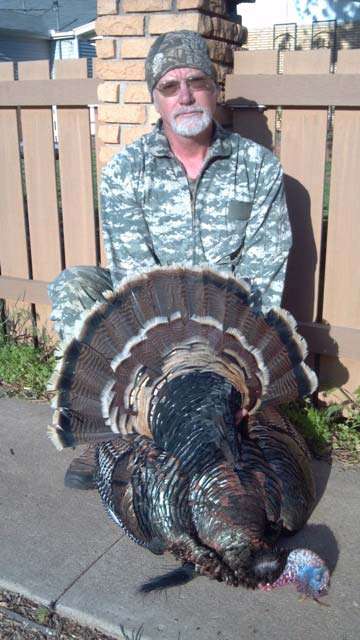
Today, as I sit here at my computer, not sure whether I’m gonna’ hunt turkeys this year or not, one spring turkey hunt from years ago keeps rambling through my mind. Now, everyone knows wild turkeys MUST be hunted from the ground. Sitting on the ground or on a five-gallon bucket until your butt and both legs are numb is just part of the turkey hunting experience, and NOT to do so would certainly be as un-American as eating pizza without potato chips, or owning a corvette with an automatic transmission. Yet, that morning, there I stood, gazing longingly up the ladder of the landowner’s tree stand thinking what a perfect spot it would be to call-in the gobbler that roamed this wood lot. But I must persevere and not break turkey hunting protocol!

“What a great seat,” I thought to myself as I surveyed my surroundings from above (I’m sure you saw this coming.) At this point several acres of nice timber separated the crop field to my left from the river. Right here is where I wanted to be, but the ground below was unusually void of the normal brush and downed tree limbs that make such good camouflage, so I put out a couple hen decoys and up the tree I went.

My “yelps” were occasionally answered by a gobble from afar, and soon a young gobbler and a hen appeared from the far corner of the crop field and started toward me. “This is too easy” I thought as the pair steadily came my way. At fifty yards, they veered away and taunted me from the edge of the trees, hidden from sight by limbs on the tree next to my perch. For the next forty-five minutes it was a stand-off, and my desire to harvest him soon turned to wishes that he would just leave so I could climb down without totally spooking him and start afresh in the morning.

The next morning, I followed my bouncing flashlight beam across the field, found the proper tree, set the decoys out and scaled the ladder once more up and into the tree stand. This tree stood barely three feet into the woodlot from the edge of the crop field; if I fell out, I’d land in the bean stubble. I figured the gobbler to be roosted at the end of the crop field and along the river, some distance away. Usually, you can hear a gobbler even in the dark, as he’ll often gobble at every barking dog, hooting owl or slamming car door, but this morning the woods was unusually quiet. Perhaps that wasn’t good; perhaps I had misdiagnosed where he roosted and would be left high and dry. Trying not to shatter yet another turkey hunting rule of “calling very sparingly while the turkeys are still roosted,” I watched and waited as daylight slowly poured itself across the landscape around me. I yelped softly with the box call and a gobble erupted beside me along the river probably seventy yards away; the rascal was roosting where I had not even considered. For thirty minutes he gobbled away, and I tried to find a good balance between calling back to let him know I was still interested and playing hard to get to make him come find me. For those thirty minutes he seemed not to move, and suddenly he was silent. I called softly a couple times but heard nothing in return. My heart dropped to my toes; what had I done wrong or not done right?

As I tossed the situation around in my mind, a gobble broke the stillness again, this time directly in front of me not far away; he had snuck quietly through the trees and was in the bean stubble where I knew he would see my plastic decoy “jezebels.” Soon I saw him strutting his way toward the decoys in the open

field. I put the call aside and brought the shotgun around into position. He got so close I heard him spit each time he fanned out, and could hear the scratching noise as each wingtip drug across the ground. I could see him well, but too many tree limbs were in the way for a sure shot. Like a target in an arcade, he marched back and forth but would not come any closer. I had just read an article where the author warned about placing decoys too close and creating just such a situation. It became another standoff as he remained behind too many limbs for a safe killing shot. I decided it was time for a plan “B”; if he would just step a little closer to the edge of the trees during his little show, he would momentarily be in a small clear spot for a shot. Finally, he appeared to stray a little closer to the trees, so as his back was toward me as he turned, I swung the shotgun around and leaned out around the tree trunk in front of me. He saw or heard me move and immediately dropped his tail feathers to run, but the twelve-gauge nailed him to the ground before he could take more than a couple steps.

If this story leaves some of you turkey hunting purists shaking your heads, I apologize. I’ve never been one to worry much about protocol. Maybe more of you have shot turkeys from tree stands than I know, but if not and the situation presents itself, give it a try. So, from Mr. Politically Incorrect himself, Continue to Explore Kansas Outdoors!

Steve can be contacted by email at [email protected]

Strange World, Strange News

0

Sometimes I feel that our world is too serious. Now, that comment can be taken in many ways, so allow me to elaborate. Our existence on this rotating rock in the vast expanse of the known and unknown universe is quite preposterous. I mean, just how lucky are we to really be alive right here and now? The amount of mind-boggling randomness that has happened in order to make our existence possible is just insane. So what I really mean to say is, relax, the rest of the world is just as crazy as you are. To prove it, I have found and researched several stories that seem pretty ridiculous to me, keep reading and maybe you will feel the same.

First of all, let’s talk about friendships. Friendships are great, we surround ourselves with the people we can tolerate in social interaction and our journey through life. Such is true for this feral Cow who decided she was going to live among the deer rather than the fellows of her own species. Bonnie the cow was being loaded for the slaughterhouse when she was ready for it and decided that she wasn’t going to become some meat and instead, took a retreat into the woods where she lived for several months. Eventually, she was recaptured by the Farm Sanctuary where she enjoys more controlled freedom.

Another such relationship is that of Penzie the Tortoise and Tuesday the Cheetah. Yeah that’s right, the world’s slowest animal and the fastest, kind of ironic to be honest. It sounds as though these two get along like an old married couple and enjoy their lives together in the Carson Springs Wildlife Conservation Centre in Florida.

In other strange news, NASA launched their Psyche missions to an asteroid made mostly of metal back in October of last year and it is just another example of our efforts to understand the space around us. The mission took off with the intent of discovering all that they could about the history of the asteroid named Psyche. The journey will take about 6 years to complete, using the gravity of Jupiter and Mars to slingshot its way there. All I know is, that I hope to live to see the first manned Mars mission, boy would that be a day to behold.

Rocketing back to Earth now, Italian scientists have discovered some rapid plant growth across parts of Antarctica recently. There are only two native species of plants that can be found in Antarctica as it is mostly Icy Tundra, but now those plants are being found in much greater abundance than before. The suspect? Climate change. The rapidly changing climate allows for such a shift in Antarctica’s ecology that hadn’t really been a concern. Scientists are now looking into how the continued rise of global temperatures contributes to the change in biodiversity in Antarctica.

Overall, I think it’s fair to say that our world is such a strange concept. These stories are but mere examples of the oddities that currently exist. Who knows what will happen next? From the bridge collapse this past week, to the election this year there are plenty of things around to keep us on our toes. Personally, I believe a little weirdness in the midst of our lives is a good thing, it gives us something to talk about at the dinner table if nothing else. It also reminds us that despite how busy we get, or how stressed out we may become, we need not worry about something so little in the vast expanse of life and the universe. Always remember, breathe, the world will keep on spinning if you forget about that one thing you were supposed to do.

R.I.P.O.F.F.

0
Thayne Cozart
Milo Yield

Our new home is close to Tuttle Creek federal reservoir. It wuz built in the late 1950s to control flood damage to land and property down through the Kansas and lower Missouri rivers system from Manhattan, Kan., to St. Louis, MO.

I happened to attend the ribbon cutting opening of Tuttle Creek in the fall of 1960 and recall all the dignitaries proclaiming that the dam would provide flood control for at least 40 years. I don’t recall any mention of the rate of siltation in the reservoir or what would happen if and when siltation occurred.

Well, 65-years of history has shown that Tuttle Creek dam has indeed mitigated, but not prevented, flood damage. It has weathered several epic floods, but not unscathed. The catastrophic rainfall of 1993 almost washed away the spillway and threatened the dam itself. It took untold millions of federal dollars to rebuild and restore the spillway. Plus, additional federal millions were spent to re-strengthen the dam with deep-drilled and filled concrete shafts because it is built on an ancient earthquake zone.

In spite of all the turmoil, Tuttle Creek dam and lake persist today. However, a drive to the upstream end of lake reveals, not water, but hundreds of acres of deep silt. Millions of tons of silt. I’ve read that the lake has lost more than 30% of its water-retention capacity, from siltation, at normal conservation levels.

All the above discussion brings up the matter of how to solve the siltation problem in Tuttle Creek. It’s pretty obvious that “doin’ nuthin'” will end up with an all-silt, no-lake result in the next 50 years — give or take a decade or two.

So, I gave the matter a lot of thought and I think I’ve come up with a siltation solution. First, acknowledge that all that siltation washed into the lake from all the upstream pastures and farm fields in the entire watershed drainage.

Second, there’s no question but that the eroded land is now inferior to what it wuz previous to the erosion and needs to be restored.

Third, the obvious solution is to find a way for all that siltation to be returned to the pastures and fields where it eroded from. But, how?

Well, with most things being cyclical in nature, what goes around comes around again. Since it wuz federal dollars that originally built Tuttle Creek, and, since, it wuz federal dollars that have maintained the structure down through the years, it just makes sense that federal dollars can solve the siltation problem.

Here’s my suggestion: The federal government aspires for 100 percent employment of the national workforce. Well, there’s plenty of work to be done dredging the silt from Tuttle Creek. It needs to be hauled back upland to restore the inferior pastures. Then, fill all the eroded gullies with the silt — and, simultaneously, bury millions of invasive cedar trees in the process. Then, replant and restore the inferior pastures to the original prairie tallgrass species.

Just imagine all the heavy equipment that would have to be manufactured to complete the restoration of the prairie. Imagine how many cattle can be grazed on the restored pastures. Imagine all the crops that can be grown on the newly-deposited topsoil.

And, where does the labor force come from? Obviously, the workers come from the ranks of the unemployed from coast to coast and from the newly-arrived immigrants eager to pursue the American dream. The benefits seem endless to me.

And, since all new federal programs seem to need an initialized acronym name for public recognition, I’ve come up with the perfect name. The entire de-siltation program for Tuttle Creek should be known as the “Restore Inferior Pastures On Federal Funds” — or the RIPOFF program for short.

***

In my March 11 column, I completed reminiscing about the silly children’s songs that my Grandma Anne sang to me while playing the ragtime piano. I didn’t figger it would trigger any memories for any reader, but I wuz wrong.

One fella from Colorado, ol’ Ike N. Recawl, send me this email:

“Dear Milo. Your recent column in the Fence Post brought back many pleasant

memories to me. My maternal grandmother sang and taught several of her grandkids the animal fair song, which we sung in the round. I am now 84, so that was a long time ago, but I still sing it to this day. Thank you.”

Sounds like Ike’s grandma wuz as fun-loving as mine.

***

You never know how rural young’uns will react to new things. One rural dad took his 4- -year-old son for his first ride in an elevator. After the ride, he asked his son what he thought of the experience. His kid replied, “It wuz pretty funny and fun. We went into a little house and the upstairs came down to us.”

Another rural youngster came home from her first day in the first grade and her mother asked her, “What happened at school today?”

Her daughter replied, “Nothing really. A nice lady asked me if I knew how to spell ‘cat.’ So, I spelled it and she left me alone for the rest of the day.”

And, one more: The teacher of a rural third grade class decided to test the degree of sophistication of her pupils. She asked one ornery boy to name man’s best friend. And, to give him a little help she added, “The word begins with a ‘d.'”

Without a second thought, the kid replied, “Dame!”

***

A few days ago, the temperature wuz in the 60s. This Tuesday morning I woke up to a half-inch of new snow. The forecast for Thursday is in the 70s. So, I guess this is “yo-yo” weather.

Now, my words of wisdom for the week are: “There’s no sense in advertising your troubles. No one will buy them.”

Have a good un.

Spring’s burst

0
john marshal

Officials in McPherson County are rearranging their trouble shooters through a new alliance called the Local Emergency Planning Committee. The group is to fortify a joint response to natural or man-made disaster.

In Lindsborg this includes police, fire and ambulance services, public works, Bethany College, the hospital, schools, day care center and Bethany Village. City Administrator Kristi Northcutt said public meetings will be scheduled to help the community understand this coordinated response during an emergency.

Put another way, better informed is better prepared. Spring is here and summer is coming, both lugging the usual baggage of volatile, random weather.

Spring in Kansas can be full of surprises, early and late, because Winter is prone to stubborn streaks, holding on with ice breath and sharp elbows, and its kinship with Alberta and her clippers. Winter is like the party guest who doesn’t know when it’s time to leave.

*

Robert Frost’s poem, “Two Tramps in Mud Time”, tells of an April moment, the air and sky fresh and lighthearted. Suddenly a cloud crosses the sun’s path and a bitter little wind finds us out, and we’re back in the middle of March, chilled and frustrated. Kansans can relate to that kind of moment – the promise of warmth, the raised hope, the ruthless rebuff.

While the hint of spring-burst is only a hint, winter slithers along in the shadows, knocking us with a late freeze or an early hail. But as the sun climbs higher, spring’s small caresses begin to acquire a total embrace of warmth and life, the need for man and nature to sit down somewhere in the sun.

The lawns get green, crocus and hyacinth sprout, the daffodils and tulips are not far behind. Summer will be here soon enough with its share of tragedies, of wars and plague and loved ones dead, of broken promises. There is also the exotic fancy of fireflies, the frolic at the swimming pool, the gentle mystery of lives and adventures shared and the hope that more summers will come as this one ends.

*

Meanwhile people at city hall and the courthouse keep an eye on the potential for ugly scenarios, how to soften their impact, and yet here we are. Spring drifts our way, at long last bending her face to be kissed, deliberate and unabashed. In spite of our tremor and warnings, she returns on the earth’s steady cadence, free of fear or worry, and again with the promise of certain days when no wind blows either over the plain or in the mind and no chill or fever finds the bone. It is a time that comes with a special prairie climate, its freshly laundered air, the lightest of breezes that come along not like an invader but like a friend who has stopped by for a visit.