Friday, February 13, 2026
Home Blog Page 467

Lovina Remembers 20 Years in Michigan

0

Lovina’s Amish Kitchen
Lovina Eitcher,
Old Order Amish
Cook, Wife &
Mother of Eight

As I write down today’s date, many memories flow through my mind. Twenty years ago we left Geneva, Indiana with all our belongings and headed north to our new home in Michigan. We had six children at that time: Elizabeth, age 9, Susan, 8, Verena, 6, Benjamin, 4, Loretta, 3, and Joseph, 20 months. The years have passed so quickly. Daughter Lovina joined our family eight weeks later, coming three and a half weeks earlier than expected. I was sick in the hospital for a week, and she was delivered by emergency C-section. We were not unpacked yet and not at all prepared for a newborn. 

Then fifteen and a half months later, our last child joined the family—Kevin. He will be 19 in September. Kevin has muscular dystrophy, and we are in the process of getting him a power chair. I really hope this will be much more useful to him than the mobility scooter, since it will let the seat rise higher and also recline. He will also be able to stretch his legs out better. He’s over six feet tall, so he needs more room for his long legs. 

On Sunday, daughter Susan and Ervin hosted church services for our church district. It was a cold, snowy day, so it took a lot of propane to heat the pole barn. After services were over, six tables were set up to feed everyone in two seatings. We fed a total of 11 tables, which held 16 at each table. The babies and the toddlers don’t eat at the table, so I am guessing there were around two hundred people there. We made a noodle soup for the younger children that don’t eat sandwiches at the table. The lunch menu consisted of homemade wheat and white bread, ham, Colby cheese, peanut butter spread, pickles, pickled red beets, hot peppers, jelly, butter, coffee, spearmint tea, and four different kinds of cookies.

While dishes were being washed, baggies of popcorn were passed out to everyone. It took a lot of coffee on a cold day. I made 150 cups of coffee and a 20-quart pot of tea. There wasn’t much left of either.

Susan and Ervin invited mostly family back for supper. I had helped Susan make two big roasters of pizza casserole the day before. So along with that, on the menu was potato salad, deviled eggs, bread, ham, cheese, peanut butter spread, pickles, pickled red beets, hot peppers, a variety of pies, cakes, pudding, jello, etc. A lot of us took a dish so it made an easy supper for Susan.  

I am so glad this is over for Susan and Ervin. It was a little rough getting ready, but now she can relax that all her closets, walls, ceilings, furniture, windows, etc. all had a good cleaning. 

On Saturday son Benjamin and I went to help Ervin and Susan with last-minute prep. Daughter Verena and her special friend Daniel Ray went to get Kaitlyn, Jennifer, Isaiah, Ryan, and Curtis and took them to Dustin and Loretta’s house for the day. Verena and Loretta gave all the children a bath and washed their hair. Verena and Daniel Ray took them back home in the evening. It was much easier cleaning for Susan with someone else looking after their five children. Of course Baby Ervin stayed home, and this Grandma would stop working once in a while to cuddle him. He’s such a blue-eyed little sweetie. He can give the biggest smiles. He’s short on patience though, when he’s hungry. 

My husband Joe, son Joseph, and son-in-law Dustin dressed a 1,000-pound beef, and it’s hanging in our cold pole barn. That’s on our agenda this week. Dustins will take a half and we will take the other half. God bless!

Cheesy Chicken Chowder

1 onion, chopped

1 cup chopped carrots

1 cup diced potatoes

1 cup diced celery

4 cups water

5 cups diced cooked chicken

4 tablespoons butter

6 tablespoons all-purpose flour

2 cups milk

1 cup shredded Cheddar or mozzarella cheese

1 teaspoon salt

Lovina’s Amish Kitchen is written by Lovina Eicher, Old Order Amish writer, cook, wife, and mother of eight. Her two cookbooks, The Essential Amish Cookbook and Amish Family Recipes, are available wherever books are sold. Readers can write to Eicher at Lovina’s Amish Kitchen, PO Box 234, Sturgis, MI 49091 (please include a self-addressed stamped envelope for a reply); or email [email protected] and your message will be passed on to her to read. She does not personally respond to emails.


Come see a Musical Drama

0

A Goodly Heritage, a musical drama sharing a history of the Swiss Volynian Mennonites on Saturday, March 23 at 7:00 or Sunday, March 24, at 2:00

at Eden Mennonite Church, 401 18th Ave., Moundridge, Kansas..

One of many groups of Mennonites moving to the U.S. in  the 1870’s, the Schweitzers settled near (what is now) Moundridge, Kansas, and Freeman, South Dakota.  Mennonites were part of the larger Anabaptist movement that began in Europe in the early 1500’s.  The drama seeks to explain the religious beliefs underlying the Anabaptist movement, and the journey over  centuries that brought these groups to America.

 The cast is made up of Schweitzer’s and friends, adults and children, from McPherson County and surrounding   areas.  Jenny Schrag, who wrote the drama and composed some of the music, is directing, along with Dawn Abrahams.  Bonita Howard is the choir director.

Lrics and music are by Jenny Schrag, with hymns from Voices Together and The Mennonite Hymnal (used with permission).

The drama is one of the events of the 150th celebration of forebears coming to the U.S. in 1874.  Admission is free.

Companion planting: Positive partnerships that produce more

0

Some things just go together like biscuits and gravy or peanut butter and jelly.

Likewise, plants have companions that produce best when planted side by side, says Kathi Mecham, a University of Missouri Extension horticulture specialist in Carroll County.

With gardening season ahead, Mecham suggests considering how plants can benefit each other. Plan so that “function and beauty” go hand in hand, she says.

“It’s important to think of your garden as a whole, rather than as separate parts,” Mecham says.

In addition to enhancing growth and production, companion planting also helps supports natural pest control. Pests typically prefer monocultures – plants of a single variety. But you might have able to deter pests by adding plants that have a texture, smell or taste that is unappealing to insects and other pests.

“There are benefits to aromas,” Mecham says. “Consider planting between rows so that you disrupt and trick the pests.”

Pairings work well for several reasons:

Pest deterrent. Strong scents and annoying textures can keep some pests out of the garden. Planting marigolds around the perimeter of a garden may deter some pests, although there is limited science behind this. No matter what, the marigolds are aesthetically pleasing, says Mecham. Likewise, basil has been found to mask tomato plants from thrips.

Attract beneficial insects and pollinators. Some plants can provide biological control by attracting insects seeking pollen and nectar.

Beauty. Choose plants that complement each other in color, balance, scale and design. Also consider functionality of your plants – do they serve to feed wildlife or encourage pollinators?

Improved soil fertility and structure. Some legumes add nitrogen to the soil while other deep-rooted plants can move water and nutrients higher up in the soil bed.

Crop rotation. Rotate crops annually to reduce the risk of disease and insects. Crops that need high nitrogen such as leafy greens and broccoli benefit from planting where nitrogen-producing legumes grew the previous year.

The pairing of plants has long been part of folklore, but recent scientific evidence indicates there’s more to it, says Mecham. Research shows that plants communicate with one another and share messaging and resources to influence surrounding plants.

University of West Virginia Extension touts the “Three Sisters Garden.” This includes corn, which provides a natural trellis for climbing crops such as beans and peas. The legumes return nitrogen to the soil. Squash and pumpkin leaves provide weed protection.

Learn more about gardening and companion planting in articles featured on the MU Integrated Pest Management website at https://ipm.missouri.edu/search.

Trap cropping

Another companion planting practice involves planting one crop to save another crop, says Mecham.

Plant a crop that attracts insects at the end of a row or around the perimeter of the garden. Insects are drawn to these plants and leave the desired crop alone.

This is also a natural way to limit use of pesticides, says Mecham, and it is commonly used to control squash vine borer and squash bugs in squash crops.

Plant trap crops three weeks ahead of planting the desired crop.


Eight great plants to bring butterflies to your garden

0

A delicate butterfly alighting on a garden bloom is a tangible sign for many that spring has indeed arrived.

Texas A&M AgriLife Extension Service specialist shared insights on how to draw these beautiful beneficial insects to your yard — not only in the spring but throughout the summer and fall.

“The key to having the most butterflies is to have constant or overlapping blooms,” said Molly Keck, AgriLife Extension entomologist, Bexar County. “You can keep pollinators coming back to your garden with reliable, continuous food sources that they like.”

By planning ahead, both with planting at appropriate times and knowing when you’ll have butterfly-favorite flowers, they will return to your bloom buffet over and over again.

Eight plants for pollinators

Keck, who is also the AgriLife Learn Butterfly Gardening course instructor, said some plants do a better job than others of attracting butterflies and other pollinators, and plants designated Texas Superstars are a good choice to survive and thrive. Here are some of her Texas pollinator plant suggestions:

  1. Pride of Barbados: With showy orange and red flowers, it is a dramatic plant for Texas gardens. Depending on the zone it is grown in, it may serve as everything from an annual to a shrub.
  2. Henry Duelberg salvia: This true Texas native was discovered in Central Texas, growing at the grave of the person for whom it is named. It can bloom spring through fall if it is cut back regularly.
  3. Mystic spires blue salvia: This salvia flowers freely during the growing season and is a plant butterflies love. It has a very tubular flower, and the butterfly must use its long proboscis to get down into the nectar, which is exactly as it was designed to do.
  4. Lantanas: These are a good option available in many colors and bloom even during the hottest weather. The new gold lantana is very hardy and highly attractive to butterflies and native pollinators as well.
  5. Butterfly deep pink penta: Another option to bring blooms to your garden for three seasons are pentas. The unique star-shaped flowers are a dazzling color and relatively low maintenance and pest tolerant.
  6. Fall zinnias: When planted late summer, fall zinnias can play a crucial role in providing butterflies food in the fall, often up until the first frost. Available in a variety of bright colors, you can buy zinnias nearly year-round, but fall offers the most variety.
  7. Turk’s cap: A native plant to South Texas, it is relatively low-maintenance, tough throughout Texas and attracts hummingbirds. Although it doesn’t have a ton of flowers, the turban-shaped flowers it does produce are usually red, but varieties can range from white or pink or both.
  8. Gregg’s mistflower: This quick growing native plant is beloved by bees and serves as a good food source in the fall for migrating butterflies like the Monarch.

What else should I know about butterflies?

It is important to keep in mind that a butterfly garden and butterfly-friendly plants are food-sources for the adults. If you want to observe butterflies through their whole life cycle, you will need to plant food sources for caterpillars and have plants where butterflies will lay their eggs.

Groundwater levels dropping in Kansas

0
Registration now open for the June 23-25 Republican River basin tour in Nebraska and Colorado. Seating is limited and first-come, first-served. Interest in the tour has been running very high for the past several months, so register now. More information is at watercenter.unl.edu

The Kansas Geological Survey is reporting lower groundwater levels across the state.

The Survey, based at the University of Kansas,  said while small increases were reported last year in western and northwest parts of the state, most other areas are tracking declines in water levels.

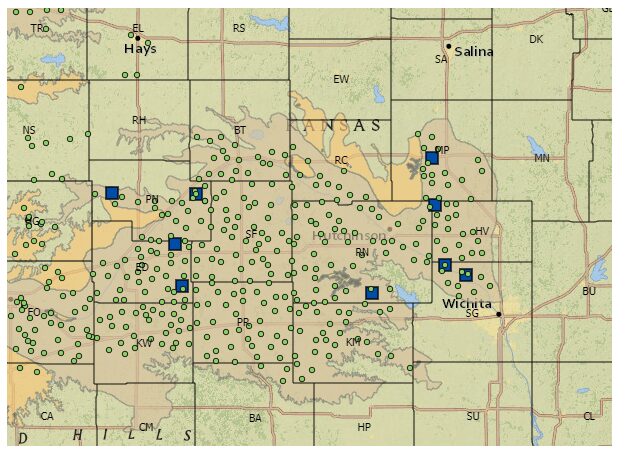
There is an ongoing drop in levels of the southwest portion of the mighty Ogallala aquifer, which continues to shrink following back to back declines totaling almost five feet in 2022 and 2021. Authorities are also tracking ongoing declines of the Equus Beds, which serves Wichita and Hutchinson; and the Great Bend Prairie aquifer, which provides water for Pratt, Stafford and parts of neighboring counties.

Drought conditions have also caused a drop in water levels at the Cheney Reservoir, and Wichita officials have been watching the situation there and the levels in the Equus Beds.

[ High Plains Aquifer map:  Kansas Geological Survey ]