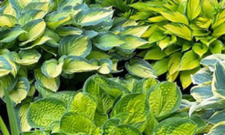
Once considered a “green filler” for shady areas, hostas are now the stars of shady landscapes because of the plethora of cultivars now available to the gardening public. Hostas are low-maintenance, hardy perennials that are easy to grow. Available with impressive leaves that come in a variety of sizes, shapes, colors, and variegation, it is little wonder why the National Garden Bureau chose hosta as its “Perennial of the Year” for 2024.
Hosta (singular) is the common name given to any number of species, inter-specific hybrids and cultivars belonging to the genus Hosta. Hostas are native to the Orient, where they were discovered growing in the wild in Japan, China, and Korea as early as the 8th century. Hostas traveled to Europe by the late 18th century because of European settlements in China. Hosta plantaginea is thought to be the first member of the genus brought to Europe, with Hosta ventricosa arriving soon thereafter.
For many years, hostas were classified in the genus Hemerocallis (along with daylily), but plant taxonomists ultimately realized hosta was distinct and should be put into a genus of its own. In 1812, the name “Hosta” was given to this plant’s new genus in honor of Australian botanist Nicolas Thomas Host. Unfortunately, this name had been assigned to a genus in the family Verbenaceae and, according to the rules of naming plants, the same name cannot be given to two different plants. The error was corrected in 1817 when the genus name Funkia was given to hosta. This designation prevailed until 1905 when the governing body for plant nomenclature changed it back to Hosta. Over one hundred years later, it is not uncommon to see the term Funkia parenthetically inserted behind hosta in magazines, catalogs, or on the internet.
It is estimated there are 70 species and over 7000 registered cultivars in the genus Hosta. They range in size from miniatures (e.g. ‘Baby Bunting’ and ‘Tiny Tears’) which are only several inches in diameter at maturity to “giants” such as ‘Sum and Substance’ and ‘Emperor Wu’ which approach a height and spread of 48 inches. Within those extremes, hostas usually are placed into one of five different categories according to height or leaf color.
The five major height categories defined by the American Hosta Society Size include mini (less than 6 inches tall), small (7-10 inches tall), medium (11-18 inches tall), large (19-28 inches tall), and giant (more than 28 inches tall).
The five major leaf color categories include green, blue, gold, medio variegated (light center, dark margin), and marginal variegated (dark center light margin). A few cultivars are viridiscent, meaning they change from light in color to darker shades during the growing season. Others are lutescent and change from green to yellow during the growing season. A very few change from yellow to white, a trait know as albescence. Additionally, hostas can be classified according to their leaf shape (e.g., strap, lance, egg, heart and circular) and leaf surface (e.g., flat, rugose, cupped-rugose, wavy undulate, contorted, piecrust or furrowed).
Like daylilies, hostas bear a compound inflorescence known as a scape. Individual flowers on the spike are lavender, purple or white, depending upon cultivar. Some flowers (e.g., cultivars of H. plantaginea) are delightfully fragrant, adding further appeal to this attractive perennial plant.
Although hostas are considered shade plants, most do not thrive in deep, heavy shade. An ideal scenario for most cultivars is several hours of morning sun followed by afternoon shade, or broken patches of sun/shade that might be characteristic of the exposure under a large, open tree. Hostas have fairly aggressive roots that compete well with the roots of most tree species. As a general rule, the blue-leafed cultivars require shadier exposures while the green- and yellow-leafed cultivars can tolerate more sun. However, most of the sun-tolerant cultivars will exhibit some leaf-edge burn if exposed to afternoon the afternoon sun and heat characteristic of a Midwest summer day.
Some hosta cultivars require years to develop into a mature clump. Therefore, they represent a long-term installation in the garden and adequate soil preparation is a sound investment. Hostas prefer a rich loam soil high in organic matter that is slightly acidic in nature. Good drainage also is important. Deeply incorporating about four inches of organic matter is a good way to prepare average soil for hostas. Well-rotted manure, compost, leaf mold or peat are good sources of organic matter.Since hostas have fairly deep, aggressive root systems, the hole in which they are to be planted should be about 12 inches deep and 1½ times in diameter the mature diameter of the cultivar being planted.
Hostas are readily available as dormant divisions, but gardeners can hasten their establishment in the landscape by purchasing plants that are already started in nursery containers. Upon planting, remove the hosta from its container and free any tangled roots. Place the plant in the planting hole so that the roots will be covered with soil to the same level they were in the nursery container (remember that soil settles upon being watered). If dormant divisions are planted, the roots should be soaked in water for about 30 minutes before planting. In both cases, water thoroughly after planting has been accomplished.
Fertilizing remains somewhat of a controversial topic among hosta experts. Some insist that hostas growing in soils containing sufficient amounts of nutrients do not need additional fertilizer, while others maintain supplemental fertilization is beneficial. The latter group suggests the addition of a granular, complete fertilizer (e.g., 12-12-12 or 5-10-5) early in the spring, followed by two additional applications, each approximately six weeks apart. Apply according to label directions and the stature/vigor of the cultivar being fertilized. It is important not to fertilize hostas after the middle part of July to avoid stimulating late-season growth which can prevent the plant from hardening for the winter.
Hostas require about an inch and a half of water per week during the summer. Burned leaf tips are a tell-tale sign of insufficient amounts of moisture as are drooping leaves. If supplemental irrigation is required, water early in the morning to allow leaves to dry as quickly as possible. Hostas are easily increased by dividing the clump early in the spring when the shoots start to emerge from the soil. Most cultivars, however, should not be disturbed for about five years after planting to allow the clump to become established.
Slugs and snails are especially fond of hostas and the shady, moist environment in which most are planted. They typically chew small, round holes in the leaves of plants on which they feed and leave a dried trail of slime as they move from one spot to another. Poison baits containing iron phosphate, metaldehyde, or measurol have been shown to be effective in controlling slugs and snails as has been placing pans filled with beer in the garden. The odor of beer is attractive to these pests which will crawl into the pan and drown. Deer also love hostas and represent a more formidable challenge to control. Repellents, electrical fences, guard dogs and motion detectors have all been used to control deer, to greater or lesser effectiveness.
Other than for foliar nematodes, hostas are relatively disease free. Hosta Virus X (HVX) is a virus that has been getting a lot of publicity as of late. On cultivars with light-colored leaves (e.g., ‘Gold Standard’) symptoms include blue or green markings. These markings usually follow the vein of the leaf out into the surrounding tissue, resulting a mottled appearance. A lumpy or puckered appearance to the leaf may also be present. Symptoms on cultivars with dark-colored leaves are more difficult to detect and may appear as light-colored mottling instead of colored streaks. HVX is spread by mechanically transferring it from an infected plant to a health one, especially during propagation. There is no cure for this disease and gardeners should rogue out any suspect plants from their collection.
As mentioned above, there are over 7000 hosta cultivars from which to choose. The American Hosta Society polls its membership each year to determine their favorites and the following table represents the 15 most popular large-size cultivars from a recent (2022) poll. For the entire list as well as the names of popular smaller hostas, please visit the following website: https://americanhostasociety.org/resources/popularity-poll/
| Cultivar |
Description |
| H. ‘Lakeside Paisley Print’ |
Heart-shaped leaves with very wide, wavy, green margins. |
| H. ‘June’ |
Medium-sized leaves; gold center and blue-green margins. |
| H. ‘Liberty’ |
Blue-green leaves with wide, streaked, yellow margins which fade to creamy-white. |
| H.‘Guardian Angel’ |
Large, thick, blue-green leaves display a white center. |
| H. ‘Sum and Substance’ |
Large, glossy chartreuse leaves changing to gold; upright. |
| H. ‘Rainbow’s End’ |
Mostly yellow leaves with dark green margins. Centers brighten to creamy-white in summer. |
| H. ‘Sagae’ |
Large chalky blue-green leaves with neat gold margins. |
| H. ‘Coast to Coast’ |
Huge leaves emerge gold in spring and turn lighter gold later. |
| H. ‘Victory’ |
Shiny green leaves with white margins that have a dramatic grooved texture. |
| H. ‘Key West’ |
Bright gold, very large heart-shaped leaves form a clump up to 6 feet across. |
| H. ‘Paradigm’ |
Gold leaves with streaked, blue-green margins; variegation pattern that intensifies later in the spring. |
| H. ‘Earth Angel’ |
Large, heart-shaped, blue-green leaves with wide, creamy-white margins that are creamy yellow in spring. |
| H. ‘Brother Stefan’ |
Thick, heavily corrugated and puckered green leaves with a brilliant gold center. |
| H. ‘Goodness Gracious’ |
Glossy heart-shaped dark green leaves with distinctive, wide yellow margins. |
| H. montana ‘Aureomarginata’ |
Huge bright-gold leaves with green center. Holds color well. |
Other excellent, attractive cultivars exist that should not be ignored just because they do not appear on the popularity poll. When in doubt, look for a cultivar that has won an award given by the American Hosta Society such as the Eunice Fisher Award or the American Hosta Growers’ Hosta of the Year Award.
Hosta Fun Facts:
- Hostas are native to Japan, Korea, and China.
- Hostas were first imported and grown in Europe in the late 1700s and, by the mid-1800s, they were grown in the United States.
- Today, hostas are the most widely grown ornamental perennial in the United States.
- Common names for hosta still used by some in commerce include Plantain Lily and Funkia.
- Attractive to hummingbirds, butterflies, and bees, hosta flowers come in a range of colors including white, lavender, and purple.
- Hostas are extremely hardy and grow in zones 3–9. They do not grow well in very warm states because of their need for several weeks of dormancy under 40°F each winter.
- Hostas flowers are edible, and some varieties are grown as a leaf vegetable and are especially popular in Japanese cuisine.
- Hosta has been nicknamed the “Friendship Plant,” since mature clumps are easily divided and can be shared with friends.