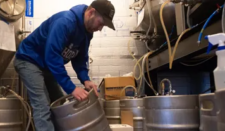
Microbreweries have a peculiar place in the beer scene as both a creator of their product and a retailer at their own brewpubs, and they’re trying to expand their ability to sell even further.
Kansas, like most states, uses a three-tier system for the beer market: there are producers, distributors and retailers. Producers can only sell their product to distributors who sell to retailers who sell to consumers.
Microbrewers are an exception, selling most of the product they make directly through their own taps. Over the past two decades local craft beer exploded in popularity; in 2011 there were only 17 craft brewers in Kansas, compared to 87 today, according to the Brewer’s Association.
Small business beer now competes with the largest national brands in the market and navigates sometime byzantine laws to get their products out there. It has also led some brewers to suspect their products are underrepresented by the wholesalers they’re legally required to distribute through.
Now, brewers across the state are advocating for a change in the law allowing direct sales to retailers.
“About three months ago I started to reach out to the breweries in the state to share my struggle at obtaining access to the market through my distributors and was asking if anyone was having similar issues,” said Sean Willcott, founder of Willcott Brewing. “I was astonished to find the number of breweries who have experienced major challenges and hurdles at having their product see fair representation. There are quite a few who have no distribution because of it.”
The relationship between wholesalers and brewers can get contentious. No two wholesalers can sell the same products in the same territory, and most hold franchise agreements with one of the two largest beer producers in the world — Anheuser-Bush and Miller-Coors.
Microbrewers say some distributors ineffective
Brewers seeking to get out of a franchise agreement with their wholesalers need the permission of the wholesaler itself and need a reasonable cause for terminating the contract. Either party that is aggrieved by changing or terminating a franchise agreement can take it to a district court.
“Microbreweries are not allowed to succeed or fail based on their own merits,” said Steven Petermann, the owner of Salt City Brewing Company in Hutchinson. “Their destiny in distribution is controlled, good and bad, by the performance and goals of unrelated third-party distributors.”
Several microbrewers said some distributors are ineffective at getting local craft products on the taps in local restaurants or the shelves of local liquor stores. The Kansas Beer Wholesalers Association didn’t respond to emails and phone calls, but the Kansas Association of Beverage Retailers took a cautious approach to the proposed legislation.
“We don’t take lightly the idea of reducing the role of the three tiers,” said Amy Campbell, a lobbyist with the Kansas Association of Beverage Retailers. “That doesn’t mean that there isn’t potential legislation that everyone would support, but we wouldn’t want something dramatic that opens us up to some sort of legal action.”
Campbell said retailers are particularly interested in maintaining nondiscrimination in pricing, so that alcohol retailers are working on an even playing field in the market. There are also clear paths for enforcing regulatory standards built into three-tier system that need to be maintained.
“If there’s a tainted product that’s coming through the system, it could be identified, isolated and addressed at the distribution level instantly rather than having to find trucks that are coming out of California or Florida,” Campbell said.
However, Campbell said craft beers are a bright spot in the beer market, which has been eaten into the last couple of years by wine and cocktails.
“We love craft beers, the markup is better on them, they’re a very popular consumer product, so wholesalers and retailers love having a variety of craft beer available,” Campbell said
The legislation is still in the early stages of the process. Last week it was introduced in the Senate Federal and State Affairs Committee, where chair Mike Thompson, R-Shawnee, foresees the debate being over finding the right balance of what the microbrewers are asking for.
“The bigger guys are delivering a huge amount of product, and from a cost standpoint it doesn’t make sense to take on a small (brewery) like this,” Thompson said. “So, this allows for a niche type of market for them so I think the big debate is going to be probably in terms of how many gallons that they can provide per year to a local restaurant or in aggregate to other businesses.”
Though some brewers expressed frustration with distribution, they all said distributors are a vital part of the market and that the legislation isn’t necessarily an attack on them. One of Willcott’s reasons for getting involved in the bill is a frustration selling his beer at a community event.
Over the summer, he agreed to sell a bit of beer at Jackson County’s Fourth of July celebration. But he couldn’t just set up shop — to legally sell his beer he had to first sell it to a distributor and buy it back at the standard markup afterwards.
“We had a lower turnout than expected,” Willcott said. “But under law, the cases that we took out there I can’t bring back to my Taproom. So basically, we had to destroy the beer that we took that we didn’t sell. At the end of the day, we ended up losing money to support our local communities.”
Jared Rudy of Norsemen Brewing said microbreweries like his primarily make money on the sales done at the brewery level. Direct sales, for him, would be for small-scale sales that wouldn’t be worth a distributor’s time.
“This whole thing about direct sales really isn’t about distribution,” Rudy said. “It’s really more about small guys supporting small guys.”
Brewers want modernization of antiquated liquor law
Most Kansans are older than the oldest brewery in the state, Free State Brewery. That’s because Kansas had one of the longest periods of prohibition in the country, preceding federal law and not repealing statewide prohibition until 1937. Even then, it only narrowly edged around prohibition, allowing what it called “cereal-malt beverages” with an alcohol content of 3.2% or less.
In 1948 voters approved an amendment allowing the state to regulate, license and tax the manufacture and sale of intoxicating liquor, including spirits, wine and stronger beer. But sales were limited only to take-home drinks. It would be another 30 years before Kansas legalized on-premise alcohol sales.
Kansas’ liquor laws, and those in much of the United States, were created after prohibition and address concerns from that era with tax collection, vertical integration and quality control. Brewers often point to some of the concerns as outdated and archaic when enforced on their businesses.
“This bill is not an attack on distributors, nor does it seek to take any rights away from them,” said Petermann, of Salt City Brewing. “It is an effort to modernize an antiquated law that was established before the first microbreweries in Kansas, level the playing field for small business and provide microbreweries with free-market options in the event that they do not believe their interests are being well represented.”
With limited time remaining in the legislative session, it’s not clear if the legislation will get a vote. Thompson said whether it gets a hearing in his committee will depend on how negotiations between parties progress.
“I’m going to see how both sides are doing in the negotiation before I see whether or not I can run it in the second half after turnaround,” Thompson said. “I’m willing to hear it and have that discussion, but I want to make sure I talk to all parties and get people to sign off on what’s going on.”