Monday, February 16, 2026
Home Blog Page 498

Notorious

0

NOTORIOUS is now on exhibit at the Rice County Historical Society. This engaging exhibit explores a selection of so-called notorious figures from Kansas' past, leaving the visitor to answer just what made them receive such a title. Perhaps they might even disagree.

Kansas history is filled with colorful characters that have shaped the state we know today. Through the passage of time, perspectives change and reality can give way to legend. Lines begin to blur exactly who truly deserves the title NOTORIOUS.

The exhibit was designed and produced by Smoky Hill Museum, a division of Salina Arts and Humanities, a department of the City of Salina, Kansas. The exhibit team: Rosa De La Cruz, Susan Hawksworth, Hannah Mahnken, Nona Miller, Joshua Morris, Kay Quinn, and Jennifer Toelle.

The Rice County Historical Society/Coronado Quivira Museum is located at 105 West Lyon, Lyons, Kansas. Hours of operation are Tuesday to Friday from 10:00 a.m. to 4:00 p.m. and Saturday from 10:00 a.m. to 1:00 p.m. Call (620) 257-3941 for more information.

K-State health specialist urges routine blood pressure checks

0

It may sometimes seem that getting your blood pressure checked at the doctor’s office is a trivial task, perhaps only a necessary prelude to a more immediate reason for the day’s visit.

In reality, says Elaine Johannes, checking one’s blood pressure and knowing what it means is an essential part of good health. Left unchecked, high blood pressure – also known as hypertension – can lead to heart attack, stroke, diabetes or other diseases. Hypertension is often called the ‘silent killer.’

“In Kansas, the rate of adults who have been diagnosed with hypertension is 32.8%,” said Johannes, the Kansas Health Foundation’s Distinguished Professor of Community Health at Kansas State University.

A U.S. Department of Health and Human Services initiative called Healthy People 2030 has set a goal to reduce the national rate of hypertension in American adults to 27%, she adds. The U.S. Census Bureau lists the population of Kansas adults (ages 18 and over) at 2.2 million, as of 2023; a 6% drop in those diagnosed with hypertension represents a decrease of 132,000 people.

“So, Kansas has a ways to go to reduce our high blood pressure, as a population.”

Johannes urges Kansans – indeed, all Americans – to routinely check their blood pressure, whether it be by a medical professional, or even with the handy self-check kiosks often found in drug stores, grocery stores and other locations.

She’s also now promoting another convenient spot: the local extension office.

According to Johannes, several counties have extension agents or staff who are trained to administer blood pressure checks, and explain what the numbers mean. Interested persons may contact their local extension office for information.

“In 2022, K-State Research and Extension became the very first extension system in the United States to become what is called a ‘self-measured blood pressure champion,’” Johannes said, noting the designation came from the U.S. Department of Health and Human Services Office of Women’s Health.

She said the Kansas Department of Health and Environment provided funding to train extension agents as Healthy Heart Ambassadors. In addition to checking blood pressure, Kansas extension staff are being trained to coach residents on blood pressure, and manage it “using good practices that are fairly easy to do,” according to Johannes.

According to the Mayo Clinic, some lifestyle changes that can help people manage or reduce hypertension include exercising regularly, eating a healthy diet, reducing sodium, limiting alcohol and getting a good night’s sleep. Johannes said local extension offices can provide information and programs about these and other factors that influence cardiovascular health.

K-State’s Healthy Heart Ambassador approach encourages residents to maintain their lifestyle changes for at least four months to realize improvements in blood pressure.

A longer discussion with Johannes regarding efforts in Kansas to reduce high blood pressure is available on the weekly radio program, Sound Living, produced by K-State Research and Extension.

What do my blood pressure readings mean?

Blood pressure is measured based on two numbers.

Systolic blood pressure – the first number – indicates how much pressure your blood is exerting against your artery walls when the heart contracts.

Diastolic blood pressure – the second number – indicates how much pressure your blood is exerting against your artery walls while the heart muscle is resting between contractions.

According to the American Heart Association, typically more attention is given to systolic blood pressure as a major risk factor for cardiovascular disease in adults over age 50.

The AHA lists five ranges for healthy and unhealthy blood pressure:

  • Normal – Systolic less than 120 and diastolic less than 80.
  • Elevated – 120-129 and less than 80.
  • High blood pressure, stage 1 – 130-139 (systolic) or 80-89 (diastolic).
  • High blood pressure, stage 2 – 140 or higher (systolic), or 90 and higher (diastolic).
  • Hypertensive crisis (consult your doctor immediately) – Higher than 180 (systolic), or higher than 120 (diastolic).

A county-by-county listing of the prevalence of high blood pressure in Kansas is available online from Kansas Health Matters, www.kansashealthmatters.org.

Healthier eating is a lifestyle choice

0

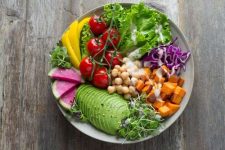
The growing popularity of a plan that encourages people to eat more healthy foods and less added sugars is not really about getting rid of specific foods in the diet completely, says a K-State Research and Extension agent in Johnson County.

Chelsea Reinberg notes that the Mediterranean diet “is really more about an overall lifestyle and making small changes to eat more nutritious foods and less of the not-so-nutritious foods most of the time.”

“Typically, when you hear ‘Mediterranean’ you think of the region or a specific cuisine, when – really – eating the Mediterranean way is focused on a holistic approach to incorporating healthy protein and healthy fats. It’s also about eating more fruits, vegetables and whole grains; incorporating nuts and seeds; and eliminating added sugars.”

Reinberg – a nutrition, food safety and health extension agent – says some studies have shown that eating nine servings of fruits and vegetables a day could reduce a person’s risk of cardiovascular disease by as much as 60%.

“Antioxidants, which are found abundantly in fruits and vegetables, are really important for heart health, as well as overall health,” she said. “So when we eat these foods, we’re talking about getting the most bang for our buck.”

‘Heart Healthy’ fats – such as avocado oil and olive oil – are more friendly to the heart than saturated fats like butter and lard, according to Reinberg.

Reinberg added that as we inch closer to spring and summer, a greater variety of fruits and vegetables will become available, making it easier for people to incorporate them into their diet.

“One of the problems with fruits and vegetables is that many people do not like the taste or texture,” Reinberg said. “But there are a multitude of ways that you can cook vegetables to make them tasty. As we get into the warmer months, grilling fruit and vegetables can be a great way to add a different flavor profile. Roasting them in the oven, or sautéing them in a pan are also great options.”

“The one thing to be aware of is that we don’t want to cook fruits and vegetables for long periods of time. The longer they’re exposed to heat, the more that those traditional benefits – vitamins and minerals – can be lost.”

Some heart-friendly whole grains include brown rice and whole wheat flour. Beans, legumes and other high fiber, high protein foods are also good for the heart and overall health.

Reinberg said a traditional Mediterranean diet encourages eating fish or seafood 2-3 times a week. Fresh fish is a good option but may be more expensive. Frozen and canned varieties are beneficial as well and may be more budget friendly. If buying canned products, choose low-sodium options. Meats can be part of the diet, though consumers should choose leaner options.

All of those recommendations, Reinberg says, fall into the traditional way of thinking about a Mediterranean diet, “and help us eat a healthier diet whether or not the individual is purposefully following the Mediterranean style.”

Reinberg recently talked at length about healthy eating and the importance of physical activity on living a longer, healthier life on the weekly radio program, Sound Living, produced by K-State Research and Extension. The program is available online.

More information about healthy eating also is available at local extension offices in Kansas.

Reducing hay waste when supplies are low

0

After two years of droughts in Missouri, hay supplies are low, with many producers feeding hay during the summer months and lacking the pasture growth to get the tonnage comparable to previous year’s hay crops. Many producers in southern Missouri reported 50%-75% reductions in first-cutting hay crops in 2023. With such a low availability of hay in the state and high input costs, the price of hay has increased, which adds insult to injury for livestock producers. Minimizing hay waste should be at the forefront of the minds of producers this winter.

Here are some tips to reduce hay waste:

Reduce waste from rot caused by outside storage

Storing hay inside a barn is the gold standard for storage. If hay is not rained on, it will maintain its quality indefinitely apart from vitamins A and E, which can reduce slightly over time.  When hay is stored outside and allowed to be rained and snowed on, spoilage occurs on the outer edge of the bale. Even a couple inches of external spoilage can account for major losses of valuable hay for livestock.

While reducing loss during storage is important, not all farms have adequate barn storage for all of their hay. In this case, producers should consider how they can minimize moisture exposure on the top of bales as well as from the ground.

Stacking bales in a pyramid shape and covering with tarps is a great way to reduce weathering from rain and snow. Also, storing bales on pallets, railroad ties, or a raised gravel or concrete pad is an excellent way to reduce spoilage of the bale from ground moisture. Further, if storing round bales in rows, farmers should leave a few feet in between the rows to allow for better airflow and to prevent rain pooling and seeping into the bales when the rounded edges of the bales are touching.

Consider hay feeders or unrolling

Most farmers would agree that giving any type of livestock access to a bale of hay without a feeder leads to more waste. Research shows that feeding without some type of hay feeder can result in upwards of 45%-57% wastage, depending on the class of livestock and the number of animals. While there is a plethora of hay feeders available at varying price points, using any type of hay feeder will reduce hay waste compared to no feeder. Within the many round bale feeder options, choosing a ring that has an enclosed bottom or one that suspends the bale off the wet ground will help reduce waste.

Some producers prefer to unroll their hay on their pastures. This is an excellent option for more evenly distributing hay waste and manure across the pasture. Taking advantage of this fertilizer wrapped up in net wrap can make improvements to the soil over time. However, when multiple days’ worth of hay is unrolled at once, unrolling hay can have upwards of 40% waste. Producers should consider unrolling only one day’s worth of hay at a time, reducing that waste to around 12%.

Feed less hay more often

Another way to stretch an operation’s hay supply and reduce waste is to feed smaller amounts of hay more often. Feeding one day’s worth of hay will reduce the waste compared to feeding three days’ worth.

Most livestock should consume 2%-3.5% of their body weight in dry matter every day. Calculating daily intake depends on the stage of production of the animals and size of the animals. For example, heavy bred cows that average 1300 pounds will eat about around 2.5% of their bodyweight in dry matter per day. Assuming these cows are being fed hay that is 90% dry matter and 10% moisture, here’s how to do the math:

1,300 lb. cow X 0.025 = 32.5 lbs. of dry matter/day

32.5 lbs. of dry matter / 0.9 = 36 lbs. as fed/cow/day

Ultimately, waste happens during storage as well as feeding and can be utilized as fertilizer for pastures. However, if the goal is to reduce waste, producers should consider how they can minimize moisture infiltration of the bales during storage and feeding. Farmers should also aim to limit the amount of hay that animals can bed down in and defecate on by using a hay feeder and by feeding less hay more often.

University of Missouri Extension

Wheat Scoop: Get your prescription for next year’s wheat crop during upcoming Wheat Rx seminars

0
Kansas Wheat

Contact: Marsha Boswell, [email protected]

For audio version, visit kswheat.com.

A prescription for producing high-yielding and high-quality wheat is just what the doctor ordered for Kansas wheat producers — referring to expertise from Kansas State University like Drs. Romulo Lollato, Carlos Bonini Pires, Kelsey Andersen Onofre, Dorivar Ruiz Diaz, Dan O’Brien and others.


Kansas Wheat Rx is a combination of suggested management practices for economical and sustainable production of high-quality winter wheat in Kansas.


Mark the calendar now for two upcoming seminars in Dodge City and Wichita. Speakers will discuss cover crops and soil health, the role of wheat in a cropping system, soil fertility, fungicides and economics of wheat production. The program will qualify for certified crop advisor (CCA) continuing credit units (CEUs).


“We cannot change the impact of weather on each year’s crop, but we can arm wheat producers with the knowledge they need to maximize profitability through utilizing the genetic potential of new varieties and best management practices,” said Aaron Harries, vice president of research and operations for Kansas Wheat. “We’re excited to share with Kansas wheat producers what we’ve learned through the Kansas Wheat Commission’s research investments — from the importance of variety selection to the practices and tools farmers can use to improve quality.”


These programs are part of Wheat Rx, a partnership between Kansas Wheat and K-State Research and Extension to disseminate the latest research recommendations for high-yielding and high-quality wheat to Kansas wheat farmers. This effort includes a series of extension publications at https://kswheat.com/wheatrx and educational outreach like the upcoming seminars.


Registration fee is $110; members of the Kansas Association of Wheat Growers receive one free registration. Lunch will be provided.


These programs are scheduled for March 7, 2024, in Dodge City, and March 8, 2024, in Wichita.


March 7, 2024

8:00 a.m. to 3:00 p.m.

7:30 a.m. Registration

Dodge City, Depot Theater, 201 E Wyatt Earp Blvd.


Breakfast and lunch will be provided. View the full agenda and register for the event at https://kswheat.com/dodgecity.


March 8, 2024

8:00 a.m. to 3:00 p.m.

7:30 a.m. Registration

Wichita, Double Tree at the Airport, 2098 Airport Road


Breakfast and lunch will be provided. View the full agenda and register for the event at https://kswheat.com/wichita.


Members of the Kansas Association of Wheat Growers receive one free registration to these full-day seminars. The nonmember registration fee is $110. To take advantage of this benefit, join or renew your membership today at https://kswheat.com/join.


###