Monday, February 16, 2026
Home Blog Page 500

Your Carbon Footprint

0
lee pitts

We hear a lot about our carbon footprint but so far no one has come up with a formula or algorithm to calculate it. It’s not as easy as just buying a pair of Birkenstocks and trading in your Cadillac for a Smart Car.

We’re told that the goal of all of us should be to become “carbon neutral”, or “net zero”. If we don’t we’re told the ice caps will melt and Polar Bears will have to relocate to Detroit and Los Angeles. San Francisco and Portland will be flooded away. There could be some negative consequences too.

The day is rapidly approaching when your carbon footprint score will be more important than your credit score. You’ll try to buy a fossil powered car and the salesman will be forced to say, “Sorry, we’d like to sell you this car but your carbon footprint is already bigger than Sasquatch’s.”

For the first time someone (me) has figured out a way to calculate your carbon footprint. Here’s my formula: Everyone starts out at net zero, in other words, you use up as much carbon as you produce. If your carbon footprint score is less than net zero that’s good, whereas a carbon footprint score larger than net zero means you’re a revolting pariah and socially undesirable.

If you drive a Tesla, Volt or Prius you’re off to a good start, provided of course you remembered to plug your car in. Subtract 50 points for every electric car or truck you own despite the fact the electricity it runs on was actually produced by nuclear power or natural gas. If you drive a gas powered truck with a bed large enough to hold two Smart Cars add 50 points. Also add ten points for every foot your truck is off the ground because it makes the drivers of diminutive electric cars like the Ioniq, Ariya, Lyriq, Lucid, Crosstrek and Euv’s nervous. (For every misspelled electric car you own subtract another 50 points.)

If you voted for Donald Trump for President add 100 points to your score. Also add 30 points for every time you stayed in one of his hotels, played one of his golf courses, gambled at one of his casinos, watched his TV show called The Apprentice, or attended one of his MAGA rallies. Also add 50 points if you are a registered Republican. Conversely, subtract 50 points if you are a Democrat. Subtract another 50 points if you still have the Biden/Kamala bumpersticker on your car. That takes real courage to admit to it.

If you are a member of Greenpeace, the Sierra Club, PETA, World Wildlife Fund or Black Lives Matter subtract another 50 points from your carbon score. Also subtract dollar for dollar any extra money you’ve given to these organizations.

Add 25 points to your carbon score for every child in your family more than 2.2 children, which is the amount we would need to maintain a stable population, if hordes weren’t crossing into the U.S. via our southern border. Celebrities with 19 or 20 kids who have their own TV show on cable are exempt. Ditto famous actors who have their own jets and often go places in them to preach to people about lessoning their carbon footprint accompanied only by their pilot, co-pilot and mistress.

If you have solar panels on your roof subtract 50 points even if they are blocked by the Mangrove trees you planted Subtract another 10 points for every tree you planted. You can also subtract 10 points for every pound of Beyond Meat or Impossible Beef burger you’ve consumed. (Not just purchased but actually eaten.) Speaking of beef patties, add 25 points each for every cow you own that leaves behind little cow patties of carbon to decompose. For every Big Bird Blender windmill on your property that is busy producing clean energy while slicing and dicing endangered bird species subtract another 50 points.

To reduce your carbon footprint score even further you can subtract 20 points for every time you watch Al Gore’s “An Inconvenient Truth”. Don’t forget to subtract the same amount from your IQ too!

Once you die and your carcass is buried in the ground where it can decay and rot away gracefully, CONGRATULATIONS, you have now officially achieved net zero and are carbon neutral.

Now that wasn’t that hard, was it?

Lettuce Eat Local: My Chief takeaway from the Super Bowl

0

Amanda Miller
Columnist
Lettuce Eat Local

You may already be able to guess that my chief takeaway from the Super Bowl was not about the football. Don’t get me wrong, I’m glad the Chiefs won! I like when the people around me are happy. 

And while I’m not personally invested in their victory, I do even know a few things: Patrick Mahomes has sweet hair, this is Kansas City’s third win of the title in five years, and their jerseys are red and yellow (a similar color scheme to the 49ers, which was concerning to me). I wanted to do a bit of schputting, maybe say something about how they made three baskets in the second quarter thanks to their pitcher, but Chiefs football isn’t always a joking matter. And it’s just safer not to say anything about Taylor & Travis. 

I did watch the game — or at least, I was in the vicinity of a TV playing the game. Yet between the commercials, a smorgasbord of snacks, and my kids, there was barely time to direct much attention to football. We were with friends, so I had plenty of arms ready to hold Kiah, but I’m not sure whether Benson had had too much sugar at family lunch earlier or if he was trying to copy the players running up and down the field. Either way, he was under the influence of something, so when he wasn’t sneaking Brian’s soda or hiding in the giant blanket fort they built, he was running. Back and forth, back and forth, back and forth — right in front of the TV of course — careening into whichever parent was ready (or not). I don’t know how long or how late he kept that up, but it was impressive. 

Not quite as impressive, however, as the avocado stats I looked up, which is my real point. 

I know the Super Bowl is the biggest eating day of the year for avocados, but the data is still just always incredible. Although numbers vary, the major growing region in Mexico was projected to export close to 140,000 tons of avocados just for this year’s game, even with environmental factors resulting in a reduced harvest yield. Again, actual numbers are sketchy (or rather, the internet is?), but that equates to over 50 million avocados. Which is even way less than ten years ago, with the USDA estimating that 240 million avocados were consumed on Super Bowl Sunday: “enough to fill an entire football field from end zone to end zone over 46 feet high.”

Specifics aside, that’s a lot of guac. While avocados often get eaten straight out of the shell in our house (give Benson and me a little salt and pepper and we’ll make short order of one), guacamole is by far and away the most common way they show up at a Super Bowl snack bar. There are some variations, mainly in texture and spiciness, but guacamole follows a pretty standard flavor profile: avocado, lime, onion, garlic, maybe tomato and cilantro and jalapeño. 

Clearly, that’s delicious; otherwise, it wouldn’t be eaten in such astronomical quantities. But everyone can make that, so you’ll notice my recipe below is a bit different — however, as long as there’s avocado available in some form, I’m happy. 

To echo an online report’s sentiment, “Avocados are the real Super Bowl champion.” That’s a team we can all cheer for. 


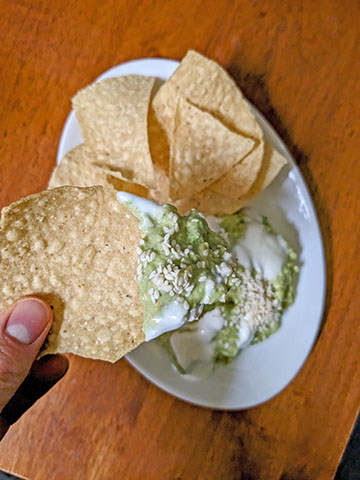
Sesame Guac

I know the Super Bowl is past, but we can still celebrate our win with a super bowl of guacamole. Especially since I forgot to actually bring my avocados to the game. This dip has some of the same aspects of regular guac, but it gets intercepted by the mild crunch and nuttiness of the sesame. Don’t relegate this simply to tortilla chips; try it with everything from dipped on pita to swiped on sandwiches to dolloped on salad.

Prep tips: if you don’t have toasted sesame oil, you can use extra virgin olive oil; it obviously won’t have the same effect, but still add a pleasant fruitiness.

2 avocados

1 teaspoon coriander

1 teaspoon toasted sesame oil

juice of half a lime

¼ cup plain yogurt or sour cream

2 tablespoons sesame seeds

salt

Mash avocados with a fork until smoothly chunky or chunkily smooth. Stir in the coriander, sesame oil, lime, and half the yogurt and sesame seeds. Season liberally with salt. Mound onto a serving dish (or your plate) and top with remaining yogurt and sesame seeds. Eat with whatever you would eat guac.

Invasive species in Kansas can cause thousands in vehicle damage

0

Be careful where you park your car this summer because it could cost you.

Last year state officials sought public input on a tree species that is causing harm to Kansas’ ecosystem. The trees are from the pear tree family and include Bradford, Cleveland Select, Chanticleer and other pear trees.

Callery pear trees, sometimes known as Bradford pears, are known for their strong, invasive roots that can damage sidewalks and plumbing. The trees can have branches snap off during severe weather which can cause property damage.

The sap that falls from the trees can cause paint jobs on vehicles to deteriorate. Tim Hicks of Tim’s Paint Works Collision Services of Topeka said he’s seen cars come into his shop with evidence of sap damage to paint.

It will penetrate the clear coat,” Hicks said. “You would have to strip and reprime and refinish the hood. It would penetrate the clear coat and the base coat. You’d have to sand it down primer it and then refinish it.”

When sap bonds to a vehicle surface, it shrinks over time . As the sap shrinks it creates stress on the car’s finish. Additionally, tree sap is acidic and can feed on surfaces like clear coats if neglected. The longer sap is left on a vehicle the harder it becomes to remove, according to autodetailingpro.ca .

Depending on how much sap has been left on your vehicle, the cost to repaint your vehicle could be as high as $5,000. Hicks said when the sap falls onto a car and is left unattended it will etch down into the clear coat.

“I say two to three months for it to do any damages,” Hicks said. “I’ve seen it on a quarter panel of a car from last year.”

Hicks said each car panel the sap falls on could cost $600 to $800 to repair.

“You’d notice it on the windshield before you noticed it on your car,” Hicks said. “If you hit your windshield wipers it would smear and you would have to wash it off.”

Kansas Department of Agriculture (KDA) spokeswoman Heather Lansdowne said the invasiveness has prompted the KDA to restrict their spread in Kansas. Public input was received in 2023 to quarantine the trees due to their invasive qualities. Quarantine of plants is allowed under the provisions of K.S. A. 2-2117.

USDA rules ‘color-coded’ corn plants can be sold and grown without restriction

0

A final ruling by the U.S. Department of Agriculture’s Animal and Plant Health Inspection Service allows farmers and growers to run field trials on corn plants with genetic traits developed by Insignum AgTech without restriction or the need for permits.

These plants use naturally occurring pigments to signal when specific plant stresses begin. The USDA found the genetically modified “color-coding” plants posed no risk to the environment or other plants.

Insignum CEO and founder Kyle Mohler called the announcement a “milestone for Insignum AgTech and its customers. It means our edited plants can be grown and tested across the U.S. without restrictive permits, opening the door for our customers to run trials. It strengthens our ability to help farmers treat specific problems affecting their crops exactly when, precisely where and only if needed to sustainably increase crop production.”

Additional traits

Mohler said the company will develop additional plant traits that utilize other natural pigments, like red or blue, to give an early indication of yield-limiting factors such as insect pests or fertility loss.
The techniques used by Insignum switch on existing plant genes without importing any foreign genetic material.

Mohler said all plants have the ability to make purple, red, and blue pigments, but normally that system is turned off. Insignum creates a new gene from pieces of DNA that are already present in the plant, not from foreign DNA or transgenes.
Insignum’s current corn product in testing causes the plant to turn purple at disease infection points as a leaf reacts to the first sign of infection at a molecular level. The purple color appears before any other symptom and about a week or more before diseases can be identified by other means.

In addition to the naked eye, the purple spots are visible by color cameras on satellites, drones, and other equipment. For example, a smart sprayer could use the same system to hunt for weeds and detect purple colors. In 2023, Mohler said, multiple drone companies were able to detect the purple spots from aerial imagery.

Cost cutting move

The color-coding can also help growers reluctant to use expensive pesticides to know where and when to use them. According to the Crop Protection Network, farmers lose about $5 billion worth of corn to diseases every year. This works out to $50 to $60 per acre. About 80% of U.S. corn farmers do not spray fungicides, according to USDA surveys.
After growing up on the family farm in Boone County, Indiana, Mohler earned his bachelor’s in biochemistry from Purdue University’s College of Agriculture and a doctorate in plant biochemistry from the University of Edinburgh in Scotland. He founded Insignum AgTech in 2019.

His company is working with corn but plans to work with the entire range of food plants once more funding is secured.

His own experience

The idea for his company occurred to Mohler when he saw family members applying fungicides before they knew whether or not they were needed.

“By the time a farmer sees disease, it’s too late to save the crop,” he said. “This is why many plan to spray preventively—and why that’s often profitable. However, if fungicides are applied too late, some damage is already done. If applied too early, efficacy fades and leaves crops vulnerable to late-season attack. When fungicides [are] applied at the right time, green, healthy crops remain green and healthy, leaving farmers wondering if the treatment did anything at all. Because of these challenges, most crop farmers ignore diseases altogether.”

“[With Insignum plants], farmers will gain the ability to sustainably and precisely treat when and where needed, ultimately increasing yields without arbitrarily increasing costly inputs,” Mohler said.
Right now, Insignum’s “go to market” strategy is to license its technology to seed companies. Three more years of field trials are in the offing, with a commercial product launch in the “late 2020s.”
In April 2023, Insignum AgTech and Beck’s signed an agreement to test Insignum’s corn traits in Beck’s elite varieties.

In January 2022, Insignum AgTech received a $100,000 investment from the Purdue Ag-Celerator, an agriculture innovation fund operated by the Purdue Foundry, with assistance from the Purdue College of Agriculture, the Purdue Research Foundation Office of Technology Commercialization and the agricultural industry.

As reported in the High Plains Journal