Tuesday, February 17, 2026
Home Blog Page 507

Ye Haw, PETA Rides Again

0

One of several problems in our society today, is the intolerance of differing opinions; by many, anyone with a different opinion is seen as the enemy. I’m told I sometimes lean in that direction too, so in this column, I’ll attempt to control the urges I have to ridicule the subject matter contained herein. However, having said that, I also have to state right up front, that in today’s world, it seems facts and common sense have been replaced by emotions and ideologies, so here goes nothing.

Wichita, KS is home to Chance Rides, the largest manufacturer of amusement park rides in Kansas and probably one of the biggest in the United States, if not the world. One of their most popular products is the carousel, the ride where kids are seated on animals, mostly horses, that bob up-and-down as the whole rides spins around. Carousels have been around for generations and are a staple at fairs and carnivals.

Recently, our friends at PETA (People for Ethical Treatment of Animals) sent a letter to President and Chief Operating Officer of Chance Rides, Aaron Landrum, urging them to end the production and sale of animal-themed carousels. I’ll use a lot of direct quotes from the letter, as I don’t want to misrepresent anything. The letter began, “PETA urges Chance Rides and all other carousel manufacturers to hit the brakes on old-fashioned animal-themed rides and embrace designs that engage children’s imagination and showcase human talent.” (whatever that means) The letter continues “asking that the company end production and sale of animal-themed carousels that normalize the use of animals as conveyances and amusements and instead produce carousel figures in the shape of cars, airplanes, spaceships, bulldozers, and other vehicles, or more whimsical designs like shooting stars, rainbows or brooms.” I’m almost at a loss for words…oh wait a minute, here they come. The last time I checked, lots of those other suggested “figures” are already on carousels all over the midway at most fairs and carnivals. And let’s help our kids imagine they can ride brooms, rainbows and shooting stars, but not horses they can actually ride and enjoy in real life.

The letter continues saying “times change, and that animal-themed rides “unintentionally” celebrate animal exploitation. It continues “All animals are thinking, feeling, affectionate, playful and social beings who form strong bonds

with their offspring if permitted to keep them (a rarity.) They crave freedom from oppression.”

My tongue is literally bleeding from biting it, but I have to congratulate you PETA, on staying abreast of the times, as your priorities in this letter seem to fall right in line with the world’s priorities of late. I’d like to introduce you to some Amish friends of mine. Yes, their horses work hard for them, but they are treated like kings and queens once in the barn when the work day is over. There are literally thousands of horse enthusiasts around this country who also treat their horses better than our country treats its homeless and veterans. But there are also people and farmers in our land who very much mistreat their animals and pets, so please concentrate on them where there is actually a problem needing fixed, rather than on plastic horse figures on a carousel ride…Continue to Explore Kansas Outdoors.

Steve can be contacted by email at [email protected].

Haven Wildcat headed to State Competition

0

Our Lady Wildcat Wrestlers traveled to McPherson today for the KSHSAA 4-3-2-1A Girls Regional B Tournament . We wrestled well taking 15th place out of 35 teams. We had one State qualifier today, Trista Rogers. Trista brings home the title at 155lb weight class. Trista beat her nemesis from Pratt with a first period pin. Trista’s next stop will be in Salina for the KSHAA State tournament.
The other wrestlers finished their HS wrestling season today. 125lb Kayla Rose had the biggest bracket today with twenty wrestlers . Kayla came away with a victory, finishing her season with a 7-17 record.
135lb Lorena Garcia found the win column as well. Avenging a prior loss. She completed her season 4-26.
190lb Kyleigh Kelley improved tremendously this season. Her final record was 3-19.
130lb Haydan Williams lost a heartbreaker, losing in the blood round. Ending her season one match away from qualifying for State. Haydan had a very impressive first year. She earned the Lady Wildcats Freshman Season Record with a 25-16 record.
These four first year wrestlers made huge improvements throughout the year.
Congratulations Trista and the Lady Wildcats.
The Haven Boys will wrestle in the KSHSAA 3-2-1A Regional B this coming Saturday 2/17/2024 at Southeast of Saline HS, Gypsum Ks.
Photo and information provided by Haven Wildcat Wrestling Facebook Page

Why Not?

0
lee pitts

Both the dairy and the beef industries have used EPD’s (Expected Progeny Differences) to greatly enhance the quality of the cattle they’re raising. Which raises the question, why don’t we have EPD’s for humans? Maybe if we did we could gradually lower the divorce rate and get more people, like Congresspersons, off welfare.

Here’s what I’m thinking. Suppose a man gets on bended knee and pops the question but the woman says something like, “Gee Mike, You know how much I love you but in looking at the data I see that your EPD for yearly salary ranks in the bottom half of all men. I’m afraid I’m gonna have to turn you down because I don’t want our kids to be on food stamps their whole life.”

I realize that many of you may be reading this in a weekly paper or farm publication and may have no idea what an EPD is. Basically it is a prediction of the breeding value of an animal that helps you compare one animal with another.

In the Angus bull sale catalog I have in front of me I count 31 different traits for which there are EPD’s. These range from calving ease to the shape of the foot. I don’t think the size of the scrotum or the shape of the foot should be a real deal breaker when it comes to two people getting married, but there are many cattle EPD’s that would be applicable for humans. Take “stayability” for example. With cattle this is an estimate of how long an animal will stay in the herd. Consider how helpful this might be when it comes to humans. Says Mary, “George I don’t know if you realize this but your EPD for stayability is the bottom one percentile. I’m not going to marry you and have sons who go on frequent “business trips” and come home to their wife smelling like Obsession by Calvin Klein.

I think we could also use birthweight, yearling weight, milk, docility and fat EPD’s. We don’t want granddaughters who look sleek and sexy when they’re 25 but end up sad and lonely because they weigh 400 pounds at 45. And can you believe all these grossly obese men eating the all-you-can-eat pasta at Olive Garden? We have to start fighting the obesity problem in America somewhere and human EPD’s could be a good place. In fact, I think I should get a Noble Prize for merely mentioning it.

Just think how EPD’s could be applied. If you’re weak in one trait you should breed with a person who has a good EPD in that area. If you are tall and want your son or daughter to play professional basketball you should breed with a person in the top one percent for height. Maybe they’d appreciate the start you gave them and buy you a house when they’e making millions in the NBA.

The only drawback I see for human EPD’s is that cattle EPD’s have been calculated using data from several generations and this kind of data is not readily available for humans so we’d have to start immediately collecting this information. To do that everyone in the country would be forced to answer screening questions such as, was your father a member of AA before he died of cirrhosis of the liver; was your grandfather the town drunk; How about your great-grandfather?

Progress would be slow at first but over time people could know in advance what they were getting themselves into. I’d suggest we start with the most important traits first such as propensity to bounce checks, temperament, and performance in the bedroom.

Unfortunately, we can’t fix the mess you’ve already gotten yourself into, we are talking here of breeding for the next generation. In no time we’d begin to breed the faults out of future people. Of course this is gonna’ need a policing body such as a new federal agency that will okay marriages while not permitting others. It probably won’t shutter the doors of all the wedding chapels in Vegas because some people will tie the knot while they’re in a drunken state even if they know there’s a good chance they’ll have to visit their grandchildren in a federal prison, or have three lazy generations all living in their house.

Monarch butterflies just took a big hit. Midwesterners may see few of them this year

0
Monarch Watch/University Of Kansas

Celia Llopis-Jepsen
Kansas New Service

Butterfly enthusiasts in the eastern half of North America will have to look harder this spring and summer to spot the winged migrants that have become an international symbol of insect conservation.
At a news conference in Mexico City on Wednesday, conservation scientists revealed that the second smallest population of monarchs on record reached their overwintering sites in the mountains of south-central Mexico last fall.
Scientists gauge the size of the roosting population in terms of how much forest the clustering butterflies occupy.
The size fell to 2.2 acres this winter, the second smallest since scientists began tracking in this manner in the early 1990s and down from a peak of 45 acres in the mid-1990s. The lowest recorded size was about 1.7 acres in the winter of 2013-2014.
The news could intensify debates among monarch scientists over whether the species deserves federal protection, how much risk the species (or its migration) faces, the size of the species’ population historically and how to increase current numbers.
“A lot of people may see very few this year,” said Kristen Baum, a professor of ecology and evolutionary biology at the University of Kansas. “It could be a rough couple of years.”
Baum directs Monarch Watch, a conservation, education and research program at the Kansas Biological Survey and Center for Ecological Research. It typically distributes more than 350,000 butterfly tags each year to thousands of volunteers across the continent to help study the species’ fall migration.
Baum and other scientists from Mexico, Canada and the U.S. gathered in Mexico City this week to discuss conservation efforts.
There, the Mexican agencies and conservation groups that estimate the size of the famed, eye-popping masses of roosting monarchs revealed that few clustered in fir forests this winter. They occupied about 60% less area than last winter.
Why so few butterflies this winter?
So, how many butterflies are roosting this year? Translating acres of roosting insects to numbers of individuals is tough, but a 2017 study suggests calculating about 21 million butterflies per hectare (2.47 acres). That translates to fewer than 19 million roosting monarchs this year.
Widespread use of agricultural herbicides that kill milkweed, the spread of cities and suburbia, insecticides, parasites, climate change and logging in Mexico all get blamed for declining numbers of migrating monarchs in recent decades. Drought years deal an extra blow.
Last year’s drought along key parts of the migration route, such as Oklahoma and Texas, meant the insects likely struggled on their way south in late summer and fall to find enough flower nectar to complete the journey and survive the winter in the mountains of Mexico, according to Monarch Watch.
The good news: Insect populations can bounce back fairly fast when conditions improve, so roosting numbers could climb a year from now if rainfall and temperatures cooperate.
“That’s kind of the nature of insects,” Baum said. “There is the capacity to build back up.”
Rainfall impacts flower production. Temperatures affect how quickly or slowly eggs develop into adults that can carry the baton northward for the species’ annual migration to the northern U.S. and Canada.
“The thought is, the population will rebound,” Baum said. “But it’s going to take time and it really depends on all those other conditions.”
Monarch fans can’t change the weather, but they can take other steps to support the creatures.
Planting milkweed
Along the monarch’s migration routes, the adult butterflies hunt for the milkweed that lets them lay eggs in the spring and summer. Caterpillars eat the leaves.
Many North American gardeners now embrace milkweed, prompting some cities to drop bans against plants traditionally viewed as weedy. In 2017, the Illinois Legislature struck down all municipal bans on milkweed and made the milkweed genus the state’s wildflower.
In Kansas, Overland Park dropped its ban against common milkweed in November.
Some schools and educational groups can get free milkweed from Monarch Watch, which also offers free milkweed for some large habitat restoration projects.
Planting late-blooming flowers
Adult monarchs must find enough nectar to complete their fall migration and to store energy for the winter months.
Baum suggests adding late-blooming wildflowers to gardens, including some that hold up well in dry conditions. She notes that many native wildflowers fit the bill.
The Missouri Prairie Foundation’s Grownative.org website lists species that thrive in the Midwest and offer nectar in fall, such as goldenrods and asters.
The National Wildlife Federation, Monarch Watch and other groups offer tips and certification or registration programs for creating effective pollinator gardens. Such gardens also support a wide array of pollinators beyond the monarch, such as native bees.
Participating in
citizen science
Citizen science opportunities abound and go beyond fall tagging efforts.
Each spring, for example, people can report their first annual sightings of monarch eggs, caterpillars and adults to Journey North to help document the species’ northbound movement.
“All of those pieces of information are really helpful,” Baum said, “and (it) would be impossible to get that across the whole range with just scientists going out.”
Debates about helping butterflies
A few popular ways of engaging with these butterflies have split the monarch-loving world. This includes disagreement over whether rearing the insects in captivity and releasing them — sometimes in large numbers — helps the species or spreads disease. Planting nonnative, tropical milkweeds to feed monarchs has also divided experts for related reasons.
The federal status of monarchs
Each spring, adult monarch butterflies that survive the winter in Mexico head north.
They lay eggs and die, and their progeny continue north, lay eggs and die. Ultimately the insects reach the northern U.S. and Canada over the course of three or four short-lived generations.
The butterflies then head back to Mexico later in the summer and fall. This last generation of the year lives up to nine months so that it can migrate the entire way to Mexico in a single generation, hunker down for five months of cold and postpone egg-laying until the spring. They overwinter by clustering together in trees to stay warm.
Nonprofit groups and the Mexican government work together each winter to compile an estimate of the overwintering population.
In the winter of 2013-2014, the overwintering population dropped to just under 1.7 acres of roosting butterflies. In 2014, conservation groups and entomologists petitioned the U.S. government to declare the species threatened.
The U.S. Fish and Wildlife Service reviews such petitions. In 2020, it concluded that listing the species as threatened or endangered would make sense. However, the butterfly effectively had to get in line: The agency needed to work through other pending species listings first.
“We will develop a proposed rule to list the monarch butterfly as our priorities allow,” the Fish and Wildlife Service wrote in its findings.
The agency plans to revisit the matter annually.
The International Union for Conservation of Nature considers migrating monarchs “vulnerable” to extinction.
After Wednesday’s announcement that overwintering populations had fallen to a near record low, Monarch Watch founder Chip Taylor called the news “a shock.”
“The depth of this decline is beyond our experience,” he said in a KU news release, but added that numbers have rebounded after past extreme weather events. “This count does not signal the end of the eastern monarch migration.”
A separate population of monarch butterflies exists west of the Rocky Mountains. Its numbers have also plunged in recent decades.
Last month, the Xerces Society for Invertebrate Conservation announced that scientists and volunteers counted about 233,000 of these western monarchs at winter sites primarily in southern California. That’s about 5% of the numbers tallied in the 1980s.

Monarch Watch/University Of Kansas

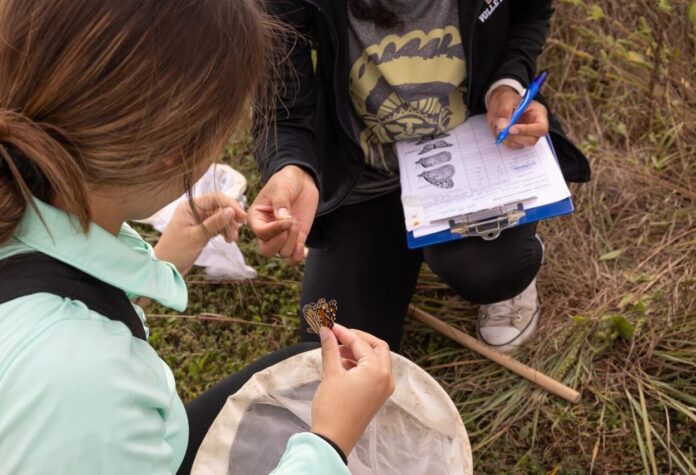
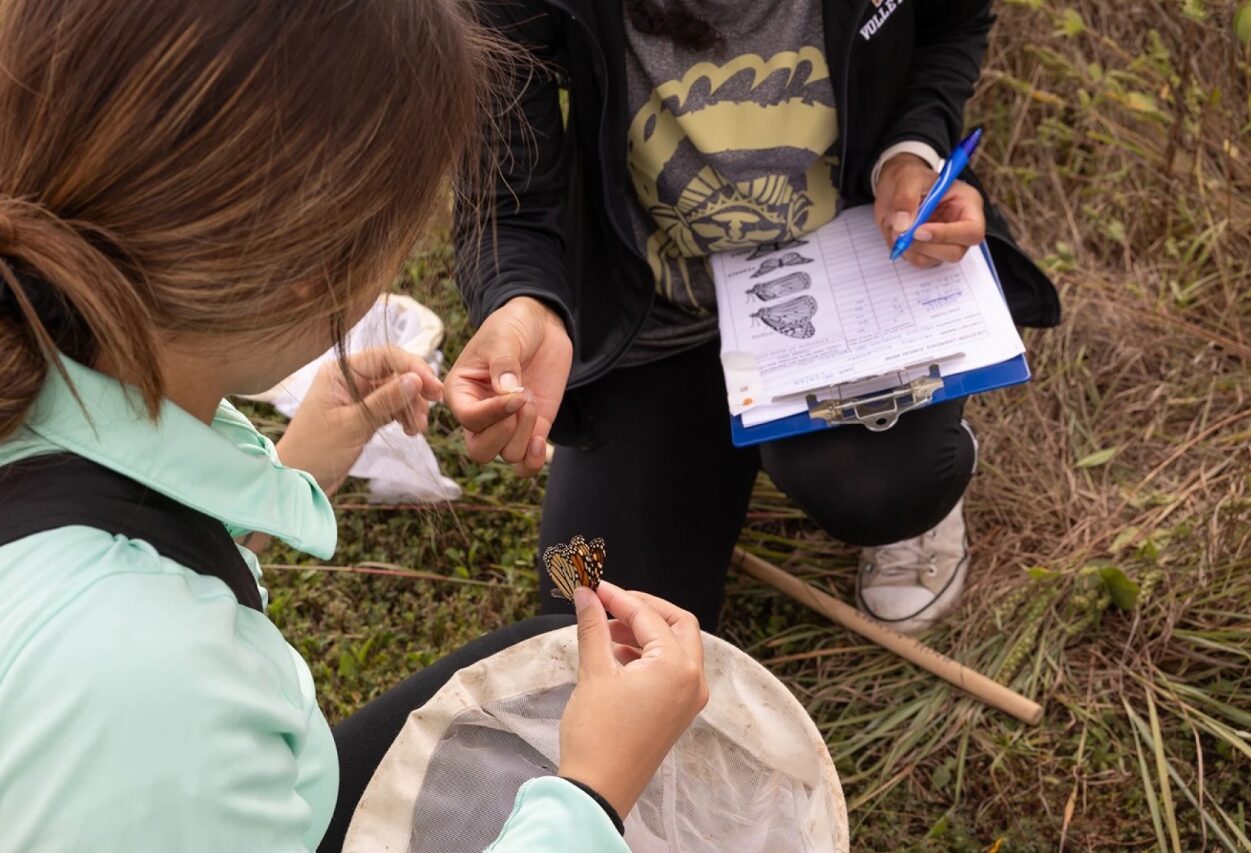
People tag monarchs at Baker University’s Wetlands Discovery Center last September. Monarch Watch holds a tagging event each fall during migration season.


https://www.kcur.org/news/2024-02-07/monarch-butterflies-just-took-a-big-hit-kansans-may-see-few-of-them-this-year