
Friday, January 16, 2026
Home Blog Page 101

Time For Football

0

Richard Shank
Columnist

In these early days of August, it is hard not to think of football at all levels as another season is soon to start. 

My old alma mater, Kansas State, is primed to start the season across the pond in Dublin, Ireland, again perennial rival Iowa State. It is a must win for Kansas State to start a season with a team picked to compete for bragging rights in the Big 12 Conference. 

The other day I caught myself thinking of my college years watching games in K-State’s Memorial Stadium before the move in 1968 to what is now the Bill Snyder Family Stadium. 

Watching my first K-State game with Kansas University was what could now be called a laugher. On October 29, 1966 the Jayhawks arrive in Manhattan with a 2-4-0 record to play the winless Wildcats featuring an 0-6-0 record. Broadcasters dubbed the game the “loser’s bowl.” One even went so far to call the game the “toilet bowl.” 

The most prophetic broadcaster whose name escapes me said the teams were so far down that the game could end in a tied, which it did with a 3-3 score. Soon, both teams bid their coaches farewell. 

Three years later, K-State’s football fortunes were on the rise thanks to Coach Vince Gibson who arrived in town with a southern drawl and proclaimed, “we gonna win because we have good kids.” “And, we ain’t going to be embarrassed,” Gibson promised. 

On October 25, 1969, the 11th ranked Oklahoma Sooners came calling and were unexpectedly thumped 59-21, thanks in part to 380 yards passing from Junior Quarterback Lynn Dickey. Dev Nelson, the legendary voice of K-State from that era was announcing the game yelling into the microphone “Dickey, Dickey, back, back” as the Osawatomie native performed his magic setting a new Big 8 record for passing. 

Bud Wilkinson, Oklahoma’s former Coach, was broadcasting that day for CBS Sports, and when handed the K-State/Oklahoma score, he turned to a staff person and said, “somebody check that score” signifying he could not believe what had just happened. 

A harsh three-year penalty was levied against K-State in 1970, which stopped K-State’s rise in the football world. I always wondered how perennial football powers seem to escape NCAA penalties and probation, but that seems to be the norm. 

In 1988, the offensive coordinator from Iowa University was hired to coach Kansas State which was the start of a Hall of Fame career. Today, Coach Chris Kleiman continues that tradition as he starts his seventh year as the K-State skipper. 

This past Saturday, Larry Brown, a K-State running back from the 1960s was inducted into the Kansas Sports Hall of Fame in a ceremony held in Topeka. Brown was a year ahead of me at Kansas State and his story is one worth repeating. 

As the story is told, Brown graduated from high school in the Pittsburg, Pennsylvania area where he was a standout player. Still, he was short on offers to continue football. Finally, the coach at Dodge City, Kansas Community College made him a scholarship offer, contingent on him making the team as a walk-on player. 

Soon, he was halfway across the nation in Dodge City where he, as a blocking back, not only made the team but earned honorable mention All-American status during his sophomore year. 

Gibson was amassing some great recruits including Dickey, and was anxious to make Brown a Wildcat, an offer he accepted. 

During the 1967 season, Brown was a blocking back and a year later elevated to a running back where he ran for 406 yards on a 4-6-0 team, which then was a respectable season for Kansas State. 

Legendary Coach Vince Lombardi, who earlier retired from coaching at Green Bay, returned to the sidelines with what is now the Washington Commanders. During the eighth round of the 1969 NFL draft, Lombardi selected Brown as the 191st pick. 

Lombardi knew Brown was something special, but noticed he was often late getting into action following the snap of the football. Lombardi ordered hearing tests for Brown which confirmed he had a hearing impairment in one ear. With a  hearing aid built into his helmet, that problem was solved but the coach had one more issue to solve. Brown had a propensity to fumble the football, so Lombardi had a solution for that too. Lombardi required Brown to always carry a football with him. People who met Brown on the street probably wondered why he was always walking with a football in hand.

With that being done, Brown ran for 888 yards in a 14-game season and was second in the voting for Rookie of the Year, and then was selected to play in his first of four Pro-Bowls. 

Lombardi died of cancer before the start of the 1970 season and Brown lost his football mentor, but his greatness as a professional running back was just beginning. 

In 1972, Brown was named the NFL’s Most Valuable Player and led the league in rushing with 1,216 yards. 

In a career that spanned eight years, Brown rushed for 5,800 yards, caught 238 passes for 2,485 yards, and scored 55 touchdowns. Injuries shortened his career and he retired in 1976. 

After retirement, Brown had business careers with E.F. Hutton and Xerox. 

Following his rookie year in pro-football, Brown returned to Kansas State to deliver a commencement address to students. A packed house was in McCain Auditorium that day to hear Brown’s presentation. 

Brown chuckled as he told the story how his coach in college admonished him to make certain he finished his degree as he was not cut out to play pro football. 

Brown seemed proud that he had defied the odds, and that he should be.  
Lettuce Eat Local: Here’s A Butter Idea

0

Amanda Miller
Columnist
Lettuce Eat Local

I stood there quietly, processing for a few seconds. “And she just…eats it like that?” 

This was a few years ago, but the memory holds strong. I was going to watch some friends’ kids for the evening, putting the children to bed before their parents came back, so we were going over their bedtime routine. I didn’t have kids yet, but had been babysitting for 20 years, and everything was making perfect sense — up until this point. 

My friend was explaining, with full nonchalance, that her young daughter might ask for some butter before bed. She opened the fridge and showed me where the sticks were, but location was the least of my questions. I kept waiting for the bread or bagel or any sort of carrier to be mentioned, yet none ever was. I seemed like a child myself as I had to have each step spelled out for me — unwrap butter, cut off chunk, hand to girl — and I still felt unprepared. Was this normal?? 

As it happened, she did ask for butter as a bedtime snack, and it all went as smoothly and naturally as possible…at least on her end. For some reason it was still just such a weird idea to me that it was like I was watching myself going through the motions, and while I wasn’t exactly disgusted, I certainly was not jealous of her nighttime treat. She, however, thoroughly enjoyed it. This sweet girl stood there in her pajamas in the kitchen, happily nibbling on her tablespoon-sized chunk of butter; then she was ready for bed. 

Little did I know this moment would change my life. 

Because now, years of my memories are filled with images of my own pajama-clad children eating their nightly butter. It’s crazy to think of how much bedtime butter our family has gone through, simply because of that one babysitting instance. 

As with so many things in parenting, once there are actually kids in the picture, we might have to swallow our previous words. (If only they could all go down as creamily and saltily as butter!) Once I thought about the reasoning, healthy fats to help satiate the kids’ bodies and brains overnight, the steps of giving bedtime butter made a lot more sense — and if it helps the children sleep, by all means, feed it to them! 

I don’t know that it actually helps them sleep better or longer; it might all be placebo. I just looked the idea up for the first time, and apparently it’s trending on social media right now; catch up, internet, you’re years behind. The “experts weighing in” have conflicting opinions, of course, but we don’t care anyway, because a smidgen of butter isn’t hurting my littles and it helps at least emotionally in our heading-to-bed routine. 

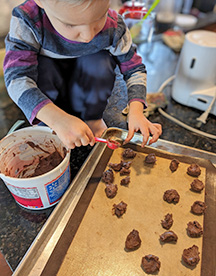
We’ve modified the practice to fit our household, turning the butter into “butter buttons”: mixing still-soft fresh homemade butter with some flavorful additions, spooned into little dollops and kept in the freezer. In the years of age two and three, Benson probably only went a handful of nights without his crucial routine of two butter buttons alongside his bedtime stories; frozen grapes have taken its place over the summer, but Kiah is picking up where he left off. 

Sometimes I eat one, too, because they really are rather tasty. Turns out it’s a butter way to end the day than I would have ever thought. 

Bedtime Butter Buttons

These melt-in-your-mouth buttons are a great treat for any age. What they lack in aesthetics, they make up in flavor and nutrition. They are also a great way to get kids helping in making their own snacks, and Benson loves to give his opinion on which ingredients to add, to help portion them out, and of course to assist in taste-testing to see if we’ve reached the proper ratio. (We just throw all the ingredients together and mix until it tastes right.) Working with kids plus butter can get a little messy, but it’s all worth it. Especially if they sleep all night then. 

Prep tips: obviously you might not be in the routine of making butter, but you don’t have to have a dairy farm to make it — email me if you want to know the simple method I use. 

8 ounces butter, preferably local but any will do; room temp

optional: 4 ounces peanut butter 

¼ cup cocoa powder

2 tablespoons local honey

optional: dash of cinnamon

salt to taste

Mix all ingredients together until smooth; take a taste and adjust to your preference. Portion out on a plate or baking sheet in small “buttons,” and freeze until firm. Transfer to a container and keep in a handy spot in the freezer.

Baking It Forward: Russell Kern Honored for Youth Leadership

0
Kansas Wheat

Contact: Marsha Boswell, [email protected]

For the audio version, visit kswheat.com.

Russell Kern, a nine-year 4-H member from Chase, Kansas, is the recipient of the Home Baking Association’s 2025 Bake to Give: Maddie Kruse Youth Award. Kern’s leadership, generosity and enthusiasm for teaching others through baking is inspiring. Kern is a Kansas 4-H member who exemplifies the values of the wheat-growing and baking communities. Kern has done just that through a remarkable series of hands-on workshops, community service projects and creative educational activities that exemplify the spirit of this award.


A talented baker and teacher, Kern has taken his passion for the 4-H Foods and Nutrition project beyond personal achievement, though his own accomplishments are impressive. Last summer, he earned grand champion honors at his county fair with his expertly crafted buttery croissants. But what sets Kern apart is his deep commitment to helping others, particularly younger 4-H members in his community. Over the past year, he has organized and led a series of interactive baking workshops that not only taught practical skills but also integrated science, nutrition and cultural traditions in a fun and accessible way.


In one workshop, held the day before Thanksgiving, Kern taught a group of young 4-H members how to make butterhorn rolls. Each participant took home a dozen freshly baked rolls to share with their families, but the lesson didn’t stop at baking technique. Kern also led an engaging experiment demonstrating how yeast works, using balloons to show how warm water and sugar help activate the yeast. During Christmas break, he taught participants to make New Year’s Cookies, a family tradition he was excited to share. That session also included a MyPlate nutrition activity, encouraging students to think about healthy food choices as they cooked together.


On St. Patrick’s Day, Kern hosted an Irish Soda Bread workshop, introducing the difference between yeast-leavened and soda-leavened breads. While the bread baked, students shook heavy cream into homemade butter, learned knife skills for chopping herbs and watched a video on how flour is milled. Each class welcomed about 10 students, lasted two hours and gave participants more than just recipes; they left with a deeper understanding of baking, food science and nutrition.


“I think that it is very important for upcoming generations to know how to bake food and the importance of their health,” Kern said. “I strive to teach people about cooking and living a healthy life while learning while they are at it.”


His leadership goes beyond the kitchen. Kern serves on the Kansas 4-H Health and Wellness Team and traveled to Washington, D.C., to learn new strategies for promoting healthy living in his state. He regularly volunteers with the Northern Rice County Food Bank, where he donated 30 pumpkin pie kits last Thanksgiving, and is currently organizing a Swipe Out Hunger meal packaging event at his school. He’s also raised over $1,000 for the Ellinwood Energizers 4-H Club and Ellinwood High School SkillsUSA by baking and selling cinnamon rolls, macaroni and cheese and burritos.


As the 2025 Bake to Give: Maddie Kruse Youth Award winner, Kern will receive a $1,000 prize and a trip to the Home Baking Association’s Annual Meeting in Fort Collins, Colorado. His work embodies the values this award celebrates, sharing baking skills with others, fostering community connections and making a meaningful impact through generosity, leadership and a love of baking.


Kansas Wheat is a proud member of the Home Baking Association and is dedicated to supporting baking education and outreach across the state. From preserving baking traditions to promoting wheat-based nutrition, Kansas Wheat works alongside partners to ensure baking remains a valuable and accessible life skill. Supporting youth like Kern is a reflection of that commitment.

Harvey County Fair time!

0

Harvey County Fair time! Time to pick out your best garden produce and see where you stack up with others in the county! I always enjoy seeing the garden entries at the fair. Horticultural exhibits provide something for everyone. Participants enjoy an exciting educational opportunity. Exhibits are visually appealing and provide food. Things to keep in mind when exhibiting fruits and vegetables:

• Follow fair show rules and regulations.

• Show your best quality specimens.

• Choose items of uniform size, shape, and color.

• Arrange items to develop a central point of interest.

• Display standard amounts of specimens.

• Items should be grown and cared for by the exhibitor


Selecting Horticultural Exhibits

Here are the most important factors when selecting exhibits for show. Quality and condition:

1. Specimens should be of edible maturity, not overripe, shriveled, or wilted.

2. Free of injury from diseases, insects, or mechanical means.

3. Color should be uniform and typical for the product.

4. The shape should be typical of the variety.


Shelf life: Consider how well exhibits hold up after the show.

1. Enter only firm fruits and vegetables that will stay fresh and appealing for the entire show, especially if cooled display cases are not available.

2. Choose products with a longer shelf life. Avoid those that deteriorate rapidly, including leafy greens, green beans, and strawberries.

3. Specimens should be evaluated on appearance at judging time. It is hard to predict what they will look like or what they looked like before. Crops that change rapidly should not be used unless absolutely necessary.


Cleanliness: To improve the appearance of specimens.

1. Brush or wash root crops, taking care not to damage the skin.

2. Dip leafy vegetables in cool water.

3. Wipe vegetables such as eggplant with a damp cloth.

4. Polish apples with a soft dry cloth


Preparing Vegetable Exhibits

Cantaloupe

1. Uniform in size, shape and color.

2. Free from injury.

3. Picked at full slip, or when the stem slips easily away from the attachment to the melon.

4. Uniform netting and true to type.


Onions, Mature

1. Uniform, mature, solid, bright.

2. Neck small and well cured or dry.

3. Smooth, clean, with outside skin intact. Do not peel.

4. Color typical of variety.

5. Tops trimmed ½ to 1 inch above the bulb.

6. Roots neatly trimmed ⅛ to ¼


Tomatoes

1. Select for varietal type, size, color, and maturity.

2. Firm, without cracks; free of disease, insects, or mechanical injury.

3. Remove the stem.

4. Do not select overripe or soft specimens.

5. Exhibit with stem end down


Peppers, Sweet

1. Deep in color.

2. Fresh, firm, symmetrical

3. Traces of red color not desirable unless peppers are uniformly red in color.

4. Number of lobes should be uniform.

5. Trim stems ¼ to ½ inch (but not so long that the peppers cannot stand up on the stem end).

6. Exhibit with the stem end down.


For more information see the publication C405 Exhibiting Fruits and Vegetables AND see the Harvey County Fair rule book for exhibit numbers and classes.

Corn Dip

0

I had all kinds of plans last week to freeze sweet corn for the winter months. None of it made it to the freezer! We had company, I cooked the corn, and in a blink it was all consumed. I might try again this week to find some laterears, so I can attempt the endeavor again. When I was on Facebook Sunday afternoon, I saw that my friend, Becky, up in Lewistown, Missouri, had packaged like 4 gallons of corn. Which unbeknownst to her, gave me a very unsatisfactory feeling!

I was wondering what recipe to run this week, when I flipped past my corn dip, I thought, yum, made with fresh sweet corn, this would be so delicious. One thing I would definitely do is cook the corn thoroughly, before putting it in the dip, and I think I would go about this with a skillet saute using olive oil. Allow to cool, and then implement into the dip.

There are so many different things to make with corn besides buttered and spiced. This weekend some of our family was here and they wanted to make Mexican sweet corn, which was much more fattening than regular, but they enjoyed it. Corn Souffles, of course, good ole’ corn casserole, creamed corn. I even have a delicious recipe for a hominy and corn salad. I’m not a huge fan of the cornbread salad, but this too is an option for the fresh corn. I’m like a little kid, I like to eat mine cut off the cob with the big strips connected together, butter pat, a bit of salt and pepper and yummy. Then I have Fiesta corn with red onion, cilantro, red pepper, and zucchini. Lots of directions to go with our North American corn. While we enjoy each kernel across the pond they think corn is the nearest thing to nothing there is.

I call the corn dip a casual appetizer. Yes, I did say that! Perfect for tail gating, cookouts, outdoor events, adding corn chips or tortilla chips. It could even be served slightly warm. There’s no cilantro, but I would definitely add it, chopping very fine. (My husband greatly dislikes cilantro.)

This week is about keeping the house picked up, and finishing a few small projects before diving into bigger things. The extra warm temperatures here in the Ozarks have driven all of us inside more this past week. Early morning is the best way to stay active in this heat.

Keep visiting the city markets for home-grown vegetables and fruit. They are so

good for us, and the flavors just seem to pop on the palate. ErvIn got me into eating tomato sandwiches a few years ago, and now it’s one of my favorite things, especially with a little chopped basil on top. Enjoy your week, and relish the good times. The Covered Dish

Spicy Corn Dip

1 (8 ounce) package softened cream cheese

1 dry package Ranch Dressing Mix, makes (32 oz.)

1 (11oz.) can drained Mexicorn

1 can Rotel Tomatoes, undrained

4 ounces sour cream

4-6 green onions, finely chopped.

Soften the cream cheese and work the dry ranch dressing into it. When smooth; add the corn, Rotel, sour cream and lastly; the green onion. Work ingredients together until blended. This will yield about 2 cups of dip. If made the day before it allows the flavors to permeate the dip.

If the dip is softer than you desire add some finely shredded cheddar cheese to make it into a tighter bind. Pepper Jack would be another good cheese choice.

You could omit the Rotel and sour cream if you wanted. Bring in hotter spices if you like, green chilies, jalapenos, cilantro, even a shake or two of hot sauce.

This appetizer will hold for several days in the refrigerator, which is great for weekend entertaining. Allowing you to make things of an evening after work. Imagine making a few pinwheels to go with the appetizer, a marinated salad, and more all before Saturday, leaving you time to tidy and sleep in a bit on Saturday morning!