Saturday, January 17, 2026
Home Blog Page 109

Kansas claims part of a nationwide $720 million settlement with opioid companies

0

Kansas Attorney General Kris Kobach announced the state will receive $5.7 million from eight companies that manufactured opioid pills as part of a national settlement that totaled $720 million.

Kansas’s piece of the settlement is based on the impact of the opioid crisis in each state and how it participated in the court proceedings. The companies include the following

  • Mylan (now part of Viatris): $284,447,916 paid over nine years.
  • Hikma: $95,818,293 paid over one to four years.
  • Amneal: $71,751,010 paid over 10 years.
  • Apotex: $63,682,369 paid in a single year.
  • Indivior: $38,022,450 paid over four years.
  • Sun: $30,992,087 paid over one to four years.
  • Alvogen: $18,680,162 paid in a single year.
  • Zydus: $14,859,220 paid in a single year.
  • Each company can no longer promote or market opioids, and are not allowed to sell any product with more than 40mg of oxycodone per pill, except Indivior who will not manufacture or sell opioid products for 10 years. They also must use monitoring and reporting systems for suspicious orders.

    Payments could begin as soon as 2026, and 45 states in total have signed up in the settlement, which was negotiated by the attorneys general offices in North Carolina, California, Colorado, Illinois, New York, Oregon, Tennessee, Utah and Virginia.

    The attorneys generals from those states announced the agreement on July 10, and allowed other states to sign on to the settlement over the next couple days.

    “We are holding these companies accountable for the human suffering caused by years of their illegal marketing practices,” Kobach said. “These dollars will help save lives, because the funds will be used to prevent and treat drug addiction throughout Kansas.”

    The entire nation has seen rising overdose deaths from opioids over the past two decades. Kansas recorded 613 fatal drug poisonings in 2023, and the Kansas Department for Health and Environment said at least 63% of overdose deaths involved an opioid.

    As reported in the Topeka Capital Journal

One last cast lands largest blue catfish ever hooked in Kansas at 121.1 pounds

0

Danny Mayer was about to call it a night when he cast his fishing line into the Kansas side of the Missouri River about 9:30 p.m. on May 15, north of Kansas City, Kansas.

Instead, Mayer hooked and reeled in a massive 121.1-pound blue catfish, obliterating the previous Kansas state record of 102.8 pounds for that type of fish.

“What I thought was the end of the night was just the beginning,” Mayer told The Capital-Journal on July 15.

Fisherman: Officials determined record fish was 23 years old

The Kansas Department of Wildlife and Parks recently updated its website to reflect that Mayer caught the record blue catfish using common carp as bait. The fish was 59.75 inches long, that site said.

The state’s previous record blue catfish had been taken from the Missouri River by Robert Stanley of Olathe on Aug. 11, 2012. That fish had been 56.75 inches long, the KDWP website said.

It was a lucky deal that I was on the Kansas side,” said Mayer, 44, acknowledging the fish wouldn’t have set a record if he had caught it in Missouri.

The record blue catfish for Missouri weighed exactly 130 pounds and was taken from the Missouri River by Greg Bernal of Florrisant, Missouri, on July 20, 2010, according to records posted online.

The catfish Mayer caught was female and was determined by KDWP to be 23 years old, Mayer said.

That made her a very old catfish, he said.

Blue catfish have an average life expectancy of nine to 10 years, and have been known to live as long as 25 years, said the website of the American Catfishing Association.

Mayer had recently helped bring in a 99-pound catfish

Mayer, an experienced tournament angler, said he fishes regularly on the Missouri River to the north and south of St. Joseph, Missouri. He lives at Agency, Missouri, near St. Joseph.

About three weeks before catching the record catfish, Mayer said, he helped a buddy bring a 99-pound catfish he’d caught into Mayer’s boat, with that fish falling roughly 2 pounds short of breaking a Nebraska state record.

“It was a good three weeks of fishing, having those two giants in the boat,” Mayer said.

Fisherman: Bringing record fish into his boat was a struggle

Getting the 99-pounder into Mayer’s boat hadn’t been a struggle — but getting the record catfish into his boat was, he said.

Mayer caught the record fish using a Big Cat Fever rod while pre-fishing alone to prepare for a tournament.

He said he caught the record fish while fishing from the last spot at which he was going to fish that day, after having caught several other fish while being out all day.

When he hooked the record fish, Mayer said, “I could tell immediately that it was the biggest fish that I had hooked that day.”

Mayer estimated he fought the fish for 10 or 15 minutes.

Western Kansans have to travel miles to see a doctor. Experts say it leads to worse health outcomes

0

Western Kansas is the place for a quiet, rural lifestyle. But with that comes shortages when you need to see a doctor. Many will drive an hour or more to receive quality health care. But some of the problems may not be easily fixed.

A little red car trudges through dirt roads and dodges potholes before it zooms down the highway.

In the car is Isabel Yara and her daughter. Yara spent most of the early morning getting her daughter ready for a doctor’s appointment. But Yara lives in rural southwest Kansas, and seeing the doctor is about an hour’s drive.

She lives in Seward County and the closest town of Liberal has a shortage of medical professionals like much of western Kansas.

“Nearby we only have two options for the pediatrician, and the pediatricians here are completely booked,” Yara said.

With rural hospitals closing or perpetually understaffed, western Kansans often have to drive anywhere from an hour to multiple hours for doctor’s appointments. And fixing that for such a large area will be hard.

Yara had to look further to towns in neighboring counties. She remembers the struggle to get her daughter in for something urgent.

“There were times where she had gotten sick, and the closest option is urgent clinics, but they don’t work with children and it would be more expensive,” Yara said.

Rural Kansans on average travel twice as far for medical care than their urban counterparts.

The U.S. Centers for Disease Control and Prevention have found that largely due to this difference in access to health care, rural residents are more likely to die early than urban residents. They’re also more likely to die from overdoses and suicide without quick access to emergency services.

And western Kansans pay the price with their health outcomes. According to the Kansas College of Osteopathic Medicine, rural Kansans are less likely to receive preventative care.

That also leaves them vulnerable to late stage diagnoses for cancer, heart disease and stroke, the main causes of death in rural Kansas.

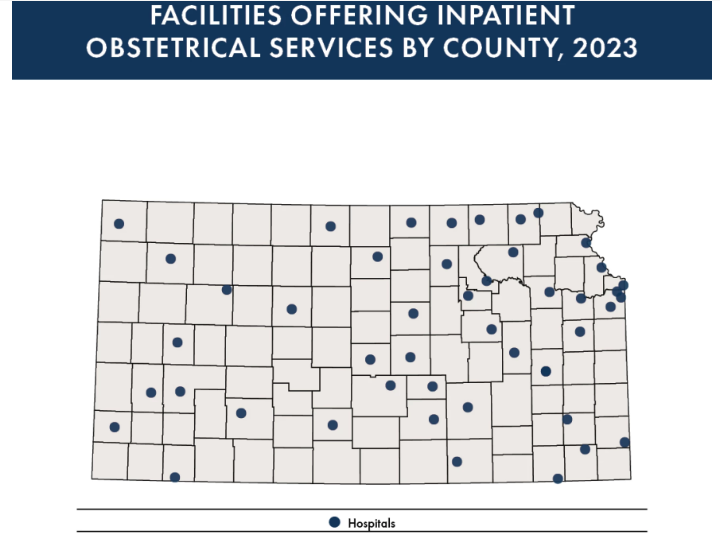
A Kansas Hospital Association analysis found many counties across western Kansas, patients aren’t able to stay in their home county for care.

A few hours away in northern Kansas, Beth Oller has seen this from the other side. She is a doctor that used to practice in Rooks County. She sums up rural living in Kansas pretty well.

“My closest Walmart was 50 minutes away, Oller said. “It’s not that surprising to also think that’s the closest place that you may be able to find medical specialists as well.

Oller was on the frontlines of rural care, with patients coming from several counties over to see her. Norton, Graham, Osborne counties, even some patients from southern Nebraska.

But even if a county is lucky enough to have a physician or a specialist like Oller, it’s a hard workload to keep up with. Oller is a good example of why it’s so hard for communities in western Kansas to attract or keep doctors.

Oller, after years of practice, became the only doctor delivering babies in her county. She was always on call, and it made it hard to do her job at the clinic, and her job at home being a mother herself.

She made the hard decision to stop delivering babies which left the county in a maternity desert like much of western Kansas.

“It was a huge hit to me personally and very hard when I realized that I just couldn’t do it anymore,” Oller said.

Oller’s experience is quite common for medical professionals in rural Kansas.

Oller eventually needed to move back to eastern Kansas like many health professionals. She is the mother of four, and there weren’t enough education opportunities for her family. Like most western Kansas communities, living there isn’t always an easy sell.
But she still tries to treat her patients through telehealth. And now she is also traveling for health care, as the provider instead of the patient every four weeks to Rooks County.

But Karen Weis, the dean of the University of Kansas School of Nursing, looks at telehealth as a Band-Aid.

“Everybody thinks the solution is telehealth, but the problem is, there has to be a plan for making sure that the mother gets to the right place at the right time,” she said.

Weis is talking about the levels of care. The first level is primary care, family doctors and nurse practitioners. They refer patients to the second level of care. The second level is specialists, hubs with better equipped clinics in places such as Hays or Wichita. The third level is complex care that requires expertise and technology, often found in urban areas like Kansas City.

The Kansas Journal of Medicine conducted a survey to better understand barriers to access for rural health providers. Of the providers that participated, 75% of them said a lack of specialists close enough to them was the number one barrier when it came to patient referrals.

And Weis worries about this being a problem that only gets worse. The distance creates another problem for health care, which is communication. The survey found that to receive quality care, specialists need to access medical records, and getting those in a timely manner creates another obstacle in rural health.

“The people that review medical images should be the same people that say, ‘here’s the plan going forward’ for the patient,” Weis said.

So what are some of the possible solutions for creating more health care in rural Kansas?

That has been on the mind of Cindy Samuelson, the senior vice president of the Kansas Hospital Association.

She said rural hospitals always struggle to keep health care workers there. Working on an island without peers, and for less pay, is hard to overcome for rural communities. That’s the nature of a small, isolated town. There’s not as much money or resources for professionals.

Her main solution is for western Kansas to “grow its own health care workforce” by targeting those who already live there and have found community.

“We are looking at our middle school students, our high school students, and we’re trying to give opportunities to talk to them about how they may want to come back and be a part of this community,” Samuelson said.

But to fix the problem of rural health care in Kansas requires addressing other places where communities fall short.

Samuelson asked where will the new physicians live? Who will look after their kids? Where will their kids go to school?

These are hard questions without direct answers, but housing, day care and education are also part of the equation when it comes to getting more health care professionals to come work in the community.

But a more robust health care system also can be vital economically for a town on the frontier as well.

Cheyenne County in the corner of northwest Kansas is an example of a community with a more robust health care system.

Having those hospitals and clinics means more dollars for the county. It also means more jobs. For example, 90 hospital jobs within the county has a ripple effect of sustaining an additional 23 jobs in various industries.

“Partnering with other industries in a rural area is another way to try to recruit more health care workers.” Samuelson said. “Maybe those in the ag sector have a spouse that actually could work at the hospital?”

Calen Moore covers western Kansas for High Plains Public Radio and the Kansas News Service. You can email him at [email protected].

 

Anthracnose on Cucumbers

0
Description: Anthracnose is a disease caused by a fungus which is most severe in cucumbers, muskmelons and watermelons. Anthracnose survives in plant debris and seeds. Infected leaves and fruit develop spores that spread easily by splashing water or contact with hands/tools. Anthracnose favors warm, moist conditions.
Damage: Infected leaves exhibit irregularly shaped brown spots that may have a hole in the center. Stems may become elongated and sunken when infected.
Control: Begin with resistant varieties and clean seed from a reputable distributor. Do not collect seed from infected plants. Practice crop rotation allowing three years between crops from the squash family. Use mulch and drip irrigation to prevent soil and water from splashing on the plants. Infected plants should be destroyed, not composted. Sanitize tools between use if they contact diseased plants.
Contact your local Extension office for other control recommendations.

Dividing Irises

0
Irises have a rhizome root system. Every year, each rhizome yields additional rhizomes creating a larger network of roots. After several years of this development, bloom production may slow down or halt altogether if the rhizomes become too crowded. This indicates it’s time to divide the rhizomes.
When the bloom season has ended dig the entire plant including all the rhizomes. Break the rhizomes apart by hand at the joints where they are connected. Healthy rhizomes should have roots extending below and a fan of leaf blades above. The rhizome should be firm and at least the width of your thumb. Discard any rhizomes that are soft, have an odor or do not have leaves protruding.
Trim the fan blades to about eight inches, cutting each blade at an angle to keep water from collecting in the thick, open leaves. Trimming the leaves prevents the plant from falling over while the roots become established. Dig a hole just deep enough that the top of the rhizome is slightly exposed when placed inside. Irises will tolerate poor soil conditions, but well-drained soil is best. Space plants 12 to 18-inches apart and do not mulch. Irises do not respond well to over-watering; however newly planted rhizomes need to be watered in thoroughly.
Fertilize according to soil test recommendations or by applying a complete fertilizer, such as a 10-10-10, at the rate of 1 pound per 100 square feet. Mix the fertilizer into the soil to a depth of 6 inches. If your soil test shows high phosphorus levels, use a fertilizer that has a much higher first number (nitrogen) than second (phosphorus). It is important to get irises planted early enough in the season to allow roots to establish before the first hard frost.