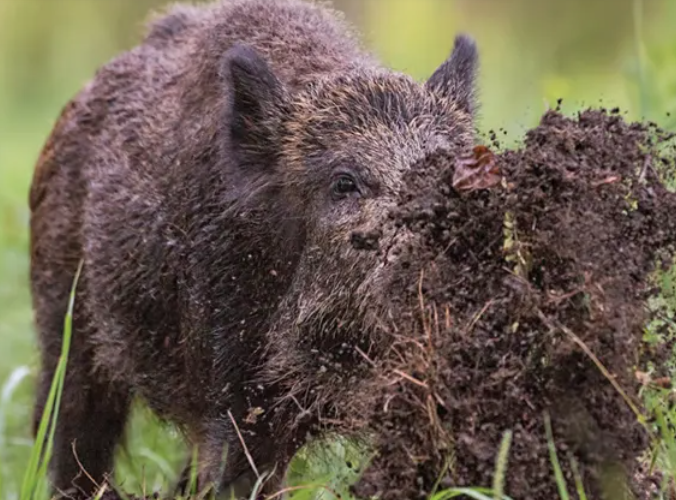
If you think that government can’t solve problems anymore, just ask a feral pig in Kansas. If you can find one. At a time when wild swine run amok in other states, a Kansas model shows how a state can cheaply and efficiently get the problem under control. Provided, of course, you’re willing to step on a few toes, including those of hunters.
The rapid expansion of wild pig populations, and the destruction they bring, is one of rural America’s greatest threats.
Spurred by rabbit-like reproductive rates, the nation’s feral pig numbers have grown from an estimated 2 million to as many as 9 million animals during the past 20 years.
Their range has increased from about 20 states to as many as 41 within a few decades, because of natural expansion and human assistance.
According to the U.S. Department of Agriculture, the annual damage to agriculture nationwide by the four-legged rototillers is estimated at $2.5 billion. Damage to wildlife habitat, wetlands and anything earthen, such as runways and important flood-control dikes, may add another billion in damages.
Wild swine also contribute significantly to water erosion and pollution. They can carry diseases that can be deadly to domestic pigs and humans.
Some states report hundreds of millions of dollars in annual damages. Millions more are spent to fight the growing wild swine problem by state and federal agencies.
Two of Kansas’ neighbors – Oklahoma and Missouri – are deep into feral pig problems. Oklahoma’s population has grown from a few herds, known as sounders, along its southern border 40 years ago, to a statewide population estimated as high as 1.5 million animals that annually inflict hundreds of millions of dollars in damages.
Missouri fields a platoon of as many as 48 full-time anti-swine technicians at a cost of up to $2 million annually.
Kansas was not immune to the spread of wild pigs. Like Missouri, its first sounders appeared in the mid-1990s. Within 10 years, problem populations were scattered nearly border to border. Most assumed Kansas would soon be overrun by wild swine.
But that didn’t happen.
Kansas, in just a few years, became the first state to drastically reduce feral swine populations statewide, thanks to innovative, yet somewhat controversial, methods.
To date, 12 of Kansas’ 13 isolated populations, some of which held more than 1,000 animals, have been totally eradicated.
Curran Salter, a USDA feral pig biologist tasked with battling Kansas’ wild pig problems, estimates the state’s wild pig population is 500 animals or fewer. He estimates annual damages have dropped to less than $100,000.
Kansas’ entire program has just three full-time technicians in the field. The annual budget is $350,000 – equal parts state and federal funds.
“Kansas has pigs, and we may always have pigs, but we no longer have a pig problem,” says Salter, of Hoisington. “We’re miles and miles ahead of where we were, and of where many other states are. It is pretty much a maintenance program.”
Kansas agriculture officials are thrilled.
“This program sticks out because of all we get out of it, for what’s really not much money,” says Kansas Secretary of Agriculture Mike Beam. “We are putting up $175,000, which is a heck of a deal when you see that some states are spending millions and still getting hundreds of millions in damages. This entire program is a thing of beauty, something Kansans should be proud of, really.”
Kansas’ tactics for wild swine eradication, known as “the Kansas model,” are now being replicated by many other states. That includes the controversial aspect of stopping sport hunting for wild swine.
The success story comes at a time when the efficiency and effectiveness of government is under a microscope. Thousands of government employees were dismissed during the first month of President Donald Trump’s administration, part of a large-scale culling led by the White House and its Department of Government Efficiency.
But the Kansas approach to eradicating feral swine shows that different layers of government, embracing smart tactics and working in collaboration with one another and property owners, can head off the menace.
If you think that government can’t still solve problems, just ask a feral pig in Kansas. If you can find one.
Meet the enemy
Wild pigs aren’t native to America. Today’s problems began when Spanish explorers arrived in the 1500s with domestic pigs for sustenance. Some animals escaped from them and from early settlers over the next 400 years. The escapees adapted quickly to the wild.
Within three generations, the fugitives’ shoulders became larger than their hams. Heads and tusks became enlarged to help them root for food. Most adult wild pigs weigh 100 to 300 pounds (leaner than domestic pigs), though animals twice as large are killed annually.
Yet feral pigs have retained one of the highest reproductive rates of domestic mammals. Wild sows can have up to two litters, averaging six piglets, a year.
Like their tame brethren, wild pigs possess an intelligence greater than most dogs. The one-two punch of brains and brawn isn’t good for farmers.
Bourbon County farmer Mike Wilson recalls taking a combine to harvest a 40-acre cornfield. In the center of the field, he found 10 acres that had been destroyed by wild pigs. Wilson says, conservatively, it was at least $5,000 in lost harvest.
“Those pigs start in the middle of a field, so you don’t know they’re anywhere around until it’s too late,” Wilson says. “People complain about deer, but deer don’t do near the damage hogs can do.”
Wilson says feral pig damage is much of the reason he switched his lands from growing crops to grassland for hay and grazing cattle.
In Southern states, some farmers have reported annual damages of $100,000 or more.
Up to 30 different diseases have been documented in America’s feral swine. Some had been wiped out in domestic swine, then reappeared when spread by feral swine.
Justin Smith, Kansas Department of Agriculture animal health commissioner, says a few such diseases have been found in Kansas’ wild swine, though in low numbers.
Smith fears what could happen if African swine fever were to make its way into American feral swine populations. The deadly and highly contagious disease has killed millions of domestic pigs as it spread from Africa through much of Asia and some Pacific islands. It is now as close to the U.S. as the Dominican Republic in the Caribbean.
Feral swine helped transmit the disease to domestic pork in those places.
“Basically, it could damage our domestic swine industry in the U.S. beyond repair,” Smith says.
People spreading the wild pig problems
For centuries, America’s feral pigs were mostly relegated to wild areas deep in Dixie. That changed in the 1990s when people began hauling them northward by the truckload.
Salter and Brad Jump, Salter’s USDA counterpart in Missouri, says the increase in hunting shows on cable television introduced wild pig hunting to millions of hunters who’d never pursued the animals. With no closed seasons, kill limits or expensive licenses required for hunting, wild pigs and their delicious meat quickly appealed to many hunters. Ranches in Texas, Oklahoma, Florida and other states began catering to pig hunters.
“I guess it’s not a surprise people started figuring it could be even better if they could do pig hunting close to home,” Jump says.
Live-trapped feral pigs were readily available for purchase, especially in Texas, and illegally released in other areas.
Salter believes Kansas’ first pop-up feral pig population had human assistance, getting started on the 100,000-plus acres of Fort Riley in the 1990s. In crop fields and Fort Riley’s vast backcountry, those feral swine thrived while tearing up important military training areas.
The Army wanted them removed. That task fell to Chad Richardson, a USDA biologist.
Tom Halstead, USDA Wildlife Services director in Kansas, says Richardson began trapping the animals, and sport hunting was encouraged. Wise to the ways of both, Fort Riley’s pig population retreated to areas off-limits to humans because of artillery use.
While that initially allowed the pigs to thrive, it eventually led to tactics that resulted in the eradication of the fort’s pigs and eventually other Kansas populations.
With ground access severely limited, Richardson called in specially-trained USDA helicopter crews to use aerial gunning to kill Fort Riley’s wild pigs. With the pigs concentrated during the late winter, when the landscape was barren, aerial gunning with shotguns was very effective.
After the winter of 1999, and the overall removal of about 400 animals, Fort Riley’s pigs were no more. None have been seen on the post since.
By then there were plenty more problem pigs in Kansas.
Sounders were thriving within some big wooded regions of eastern Kansas, through the vast Red Hills and along nearly all of the 96 miles of the Cimarron River in western Kansas. They also came up the Arkansas River and into the southern Flint Hills.
Tom Berding, a Cowley County landowner, says feral pigs went from “you’ll never guess what I saw” novelties to justifiably cursed problems within months.
“Farmers would plant corn, and the pigs would go down the row, rooting up the seeds,” Berding says.
“They tore up all kinds of crops. They damaged a cemetery, and people started seeing them all over.”
Spurred by Richardson’s success at Fort Riley, by 2006 Kansas and USDA officials had declared an organized war on Kansas’ remaining wild pigs.
“We all benefited from the quick working relationship we established with the state of Kansas. They recognized we probably had some serious problems coming,” Halstead says. “Getting proactive so soon kept us from having the kind of population explosions that were happening in other states.”
In 2007, Kansas allocated $225,000 to the Kansas Division of Animal Health to help fund three full-time field technicians working toward eradication.
Salter also credits Kansas landowners as key allies in eradication efforts.
“Across most of the state, 99.9% (of landowners) worked with us,” Salter says. “That leaves pigs almost no place to hide. That’s a huge advantage. That’s made us the envy of a lot of other states.”
Halstead says such quick action also kept scattered populations from joining others, which would have made eradications much harder.
The Kansas model
Even though translocation from other states had been outlawed in 1995, Salter says pigs were being unintentionally pushed into new areas by those trying to help with eradication – sport hunters.
“A hunter may take a pig or two from a sounder, but it just scatters the rest of the pigs. They’ll spread into new areas and start reproducing.” Sport hunting, he says, can undermine a lot of work done by professionals.
In the early days of the Kansas program, technicians might spend weeks getting a trap ready, gradually assembling it at a bait site to let the pigs acclimate to its assorted components. All could be for naught if a sport hunter took a few shots in the immediate area. The sounder might not return for weeks.
Salter says they needed only to examine how well Richardson’s efforts went where hunting wasn’t allowed to know how detrimental sport hunting could be.
So in 2006, the Kansas Legislature made Kansas the first state to make sport hunting wild pigs illegal. (Landowners retained the right to kill pigs on their property.) An important byproduct, Salter says, was that the stoppage of hunting also removed the incentive for illegally releasing pigs in Kansas.
The hunting ban initially wasn’t well-received by many Kansans. That’s evolved. Many hunters who were once opposed now support it.
Eric Brown of Emporia, an avid wild pig hunter, has come around in his thinking.
“I’ve seen the damage these things can do down in Texas,” Brown says. “I’m fine driving six or seven hours to hunt them, rather than having them on our family farm.”
Brown is the founder of the 51,000-member Kansas Hunting and Fishing Facebook page. He says increasing numbers of posts and comments show more and more hunters feel the same way.
Officials in many states have recently followed the Kansas model and have outlawed sport hunting for feral pigs, at least in parts of their states.
“There’s no doubt we’d have been better off had we (stopped sport hunting on public lands) 20 or more years ago,” says Jason Jensen, the Missouri Department of Conservation’s branch chief for community and private land conservation.
“The entire time we encouraged sport hunting, our pig problems kept expanding. We also allowed a complete feral pig hunting culture to get established. That’s made things tougher to manage.”
Jensen says making sport hunting illegal on Missouri’s over 2 million acres of state, federal and public lands has helped the state eradicate about 65% of its feral pigs.
Progress
The Kansas model uses a variety of tools to find and eradicate pigs. Biologists occasionally use rifles, often with night vision capabilities, when seeking individual animals, like a wild sow that’s become wise to trapping.
For years, aerial gunning in late winter, when food and cover are scarce, was the most important tool. Salter says technological advancements have recently made trapping the most effective technique.
Early in the program, it often took weeks to get feral pigs used to livestock panel traps, gradually assembled around bait piles. The traps had to be checked daily. If tripped too soon, the trap might hold a few pigs while educating the rest of a large sounder. (The pigs are quickly shot on the spot after they are trapped.)
These days, cellular cameras transmit images that allow biologists to see what’s at a corn pile in real time. The traps are triggered remotely. Salter has been over a hundred miles away, when he’s pushed the button on his cell phone to trip a trap.
It was eventually learned that wild pigs often don’t worry about danger from above, and can be caught with suspended, circular traps the same day a trap is set.
The Kansas daily record is 48 pigs from one trap. Aerial gunning has had days when 100-plus were eradicated. Salter credits a dedicated staff of young biologists, all Kansas natives, for much of the program’s efficiency.
“It can take a lot of time to get every last pig, but that’s their goal,” Salter says. “Ryan Hubert, in Chautauqua County, monitored a trap for 31 nights before he dropped on all 27 pigs in a sounder. He had some in (the trap) most nights, but waited to get them all. That’s what it takes.”
Aided by increased state and federal funding, more states are following Kansas’ lead. Jeanine Neskey, USDA national extension specialist, says seven states have eradicated small, fledgling populations before they could spread using Kansas’ methods. Five other states are in the process of doing the same. Neskey believes all will be successful.
For about 10 years, the USDA has helped fund those efforts. In the 2018 Farm Bill, $75 million was allotted over the following five years, according to Neskey.
Having all states working together has helped efforts to stop the spread and eradicate populations.
Salter says increased eradication efforts in northern Oklahoma have helped slow the progression of that state’s animals into Kansas. The strategy has included outlawing pig hunting on several Oklahoma public areas near the Kansas border.
Salter and crew closely monitor the border, with the help of many landowners. The occasional sounder that makes it into Kansas usually finds a sizable pile of corn and is quickly killed.
Kansas’ only self-sustaining interior feral pig population inhabits a few farms near Fort Scott. Salter says several of the properties are managed primarily for hunting, and those landowners welcome the chance to hunt feral pigs on their lands, despite damage done to nearby farm fields.
Denied access to the pro-pig properties, Salter and his crew are still making progress by removing pigs as they leave those sanctuaries.
“We’re probably down to just a few sounders in and around Bourbon County,” he says. “We kill fewer pigs every year because there are fewer and fewer pigs.”
While pig numbers are dropping, support for the Kansas program keeps growing.
Kent Giffin was shocked when a sounder, probably from a translocation, appeared on his property west of Wichita in 2022. He initially feared he would soon be overrun, as had happened to friends in other states. Within a few months, Salter removed about 30 feral pigs from that area. Giffen says there has been no sign of wild pigs since.
“Whatever Kansas is doing, they need to keep doing it,” Giffin says. “I can’t even imagine what would happen if the program was stopped for even two years. We’d probably end up with 20 times as many pigs, and in so many new areas. I’m really proud of what we’ve accomplished in Kansas. Always good to see other states looking up to us.”
A version of this article appears in the Summer 2025 issue of The Journal, a publication of the Kansas Leadership Center. To learn more about KLC, visit http://kansasleadershipcenter.org. Order your copy of the magazine at the KLC Store or subscribe to the print edition.