In 1886, Pliny Axtell gave ten acres of land to build a dream on the Kansas prairie. The United Presbyterian Church took the gift and set out to build their westernmost college in America.
They named it Cooper Memorial College after a church leader they loved. Soon, architects Evans and Gall got to work on a grand plan.
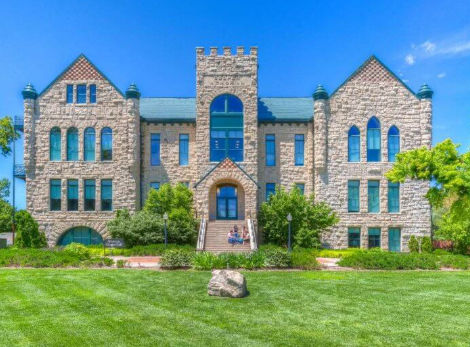
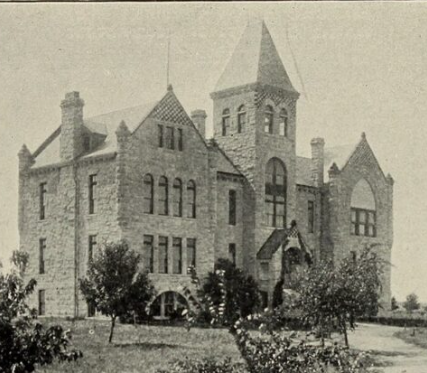
Local men cut huge blocks from nearby limestone beds to build the three-story hall with its tall 75-foot tower.
When Cooper Hall opened in 1887, it stood as both a school and church, with thick walls and round arches that still catch the eye.
Settlers Wanted Their Own College in 1880s Kansas
Pliny F. Axtell came to Sterling, Kansas as one of the first settlers and bought lots of land in the area.
The growing Presbyterian community in this small frontier town needed a college to teach their young people.
The United Presbyterian Church of North America was looking for a place to build their westernmost college.
Local folks in Sterling got excited about having a college in their small prairie town, as it would put their community on the map.
Ten Acres of Prime Land Sealed the Deal
In October 1886, Pliny F. Axtell gave 10 acres of his best land in Sterling for the college.
He picked a spot on high ground where people could see the building from miles around. This was a big gift worth a lot of money, and Axtell knew it.
The spot worked great as a landmark that farmers and travelers could spot from across the flat Kansas landscape.
Church Leaders Said Yes to the Sterling Proposal
The United Presbyterian Church Synod of Kansas took Axtell’s offer. They promised to pay for the school and keep it running for years.
This choice made Sterling home to the most western college in the entire United Presbyterian system. The church saw this as their chance to spread their values and education into Kansas frontier.
A Beloved Pastor Gets His Name on the Building
The church named it Cooper Memorial College after Reverend Joseph Cooper, a top Presbyterian leader everyone respected.
Cooper had made such a big impact on the church that they felt he earned this lasting tribute. Presbyterians often named important buildings after church leaders.
The Cooper name gave the new school instant trust within church groups.
Two Talented Architects Dream Up a Masterpiece
George H. Evans and William Gall got the job to design the building.
They picked the popular Romanesque Revival style that people liked for big public buildings in the 1870s and 1880s.
Their plans called for a huge three-story limestone building stretching 120 feet long and 50 feet wide. The best part of their design was a 75-foot tower that would stand tall above the flat Kansas fields.
Kansas Stone Created a Lasting Monument
The builders found plenty of limestone right in Kansas to build Cooper Hall. The area had rock formations that gave perfect building material.
Using local stone saved money on shipping and gave jobs to local quarry workers. The limestone looked great and would last for many years.
Local Workers Tackled a Massive Building Project
Construction teams started work in 1886 right after the architects finished their plans. Workers from the area brought their skills to this big project that would change the town.
The Romanesque style meant they built round arches, thick walls, and used heavy building methods. Moving the giant limestone blocks from quarries to the building site took special tools and lots of workers.
One Building Served Two Important Purposes
Cooper Hall wasn’t just for classes. It also housed the Second United Presbyterian Church.
This smart plan meant the building stayed busy all week with students and then filled with churchgoers on Sundays.
Sharing the space helped save money when money was tight on the frontier. The multi-purpose approach showed how practical these frontier Presbyterians were.
One Man Ran Both School and Church
Reverend Francis M. Spencer ran both the college as president and the church as pastor.
His background in teaching and preaching made him perfect for this hard job. Having one person in charge of both places kept everything running smoothly.
Spencer became the face of this new school in Sterling.
Doors Opened to Students in Fall 1887
Cooper Hall welcomed its first students on November 1, 1887, with much celebration.
The college became the very first United Presbyterian higher education institution in this part of America, and the farthest west. The impressive building brought big-city architectural style to small-town Kansas.
The successful project showed what could happen when settlers, church leaders, and skilled architects worked together toward a common goal.
Visiting Kansas Historical Society in Topeka
The Kansas State Archives research room at 6425 SW 6th Avenue in Topeka offers free public access to historical records related to Cooper Memorial College (now Sterling College).
The archives operate Tuesday through Friday from 9am-12pm and 1pm-4pm, plus Saturday mornings.
While the Kansas Museum of History remains closed for renovation until November 22, 2025, administrative offices are available weekdays from 8am-5pm.
“They stopped judging chickens when they learned to count eggs.” Anonymous
I enjoyed some success on my collegiate livestock judging team so after college I was asked to judge some cattle shows. I was better at judging horses and sheep but I never did get asked to judge a horse show which was probably for the best. I’m told that losing halter horse owners can become quite irate to the point of fingering a firearm in their shoulder holster as an enticement to see things their way. I was a terrible swine judge and the porkers all looked the same to me. A seasoned and well traveled swine judge once told me that when explaining his reasons for picking his Grand Champion he just picked someone in the crowd and described that person with god-like superiority.
The 1970’s were a terrible time to be a cattle judge because the industry was in a quandary as to whether it wanted them tall and long or short and dumpy. Oops, the grammar police would have me say, ‘vertically challenged’ instead of ‘short’. In high school I worked on a ranch that once owned an International Grand Champion Angus bull and photos of him show he was belt buckle high to a fourth grader. I called such cattle ‘belly draggers’ because you couldn’t see any daylight underneath them.
I really didn’t like judging cattle shows because they took up a lot of time, the pay was peanuts and, alas, no one ever tried to bribe me. Plus you made a lot of enemies. I may be the only person to be banned forever from a county fairgrounds because I rolled a heifer to the bottom that belonged to the daughter of a fair board member. My psyche is fragile enough to begin with and I really didn’t enjoy people hating me.
I was once asked to be a member of a three person team to judge a breeding show which I wouldn’t recommend to anyone seeking to advance their career. One of my fellow judges was a breeder of the the breed we were judging, another was an academic who spent his time before shows studying the results of prior shows in breed journals so he’d have some idea of what was expected of him. He didn’t want to put a Denver Grand Champion fourth in his or her class. Then there was me who primarily served as a referee that broke out on every class between the academic and the breeder. In every instance I found them both to be wrong.
In one show I judged there was a two year old bull I’d seen before. He’d been winning all the shows but I disliked him very much. So much so that when I judged a class with him in it at the Cow Palace Collegiate Judging Contest I put him in third place knowing I’d bust the class. The bull was so tall you could drive a Smart Car under him and come out the other side untouched. I’ll admit the bull was the longest beast I’d ever seen but my problem with the bull was that he was devoid of muscle. Funny thing, even though I busted the class I got a 50 on my reasons, a perfect score. Still it cost me several points and I lost winning the entire contest by two points.
A smart person would have just realized who owned the bull and put him on top. In horse judging this is known as ‘judging the halter’, or recognizing the horse’s name that was on the brass plate on his halter. A friend told me this frequently happened at cattle shows too and to prove it he once showed the lesser of two heifers he had in a class but was picked first because, he explained, “The judges always assumed I’d be showing my best animal in every class.”
For me and the gutless wonder who, to this day, I’ve never seen in any pedigree, judgement day came when the fraud was sent to slaughter. I’m told they couldn’t scrape enough meat off his long bones to produce a decent Quarter Pounder. I felt vindicated at last, but still, I was never asked again to judge another cattle show and for that I will be forever grateful.
The National Agricultural Hall of Fame will induct three individuals this fall whose work has significantly shaped American agriculture—antique tractor preservationist Michael Hinton of Hutchinson, former U.S. Agriculture Secretary Sonny Perdue, and pork industry innovator Wendell Murphy. The ceremony will take place Oct. 23 at the National Agricultural Center in Bonner Springs.
Chartered by Congress in 1960, the Agricultural Hall of Fame honors those who have made outstanding national or international contributions to the advancement of agriculture. Previous inductees include such figures as Sen. Pat Roberts, Eli Whitney, George Washington Carver, and John Deere.
Honoring a Hutchinson Preservationist
Hinton, known nationally for his dedication to preserving vintage tractors and the stories they carry, founded Antique Tractor Preservation Day and created TalkingTractors.com in 2024, a platform celebrating the heritage of rural life and agricultural innovation.
His efforts have earned multiple Kansas Governor Proclamations—in 2025, 2024, 2012, 2011, and 2010—along with two U.S. Congressional Record Statements and four USPS Pictorial Postmarks recognizing Antique Tractor Preservation Day.
Through his preservation and storytelling work, Hinton has brought global attention to the enduring spirit of American farmers. “It’s about storytelling, stewardship, and strengthening the bond between generations,” the Hall of Fame release noted. “He works to honor those who labored in the fields, advanced American farming, and embodied the values of hard work, innovation, and community.”
National Leaders in Agriculture
Also being honored is Sonny Perdue, who served as U.S. Secretary of Agriculture from 2017 to 2021. During his tenure, he established the first Under Secretary for Trade and Foreign Agricultural Affairs to open global markets for American farmers, expanded food programs during the COVID-19 pandemic, and advanced rural broadband initiatives. Perdue now serves as chancellor of the University System of Georgia, overseeing agricultural research, education, and the creation of the 250-acre UGA Grand Farm research facility.
Wendell Murphy, of Rose Hill, North Carolina, transformed modern pork production. Through Murphy Farms, founded in 1962, he pioneered contract feeding systems, confinement technology, and genetics programs that revolutionized pork production nationwide. His innovations in nutrition, biosecurity, and efficiency remain industry standards.
For more information about the inductees or the October 23 ceremony, visit www.AgHallofFame.com
Deep Fission is a fledgling startup that says it can help tech companies meet the “explosive demand” for more energy to power artificial intelligence. It’s one of two nuclear companies that have announced plans related to Kansas in the past month.
A company with a vision of installing “discreet, bespoke,” small, nuclear reactors 1 mile underground for data centers and other electricity-hungry industries plans to put its first reactors in Kansas, Texas and Utah.
In email exchanges, the company said it will not currently disclose the partner and location in Kansas, but would “share more information soon.”
The Kansas News Service asked Deep Fission whether it intends to engage in community outreach and what forms that outreach would take.
“Our approach to community engagement always involves early, open conversations,” Vice President for Strategic Affairs Chloe Etsekson Frader wrote, “with the opportunity for people to ask questions, share feedback, and understand the project in detail.”
“We focus on listening, sharing clear information, and understanding local priorities,” she wrote, “to build long-term, mutually beneficial relationships with these communities.”
The Kansas News Service asked whether the company is in touch with any Kansas state agencies about its intentions, and which state and local agencies it will need to liaise with or report to, in order to install an underground nuclear reactor in Kansas.
Deep Fission didn’t answer but said its approach “is built on collaboration and compliance from the outset.”
Democratic Gov. Laura Kelly’s administration didn’t respond to questions last week about whether it has any information about the project.
Deep Fission is one of two nuclear companies that have announced plans related to Kansas in the past month. The other is TerraPower.
TerraPower has signed a memorandum of understanding with the Kansas Department of Commerce and Evergy to explore the prospects.
Deep Fission enters the scene
Deep Fission is a new company working toward installing its first sites.
The company wants to create “scalable onsite power” by putting nuclear reactors into 30-inch boreholes drilled 1 mile deep.
It says this ensures “billions of tons of natural shielding and passive containment” that add to the reactor’s safety. Plus, it takes up less surface area and lowers costs.
In a recent filing to the U.S. Securities and Exchange Commission, the company said its model is “uniquely suited to meet the explosive demand for power from artificial intelligence (“AI”) workloads, energy-intense manufacturing, and energy-constrained regions.”
It suggests its approach can help with potential public opposition to nuclear installations.
“With site flexibility and no above-ground reactor visibility, Deep Fission Reactors overcome many of the siting and public acceptance challenges facing traditional nuclear power solutions,” the filing said.
Deep Fission was founded by energy and environment entrepreneur Liz Muller and her father, Rich Muller, a physics professor emeritus at the University of California, Berkeley, and a 1982 winner of what is commonly called the MacArthur “Genius Grant.”
The pair also founded a nuclear waste disposal company based on the same idea of using deep boreholes, albeit in that case to contain nuclear waste rather than reactors.
Deep Fission’s advisory board is stacked with high-profile names, including physicists and energy experts. Among these are two Nobel laureates in physics, one of whom is former U.S. Energy Secretary Steven Chu, who served during the Obama administration.
The company’s vice president of engineering is a former executive at Kairos Power, one of the industry leaders in the race to commercialize next-generation nuclear energy designs.
Deep Fission was one of 11 projects picked in August for President Donald Trump’s nuclear pilot program. The program doesn’t fund the companies but aims to expedite their testing and ultimately offer a fasttrack to commercial licensing. And it aims to get at least three reactors operating at a state of steady fission before the Fourth of July next year.
But to make this happen, Deep Fission will need to climb a steep financial hill. And the Trump announcement has significantly sped up the company’s timeline.
A month after the Trump announcement, the company went public in a nonstandard maneuver called a reverse merger, that involves using a shell company and that requires disclosing less information to regulators in the process. It’s generally a faster, cheaper way to go public than the traditional initial public offering route.
Asked why Deep Fission chose a reverse merger, given that this form of going public can raise some questions for investors, Frader replied that the pilot program altered Deep Fission’s timeline.
“Initially, we were targeting 2029 for our first reactor, but the program allows us to build one in 2026,” she said. “The reverse merger gave us a faster path to align our financing with this accelerated timeline.”
Deep Fission’s shares sold for well under typical prices and raised $30 million, Tech Crunch reported, and the company plans to list on a lesser known stock exchange for smaller firms.
Frader said the company intends to start there and then switch to the NASDAQ Stock Market.
Tech Crunch reported that the details of Deep Fission’s go-public maneuver “suggest that Deep Fission wasn’t able to raise cash from new or existing shareholders, who first capitalized the company with a $4 million check last year.”
BloombergNEF, which researches and covers the energy sector, wrote last week that the industry is seeing a spate of nuclear companies going public through reverse mergers. It has documented six examples that are complete or are in the works.
BloombergNEF says a flurry of these maneuvers also happened in 2021 with climate tech startups. Most of those companies’ stocks didn’t fare well, but BloombergNEF sees initial signs that this new round might pan out differently. It says a few of the nuclear companies are seeing initial boosts to their stock prices amid the interest in finding energy sources for AI.
Deep Fission’s underground design
Deep Fission says its underground design could be scaled up to provide a lot of energy with little space. It says, for example, that it could nestle 100 nuclear reactors into 1-mile-deep holes on less than 3 acres of land and generate 1.5 billion watts of electric power.
For reference, the U.S. Department of Energy says it takes 294 wind turbines of the typical size installed nowadays to generate 1 billion watts.
Parts of Kansas experience earthquakes. The Kansas News Service asked the company what kind of analysis it has conducted on the geological stability of the site in Kansas.
“Deep Fission always conducts rigorous geological analysis when evaluating potential sites,” the company said, “including seismic activity and other environmental factors.”
The company’s federal filing last month said it plans to build its first reactor sites at locations “with existing industrial use and limited environmental sensitivity.” Its goal is to qualify for a streamlined environmental regulatory process or exemptions.
Since Trump wants to see three reactors up and running by the Fourth of July, the Kansas News Service asked Deep Fission whether this is the timeline for its work in Kansas.
The company said it is aiming for that date at one of its sites, but wouldn’t say whether this means the Kansas location.
TerraPower and its Kansas plan
TerraPower, the other nuclear company eyeing Kansas, was cofounded by former Microsoft CEO Bill Gates.
This summer it broke ground on a $4 billion nuclear facility in Wyoming as a demonstration project that is cofunded by the U.S. Department of Energy.
The company’s technology envelops uranium in liquid sodium instead of water. This liquid has a far higher boiling point, which the company says adds to the reactor’s safety.
The company’s design also would also allow for scaling up and down the plant’s power output. That function appeals to utility companies.
It would make it possible to adjust to the ebb and flow of electricity demand and to the sunny and windy days when solar and wind farms churn out lots of power. Traditional nuclear power plants, such as Evergy’s Wolf Creek Nuclear Generating Station, cannot do that.
Its goal in Kansas is to explore the prospects for a utility-scale advanced nuclear facility, search for appropriate reactor sites and gauge the interest of those communities in having such a facility. TerraPower is looking for sites on the Kansas side of Evergy’s two-state service area, which would mean somewhere in eastern or central Kansas.
The push for advanced nuclear power
Advanced nuclear power and small, modular reactors represent a new chapter in U.S. nuclear energy that remains largely in the design and testing phases.
The next-generation designs are meant to address key challenges with nuclear power plants, including the fact that traditional facilities were so large and complex to build.
Companies working on the newer designs argue that these will be safe yet faster to build. The vision has received support from both Democrats and Republicans at the federal level, including both the Biden and Trump administrations.
Several states are considering legislation or incentives for advanced nuclear power. This includes Kansas’ neighbor, Oklahoma, which passed a law this year directing its utility and energy regulatory body, the Oklahoma Corporation Commission, to explore the prospects.
Kansas currently has one traditional nuclear power plant, Wolf Creek, about 60 miles south of Topeka. Wolf Creek generates about one-fifth of the state’s electricity.
Although nuclear facilities don’t churn out emissions, the idea of bringing more nuclear power is already meeting with tough questions from Kansas-based clean energy advocates that have lobbied for years to grow the state’s wind and solar power.
They’re concerned that nuclear energy is expensive, and Evergy’s rates continue to rise. The groups argue that Kansas needs to provide more affordable, clean energy because many low-income households are already struggling to pay their utility bills and climate change promises worse summer heat waves.
Celia Llopis-Jepsen is the environment reporter for the Kansas News Service and host of the environmental podcast Up From Dust. You can follow her on Bluesky or email her at celia (at) kcur (dot) org.
Mountain lions are making a quiet return to Kansas. Since 2007, wildlife officials have confirmed 117 sightings across the state, with 65 occurring since 2023.
Once native to Kansas and much of North America, mountain lions were nearly wiped out by the early 1900s due to hunting and habitat loss. But as populations in neighboring states like Colorado, South Dakota, and Nebraska have grown, younger lions have started dispersing eastward in search of new territory.
Kansas’ mix of wooded areas, river valleys, and plentiful deer provides ideal conditions for these elusive predators. Most confirmed sightings still involve young males passing through, but experts say permanent populations could soon form.
Wildlife officials urge caution if you suspect a mountain lion nearby:
• Avoid approaching tracks, carcasses, or dens.
• Keep pets indoors at night and protect livestock.
• Report any sightings immediately.
• If encountered, stay calm, face the animal, make yourself appear larger, speak firmly, and back away slowly—never run.
With over 60 sightings in the past two years, mountain lions are proving their resilience and ability to reclaim old territory in Kansas.