Tuesday, January 13, 2026
Home Blog Page 55

Pruning Trees and Shrubs

0
Woody plants are actively building up their storage of sugars as leaf drop approaches. Pruning in the fall limits the amount stored reducing the amount of energy the plants have available through dormancy. Also, pruning now may encourage woody stems to send out new growth that will be more susceptible to freeze damage during winter.
With the exception of removing dead or diseased branches, it is best to save pruning until after winter. For shrubs that bloom in spring, pruning in the fall can reduce flowering. Spring-flowering shrubs, such as forsythia, lilac, flowering quince, almond, beautybush, deutzia, pyracantha, mock orange, cotoneaster, weigela, viburnum and witch hazel should be pruned after they bloom.
Summer-blooming shrubs, such as hydrangea, rose of Sharon, butterfly bush and crepe myrtle, can be pruned in early spring because the blooms establish on new growth. With a few exceptions, most deciduous trees respond best to late winter/early spring pruning. Proper timing of pruning allows trees to go into dormancy healthy, without increased stress from pruning.

Joe and Lovina Attend Uncle’s Funeral in Ohio

0

Lovina’s Amish Kitchen
Lovina Eitcher,
Old Order Amish
Cook, Wife &
Mother of Eight

It is a rainy Tuesday morning. We sure appreciate this rain, it has been really dry here. I need to get this column written. I wish I wouldn’t always wait until the last minute to write it. Life gets too busy sometimes and we need to stop and take time to read God’s wonderful words of encouragement daily. Without “His” love what would we have? 

On Wednesday my sister Emma, my husband Joe and I attended the funeral of his Uncle Jonas in Hicksville, Ohio. Jonas was married to Joe and Jacob’s (Emma’s late husband) Aunt Mandy. She was a sister to both their mothers. Jonas left to mourn his wife, seven children, and fourteen grandchildren. Our sympathy goes out to the family of Jonas that are left behind. 

Jonas and Mandy also have three out of the seven children that have Muscular Dystrophy and are wheelchair bound. It is good to talk to others who also face life’s challenges of having handicaps in the family. As my children have often let me see that life can still be rewarding even if they have a limit to what they can do. We have so much to be thankful for. We also want to thank everyone for all the nice notes that have been sent to son Kevin. May God bless you all for your kindness. He really appreciates the help he has received towards his goal to get his handicap accessible buggy. 

Sister Liz and Levi were also at Uncle Jonas’s funeral. They live only a half hour drive from Hicksville. They told us to stop in and come see where they live. Emma, Joe and I asked our driver if it was okay to go through there on the way home. It was so nice to see the place they call home now. They have a lot to do yet but had their final inspection on the new house approved. They can now live there while they finish it. It will be nice when they have it all done. They live on twenty-two acres with eight acres of woods. We also got to visit with Levi and Liz’s daughter Suzanne, their daughter Elizabeth, Samuel and baby Jayla. Levi and Liz had four children, three girls and one boy. Their three daughters moved with them to this new community and they all live just a few miles apart. Their son Levi Jr and his family live in a nearby community. 

Sunday we heard the sad news that sister-in-law Sarah Irene (brother Albert’s widow) and her friend who drives her were on their way home from a viewing in Bryant, Indiana when they were in an accident. The accident took the life of her friend. Sarah Irene was very shaken up with lots of bruises. She was going to go see a doctor yesterday. We haven’t heard the results yet. Our prayers and sympathy are with her as she will miss her good friend that took her everywhere. Also our prayers for the lady’s family and to the other vehicle involved. I haven’t heard how the others are that were in the accident. Life is so uncertain.

On Friday sister Verena, Emma, and I attended the viewing of a friend Amanda, age 64. We used to go to the same church when we all were younger. She died unexpectedly leaving her family to mourn. Our sympathy to them. Amanda would be an aunt to son-in-laws Dustin and Daniel and daughter-in-law Grace. 

Friday afternoon Dustin, Loretta, and their three children left for Alabama. They will be gone for two weeks. Dustin is helping on a construction job while they are out there. They went with some others so hopefully they will have a nice vacation while still getting paid. We miss them so much and they haven’t even been gone a week. They were able to stop in and visit with Joe’s sister Carol, Pete, and some of their family in Tennessee on their way to Alabama. 

Friday night our family had supper at daughter Lovina and Daniel’s house in honor of Daniel’s 24th birthday which was September 26th.  I brought a blueberry pie.

Daughter Verena and Daniel Ray have been trying their luck with hunting. Son-in-law Tim built a ramp up to a hunting shack so Verena can drive her mobility scooter up there. That was a thoughtful thing to do. 

God’s blessings to all!

PUMPKIN COOKIES WITH CREAM CHEESE

1 cup butter, softened

1 cup sugar

1 egg

1 teaspoon vanilla

1 cup canned pumpkin

2 cups flour

1 teaspoon baking powder

1 teaspoon baking soda

½ teaspoon salt

1 teaspoon cinnamon

½ teaspoon nutmeg

CREAM CHEESE FROSTING

½ cup butter, softened 

8 ounces cream cheese, softened 

4 cups powdered sugar as needed

1 teaspoon vanilla extract

Cream together butter, sugar, egg, and vanilla and pumpkin. Then, gradually add the rest of the ingredients. Mix well, then bake at 350 for 10 to 12 minutes. Cool then add frosting if desired. 

For frosting… Cream butter and cream cheese. Add vanilla then gradually add powdered sugar to your desired consistency. 


Lovina’s Amish Kitchen is written by Lovina Eicher, Old Order Amish writer, cook, wife, and mother of eight. Her three cookbooks, The Cherished Table, The Essential Amish Cookbook, and Amish Family Recipes, are available wherever books are sold. Readers can write to Eicher at Lovina’s Amish Kitchen, PO Box 234, Sturgis, MI 49091 (please include a self-addressed stamped envelope for a reply); or email [email protected] and your message will be passed on to her to read. She does not personally respond to emails.

Champions chosen at 2025 Kansas Junior Livestock Show

0

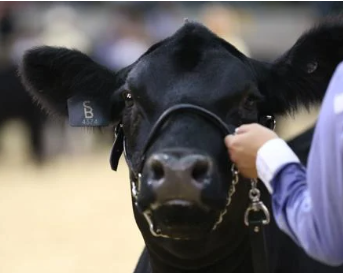
The 93rd annual Kansas Junior Livestock Show (KJLS) was held in Hutchinson October 3-5. Grand champions were named in both market and breeding divisions across all four species throughout the weekend.

Dax Seibert from Pawnee County led his 1,449 lb. crossbred steer to grand champion honors, while Emma Karst of Russell County owned the reserve champion steer, a crossbred weighing 1,468 lb.

In the breeding heifer show, a Limousin heifer exhibited by Molly McCurry of Reno County took top honors. Reserve supreme went to the AOB heifer shown by Harper Conine from Scott County. The supreme heifer in the bred-and-owned division was a Hereford owned by Brayson Mayo of Scott County. Brecken Bergkamp from Reno County led the reserve supreme bred-and-owned, a Charolais.

A 241 lb. dark crossbred shown by Gentry Ward from Miami County was named grand champion market hog. Anah Higbie of Franklin County exhibited the reserve grand champion, a 305 lb. dark crossbred.

The supreme breeding gilt came out of the commercial division and was exhibited by Kenzi Martinez from Scott County. Reserve supreme breeding gilt went to a Duroc entry from Bently Ellis of Franklin County. In the bred-and-owned division, the supreme champion gilt was a Light AOB shown by Kyser Nemecek from Allen County. Annelise Schuetz of Leavenworth owned the reserve supreme, a Berkshire.

Kaylee Schumacher of Ellis County owned the grand champion market lamb, a 152 lb. blackface. The reserve grand, a 149 lb. blackface lamb, was shown by Carter Watson from Douglas County.

Supreme breeding ewe honors went to a Hampshire owned by Lakyn Rookstool of Pottawatomie County. Her brother, Mason, exhibited the reserve supreme out of the commercial division. Quinlyn Yoho from Woodson County led the supreme champion bred-and-owned ewe, a Dorset. The reserve supreme bred-and-owned was shown by Mackenzie Krueger of Coffey County.

Heidi Mengarelli of Crawford County exhibited the grand champion market goat, weighing 99 lbs. The 94 lb. reserve champion was led by Lainey Hager from Miami County.

Jaci Falkenstien of Labette County owned the supreme champion commercial doe, with Sadie Eggers from Woodson County owning the reserve supreme.

Merck Animal Health was the exclusive sponsor of the beef show and Cargill underwrote the sheep and goat shows. Additional sponsors included Emprise Bank, Farm Credit Associations of Kansas, FerAppease, Huvepharma, INTRUST Bank, Kansas Department of Agriculture, Kansas Farm Bureau and Farm Bureau Financial Services, KLA, Kansas State University, Open Ranch Trailer Sales and PrairieLand Partners.

Water, waste and wicked problem: How K-State research helps protect and save the Ogallala Aquifer Inbox

0
Meeting the needs of Kansas communities has always been at the heart of Kansas State University’s mission as a land-grant institution.
In the case of Prathap Parameswaran and his carefully assembled, cross-disciplinary research team—spanning K-State and three partner institutions across the High Plains — their work to scale up a circular waste-recovery system could have an immediate impact on Kansas communities by literally turning animal waste into valuable resources, particularly water.
If successfully implemented by the end of the four-year project, the system would mark an important step toward addressing the complex challenges surrounding the Ogallala Aquifer, the region’s primary groundwater source.
“I think the 800-pound gorilla in the room is the depletion of the Ogallala aquifer,” said Matt Sanderson, professor of sociology, anthropology and social work at K-State and member of the project’s research team. “In that context, you’re dealing with a wicked problem, and not wicked in a moral sense, but in one that doesn’t have easy solutions. It only has tradeoffs, and trying to optimize remaining use of that water. This technology clearly has a role to play, and these wicked problems require multidisciplinary projects like this one.
The project builds on Parameswaran’s past work with anaerobic membrane reactors, which have shown the ability to take waste and produce renewable energy, extract useful chemicals and provide water, but scales up the operation and does so on-site in communities that can benefit the most from their use.
“It’s not a pie-in-the-sky idea – the unit exists,” said Parameswaran, associate professor of civil engineering and university outstanding scholar in the Carl R. Ice College of Engineering. “The way we’ve proposed the project is we will strengthen the science and the technology in the first three years, and in the last year, we will actually try to put one of our field trailers out there.”
Finding expertise across state lines
Funded through the National Science Foundation’s Research Infrastructure Improvement Focused Engineering Collaboration program, the $6 million project goes beyond the scope of just engineers. It requires a broad, multidisciplinary approach that brought in three other institutions in the University of Nebraska-LincolnOklahoma State University and Seward County Community College, an advisory board with input from industry, as well as the communities serving as a pilot for this technology.
“Without the expertise, you cannot run this,” Parameswaran said.
The core partnership organically grew from established connections at K-State, extending outward to institutions and individuals who could offer complementary expertise across the region’s top livestock-producing states.
K-State, which received $2.5 million as part of the collaborative grant, will provide the foundational technology and social aspects, including technoeconomic analysis and life-cycle assessment expertise. Other K-State members of the research team include Joe Parcell, professor of agricultural economics, and Jikai Zhao, assistant professor of biological and agricultural engineering.
Team members from the University of Nebraska-Lincoln include Siamak Nejati, Bruce Dvorak and Mona Bavarian. They will provide specialized knowledge in membrane technology — a crucial component for filtration — and regional feasibility assessment.
Oklahoma State University’s portion of the team, which includes Kiranmayi Mangalgiri and Mark Krzmarzick, will focus on water reuse, specifically taking the water recovered and polishing it further. It also includes OSU’s Doug Hamilton, a swine expert who brings practical knowledge of current waste systems for comparison, as well as Michael Long, a sociology expert who will lead efforts to identify and overcome social barriers for technology adoption in the Great Plains region.
Rounding out the partnership is Seward County Community College, which provides a crucial connection to the local community and industry workforce. Students from SCCC, who often go directly into the livestock industry, will be involved in trials and internships, developing the necessary technical skills to operate and maintain the new systems.
In addition to the academic partners, the team is supported by a broad advisory council made up of producers, groundwater management districts and user associations who recognize the urgency of the problem.
“I’ll say this about the advisory council – I think if they opened our email and read the summary of what we’re doing, they were immediately on board,” Parcell said. “Because they recognize how important this is. And that was a strength of our proposal, too. We had broad-based buy-in from all three states.”
Closing the loop on waste
At the heart of the project is developing a circular system designed to manage the enormous volume of livestock wastewater, which is abundant in the region.
Currently, most livestock operations in the High Plains handle manure by land-applying it or storing it in lagoons. While this removes the waste, it is often not optimal, leading to water loss, nutrient runoff and buildup, and odor issues.
The new technology addresses these problems by aiming to polish and clean the water, while also pulling off and condensing valuable nutrients. Those include nitrogen and phosphorus, which have practical uses such as commercial fertilizer.
“The crux of what we’re doing is about water access,” Parcell said. “We’re creating a process to polish and clean water up enough so that it can be reused in the livestock system. At the same time, we’re also pulling in those carbon and nutrient elements, such as biogas, to try and value in different ways and maybe make this process more economical so it becomes more widely adopted.”
Additionally, the process would also have the potential to reduce the odors that often plague communities downwind of feedlot operations.
“The success of this proposal is in that it meets the needs of the community,” Zhao said. “NSF grants have supported the development of many advanced technologies, but this project is focused on connecting these innovations more closely with the practical needs of people in Kansas, Oklahoma and Nebraska. This technology will be used to address current existing challenges faced by regions in these three states in a meaningful way.”
The initial focus will be on swine wastewater, as the team has three years of preliminary data from Parameswaran’s previous research.
However, the knowledge gained from the research could apply to other sectors like dairy and beef cattle, and it could lead into insights into the potential for industrial pretreatment in the food processing industry and municipal water systems.
The technology is primarily membrane-based, and a key area of research will be working with the University of Nebraska-Lincoln team to develop advanced membranes to handle the difficult conditions and prevent fouling — a major issue in such systems.
From lab to field: A phased approach
The project is structured over four years, with a clear path to real-world application, which is a goal of the NSF program providing the funding.
The first three years focus on strengthening the technology. This involves refining the system at the pilot scale, generating long-term data and rigorously studying its impact.
The last year will culminate in a major step toward adoption: a field demonstration trial. The team plans to deploy one of their mobile field trailers in a real-world setting to test its effectiveness at scale.
Adoption is not just a technological challenge, however. It also involves social and economic factors.
Parcell and Sanderson, along with other social scientists and economists on the team, will work on solutions to issues that have slowed adoption of this type of technology in the past, including government policy decisions and the economic proposition of being an early adopter.
“Part of the adoption equation is where you are at, and how far do you have to pump water now?” Parcell said. “What are the policies and the incentives going to be? We’ve seen incentives to install these types of facilities in the past. What will they look like in the future?”
The long-term vision is an automated system with a control board that can be operated remotely, though a skilled, locally trained workforce will still be necessary for troubleshooting, analysis and maintenance. This focus on workforce development through Seward County Community College ensures that the benefits of the technology will be fully realized at the local level.
By turning animal waste from a liability into assets, like clean water, fertilizer and energy, the team hopes to mobilize a long-term solution that helps to ensure the sustainability of one of the world’s most vital water resources.
“This was funded for a variety of reasons, but I think probably at the top of that list is this is the second-largest freshwater aquifer in the world,” Sanderson said. “There is no more recharge, effectively, coming into this aquifer. The Ogallala is a finite resource. Anything we can do to close loops and enhance the sustainability of this aquifer adds value.
“It’s a great team to try and do it. Now the work begins.”
As the nation’s first operational land-grant institution, Kansas State University has served the people of Kansas, the nation and the world since its founding in 1863 — and it continues to set the standard as a next-generation land-grant university. K-State offers an exceptional student experience across three physical campuses and online offerings, meeting students where they are and preparing them to achieve their personal and professional goals. The university is committed to its mission of teaching, research and service through industry-connected programs, impactful research-driven solutions, and a sharp focus on community engagement and economic prosperity.

K-State News and Communications Services
Division of Communications and Marketing
128 Dole Hall
1525 Mid-Campus Drive
Kansas State University
Manhattan, KS 66506
785-532-2535
[email protected]
k-state.edu/media

Unlucky traffic ticket

0
Thayne Cozart
Milo Yield

My friend from Asbury, Mo, ol’ A.C. Doocey, recently got the strangest traffic ticket I’ve ever heard of.

A.C. has retired from part-time farming and as a part-time electrician and has gotten himself a new part-time job as a blackjack dealer at a close-by casino. He called me the other day and his end of the phone conversation went like this:

“Milo, the other day, I was on my way home from work when the strangest thing happened. Traffic was heavy as usual in Joplin, and as I sat at a red light, out of nowhere, a colorful little bird slammed into my windshield.

“If that wasn’t bad enough, the poor creature got its wing stuck under the windshield wiper. It wuz just flapping helplessly. Just then the light turned green, and there I was with a bird stuck on my windshield. I had to make a split-second decision and I decided to try and dislodge the poor bird by turning on the windshield wipers.

“And, to my surprise, it actually worked. On the upswing, the bird flew off, and here is the crazy thing — it slammed right onto the windshield of the car behind me. No, it didn’t get caught under the windshield wipers of that vehicle. It killed itself. And, unfortunately for me, the car behind me was a police car.

“Just more of my plain ol’ bad luck. Of course, immediately the officer turned on his emergency lights, and I was forced to pull over. The officer walked up and I could see him reaching for his ticket book.

“I tried to talk my way out of a ticket, but trying to plead my case fell on deaf ears.

“The officer simply stated, ‘Talking ain’t gonna do you no good. I’m going to have to write you up … for flipping me the bird.’”

***

A farm kid, who’d gained sales experience through his FFA chapter, went off to college and got himself a part-time sales job working in an upscale men’s clothing store.

The store owner showed the kid all the inventory and ended up showing him an extremely ugly sports coat. It had been in the store’s inventory for a year, and the owner explained that, if the kid could sell that sports coat, he’d prove his worth as a salesman, plus, earn himself half of whatever dollar amount he could sell the coat.

With that explanation, the owner went off for lunch and left the kid alone as the sole salesman in the story.

After his lunch, the owner returned to the store and his eyes fell on this scene. Clothes were scattered helter-skelter. He looked for the kid salesman and didn’t see him. He then heard someone groan and he hurried over the counter and saw the kid salesman laying on the floor all cut up and bruised and bloody.

“What in the world happened to you?” the owner asked.

The kid slowly got to his feet, groaned, but then broke into a smile and and pointed at the rack where that ugly sports coat had been. “I sold it,” the kid exclaimed. “For $200. So, you owe me a $100 bonus.”

The astounded owner saw the coat was actually gone. He shook his head in disbelief and asked, “You gotta tell me how you accomplished that sale? I’ve been trying for a year and never got anyone to take a serious look at it — let alone buy it! Now wait a minute! Don’t tell me that the guy you sold the coat to, hated it so much that he did this to you?”

The kid salesman then says, “Nope, the customer just loved the way the coat fit. However, his seeing eye dog almost killed me!”

***

I might as well continue in this far-out vein. A wealthy young Texas rancher wuz returning from a trip to Europe to evaluate some cattle he hoped to import. But, on his return trip, his plane got diverted to Boston overnight and he ended up enjoying an adult beverage at the crowded hotel bar.

He wuz sitting at the bar wearing his Stetson proudly when an attractive young lady sat down next to him and asked in her clipped feminine New England accent, “And, just where are you from, cowboy?”

The rancher tipped his hat and courteously replied, “Texas, ma’am. And where y’all from?
The lady answered softly back in the noisy bar, “Yale.”

The cowboy immediately rose to his feet, cupped his hands around his mouth, and at the top of his voice yelled, “Where ya’ll from, ma’am?”

***

Last week, I wrote about some ways a farmer or rancher can tell is he’s really old and experienced. Well, I’ve thought about some more delved up from childhood memories.

You know you’re an old experienced farmer if you can remember shocking “sorgo” at harvest, then in the winter going to the field with a wagon mounted with a guillotine blade and tearing down the shocks, cutting off the heads of sorgo with the blade, then grinding the heads for cattle, hog, or chicken feed and feeding the stalks and leaves as cattle fodder.

You know you’re an experienced farmer when you can recall days of yore in the summer when milk cows were milked by hand outside in the cow lot and never put into a stanchion in the barn. The cows were fed in a pan and stood contentedly eating while they were milked.

You are an experienced farmer or rancher if you still remember how to harness work horses.

***

Words of wisdom for the week: “Agriculture is a life-long lesson is patience. It takes months to grow a crop and 9-months to bring a calf to life.” Have a good ‘un.