Friday, January 16, 2026
Home Blog Page 94

Fall vegetable gardening

0

If you have never tried fall vegetable gardening we have an educational opportunity for you to learn how it is done!


While tomatoes and peppers thrive in the summer heat, many vegetable crops prefer the cooler weather of fall. Cool season crops, such as broccoli, cauliflower, and lettuce, may bolt (go to seed) or become bitter in summer making them prime candidates for fall gardening.


Planning for a fall vegetable garden is a great way to make up for spring mishaps or just extend your garden harvest. Cooler temperatures make it refreshing for gardeners to spend more time in the garden again during the fall.


Join us on August 19 at 7:00 pm in the community room of the Harvey County Courthouse. We are having an educational program on FALL VEGETABLE GARDENING. Come learn how it’s done. This program is free but you must RSVP by emailing [email protected] or [email protected] or calling (316) 284-6930 by August 18.


My Auction Addiction

0
lee pitts

My name is Lee Pitts and I’m addicted to auctions. I’m an auction junkie and if I’m not working an auction I’m watching one on the Internet. If I had a dollar for every auction I worked or watched I’d be able to afford a therapist to help me deal with my awful auction addiction.

I’ve been working auctions as a ring man for over 50 years and have helped sell everything from A to Z; from Alpacas and Angus to Zebus and zebras. During those five decades I’ve seen some very funny stuff like the time a 2,000 pound bull decided to join the auctioneer on the auction block. There wasn’t room for both of them so the auctioneer dove into the ring.

Then there was the time a very crazy cow began butting the bullboard. A ring man was standing behind the bullboard and with each butt of the cow the board inched ever closer to the ring man’s chest. We were afraid he’d be slowly crushed to death. He survived but for the rest of his life he was a hunchback.(Note to anyone having an auction: make sure the posts of the bullboard are securely cemented and that termites haven’t compromised the integrity of the bullboard.)

I witnessed two auctions that were real show stoppers. One was delayed at least an hour and forty five minutes because the auctioneer failed to show up and the other time was when a cow got wedged in behind the bullboard and we couldn’t get her out.

Although we all laugh about it now the Pruett-Wray sale in Arizona harmed us all in a very personal way. The reason a lot of ring men and auctioneers are slightly to obscenely obese is because we pig out on the free barbecue every day at purebred cattle auctions during the Fall and Spring runs. Pruett-Wray put on a nice big spread for everyone but we should have known something was wrong with the beans because they were still bubbling long after they were removed from the fire. Before long the stands started emptying out as everyone was out behind a building barfing their guts out. The line to the Porta-Potty was 20 deep. Even the sale manager was afflicted and he left the auction stand saying WHOA OH, OH! After that sale I made it a rule to never eat the beans or the potato salad at cattle auctions.

Also in Arizona were the many John Wayne sales I attended. While the Duke was alive his sales were often the highest averaging sales in the Hereford business. If you bought a bull you got a photograph of you and the Duke. After he died the market cooled off considerably.

The most dangerous sale I ever worked was a Longhorn auction in Elko, Nevada. We were cruising along nicely when a a Longhorned devil who knew how to use her sixty inches of horn entered the ring blowing snot and kicking up dust. That witch picked up one side of the makeshift ring with her horns and then somehow got under the panel, knocked over an entire section of metal seating and was head-hunting humans to shish-kabob. The sale was indoors so we were all trapped until someone opened the door and the witch was last seen running east down Interstate 80.

I missed out on the video auctions the Texans had on an airplane and a cruise ship but I did work one of the first… and last ostrich sales. All I knew about ostriches was they were selling for around $30,000. The auctioneer had never sold an ostrich sale before so he was somewhat surprised when the ostrich in the ring became obsessed with his big diamond ring. When the ostrich pecked at the shiny object in the middle of his chant he jumped three feet in the air and said the F word on the way down, amongst other profanities. Needless to say he never sold another ostrich sale but it didn’t really matter because shortly thereafter the ostrich market took a big belly flop and the breeders were turning their birds loose to fend for themselves.

Oops, I’ve ranted on too long and I better quit because I don’t want to be late for my AAA meeting (Auction Addicts Anonymous).

Southwest Kansas towns relied on the Arkansas River for water. Now it’s dry for miles

0

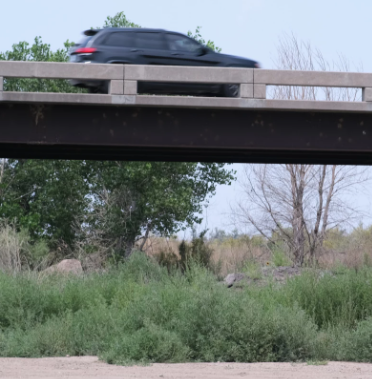
A car whizzes over the Arkansas River near Lakin, Kansas, where the river runs dry.

Southwest Kansas residents are making an effort to remember a river that helped shape communities in the area. The Arkansas River today has run dry in the region, but has left a significant impact, leading locals looking for conservation and recharge efforts.

DODGE CITY, Kansas — To enter most towns in southwest Kansas, one will first drive across bridges seemingly built over sand and briar.

Tanner Rutschman, a city engineer for Dodge City, jokes that no one really knows what it is.

“It doesn’t look like it,” Rutschman said, “but I have to tell people when they come to town that they just drove over the Arkansas River.”

Rutschman and the city are proposing a new wastewater plan that could help conserve water for the town on the High Plains. That plan will feature the bone-dry Arkansas River.

The community also wants to remember the river that shaped southwest Kansas and helped build the towns that dot the grassy desert. Today, the river is just meandering sand from Deerfield to Great Bend — more than 100 miles — which serves as a warning about water security for western Kansans.

The agriculture industry’s water usage has evaporated the once-sparkling river. In the early days it was used for ditch irrigation to help grow watermelons and sugar beets.

But now locals better understand that the river is connected to the underground water source, the Ogallala Aquifer, beneath it. And they know that pumping billions of gallons from that aquifer each day to irrigate crops like corn and alfalfa is depleting the important water source too.

“In this well just west of town, in the year 2000, the depth was about 12 foot to water,” Rutschman said of access to the aquifer. “In 2020, we’re down over 45 foot depth to water, so it’s declining.”

That’s why Rutschman and towns like Dodge City have started to look for ways to be more efficient with their water usage, and prepare for the area to become classified as a desert if water runs out completely.

The river plan

The Ogallala Aquifer is the only source for drinking water for Dodge City and many other towns in western Kansas. The city’s proposed system would dump treated wastewater into the riverbed so it can trickle down to the aquifer.

“I would say the city has been good stewards of that water resource since the early 80s,” Rutschman said. “We’re always thinking about ways to enhance or broaden our reuse practices.”

This closed-loop system has also been adopted by other cities like nearby Garden City. With this system, the cities hope to become “water neutral” by taking used water — like the treated wastewater and water from sources like a new cheese plant — and sending it back to where they drew it from.

Currently, that water is also being used by nearby farmers to decrease how much the agriculture industry pulls from the aquifer.

The project would take millions of dollars from both state and federal grants to upgrade the city’s water treatment facilities. The city is requesting a total of $34 million from state and federal funds and providing $22 million of its own. If approved, construction is slated to begin in 2027.

But the Dodge City plan still may not revive the Arkansas River or the aquifer, but could make the city less dependent on the shrinking resources.

Recharging the aquifer is a very slow process and would take thousands of years without human intervention. Municipal water use makes up only 5% of the water taken from the portion of the Ogallala Aquifer that sits under western Kansas, but the project encourages recharge efforts to secure water for the city.

“This project is setting the city up for direct water reuse, which will become more and more necessary in the coming years,” Rutschman said.

Remembering the river

Not that long ago Dodge City and other communities could rely on the Arkansas River for water. It was even navigable with kayaks and canoes.

And some locals still remember when the Arkansas River flooded in 1965.

Dodge City native Hannes Zacharias kayaked down the river twice. The first time was in the 1970s when there was still water in the western Kansas portion. But the river looked much different during his more recent attempt, which required him to use an ATV to navigate the dry parts of the river.

“I don’t know what you call a river that doesn’t have any water in it,” Zacharias said, “except you call it anything but a river, and that breaks my heart.”

He recently spoke to the locals about the power and significance of a river that no longer flows as part of a cultural project for Humanities Kansas.

Indigenous tribes like the Ute, Arapaho, Kiowa and Osage used the river for many years as a natural resource, and for travel and trade.

Then most populous towns in western Kansas were built on the Arkansas River.

“This river was a geographical feature throughout history that people recognized, and still recognize today,” Zacharias said.

Zacharias said he has seen a change in attitude towards the conservation of the aquifer and he has not given up hope on the river someday flowing again. But for now, he is focused on ways the riverbed can be used for recreation, like a walking trail, to bring more connection to the river with the communities it helped establish.

Humanities Kansas is launching a podcast with Zacharias that will focus on the river’s historical significance and its environmental impact.

“My goal is letting people know it was not an inconsequential river and deserves to be remembered,” Zacharias said.

Calen Moore covers western Kansas for High Plains Public Radio and the Kansas News Service. You can email him at [email protected].

The Kansas News Service 

Goessel Showcases Antique Farming Methods

0

Richard Shank
Columnist

As the sun rose over Goessel on Friday, August 1, it was time to launch the 53rd annual Threshing Days Celebration. 

Trucks hauling antique tractors were arriving in the Marion County town early in the morning in advance of the 9 a.m. opening. 

I remember playing basketball for Solomon High School in the 1960s, and we made an annual visit to Goessel to play the Bluebirds in what was always a tough game. 

Goessel, founded in 1874, has a proud Mennonite heritage. As the story is told, there was a large migration of German Mennonites from Russia who settled in central Kansas during that time and established several small villages, including Goessel. 

Today, Goessel sits along Highway 15 approximately 10 miles north of Newton. The Alexanderwohl Mennonite Church opened its doors in 1886 and sits one mile north of Goessel. The tall and imposing wood structure painted white is located on grounds that are nothing less than pristine. 

Arriving shortly after the event’s opening, the grounds looked much like a sea of aging beauties otherwise known as antique tractors. As an Oliver tractor owner, it was special to view three Model 60s parked side by side, owned by Jim Blough from nearby Hesston. Jim is the area’s foremost expert on everything Oliver and has made multiple trips to the Shank farm to do his magic while repairing some of the Shank’s golden oldies. I always pay him and buy lunch too in hopes he will be willing to return. 

Oliver was not the only brand exhibited. I grew up atop a Farmall H, so it was good to see one totally restored at the Goessel show. Donavan A. Schmidt from Newton, made this tractor, manufactured in 1947, look, perhaps, better than it did on a showroom floor 78 years ago. 

No antique tractor display would be complete without some John Deeres. The company that saw its origin nearly 200 years ago in 1837 in Illinois, has produced its share of classic tractors. The row of John Deeres included a Model 70 and Model R.

No show would be complete without a few corn binders that converted fields of Capricorn and Atlas into shocks. Next, farmers and their crews stood the shocks grouped together into what resembled a Tipi. The Shank’s old International Harvester binder remains on the farm, backed into a barn lean-to, and looks like it could still produce a shock or two but know it will never be called on for further duty. 

The one-way plow was invented in a barn near Plains, Kansas, and reputedly revolutionized the farm during the 1930s, so it was good to see one on display. 

To study the past 100 years as it pertains to harvesting wheat, visitors saw everything from a threshing machine, pull combine and a Massey Harris Model 26 self-propelled combine with a 12-foot platform. 

Inside a shed on the grounds were two trailer loads of wheat stocks awaiting a threshing demonstration scheduled for the event’s second day. 

For lunch on this Friday at noon, visitors were invited to dine at the Goessel Grocery and Deli and from all indications no one left hungry. 

Tractors were not the only display item. A row of antique pickups and trucks was attracting a lot of attention as well as a white Chevy Impala car. I was unable to determine if it was a 1962,63 or 64 but it was well preserved like new. 

And, no antique show would be complete without a sulky rake with a seat in the middle. Not so fondly, I remember sitting on the seat when my dad was picking up loose hay while receiving orders on raising and lowering the levers. 

And, believe it or not, there is a market for old calendars which highlights antique tractors as there were several dozen for sale. 

Thirty-two sponsors signed up to support the event including Midway Motors, Mid-Kanas Coop and AG 360. Saturday events included a 9:30 a.m. parade through the downtown of Goessel, a corn binding demonstration and a Pedal Tractor Pull. 

Driving out of Goessel, I could not help but think about the significance of events like Threshing Days to life in rural America. Summer events and celebrations define the character of towns like Goessel.  For 53 years, hundreds of volunteers have worked tirelessly to make this event happen.  

Speaking for the thousands of people who drive to Goessel from other Kansas towns and states to attend, please know your efforts are appreciated. 

Kudos to Goessel for what you have accomplished and may you have many more Threshing Day Celebrations.