
As spring-flowering bulbs go through the flowering process, keep three care tips in mind:
1. If practical, remove spent flowers with a scissors or a hand pruner. This allows the plant to conserve its energy for bloom the next year rather than using it to produce seed.
2. Allow foliage to die naturally — it is needed to manufacture food that will be stored in the bulb and used for next year’s flowers.
3. Don’t fertilize. The roots of these plants start to shut down after flowering. Fertilizer applied at this time is wasted. Instead, fertilize during the fall at the time bulbs are normally planted and again in the spring when new growth pokes out of the ground. (Ward Upham)
Care for Spring-Flowering Bulbs

Crabgrass
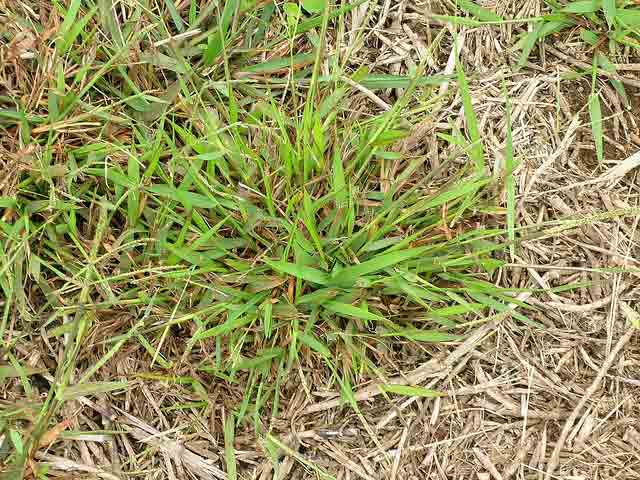
By: Scott Eckert, County Extension Agent, Horticulture
As you are planning to attend the Harvey County Home and Garden Show this
weekend you need to be thinking about controlling those awful grassy
weeds. Crabgrass preventers are another name for pre-emergence herbicides
that prevent crabgrass seeds from developing into mature plants. Many
people have a somewhat foggy idea of how they work.
They do not keep the seed from germinating but kill the young germinating plant. Crabgrass preventers are just that – preventers. With few exceptions they have no effect on existing crabgrass plants, so they must be applied before germination. Additionally, preventers do not last forever once applied to the soil. Microorganisms and natural processes begin to gradually break them down soon after they are applied. If some
products are applied too early, they may have lost much of their strength by the time they are needed. Most crabgrass preventers are fairly ineffective after about 60 days, but there is considerable variation among products. (Dimension and Barricade last longer. See below.) For most of Kansas, crabgrass typically begins to germinate around May1 or a little
later. April 15 is a good target date for applying preventer because it gives active ingredients time to evenly disperse in the soil before crabgrass germination starts. The April 15 target works well for most of the state.
Additionally, weather varies from one spring to the next, and with it the timing of crabgrass germination. It is often better to base timing on the bloom of ornamental plants. The Eastern Redbud tree is a good choice for this purpose. When the trees in your area approach full bloom, apply crabgrass preventer. A follow-up application will be needed about 8 weeks later unless you are using Dimension or Barricade. Products that do
require a follow-up application include pendimethalin (Scotts Halts) and Team (Hi-Yield Crabgrass Control). Dimension and Barricade are the only two products that give season- long control of crabgrass from a single application. In fact, they can be applied much earlier than April 15 and still have sufficient residual strength to last the season. Barricade can
even be applied in the fall for crabgrass control the next season. Dimension can be applied as early as March 1. Because of the added flexibility in timing, these products are favorites of lawn care companies who have many customers to service in the spring. Though Dimension cannot be applied as early as Barricade, it is the herbicide of choice if it must
be applied later than recommended. It is the exception to the rule that pre-emergence herbicides do not kill existing weeds. Dimension can kill crabgrass as long as it is young (two- to three-leaf stage). Dimension is also the best choice if treating a lawn that was planted late last fall. Normally a pre-emergence herbicide is not recommended unless the lawn has been mowed two to four times. But Dimension is kind to young tall fescue,
perennial ryegrass, and Kentucky bluegrass seedlings and some formulations can be applied as early as two weeks after the first sign of germination. However, read the label of the specific product you wish to use to insure that this use is allowed. Lawns established in the fall can be safely treated with Dimension the following spring even if they have not been mowed. Note that products containing Dimension and Barricade may use the
common name rather than the trade name. The common chemical name for Dimension is dithiopyr and for Barricade is prodiamine. Remember, when using Any pesticide, read the label and follow instructions carefully. We recommend crab grass preventers be applied before fertilizer so that the grass isn?t encouraged to put on too much growth too early. However, it may be difficult to find products that contain pre-emergents without fertilizer. Those that don?t contain fertilizer are listed below. Pendimethalin – Scotts Halts Team (Benefin +Trifluralin) Hi-Yield Crabgrass Control Dimension- Hi-Yield Turf &Ornamental Weed and Grass Stopper- Bonide Crabgrass &Weed Preventer- Green Light Crabgrass Prevente.
Turfgrass: Core Aeration of Cool-Season Lawns
If you are planning to core-aerate your tall fescue or Kentucky bluegrass lawn this spring, reserve a machine now so you can get the job done in March or early-April. Coring early in the spring gives cool-season lawns a chance to recover before crabgrass and other warm-season annual weeds start to germinate.
Core-aerating is one of the best things you can do for your lawn. It relieves compaction, hastens thatch decomposition, increases water infiltration and helps promote better root growth. Pay attention to the soil moisture level when coring. The soil should easily crumble when worked between the fingers. If it is too wet, the machine’s tines will plug and it will merely punch holes in the wet soil, which increases compaction. If it is too dry, the tines will not be able to penetrate deeply enough to be of benefit. (Ward Upham)
For The Love Of Horses: Heartland Therapeutic Riding Improves Lives Of People With Disabilities

By Frank J. Buchman
“The beauty and magic of the partnership between a horse and its rider have been celebrated as a symbol of dynamic unity; and emotional connection that helps heal and energize.”
One can only completely understand and comprehend that statement when seeing the magic truly come to life at Heartland Therapeutic Riding, Inc., 9655 Antioch, Stilwell, Kansas.
“At Heartland Therapeutic Riding (HTR), we know that a vital sense of freedom is experienced when riding a horse,” explained Executive Director Jennifer MaGee, who has witnessed the feeling firsthand.
“Doctors said my son would never walk when he was a baby, but a woman in Dallas, Texas, insisted that with therapeutic riding he would, and he does. My son is 19 now, walks on his own, admittedly at uneven gaits, but he graduated from high school, and is happy, largely in part to horses,” MaGee said.
“So, obviously I am a believer, and the main reason I’m here at HTR helping others find out and experience the beauty that can come from therapeutic riding,” MaGee clarified.
 Founded in 1977, and lead by a volunteer board of directors, Heartland Therapeutic Riding is designed to assist individuals with physical or cognitive disabilities, such as cerebral palsy, spinal bifida, autism, development delay, Down Syndrome emotional disorders, sight and hearing impairments and neuromuscular and orthopedic challenges.
“The horse’s rhythmic movement and the rider’s response to the gait combine to form a symbiotic partnership that creates a powerful opportunity to increase potential for personal fulfillment,” MaGee detailed.
“Because the horses are in sync with a rider’s slightest movement and respond accordingly, the horses foster an incomparable level of teamwork and a sense of accomplishment with their human charges,” described MaGee.
HTR was initiated when horseback riding as therapy was suggested to Jean Baum after doctors insisted that her then nine-month-old daughter might not walk. Baum investigated the Cheff Center for therapeutic riding in Minnesota, and was convinced that the Kansas City area needed a therapeutic riding program.
But, nobody was willing to take on the project. “They were unnerved by the prospect of having children with disabilities on their property, much less riding horses,” MaGee noted.
However, in 1981, Heartland Therapeutic Riding purchased about 27 acres of land at 133rd and Antioch, where the program grew with Baum’s initial leadership, then that of Patti Kortkamp, along with Sandy Rose and Joni Roeseler, volunteer coordinators, who are currently serving on Heartland’s Board of Directors.
. In the mid-1990s, real estate developers became interested in Heartland’s property on Antioch. “Eventually, the bids became so high that the Board determined they should sell the property and move farther south. The sale enabled Heartland to buy 78 acres of land at 19655 Antioch Road, and construct the facility designed specifically for therapeutic riding, and it was formally dedicated in 1998,” MaGee said.
Heartland is now recognized as a Professional Association of Therapeutic Horsemanship (PATH) Premiere Accredited Center for therapeutic riding, one of the first of now more than 800 accredited therapeutic riding centers across the United States.
“We have 86 riders, and about 130 volunteer assist our staff each week Heartland Therapeutic Riding is in session,” MaGee said. Classes are not conducted during the cold of winter and heat of summer.
“Horseback riding has been proven as one of the few sports that fully utilizes the body’s entire muscle system and helps strengthen muscles, which frequently results in improved balance and coordination,” MaGee continued.
Classes are designed to assist the rider in developing essential cognitive, behavioral, psychological and physical skills needed to achieve successful, adaptive riding.
It is actually a two part program. Early intervention hippo (the Greek word for horse) therapy is provided for special needs children by a physical or an occupational therapist. Therapeutic sports riding is available for children and adults with disabilities.
“Both programs utilize motor planning, cognitive planning, and sensory integration in the design and implementation of each class session,” MaGee said.
A physical, occupational, or speech-language therapist conducts early intervention using a horse as a treatment modality. “The horse provides 3-D movement which stimulates many different systems at the same time, while the therapist applies their skills to address impairments in young children with a wide variety of diagnoses,” MaGee said.
“Hippotherapy is a different kind of therapy as an addition or stand-alone treatment,” she pointed out. This is a 30-minute session once a week mornings and early afternoon for children from two-years to teenagers, with therapists certified in physical or occupational therapy
“Each individual is evaluated before being accepted into Heartland’s programs, and are accepted with their doctor’s written permission. Final determination of eligibility is made by the Heartland staff,” MaGee noted.
There is no discrimination as to sex, creed, color, or ability to pay, but Heartland has a limited amount of scholarship funding for clients unable to pay the full fee, according to MaGee.
“The action of the horse’s back simulates the action of walking in the rider’s pelvis. Horseback riding uses all of the muscles in the body,” she continued.
An occupational therapist and a physical therapist conduct the intervention therapy program, and certified therapeutic riding instructors conduct the sports riding program.
As important as qualified, dedicated staff, and the generous 130 volunteers assisting with Heartland’s service, are the 17 well-trained, sound and patient horses with extensive riding or show experience.
“We couldn’t do any of this without our horses. Regardless of age or gender, extreme joy is apparent on our riders’ faces when they’re riding one of HTR’s gentle and patient horses and building a life-changing relationship with these compassionate creatures,” MaGee credited.
“These are all very special animals, and in reality they have a very easy life here,” she stated.
“The horses must be safe for everybody and adjust to every environment, and every type of rider. They have to be calm, very friendly, not scared of toys, screams, or anything,” MaGee said.
Many of the horses have been donated outright to HTR, and others are leased to the program until they no longer used in the program and are returned to their owners.
“Before a horse comes to Heartland, our equine manager and other staff will come out to try the horses to make sure it meets all of our stringent requirements,” MaGee said.
“Volunteers are a critical element to the success of our therapeutic and sports riding programs. Our volunteers range from high school and college students, to working professionals, and retired individuals,” MaGee said.
“Volunteers take on roles as leaders, side walkers and barn assistants who groom horses and help tack them for classes,” MaGee said.
Volunteer training sessions are offered on an on-going basis as needs arise.
“Cerebral palsy has always made moving a challenge. I’ve never walked as far or as fast as everyone else. But, once a week I get to have the blessed experience of feeling the wind in my hair and seeing the blurred objects as I trot by. I’ve been coming to Heartland since I was three, and in the last 12 years I’ve had some of my greatest experiences at Heartland,” declared one teenage rider, living proof of what occurs at HTR.
“Riding itself is extremely beneficial, but the volunteers make the experience even more so. The relationships established with the volunteers have a very calming effect on me personally. This is the only activity for which all I have to do is show up. As a parent of a disabled child, that’s a ‘biggie’ for me,” said an adult rider, with a child also enrolled at Heartland.
“Hippotherapy and therapeutic riding have been great for my grandson. He’s been involved with Heartland for five years. Riding has strengthened his core area and balance. His swim instructor commented on his ability to surface dive to the bottom of the pool that we didn’t have the previous year,” one Grandmother contended.
Youngest rider is three-years-old, and mature riders retirement age suffering from muscular dystrophy to strokes are among the riders served by a staff of only three full time HTR employees. In addition, there are part time staff including professional therapists and riding instructors.
“Safety is paramount at Heartland,” MaGee re-stated. “Even with the right horses, it requires special mounting equipment, leaders, and one or two side walkers.
“The hardest part of my job at Heartland is explaining to parents that there are more than 50 on a waiting list of riders who want to participate in our program, but it’s impossible to accommodate them. We would love to grow the program, but logistics of time, facilities, volunteers and staff will just not permit it,” MaGee said.
HTR operates on an annual budget of $350,000. No student is denied access to the programs, and 100 percent of students receive financial aid.
“About 70 percent of our operating budget comes from a fundraiser each spring, and the rest comes from rider fees, grants and donations,” MaGee said.
“The rich and abundant rewards the students receive as a result of others’ generosity are priceless. Our ability to continue providing those life-transforming experiences relies on tax-exempt donations,” MaGee said.
Donations in kind are important as well. Among items desired by the facility presently are a four-wheeler, tools, feed, lumber and much more.
“We encourage everyone to call us at Heartland Therapeutic Riding for a personal tour of our 78-acre facility, including indoor and outdoor arenas, trails, pastures, our horses, or to observe one of our classes. We know our students are changed by their experience; we think you’ll be profoundly impacted, too,” MaGee invited.
“The vision to see…the faith to believe… the courage to do,” the working motto that comes to life at Heartland Therapeutic Riding, Inc., 19655 Antioch, Stilwell, Kansas, 66085, 913-8973939, [email protected].
Eldorado Canyon announces peak reopening

ELDORADO SPRINGS, Colo. —Eldorado Canyon State Park has reopened Shirttail Peak to all uses, including rock climbing, due to movement by the golden eagles in the area. The Park has now partially closed the Rattlesnake trail to all activity through July 15 or until further notice to protect the nesting golden eagles.
Golden Eagles are protected by the U.S. Fish & Wildlife Service under authority of the Bald and Golden Eagle Protection Act and the Migratory Bird Treaty Act. A conviction of nest disturbance can carry a fine up to $5,000 and one year imprisonment.
For more information on Eldorado Canyon State Park, visit: http://cpw.state.co.us/placestogo/Parks/eldoradocanyon
CPW is an enterprise agency, relying primarily on license sales, state parks fees and registration fees to support our operations including 43 state parks covering more than 220,000 acres, big-game management, hunting, fishing, wildlife watching, camping, motorized and nonmotorized trails, boating and outdoor education. CPW’s work contributes approximately $6 billion in total economic effect annually throughout Colorado.
