
Monday, February 2, 2026
Home Blog Page 4482

Kansas, Nebraska & Colorado Continue Cooperation with Water Agreement

0
CHRIS NEAL / THE CAPTIAL-JOURNAL

Republican River Compact Adjustments to Further Benefit Basin Water Users

(Manhattan, Kan.) Today, reflecting the continued spirit of cooperation, Colorado, Kansas and Nebraska, along with the U.S. Bureau of Reclamation, have reached an agreement that will ensure more certainty to the basin’s water users in both Nebraska and Kansas. The agreement, signed through the Republican River Compact Administration (RRCA), was achieved through collaborative negotiations that began in January 2015 and will provide timely access to water for the 2015 irrigation season.

The agreement provides additional flexibility for Nebraska to achieve its Compact obligations while ensuring Kansas water users’ interests are also protected. The additional flexibility allowed the Nebraska Department of Natural Resources to open Nebraska reservoirs and water user’s rights that were initially limited in 2015. Opening the Nebraska water rights allowed the Bureau of Reclamation to agree to modify certain contract provisions for its irrigation districts, ensuring the availability of the water that was pumped from Nebraska augmentation projects for RRCA compliance.

Additionally, the agreement allows for the Nebraska Department of Natural Resources to ensure no additional regulatory water supply reductions for Nebraska surface water irrigation user’s water supplies for the 2015 irrigation season.

Current RRCA Chairman Jim Schneider, Acting Director of the Nebraska Department of Natural Resources, said, “This is a significant step forward for the states and our water users. Our collaborative work and this agreement further demonstrate the benefits of the recent cooperation that the states have been able to achieve. I am optimistic that the states and Bureau of Reclamation can work toward ensuring these types of arrangements can be in place each year so that both Nebraska and Kansas water users will secure the benefits of having more certainty in their water supplies.”

Kansas Commissioner David Barfield said, “Today’s agreement continues to move us forward toward a longer-term solution benefiting the basin’s water users. I appreciate not only Nebraska’s continued willingness to work through these issues, but also the Bureau of Reclamation and its irrigation districts for their part in reaching today’s agreement.”

Colorado Commissioner Dick Wolfe said, “These recent agreements are emblematic of the new cooperation among the states and the federal government. I hope it continues to be a model for cooperation and successful settlement of the remaining issues within the basin.”

At the Nov. 19, 2014, meeting in Manhattan, Kansas, the states reached an agreement that provided Nebraska with 100% credit for water delivered from augmentation projects to Harlan County Lake prior to June 1, 2015, and dedicated that water to be used exclusively by Kansas irrigators.

The RRCA is comprised of one member each from the States of Colorado, Kansas and Nebraska. The purpose of the RRCA is to administer the Republican River Compact. This Compact allocates the waters of the Republican River among the three states. The next RRCA meeting is scheduled for August to be hosted in Lincoln, Nebraska.
PCC Displays Work of Kansas Art Guild

0
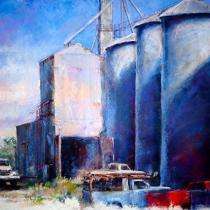
Delmar Riney Art Gallery is located in the

credit: Pratt Community College 

During the month of March, the Delmar Riney Art Gallery at Pratt Community College will feature works from the Kansas Art Guild (KAG).

The Friends Community Art Guild was formed in May 1977. The first meetings were held at Friends University with eight members present. Nona Bass, president, had just moved from Anaheim, Calif., to Wichita and was surprised to learn that there was no organization there for its local artists. She felt it was important that artists could meet and share ideas.

The Guild grew rapidly and soon moved to the Wichita Art Museum. At that time, the name was changed to the Community Art Guild. When the Wichita Art Museum underwent renovation, the Guild moved to the Wichita Center
for the Arts, where KAG is currently located.

In the summer of 1993, members voted to change the name to the Kansas Art Guild, Inc. At that time, it was decided to incorporate. The name is very appropriate since many of the members live many miles outside the Wichita Area.

Regular meetings are held at 1 p.m. on the first Tuesday of each month at the Wichita Center for the Arts. Members share their recent works which are judged by visiting speakers. The Guild also holds exhibitions at several locations in the area throughout the year.

The Delmar Riney Art Gallery is located in the Riney Student Center at Pratt Community College. The hours are Monday – Thursday 8 a.m. – 5 p.m. and Friday 8 a.m. to 1 p.m., or by appointment. For more information about the gallery or to make an appointment, please call (620) 450-2184. For more information about the Kansas Art Guild or to contact them, visitwww.kansasartguild.com.

If you would like to be considered as a “Featured Artist of the Month” in the Delmar Riney gallery, send your name, contact information and a brief description of your artwork to Pratt Community College, Vice President of Students/EM, 348 NE SR 61, Pratt KS 67124 or [email protected].

Pratt Community College Produces Highest Paid Grads in State

0

According to new data released by the Kansas Board of Regents, Pratt Community College students graduating with an associate’s degree between 2008 and 2012 have a higher annual wage than the average of associate’s degree and bachelor’s degree graduates in that same time from all Kansas public colleges and universities.

PCC students graduating with an associate’s degree in 2012, which is the most recent cohort with measurable post-graduation wage data, made an average of $42,276. The average of all Kansas community college graduates was $32,369 and the technical college sector had an average wage of $38,615.

2012 graduates from PCC out-earn even those with degrees from four year institutions; the average wage of 2012 public university graduates with bachelor’s degrees was $35,355. Kansas State University grads posted a wage average of $36,590, while those from the University of Kansas averaged $32,831.

The information comes as the fourth installment of data from Foresight 2020, a 10-year strategic agenda approved by the Kansas Board of Regents for the state’s public higher education system. Established in September 2010, the plan sets long-range achievement goals that are measurable, reportable, and ensures the state’s higher education system meets Kansans’ expectations. The original plan included six goals, but a redesign reduced that number to three: increase higher education attainment among Kansans, improve alignment of the state’s higher education system with the needs of the economy, and ensure state university excellence.

The report and its appendices provide data for 21 metrics, including demographics, graduation and retention rates, student success index rates, credential production, and data on graduates’ rates of employment and average earnings in Kansas.

Read more in this news release from KBOR. For more information, contact Breeze Richardson at (785) 291-3969 or [email protected].​

Bugner with thirteen strikeout no-hitter as Cougar Softball goes 2-1 after first day of Cloud County Tournament

0

The Barton Community College softball team went 2-1 Saturday on the first day of the Cloud County Tournament held in Concordia, Kansas.  The Lady Cougars dropped the first game of the day 8-3 to Division II No. 8 ranked Highland Community College before winning the next two to wrap up the day.  Getting thirteen strikeouts and a no-hit performance from freshman Taylor Bugner, Barton shut out host Cloud County Community College before rolling over Riverland Community College 13-3 in a game shortened five innings.  Barton improved to 12-3 on the season going into Sunday’s games beginning at 11:30 a.m. against Brown Mackie College and a 1:30 p.m. contest versus Southeast Community College.

Here’s Mud In Your Eye

0

Wine tastings are so over. The trendy thing now in California and Europe are dirt tastings in which folks with seemingly too much money and not enough to do, swirl a muddy concoction of dirt in a glass, hold it up to the light, stick their snoot in a soil slurry full of humus and then make sophisticated statements such as, “It’s a bit dusty but I taste an echo of loam with just the right notes of compost. And was that a hint of clay on the mid-palate?” Or, “I simply love the creamy and complex texture, with a surprising vegetative nose and a barnyard finish that is simply divine.”

And you thought eating snails and bugs was bad!

I’ve tasted my share of dirt in my life and, quite frankly, I don’t see the attraction. I’d eat eggs  or Lima beans before I’d eat soil on purpose. At the age of five I ate dirt on a dare and it left a bad taste in my mouth to this day. And any rancher who has worked his share of cattle through a squeeze chute with his mouth open has also tasted a bovine vintage, so to speak.

I am told that people in Georgia have been known to eat powdered clay called kaolin for its antidiarrheal properties and for a long time Kaopectate® was made from this dirt. My mother used to feed me Kaopectate® when I ate too many cherries and I’d have to say I’d rather have the worst case of the trotskys on earth than to ever taste that chalky remedy ever again.

I think this whole dirt tasting fad was started in places where they couldn’t grow grapes but wanted to get in on the fun the wine snobs were having. I hate to rain on their parade but one vital ingredient to this merriment is missing in most dirt and that’s alcohol. But as a farmer I could see the advantages of raising dirt versus growing grapes. There’s no planting, just harvesting. Start up the backhoe or skip loader, scoop up a bucket full of your 2015 vintage and that’s pretty much all there is to it. I’d say that at $30 a bottle that’s a fairly good return that compares favorably with Two bBuck Chuck and boxed wines.

The idea behind dirt tastings is for insufferable snobs to make the connection between the food they eat and the dirt it was grown or raised in. Believe me, I sure made the connection when my mother forgot to wash the tubers sufficiently. Or when we ate boysenberry cobbler made with berries that were grown over our septic tank. I am told that such an area is known as a “terrior”, which I think is French for “mental illness”. I don’t want to spoil the dirt snob’s party but I’d be real hesitant if I were you to eat anything grown in the soil around the cow towns of Dalhart, Greeley or Coalinga, if you know what I mean.

I can see it all now. At all the hoity-toity restaurants rich guys will order  an appetizer of “Your best South Dakota loamy clay.” Or a “vertical” of Gallo’s best sods. Dirty journalists will write bestsellers with titles like “The Best Soils of the San Joaquin”. Instead of wine tours people will go on dirt tours in big long limousines with hot tubs in them, and FFA kids who were on the soils judging team in high school will become dirt sommeliers or tasting room associates. Instead of wine cellars, rich folks will build dirt cellars. Believe me, I’ve had relatives who lived in dirt cellars and I’m not going back.

If I have piqued your interest in dirt tasting I am told that you should mix the dirt with a little water, decant and pour in the typical manner, being careful to let the soil breathe. Or at least let the microbes in the soil breathe. Now swirl the muddy concoction clockwise, NEVER counter clockwise, lower it under your nose and note the vibrant aroma of a cow on carrots. Close your eyes, take a sip in quiet contemplation and note the textures of fertilizer, fungicides, mold and sludge, being careful not to break a tooth on the complex and rocky structure. Finally, SPIT IT OUT! You’re eating dirt for gosh sakes!

wwwLeePittsbooks.com