Sunday, February 1, 2026
Home Blog Page 4484

Pest-Free Pets

0
Photo courtesy of Getty Images

Preventive tips for pet owners


dog and family(Family Features) Rising temperatures are a double-edged sword for pet lovers. Warmer days create the perfect setting for a run through the park or a game of fetch. But these warm days also provide an ideal environment for pests that can have a serious impact on your pet’s health.


Tiny but mighty


Both fleas and ticks are small but dangerous. Fleas are ravenous and can consume 15 times their own body weight in your pet’s blood. A serious infestation can cause your pet to become anemic. It is common for pets to have sensitivity to flea saliva and just one bite can cause a severe allergic reaction, leading to painful and intense itching. Fleas also transmit a variety of diseases such as bartonella and typhus, as well as tapeworms.


Female ticks can consume more than 100 times their body weight in your dog’s blood, which can lead to anemia. Their bites may trigger allergic reactions, but even more dangerous are the diseases they can transmit, such as Lyme disease and Rocky Mountain spotted fever, which can also be transmitted to humans.


Treat and prevent pests


The best way to protect your pet and your family is to manage exposure to pests and take preventive measures to keep them at bay. New PetArmor Plus for dogs or cats contains fipronil, the No. 1 veterinarian-recommended active ingredient,* and (s)-methoprene — the same active ingredients found in FRONTLINE Plus, but costs up to 40 percent less than vet prices.**


Each monthly dose kills fleas, flea eggs, flea larvae, ticks and chewing lice. And because it is fast acting, long lasting and kills eggs and larvae, it helps to stop the re-infestation cycle.


Protecting against infestations


When you see fleas or ticks on your pet, there is a good chance that they are in your home as well. Simply treating your pet won’t rid the problem entirely, because you risk re-infestation until pests are fully eradicated.


Household sprays, carpet powders and foggers kill fleas nesting in the home. Thoroughly vacuum and wash any carpeting, furniture or linens, including beds and pillows that your pet may have come into contact with.


Although you won’t be able to control the outdoor environment as easily as the home, you should also treat your yard so that pests aren’t reintroduced every time your dog or cat ventures outside. Prevent fleas and ticks from jumping onto pets when outside by spraying the yard and treating around the home’s foundation to kill any potential flea populations. In addition to using a pet-safe insect repellant, cut down tall brush and grasses near the house or pet runs to reduce a pet’s exposure to fleas and ticks.


Learn more about the health risks associated with fleas and ticks, and find additional prevention tips, at www.petarmor.com.


How to Check for Fleas and Ticks


Adult ticks are often visible to the naked eye, so you may be able to spot them on short-haired pets. But with longer haired pets, it’s best to do a thorough inspection with a fine-toothed comb.


Signs your pet may have fleas can include flea dirt (small dark flakes), excessive itching or scratching, redness and inflammation, hot spots and pale gums. You may also see adult fleas on your pet’s coat and skin.


Follow this advice from the experts at PetArmor to find and eliminate fleas and ticks on your pet:

  1. First, use a fine-toothed metal flea comb. Run the comb along your pet’s back or underbelly, making sure the comb comes in contact with the skin.
  2. If you pull out any fleas or ticks, immediately drown them in a nearby bowl of soapy water.
  3. Have your pet stand on a white sheet or towel. Then brush or rub your pet’s coat. Small black specks on the white sheet or towel are more than likely fleas or flea dirt. Flea dirt can also look like sand.
  4. Apply a monthly topical preventive treatment such as PetArmor Plus to keep pests from coming back.
  5. Also be sure to treat your home and yard to prevent a recurrence.


Choosing a preventive treatment


No two pets are the same, so it’s a good idea to consult with your veterinarian before you begin a flea and tick preventive program. Some questions to keep in mind as you’re determining the best treatment for your pet include:

  • Is a topical or oral treatment most appropriate for my pet?
  • How costly is the treatment?
  • Can I get the treatment from a retailer over the counter, or is it available only through the veterinary office?
  • Does it kill eggs and larvae to prevent the re-infestation cycle?
  • How quickly does it begin working and how long will it last?
  • Is it waterproof?
  • Is it safe for breeding, pregnant and lactating animals?


*GFK 2014 Vet Recommended Flea and Tick Products September 2014.

**PetArmor® Plus is not manufactured or distributed by Merial. FRONTLINE® is a registered trademark of Merial. Pricing comparison based on average veterinarian retail price survey of FRONTLINE® Plus (December 2014) and MSRP of PetArmor® Plus (January 2015). Data on file.

Source: PetArmor
USDA Awards Grants to Support Schools Serving Healthier Meals and Snacks

0
usda
Up to $25 million will be provided for new food service equipment; $5.5 million for training

WASHINGTON, March 6, 2015 – Agriculture Secretary Tom Vilsack today announced that the U.S. Department of Agriculture (USDA) will be awarding over $30 million in grants to help schools prepare healthy meals for their children. Twenty-five million dollars in grants will help schools purchase needed equipment to make preparing and serving healthier meals easier and more efficient, and up to $5.5 million will provide additional training for school food service professionals.

“Schools are successfully serving more nutritious meals to America’s students, and healthier meals mean healthier kids. We’re working to do everything we can to support schools as they work to provide kids the nutrition they need to learn and develop into healthy adults,” said Vilsack. “These grants will help schools obtain better equipment and additional training for their hardworking school food service professionals. With doctors, parents, teachers and schools all working together, we can make sure we’re giving our kids the healthy start in life they deserve.”

Since 2009, USDA has provided $185 million in kitchen equipment funding to states and schools participating in the National School Lunch (NSLP) and School Breakfast (SBP) Programs. USDA provides the funding to states, which then competitively award grants to school districts in order to purchase necessary equipment, giving priority to high-need schools where 50 percent or more of the enrolled students are eligible for free or reduced price meals.

Download the list of funding by state for FY14 and FY15.

The school equipment grants announced today are another example of how USDA is supporting schools as they implement the new meal standards resulting from the Healthy, Hunger-Free Kids Act of 2010. USDA works closely with schools to address implementation challenges, and provides funding, training and technical assistance to overcome barriers.

To further assist school food workers USDA is also announcing the availability of up to $5.5 million in Team Nutrition training grants for FY2015. These grants are only open to state agencies administering the NSLP, SBP, the Summer Food Service Program, or Child and Adult Care Food Programs. Through a competitive grants process, Team Nutrition training grants will be funded for the period of September 30, 2015 – September 30, 2017. State agencies may apply for up to $350,000. To apply for the grants, state agencies should visit www.grants.gov.

These competitive grants focus on the implementation of Smarter Lunchrooms – an innovative strategy using behavioral economics to encourage healthy eating in the cafeteria – as well as the healthier meal standards, HealthierUS School Challenge, USDA Foods, nutrition education, and wellness activities in schools and child care institutions. These funds may be also used to assist the state agency in providing training and technical assistance to school staff in creating Smarter Lunchrooms.

The Team Nutrition Training grants are two-year grants that have been awarded to state agencies on an annual basis since the inception of the program in 1995. They serve as key delivery systems for supporting the implementation of USDA’s nutrition requirements for meals served in schools and child care centers.

USDA’s Food and Nutrition Service administers America’s nutrition assistance programs including the National School Lunch and School Breakfast programs, the Child and Adult Care Food Program, the Summer Food Service Program, Supplemental Nutrition Assistance Program, and the Special Supplemental Nutrition Program for Women, Infants, and Children (WIC). Together these programs make up the federal nutrition safety net.

Peanut Prices

0
Photo credit: uacescomm
ISSN: 1949-1891

Released March 6, 2015, by the National Agricultural Statistics Service 
(NASS), Agricultural Statistics Board, United States Department of 
Agriculture (USDA).

Peanut Price Highlights

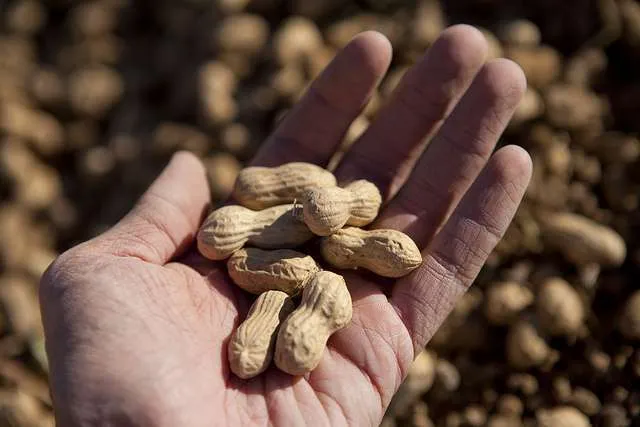
Peanut prices received by farmers for all farmer stock peanuts averaged 
21.7 cents per pound for the week ending February 28, up 0.3 cent from the 
previous week. Marketings of all farmer stock peanuts for the week ending 
February 28 totaled 104 million pounds, up 19.6 million pounds from the 
previous week.

Runner-type peanut prices averaged 21.7 cents per pound for the week ending 
February 28, up 1.1 cents from the previous week. Marketings of runner-type 
peanuts were 104 million pounds, up 28.8 million pounds from the previous 
week.

Peanut Prices and Marketings by Type - United States: January 31, 2015-February 28, 2015
-----------------------------------------------------------------------------------------
              :                               Week ending                                
 Item and type:--------------------------------------------------------------------------
              : January 31,  : February 7,  : February 14, : February 21, : February 28, 
              :     2015     :     2015     :     2015     :     2015     :     2015     
-----------------------------------------------------------------------------------------
              :                            dollars per pound                             
              :                                                                          
Average price :                                                                          
Runner .......:     0.209          0.213          0.210          0.206          0.217    
Spanish ......:       (X)          0.459          0.304          0.300            (X)    
Valencia .....:       (X)            (X)            (X)            (X)            (X)    
Virginia .....:       (X)          0.262          0.294          0.262            (X)    
              :                                                                          
All ..........:     0.209          0.237          0.224          0.214          0.217    
              :                                                                          
              :                               1,000 pounds                               
              :                                                                          
Marketings 1/ :                                                                          
Runner .......:    93,070        101,555         70,801         75,026        103,776    
Spanish ......:         -         10,513          3,155          4,321              -    
Valencia .....:         -              -              -              -              -    
Virginia .....:         -          1,211         10,027          4,846              -    
              :                                                                          
All ..........:    93,070        113,279         83,983         84,193        103,776    
-----------------------------------------------------------------------------------------
-   Represents zero.                                                                     
(X) Not applicable.                                                                      
1/  Quantity purchased from farmers.                                                     

Statistical Methodology

Survey procedures: Price and marketing information included in this report is 
provided the beginning of each week by first buyers of farmer stock peanuts. 
Each week, respondents are asked to report total pounds purchased 
(marketings) from farmers and total dollars paid, by type (Runners, Spanish, 
Valencias, and Virginias), for the previous week. The reported data are to 
include all qualities and grades and exclude peanuts used for seed. Data are 
collected by telephone, fax, and internet each week for the previous week. 
The peanut price survey is an enumeration of all known first buyers of farmer 
stock peanuts from growers. Every effort is made to obtain a report from all 
buyers.

Estimating procedures: Since a complete report is not received from all 
buyers each week, the reported quantities purchased and total dollars paid 
for each type are expanded to account for non-response. These expanded data 
are then used to calculate the weighted average price for each type. 
Estimates of price and marketings are prepared by the Agricultural Statistics 
Board and reviewed for reasonableness with recent historic estimates and 
between the different peanut types.

Revision policy: Price and marketing estimates for the prior three weeks are 
subject to revision based on late reports. At the end of the marketing year, 
all buyers will have an opportunity to update or provide any late data for 
any week during the marketing year. After this data is incorporated with 
previously reported data, revised weekly estimates will be published for the 
entire marketing year.

Reliability: The peanut price survey is subject to non-sampling errors such 
as omission, duplication, imputation for missing data, and mistakes in 
reporting, recording, and processing the data. These errors cannot be 
measured directly, but are minimized through rigid quality controls in the 
data collection process and a careful review of all reported data for 
consistency and reasonableness.

Information Contacts

Listed below are the commodity statisticians in the Crops Branch of the 
National Agricultural Statistics Service to contact for additional 
information. E-mail inquiries may be sent to [email protected]

Lance Honig, Chief, Crops Branch........................... (202) 720-2127

Anthony Prillaman, Head, Field Crops Section............... (202) 720-2127
     Brent Chittenden - Oats, Rye, Wheat................... (202) 720-8068
     Angie Considine - Cotton, Cotton Ginnings, Sorghum.... (202) 720-5944
     Tony Dahlman - Crop Weather, Barley................... (202) 720-7621
     Chris Hawthorn - Corn, Flaxseed, Proso Millet......... (202) 720-9526
     James Johanson - County Estimates, Hay................ (202) 690-8533
     Bianca Pruneda - Peanuts, Rice........................ (202) 720-7688
     Travis Thorson - Soybeans, Sunflower, Other Oilseeds.. (202) 720-7369

Access to NASS Reports

For your convenience, you may access NASS reports and products the following 
ways:

 	All reports are available electronically, at no cost, on the NASS web 
site: http://www.nass.usda.gov

 	Both national and state specific reports are available via a free e-
mail subscription. To set-up this free subscription, visit 
http://www.nass.usda.gov and in the "Follow NASS" box under "Receive 
reports by Email," click on "National" or "State" to select the reports 
you would like to receive. 

For more information on NASS surveys and reports, call the NASS Agricultural 
Statistics Hotline at (800) 727-9540, 7:30 a.m. to 4:00 p.m. ET, or e-mail: 
[email protected]. 
  
The U.S. Department of Agriculture (USDA) prohibits discrimination against 
its customers, employees, and applicants for employment on the basis of race, 
color, national origin, age, disability, sex, gender identity, religion, 
reprisal, and where applicable, political beliefs, marital status, familial 
or parental status, sexual orientation, or all or part of an individual's 
income is derived from any public assistance program, or protected genetic 
information in employment or in any program or activity conducted or funded 
by the Department. (Not all prohibited bases will apply to all programs 
and/or employment activities.) 
If you wish to file a Civil Rights program complaint of discrimination, 
complete the USDA Program Discrimination Complaint Form (PDF), found online 
at http://www.ascr.usda.gov/complaint_filing_cust.html, or at any USDA 
office, or call (866) 632-9992 to request the form. You may also write a 
letter containing all of the information requested in the form. Send your 
completed complaint form or letter to us by mail at U.S. Department of 
Agriculture, Director, Office of Adjudication, 1400 Independence Avenue, 
S.W., Washington, D.C. 20250-9410, by fax (202) 690-7442 or email at 
[email protected]. 

A Culinary Classic

0

Delicious peanut butter and its tasty recipes


(Family Features) From the classics of yesterday to favorites on the table today, peanut butter is a delicious ingredient enjoyed in recipes generation after generation.


“Whether it features creamy or crunchy peanut butter, is a snack your grandmother made, a side dish your dad loved to cook at the holidays, or even a main entree you love serving your family on a busy weeknight, we want to honor your go-to, time-honored recipe,” said Leslie Wagner, executive director, Southern Peanut Growers (SPG).


To celebrate everyone’s timeless taste for this sticky staple, SPG is hosting its annual “PB My Way” national recipe contest calling for all-time favorite peanut butter recipes. Home bakers and cooks around the country are encouraged to share their favorite recipe inspired by this rich and versatile kitchen staple. Recipe submissions are due by April 15, 2015.


For more contest information, to submit your own recipe and to view other delicious peanut butter dishes, visit www.peanutbutterlovers.com and the SPG Facebook page.


Peanut Butter Surprise Cookies

Servings: 6 dozen cookies


3 1/2    cups all-purpose flour
2          cups old fashioned oats
1          teaspoon baking soda
1          teaspoon salt
2          cups unsalted butter, chilled, cut up
1 1/2    cups packed light brown sugar
1          cup creamy peanut butter
4          teaspoons vanilla extract
2          eggs
3          cups honey-roasted peanuts
2          (10-ounce) packages peanut butter chips
2          (8-ounce) packages toffee bits or 12 (1.4-ounce) bars milk chocolate toffee, such    as Heath bars, chopped


Whisk flour, oats, baking soda and salt in medium bowl and set aside. Beat butter and brown sugar in large bowl at medium speed 3 minutes or until light and fluffy. Beat in peanut butter and vanilla. Add eggs one at a time, beating just until combined. At low speed, beat in flour mixture just until combined.


Stir in peanuts, peanut butter chips and toffee bits. Cover and refrigerate 2-3 hours or overnight.


Heat oven to 375°F. Line cookie sheet with parchment paper. Gently form into balls and flatten slightly to about 1/2- to 3/4- inch thickness. Freeze dough on baking sheets for 10 minutes or until firm. Bake about 12 minutes or until light brown on edges. Cool on baking sheet on wire rack 3 minutes. Place cookies on rack to cool completely before storing.


Source: Southern Peanut Growers

Circle bowlers get long-awaited state title

0

The Circle High boys bowling team, after falling five pins short a year ago, won the Class 5-1A state team title at Wichita’s Northrock Lanes.

Individually, Circle’s Jerod Hromek won his his second straight title. Teammates Cade Liby and Kooper Bardin finished fourth and 15th, respectively.

Circle is coached by Doug Odom.