
Gardeners are eager to get out and do something in the landscape this time of year. One chore that can be taken care of during March is pruning certain shrubs. Often, gardeners approach pruning with trepidation, but it is not as difficult as it may seem.
Remember, not all shrubs need
to be pruned (i.e., witch hazel), and certain shrubs, which will be identified later in this article, should not be pruned this time of year. Shrubs are pruned to maintain or reduce size, rejuvenate growth, or to remove diseased, dead or damaged branches. Deciduous shrubs are those that lose leaves each winter. Evergreen shrubs maintain foliage all year and include yews and junipers.
Deciduous shrubs are placed into three groups:
• Those that flower in the spring on wood produced last year;
• Those that flower later in the year on current seasons’ growth; and
• Those that may produce flowers, but those flowers are of little ornamental value.
Shrubs that flower in the spring should not be pruned until immediately after flowering.
Though pruning earlier will not harm the health of the plant, the flowering display will be reduced or eliminated. Examples of these types of plants include forsythia, lilac, flowering quince, Vanhoutte spirea, bridal wreath spirea and sweet mockorange. Shrubs that bloom on current seasons’
growth or that do not produce ornamental flowers are best pruned in March. Examples include Rose-of-Sharon, pyracantha, Bumalda spirea, and Japanese spirea.
Pruning during the spring allows wounds to heal quickly without threat from insects or disease. There is no need to treat pruning cuts with paints or sealers. In fact, some of these products may slow healing.
There are three basic methods used in pruning shrubs: thinning,
heading back, and rejuvenating. Thinning is used to thin out branches
from a shrub that is too dense. It is accomplished by removing most of the inward growing twigs by either cutting them back to a larger branch or cutting them back to just above an outward- facing bud. On multi-stemmed shrubs, the oldest canes may be completely removed.
Heading back is done by removing the end of a branch by cutting it back to a bud and is used for either reducing height or keeping a shrub compact. Branches are not cut back to a uniform height because this results in a “witches-broom” effect.
Rejuvenation is the most severe type of pruning and may be used on multi-stem shrubs that have become too large, with too many old branches to justify saving the younger canes. All stems are cut back to 3- to 5-inch stubs. This is not recommended for all shrubs but does work well for spirea, forsythia, pyracantha, ninebark, Russian almond, little leaf mock orange, shrub roses and flowering quince. (Ward Upham)
Pruning Deciduous Shrubs

Dole Institute hosts documentarian on agriculture in the Dust Bowl Era

LAWRENCE — The Dole Institute of Politics at the University of Kansas will screen the documentary “Harvesting the High Plains” at 3 p.m. Tuesday, March 10. This documentary chronicles the challenges two men faced, searching for a way to harvest in the midst of the Dust Bowl Era. Director Jay Kriss will introduce the film and take audience Q&A directly following.
“Senator Dole is a part of our state’s agricultural history as he worked tirelessly for legislation to help farmers,” said Dole Institute Director Bill Lacy. “That is why we always enjoy having the opportunity to further highlight this industry’s importance on the state, national and world levels, and this documentary is one that does so in the context of a historic and catastrophic U.S. weather event.”
Just as the U.S. was beginning to rise from the Great Depression, nature waged a war on the Great Plains. “Harvesting the High Plains” follows the risks that John Kriss, a farmer from Colby, and Ray Garvey, a Wichita entrepreneur, took to cultivate land in Western Kansas and Eastern Colorado. Because of their hard work, harvesting was possible, and thus the land became the “Breadbasket of the World.”
The film is inspired by the novel of the same name, written by Craig Martin, a professor at Wichita State University. It is narrated by Mike Rowe, of Discovery Channel’s “Dirty Jobs,” and has been featured on PBS affiliate stations across the U.S.
To conduct background research for the film, Kriss utilized the Kansas State Historical Society and the archived letters of the two farmers, who wrote to each other almost every day. They also researched letters to banks and high-level officials, such as secretaries of Agriculture. In all, approximately 30,000 documents were available. Additionally, an old Works Progress Administration film, “The Plow That Broke the Plains,” was purchased, and much of the raw footage it used was digitized through the National Archives and the Library of Congress and used in “Harvesting the High Plains.”
Kriss has more than 34 years of experience as a camera operator and cinematographer and is now a director. In addition to “Harvesting the High Plains,” Kriss has also directed the documentary “1000 Miles.” He currently works on his own projects through his production company, Inspirit Creative, with partner Sydney Duvall.
The event is free and open to the public. Refreshments will be served.
The Dole Institute of Politics is dedicated to promoting public service, civic engagement and politics. It is located on KU’s west campus and, in addition to the Robert J. Dole Archive & Special Collections, offers free public programming with world-renowned guest speakers on a variety of topics that intersect politics, as well as opportunities for students of all ages.
For more information on this or any Dole Institute events, visit www.doleinstitute.org or call (785) 864-4900. The Dole Institute of Politics is dedicated to promoting public service, civic engagement and politics. It is located on KU’s west campus next to the Lied Center.
Contact: Melanie Coen, Dole Institute of Politics, 785-864-1156, [email protected]
https://news.ku.edu/2015/03/03/dole-institute-hosts-documentarian-agriculture-dustbowl-era
Prevention Is Key When Treating Ticks And Fleas

(NAPS)—When it comes to your pet’s health, investing the time and effort to use tick and flea preventatives can really pay dividends. For starters, such treatment will do more than just eliminate your pet’s itchy fleas and prevent allergic reactions.
The right medication can also prevent fleas, ticks and other insects from biting your pet, and prevent these pests from getting inside your home, on your furniture and in your bedding.
Prevention Beats Treatment
Experts agree that fleas and ticks are stubborn parasites that can cause discomfort and transmit dangerous diseases. They can also be difficult to get rid of. That’s why prevention really is the best medicine.
Many pet owners believe that a topical application offers the best protection against ticks and fleas, but ingredients that make the better products effective can also cause them to be expensive.
Now, thanks to a new product, it’s possible to provide your pet with exceptional protection for up to 40 percent less than vet prices.*
The product, called PetArmor® Plus, contains fipronil, the No. 1 vet-recommended active ingredient, and (s)-methoprene, which prevents eggs from hatching and growing. PetArmor Plus provides the same flea and tick protection as FRONTLINE® Plus but at a significant savings.
As an added plus, the product is safe to use in a multipet household. However, pets should be separated for 24 hours following application to ensure that the product has dried completely, thus helping to reduce the chance of other pets ingesting the product off of the treated pet.
Available in three application doses, it can be used for dogs over 4 lbs. or cats over 1.5 lbs. and 8 weeks of age or older. In addition, it can be used on breeding, pregnant and lactating animals.
Additional Tips
- It’s important to read a product’s label and prepare to follow directions thoroughly before applying any powerful medicine to your pet. Even if you have a product made specifically for dogs, applying it correctly is still essential.
- Buy the right product for the right species. Always choose a cat product for cats and a dog product for dogs. These products are different formulations based on the pet’s species and should never be used interchangeably.
- Know your pet’s weight.
- Consider your pet’s age.
PetArmor® Plus is available in four weight breaks for dogs and one weight break for cats and should only be used on pets 8 weeks of age or older.
To learn more, visit www.petarmor.com.
Experts agree that fleas and ticks are stubborn parasites that can be difficult to get rid of. That’s why prevention really is the best medicine.
*PetArmor® Plus is not manufactured or distributed by Merial. FRONTLINE® is a registered trademark of Merial. Pricing comparison based on average veterinarian retail price survey of FRONTLINE® Plus (December 2014) and MSRP of PetArmor® Plus (January 2015). Data on file.
Program aims to strengthen families faced with toxic stress

LAWRENCE — Adverse experiences that happen early in life may have a long-lasting effect on child development that could lead to lifelong health and mental health problems. According to the Adverse Childhood Experience study conducted by the Centers for Disease Control and Prevention and Kaiser Permanente, early stressful experiences such as abuse, neglect, hardship and family dysfunction may lead to disruptions in child social-emotional health and brain development, later engagement in risky behaviors, chronic health problems and early death.
Research has shown that interventions that target parenting to improve the child’s environment and promote factors like maternal sensitivity and secure attachment can help protect children from the effects of early adverse experiences. Intervening in this way promotes resilience and development of coping skills that lead to healthy child social-emotional development. Appropriate intervention may also at least partially reverse negative effects on child brain development that can result from experiences of adversity.
In response to these recent developments in brain science and protective factor research, researchers at the University of Kansas School of Social Welfare Center for Children and Families and the Schiefelbusch Institute for Lifespan Studies at Parsons have initiated a project in partnership with Early Head Start and Smart Start agencies throughout the state of Kansas.
The purpose of this collaboration is to develop and test strategies for screening to identify children who are experiencing environmental risk before behavioral issues begin to emerge and to providing and testing a new brief intervention that aims to strengthen caregiver sensitivity and attachment to promote child coping and resilience against adversity.
“Waiting until we begin to notice disruption to the child’s behavior is often well past the time when toxic stress has begun impacting the child’s brain structure and development. It is crucial that we find a way to intervene earlier and support healthy development rather than try to course-correct after the fact. We want to improve screening and intervention to support a positive life trajectory as early, effectively and efficiently as possible,” said Kaela Byers, principal investigator.
This project is in its third year and has been conducted with support from the United Methodist Health Ministries Fund and the Kansas Department of Aging and Disability Services.
Agencies who have or are currently participating in the project include Early Head Start programs at Early Childhood Connections in Hays; Southeast Kansas Community Action Program in Girard, and Northeast Kansas Community Action Partnership in Hiawatha, as well as the Smart Start Program at Northwest Kansas Council on Substance Abuse/Birth to Success Coalition. Together, these agencies provide services to 37 of the 105 counties in Kansas.
As part of this project, providers at participating agencies are trained to deliver Attachment and Biobehavioral Catch-Up, or ABC, an intervention developed by Mary Dozier at the University of Delaware. ABC is a 10-week home-visiting program for families with children up to age 3. Research on this program conducted by Dozier and colleagues has shown that it is effective in helping caregivers learn to identify and reinterpret child behavior and respond in ways that promote safe, stable and nurturing care, which fosters development of child coping and regulatory skills. ABC has been shown to improve child stress hormone levels, reduce behavioral concerns, reduce disorganized attachment, improve child social-emotional difficulties and improve parent attitudes and stress.
“These outcomes are also evident among families who have received this service from Kansas providers who are participating in the project.
“ABC was the single most effective program I have seen and the progress you see with families even in a few short weeks is remarkable,” said Paige Campbell, Smart Start provider in northwest Kansas.
Families who enroll in services at the participating agencies are eligible to participate in the research study and receive the ABC program. While the current research study will be completed in June 2015, ABC services will continue to be available at the participating agencies with certified providers on staff. Additionally, once the evaluation is complete, the research team anticipates the final resulting product will consist of a comprehensive, biologically validated early-screening tool and improved capacity around the state to provide a brief supplemental intervention for children receiving early childhood services – to be provided in conjunction with traditional services – to target children most at risk of disrupted social-emotional development due to adverse early environments.
The School of Social Welfare has demonstrated its commitment to and capacity for its mission in working with children and adolescents through the development of the Center for Children and Families (CCF). The CCF exists to coordinate research, training and service activities in the areas of children’s mental health, child welfare, schools, children’s health, family well-being and community outreach.
https://news.ku.edu/2015/03/03/program-aims-strengthen-families-faced-toxic-stress
Seven-son Flower
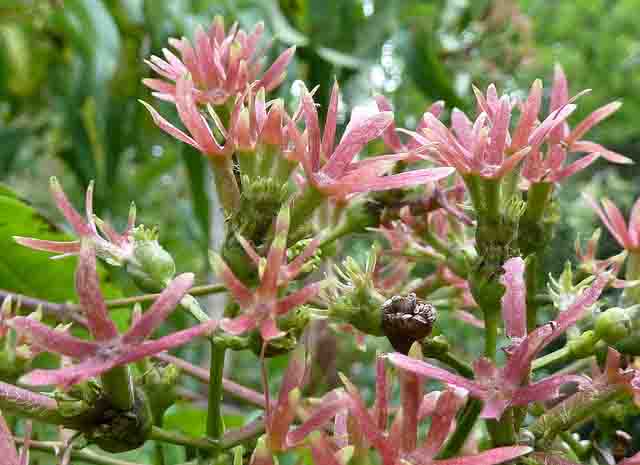
This large shrub is finally starting to receive the recognition it deserves. A native of China, seven-son-flower was first collected in 1907, named in 1916, and then languished in obscurity. Another expedition to China in 1980 resulted in a collection of viable seeds that were propagated and distributed to several botanical institutions and nurseries. Over the years, it has slowly become more widely planted.
Numerous characteristics contribute to the attractiveness of this plant. Leaves are a dark, glossy green and are rarely bothered by pests. Creamy, white flowers appear in late summer when few plants are in bloom. The inflorescence is distinctive in arrangement and effect.
Though each individual flower is quite small, they are borne in a panicle with six flowers tiered in a whorl with the seventh terminating the inflorescence. Panicles are born on the tips of branches.
After the flowers fade, fruit appears with surrounding sepals.
Color changes from green to red and persists for 2 to 3 weeks. This plant is actually more attractive in this post-bloom period than in flower.
Though often grown as a large shrub, Seven-son Flower can be trained as a small tree and reach 15 to 25 feet in height. Exfoliating
(peeling) bark is attractive with the inner bark being lighter. Hardy to Zone 5, seven-son flower prefers moist, well-drained soils. (Ward Upham)
