
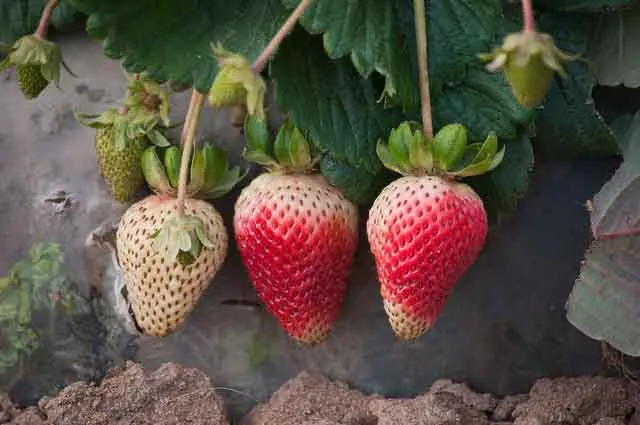
Research done in Illinois has shown that the straw mulch should be removed from strawberry plants when the soil temperature is about 40 degrees F. Fruit production drops if the mulch remains as the soil temperature increases. There are likely to be freezing temperatures that will injure or kill blossoms, so keep the mulch between rows to conveniently recover the berries when freezing temperatures are predicted. (Ward Upham)
Bolting and Buttoning in Cole Crop Plants
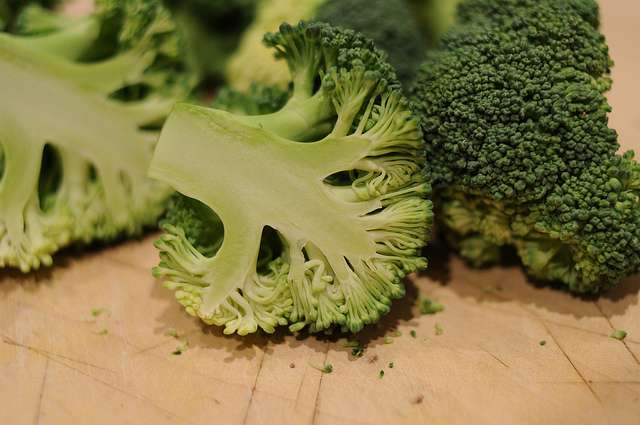
Broccoli, cabbage and cauliflower are cole crops that have a tendency to bolt (go to seed) or button (produce an extremely small
head) if plants are not grown properly. These crops need to be kept actively growing through their production cycle, including growing transplants from seed. If they slow down due to under-fertilization or are stunted due to overgrowing their container, buttoning or bolting is more likely. If you are not growing your own transplants but rather selecting plants from a retailer, choose small, stocky dark green plants.
Even after transplanting, these plants need to be well-fertilized.
Fertilize at transplanting with a starter solution and continue to fertilize every 2 to 3 weeks until harvest. Both buttoning and bolting are irreversible. Once a seed stalk starts for form, nothing can be done to force the plant to produce a normal crop. (Ward Upham)
Arizona golf tournament to benefit Hesston College scholarships
Hesston College’s sixth annual National Golf Benefit for Student Scholarships will be held March 28 in Glendale, Ariz. For golfers, there will be a four-person scramble. For non-golfers, there are more than $20,000 of prizes being raffled off.
For more information, contact Sheri Esau at (620) 327-8147 or [email protected].
Tips for Effective and Efficient Crop Water Use

A new publication available through K-State Research and Extension provides water use information for various crops in Kansas.
MANHATTAN, Kan. – Common questions agricultural producers in Kansas have regarding water use typically relate to conserving the Ogallala Aquifer in the western part of the state and reservoir sedimentation concerns in the eastern part of the state.
Beyond wanting to know the range of water use by particular crops, producers sometimes question why and how crops use water. They may inquire about what causes crop water use to fluctuate. K-State Research and Extension agricultural engineer Danny Rogers fields many of these questions and in the past has pointed producers to different research-based crop production handbooks to explain his answers.
This is why Rogers and several of his K-State colleagues recently consolidated crop water use information for common Kansas crops—corn, sorghum and wheat as examples—and included this in a single publication that speaks on maximizing irrigation efficiency. The publication, titled “Agricultural Crop Water Use,” is available now at local extension offices and online.
“We discuss fundamentally why crops use water,” Rogers said of the publication. “We discuss why crop water use fluctuates on different scales. For example, why does it fluctuate between day and night? The simple answer is photosynthesis occurs during the day and not at night. We show some examples of how that might work and the impact (on water use).”
Other daily water use fluctuations depend on the type of crop, its stage of growth and weather conditions, Rogers said. Daily fluctuations over time develop seasonal water use fluctuations. This recent agricultural crop water use publication, part of a series of publications covering irrigation management, includes these causes of water use fluctuations and more.
Daily and seasonal fluctuations
Crop water use is also referred to as evapotranspiration (ET) demand, water demand that considers the combination of evaporation and transpiration. Evaporation is the water that moves from the soil or leaf surface to the atmosphere, while transpiration is the water that passes through, which the plant uses for cooling and growth.
Simply put, crops that are smaller and in the early stages of growth require a lower ET rate, Rogers said, at least until they start to go into the dry-down phase at the end of the growing season and will again use less water. Weather conditions, however, play a more complex role in water use.
“For example, on a daily basis for a full cover crop, meaning that the crop has its maximum leaf area and is intercepting all the light it can, we may need an average ET rate of about 0.35 inch per day under normal climatic conditions,” he said. “When you have hot, windy conditions, or other factors that drive up crop water use, the ET rate can peak above one-half inch per day. Conversely, on a cloudy day that is cool, or even during rainfall conditions, the ET can go to almost nothing on a daily basis.”
Rogers said this is why irrigation data calculated in KanSched, an irrigation scheduling program for producers provided by K-State’s Mobile Irrigation Lab, are used to make recommendations on water adjustments so crop needs are met without using excess water.
Seasonal crop water use variations for a specific crop are often due to year-to-year weather conditions and the specific variety of a particular crop, especially its maturity length, which often factors heavily into a producer’s decision to grow a particular crop.
“Obviously, an 80-day (maturity) corn would use less water than 120-day corn,” Rogers said. “Why wouldn’t you plant 80-day corn? It uses less water, but that means it also has less yield potential. It’s always a trade-off on more than just a water decision.”
Leaf area factors in
Leaf area index (LAI) is important, Rogers said, as plants that fully shade the ground are intercepting solar energy that drives transpiration and maximizes water use. LAI is the leaf area of the crop per unit of land area. Producers tend to understand the leaf area index if you stripped all the leaves off of a plant, placed them on the ground and determined the square footage of cover.
“It takes a leaf area index of about 2.7 to capture all the sunlight or shade the ground, because the leaves are suspended in the air,” Rogers said. “It takes more than 1 square foot of leaf cover to capture all the sunlight. When you capture all the sunlight, you’re at your maximum photosynthesis rate. But, for most crops the optimal leaf area index for maximum production on some crops might be approaching 4 or more.”
Yield and crop water use are linearly related for given growing conditions, so more water drives greater yield, he said. Although lowering plant production reduces water use, it also reduces yield. Finding a balance is crucial, and considering LAI can help.
“We want to make sure to utilize all the light energy, nutrients, water resources and the land area to optimize crop production,” Rogers said.
Log on to the K-State Research and Extension Bookstore for the agricultural crop water use publication and others in the irrigation management series.
Story by: Katie Allen
In-Depth Fruit & Vegetable Production Workshops Planned in Kansas City Area
Workshops Hosted by Growing Growers are Open to the Public
OLATHE, Kan. – A series of workshops designed for anyone growing fruits and vegetables for sale or for the serious home gardener will be held in several locations in the Kansas City area, starting March 16.
Topics ranging from plant propagation, managing healthy soils, small farm equipment maintenance, drip irrigation, tree fruit production, introduction to cut flowers, farm business management, pest and disease control, and many other topics will be covered in this year’s workshop series. More information and registration is available at Growing Growers.
“The workshops are open to the public and are appropriate for anyone interested in growing,” said Kansas State University horticulturist, Cary Rivard. “We offer a range of workshops covering ‘Market Farming 101’ topics, plus several advanced topics. Participants typically include Growing Growers apprentices, new or experienced growers, and others who are interested in the particular topic or who are considering trying to farm.”
The workshops are hosted by Growing Growers – Kansas City, a collaborative effort of K-State Research and Extension, University of Missouri Extension, Lincoln University Cooperative Extension, the Kansas Rural Center, the Kansas City Food Circle and Cultivate Kansas City.
Cost of the workshops is $15 or $30, depending on whether it is a half- or full-day program. All workshops include farm tours of nearby commercial farms that are using techniques relevant to the workshop topic.
Workshop dates, topics and locations:
* March 16 – Plant Propagation and Production Planning – Kansas City, Kansas
* March 20 – KC Metro Area Farmers Market Workshop – Olathe, Kansas
* April 11 – Building and Managing Healthy Soils – Olathe, Kansas
* May 11 – Small Farm Equipment and Drip Irrigation – Lawrence, KS
* May 28 –– Conservation Agriculture & Sustaining Soils – Lawrence, Kansas
* June 8 – Postharvest Handling – Lawrence, Kansas
* June 20 – Introduction to Tree Fruit Production – Kansas City, Missouri
* July 13 –Equipment Maintenance– Kansas City, Missouri
* July 25 – Insect, Disease, and Weed Management – Kansas City, Missouri
* August 3– Introduction to Cut Flowers – Kansas City, Missouri
* August 10 – Field Day/Horticulture Research Update – Olathe, Kansas
* August 17 – Storage Crops – Baldwin City, Kansas
* September 5 – Farm Business Management – Kansas City, Missouri
* September To be determined – Livestock Options for Small Farmers – To be determined.
Growing Growers also coordinates a farm apprenticeship program for aspiring growers and maintains an electronic mailing list of growers. More information about Growing Growers workshops, including specific location, times and registration information is available at Growing Growers.
Story by: Molly Fusselman
