Friday, January 23, 2026
Home Blog Page 4602

Jeff Mellott Headlines Annual Horsin’ Around Conference at UNL

0

LINCOLN, Neb. — Jeff Mellott will headline the 23rd annual “Horsin’ Around” conference Feb. 28-March 1, 2015 in the RB Warren Arena at the Animal Science Complex on the University of Nebraska-Lincoln’s East Campus.


Mellott is a professional All-Around-Horseman from Andover, Kan., and a AQHA & NSBA judge, past president KQHA, and KQHA Volunteer Award 2012. Mellott is a trainer of multiple World and Congress Champions and is one of the industry’s best teachers. His goal is that each rider enjoys the journey to his or her own success in and out of the arena. For the first time in 17 years, Mellott is now taking outside customers and works with Youth, Amateur & Select riders. He specializes in All-Around horses & exhibitors, especially Horsemanship, Trail, and Western Riding. Mellott will focus on Western Horsemanship, English Equitation and Trail during the two day event.


Also speaking at the event will be equine veterinarian Amy Cook and Danielle Burn of Omaha.


Dr. Cook grew up in rural Nebraska where she was very involved with the 4-H horse program.  She received her bachelor’s degree from UNL and spent several years working in a variety of equine disciplines prior to returning to vet school.  In 2013 she received her DVM from Iowa State University and went on to complete a one-year hospital internship at Kendall Road Equine Hospital in Elgin, Ill., before returning to Nebraska and establishing In Touch Equine Veterinary Services..


Danielle Burns of Omaha prides herself in an honest straightforward approach of working with youth and amateurs of all levels and ages. Burns’ primary focus is performance events, and she specializes in Western Pleasure at AQHA and APHA shows. She is also an AQHA, NSBA and POA judges. Burns also enjoys pairing horses and riders together that make great teams.


The conference begins at 9 a.m. both days and is open to participants of all ages. Adult registration is $30 for both days or $20 for one day. For youth 18 and under, the cost is $20 for both days or $15 for one day. If the clinic doesn’t sell out, registration will be available at the door for adults at $40 for both days and $25 for one day and for youth at $30 for both days and $20 for one day.


No phone-in registrations are accepted. For more information or a registration form, call 402-472-6411, email [email protected], visit the Horsin’ Around website at http://horse.unl.edu or the UNL Horse Facebook Page at www.facebook.com/UNLhorse.

WSU Women’s BB set to open conference play

0

Wichita State Women’s Basketball (9-3) will host Indiana State (10-1) at 7 p.m. on Friday January 2nd. to open the Missouri Valley Conference season. WSU last played five days ago in a decisive 70-46 win against Sam Houston State. The game can be heard on Wichita State Radio: goshockers.com  photo credit: SD Dirk

U.S. hogs and pigs inventory up two precent

0

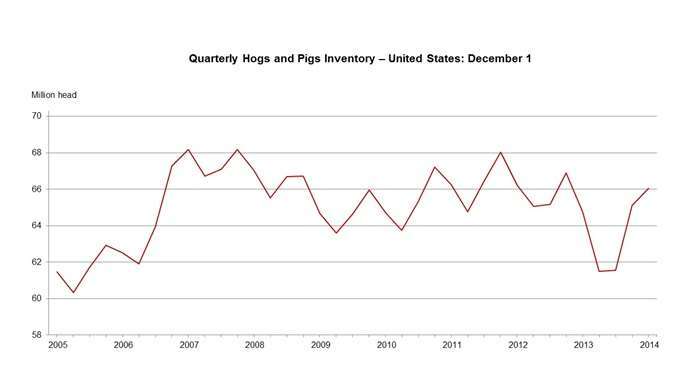
WASHINGTON, December 23, 2014 – As of December 1, there were 66.1 million hogs and pigs on U.S. farms, up 2 percent from December 2013, and up 1 percent from September 1, according to the Quarterly Hogs and Pigs report published today by the U.S. Department of Agriculture’s National Agricultural Statistics Service (NASS).
Other key findings in the report were:

•    Of the 66.1 million hogs and pigs, 60.1 million were market hogs, while 5.97 million were kept for breeding.
•    Between September and November 2014, 29.4 million pigs were weaned on U.S. farms, up 4 percent from the same time period in 2013.
•    From September through November 2014, U.S. hog and pig producers weaned an average of 10.23 pigs per litter.
•    U.S. hog producers intend to have 2.87 million sows farrow between December 2014 and February 2015, and 2.90 million sows farrow between March and May 2015.
•    With 20.9 million head, Iowa hog producers had the largest inventory among the states. North Carolina and Minnesota had the second and third largest inventories with 8.60 million and 7.85 million head, respectively.

To obtain an accurate measurement of the current state of the U.S. hogs and pigs industry, NASS surveyed over 10,900 operators across the nation during the first half of December. NASS collected the data by mail, telephone and through face-to-face personal interviews. NASS asked all participating producers to report their hogs and pigs inventories as of December 1, 2014.

The quarterly Hogs and Pigs report and all other NASS reports are available online at www.nass.usda.gov.

Contact:     Dan Kerestes, (202) 720-3570 or Alex Minchenkov, (202) 690-8121

Three Double-Doubles Help Blue Dragons Ground Golden Eagles

0

NORTH LAS VEGAS, Nev. – Clemence LeFebvre, Kalani Purcell and Cynthia Petke all posted double-doubles on Monday as the No. 2-ranked Hutchinson Community College women’s basketball team completed its fourth consecutive undefeated non-conference season after a 90-64 victory over Utah State University-College of Eastern Utah at the CSN/Las Vegas Holiday Classic.

Now 14-0 to start the 2014-15 season, the Blue Dragons head into their Jayhawk West opener at 5:30 p.m. on Saturday against Dodge City at the Sports Arena. Hutchinson won its 63rd consecutive regular-season non-conference game.

Seven different times this season, two HCC players had double-doubles in the same game, but never three. Monday’s up-tempo, high-possession game provided plenty of opportunities to score and rebound.

LeFebvre’s double-double was the first of her collegiate career. She had a season-high 24 points on 10 of 14 shooting and a season-high-tying 10 rebounds. LeFebvre added four assists.

Petke had her sixth double-double of the season with 19 points and 14 rebounds. She was 8 of 18 shooting overall.

Purcell posted her sixth double-double in the last nine games, her ninth of the season and 27th of her career with 14 points and 13 rebounds to go with four assists. Purcell jumped up to No. 19 on the career scoring list with 751 points, up to fourth in career rebounds with 527 and into a tie for sixth in career blocked shots with 63.

In addition to the three double-doubles, sophomore Alyx Bloom had nine points and four rebounds and sophomore Sydney Benoit had eight points and six rebounds.

For the eighth time this season, the Blue Dragons shot 50 percent in a game, but had to overcome a season-high 27 turnovers. HCC connected on 37 of 74 shots overall (50.0 percent), going 2 of 9 from 3-point range and 14 of 24 from the free-throw line.

The Blue Dragons out-rebounded College of Eastern Utah 65-29. The 65 rebounds are a season high and the third-highest total for a game in program history. HCC had 24 offensive rebounds, which is the third time this season that the Blue Dragons reached 20 or more offensive boards.

Bryanna Adams hit 4 of 10 shots from 3-point range to finish with a team-high 22 points to lead College of Eastern Utah (13-4). Lejia Hadzialajic finished with nine points.

The Golden Eagles are the sixth Blue Dragon opponent to shoot less than 30 percent this season, hitting on only 20 of 72 shots (27.8 percent). CEU hit 8 of 38 from 3-point range and 16 of 24 from the foul line. The Eagles had 19 turnovers, but tied a Blue Dragon opponent high with 16 steals.

Unlike Sunday then it fell behind in the first half by as many as 10 points to Salt Lake, Hutchinson never trailed College of Eastern Utah, but were tied twice at 2-2 and 7-7. The Dragons took early command with a 12-3 run that was capped off by a Benoit 3-pointer with 12:10 to play that gave HCC a 19-10 lead.

An Adams 3-pointer pulled the Golden Eagles within 19-15, but seven unanswered points – five from LeFebvre – pushed the Dragon advantage back to 26-15 with 9:56 remaining.

The Blue Dragons shot 55.3 percent (21 of 38) in the opening half and held Eastern Utah to just under 40 percent (15 of 39) and HCC led 47-36 at halftime.

Hutchinson made life particularly hard on Eastern Utah in the second half in building leads as large as 34 points (80-46). HCC held Eastern Utah to two field goals over the first 17 minutes, 25 seconds of the half, going 13:57 without a field goal. The Golden Eagles missed 28 of their first 30 shots to start the second half. They were 14 of 21 from the foul line in the final 20 minutes,

When Adams hit a 3-pointer with 16:27 remaining in the second half, the Blue Dragon lead was 56-42. CEU’s next field goal didn’t come until the 2:35 mark on a Caroline Ficher inside hoop. By that time the Dragon lead mushroomed to 85-56.

The Blue Dragons cooled off to 44.4 percent (16 of 36), but had 15 turnovers in the second half alone.

GAME NOTES – The Blue Dragons are 85-8 in the John Ontjes era against non-Jayhawk Conference teams. … College of Eastern Utah is the 269th consecutive opponent that failed to shoot better than 50 percent against HCC. … Kalani Purcell tied Ariella McGhee for sixth place on the career blocked shots list with 63. … This was HCC’s seventh consecutive holiday tournament victory. The Dragons complete their 10th all-time holiday tournament with an 18-3 record. … HCC’s 14th non-conference victory ties for the third most non-conference victories tying the 2013, 2012, 2011, 1980, 1978 and 1977 teams. … HCC reached 90 points in a game for the sixth time this season. … HCC had 23 assists, reaching 20 or more assists for the 12th time this season.

credit: (HCC Sports Information)

Broiler hatchery

0

ISSN: 1949-1840

Released December 31, 2014, by the National Agricultural Statistics Service
(NASS), Agricultural Statistics Board, United States Department of
Agriculture (USDA).

Broiler-Type Eggs Set in the United States Up 3 Percent

Hatcheries in the United States weekly program set 215 million eggs in
incubators during the week ending December 27, 2014, up 3 percent from a
year ago. Hatcheries in the 19 State weekly program set 207 million eggs in
incubators during the week ending December 27, 2014, up 3 percent from the
year earlier. Average hatchability for chicks hatched during the week in the
United States was 83 percent. Average hatchability is calculated by dividing
chicks hatched during the week by eggs set three weeks earlier.

Broiler-Type Chicks Placed in the United States Up 2 Percent

Broiler growers in the United States weekly program placed 175 million
chicks for meat production during the week ending December 27, 2014, up 2
percent from a year ago. Broiler growers in the 19 State weekly program
placed
168 million chicks for meat production during the week ending December 27,
2014, up 2 percent from the year earlier. Cumulative placements from
December 29, 2013 through December 27, 2014 for the United States were 8.94
billion.
Cumulative placements were up 1 percent from the same period a year earlier.

Broiler-Type Eggs Set – 19 Selected States and United States: 2014
——————————

———————————————-
————————————–
:                                    Week
ending
State
:—————————–———————————————-
——–
:November 22, :November 29, : December 6,
:December 13, :December 20, :December 27,
:    2014     :    2014     :    2014     :
2014     :    2014     :    2014
—————————————————————————-
————————————–
:                                    1,000
eggs
:

Alabama ………………….:    28,637        28,528        28,570
28,714        28,214        27,757
Arkansas …………………:    22,339        21,509        22,102
21,961        21,201        21,989
Delaware …………………:     4,765         4,688         4,778
4,780         4,778         4,734
Florida ………………….:     1,223         1,224         1,223
1,223         1,225         1,224
Georgia ………………….:    34,406        35,094        34,283
33,915        34,884        34,472
Kentucky …………………:     7,927         6,943         7,877
7,962         7,961         7,942
Louisiana ………………..:     3,741         3,726         3,710
3,834         3,622         3,848
Maryland …………………:     7,893         7,876         7,900
7,929         7,907         7,923
Mississippi ………………:    18,025        18,009        17,395
17,952        17,921        17,828
Missouri …………………:     8,297         8,299         8,329
8,356         8,321         8,114
:

North Carolina ……………:    21,340        21,250        20,840
21,011        21,105        20,918
Oklahoma …………………:     6,608         6,834         6,347
6,682         6,273         6,189
Pennsylvania ……………..:     4,501         4,319         4,601
4,477         4,475         4,415
South Carolina ……………:     5,665         5,551         5,242
5,177         5,928         5,574
Texas ……………………:    14,962        15,439        14,100
14,420        14,887        15,036
Virginia …………………:     6,476         6,758         6,120
6,507         6,606         6,455
California, Tennessee,        :

and West Virginia ………..:    12,301        13,143        11,300
12,120        12,080        12,513
:

19 State total ……………:   209,106       209,190       204,717
207,020       207,388       206,931
Percent of previous year …..:       104           103           102
102           103           103
:

Other States ……………..:     8,212         8,188         8,251
8,173         8,182         8,086
:

United States …………….:   217,318       217,378       212,968
215,193       215,570       215,017
Percent of previous year …..:       104           103           102
102           103           103
—————————————————————————-
————————————–

Broiler-Type Chicks Placed – 19 Selected States and United States: 2014
—————————————————————————-
————————————–
:                                    Week
ending
State
:—————————–———————————————-
——–
:November 22, :November 29, : December 6,
:December 13, :December 20, :December 27,
:    2014     :    2014     :    2014     :
2014     :    2014     :    2014
—————————————————————————-
————————————–
:                                   1,000
chicks
:

Alabama ………………….:    19,869        20,887        21,932
22,748        21,776        21,925
Arkansas …………………:    19,647        18,541        20,756
20,086        19,375        19,483
Delaware …………………:     5,292         3,806         5,714
5,305         5,357         4,967
Florida ………………….:     1,232         1,456         1,311
1,487         1,426         1,327
Georgia ………………….:    24,648        25,820        27,178
25,889        27,336        26,889
Kentucky …………………:     6,051         6,426         5,940
6,639         6,146         6,135
Louisiana ………………..:     3,116         3,133         3,366
3,339         3,337         3,307
Maryland …………………:     5,963         6,818         6,174
6,289         5,865         6,417
Mississippi ………………:    13,595        13,974        14,797
14,962        15,052        14,415
Missouri …………………:     4,974         5,501         5,308
5,629         6,402         5,927
:

North Carolina ……………:    16,258        16,295        15,639
17,142        17,081        16,505
Oklahoma …………………:     3,928         4,482         4,216
4,521         4,146         4,980
Pennsylvania ……………..:     3,532         3,914         3,999
3,859         3,891         4,081
South Carolina ……………:     4,667         4,746         5,558
5,080         4,736         5,124
Texas ……………………:    11,811        11,110        11,889
11,989        12,278        11,329
Virginia …………………:     5,143         5,650         4,806
5,111         5,345         5,067
California, Tennessee,        :

and West Virginia ………..:    10,612        10,695        11,700
10,657        11,599        10,230
:

19 State total ……………:   160,338       163,254       170,283
170,732       171,148       168,108
Percent of previous year …..:       102           103           102
103           103           102
:

Other States ……………..:     5,591         5,850         6,322
6,070         6,010         6,398
:

United States …………….:   165,929       169,104       176,605
176,802       177,158       174,506
Percent of previous year …..:       102           103           103
103           103           102
—————————————————————————-
————————————–

Statistical Methodology

Survey Procedures: Data for broiler hatchery estimates are collected weekly
from all broiler-type hatcheries that hatch at least one million chicks a
year. Individual NASS field offices maintain a list of all known hatcheries
and update their lists on a continual basis. All hatcheries that meet the
minimum size criteria are given adequate time to respond to the weekly
survey. Those that do not respond are contacted by telephone.

Estimating Procedures: All data are analyzed for unusual values. Data from
each operation are compared to their own past operating profile and to
trends from similar operations. Data for missing operations are estimated
based on similar operations or historical data. NASS field offices prepare
these estimates by using a combination of survey indications and historic
trends.
Individual State estimates are reviewed by the Agricultural Statistics Board
for reasonableness. Individual hatchery data are summed to State, 19 State
total, Other States, and the United States.

Revision Policy: Revisions are generally the result of late or corrected
data. Revisions made to the previous five-week’s data during the current
week are published in this report. Final estimates are published in the
annual Hatchery Production Summary released in April.

Reliability: Estimates are subject to errors such as omission, duplication,
and mistakes in reporting, recording, and processing the data. While these
errors cannot be measured directly, they are minimized through strict
quality controls in the data collection process and a careful review of all
reported data for consistency and reasonableness.

Information Contacts

Listed below are the commodity specialists in the Livestock Branch of the
National Agricultural Statistics Service to contact for additional
information. E-mail inquiries may be sent to [email protected]

Dan Kerestes, Chief, Livestock Branch …………………………….
(202) 720-3570

Bruce Boess, Head, Poultry and Specialty Commodities Section ………..
(202) 720-4447
Alissa Cowell-Mytar – Cold Storage …………………………….
(202) 720-4751
Heidi Gleich – Broiler Hatchery, Chicken Hatchery ……………….
(202) 720-0585
Michael Klamm – Poultry Slaughter, Turkey Hatchery, Turkeys Raised ..
(202) 690-3237
Tom Kruchten – Census of Aquaculture …………………………..
(202) 690-4870
Kim Linonis – Layers, Eggs ……………………………………
(202) 690-8632
Joshua O’Rear – Honey ………………………………………..
(202) 690-3676
Vacant – Catfish Production, Egg Products, Mink, Trout Production …
(202) 720-3570

Access to NASS Reports

For your convenience, you may access NASS reports and products the following
ways:

All reports are available electronically, at no cost, on the NASS
web
site: http://www.nass.usda.gov

Both national and state specific reports are available via a free e-
mail subscription. To set-up this free subscription, visit
http://www.nass.usda.gov and in the “Follow NASS” box under “Receive reports
by Email,” click on “National” or “State” to select the reports you would
like to receive.

For more information on NASS surveys and reports, call the NASS Agricultural
Statistics Hotline at (800) 727-9540, 7:30 a.m. to 4:00 p.m. ET, or e-mail:
[email protected].