Tuesday, January 27, 2026
Home Blog Page 192

All 10 Kansas measles cases are children who are unvaccinated or under-vaxxed

0
  • Kansas has 10 confirmed cases of measles, all children who were unvaccinated or under-vaccinated.
  • The southwest Kansas outbreak comes amid a nationwide outbreak that started in west Texas.
  • Kansas health officials are urging residents to get vaccinated against measles, especially in affected counties.
  • Measles is highly contagious, and additional cases are expected in Kansas and surrounding areas.

Kansas is now up to 10 confirmed cases of measles, all of which have been children who are either unvaccinated or under-vaxxed.

The Kansas Department of Health and Environment on Monday reported 10 cases of measles, spread across Grant, Morton and Stevens counties. The update came through the Kansas Health Alert Network.

The alert said all 10 cases are children ages birth to 17 years old. Nine weren’t vaccinated, while one child was under-vaccinated with only one of the two recommended doses of the MMR vaccine.

“Due to the highly contagious nature of measles, additional cases are likely to occur in the outbreak area in Kansas and in surrounding counties, especially among those that are unvaccinated,” the KDHE alert said.

Local health departments in Morton and Grant counties reported three cases in each county, all linked to a case in Stevens County. The local health department in Stevens County reported it is up to four cases, and, “We do have pending cases at this time.”

Theses are the first cases of measles in Kansas since 2018.

The Kansas measles outbreak comes as several states have recorded cases following an outbreak that started in west Texas. The KDHE alert said that as of Friday, the Centers for Disease Control and Prevention had reported 378 measles cases across 17 states.

“Most of these cases are occurring in children (76%) and almost all are either unvaccinated or have an unknown vaccination status (95%),” the alert said. “Fifty (50) persons have been hospitalized and two (2) have died.”

One death was an unvaccinated school-aged child in Texas, and the other was an unvaccinated patient in New Mexico. No measles hospitalizations or deaths have been recorded in Kansas.

Kansas officials told The Capital-Journal last week that epidemiologists have not been able to establish a link to the outbreak affecting west Texas. The three Kansas counties with cases are all in the southwest corner of Kansas, about 375 miles from the outbreak epicenter of Gaines County in the Texas panhandle.

The CDC said earlier this month that “this outbreak continues to expand rapidly.”

Kansas public health officials recommend MMR vaccine

Public health officials recommend that two doses of the MMR vaccine for children, with the first dose administered at age 12-15 months and the second dose at age 4-6 years, before entering school. Adults are generally recommended to get one dose. Two doses are recommended for adults working in health care or attending higher education, due to the higher risk of exposure and transmission.

In a previous alert earlier this month, KDHE noted that Kansas is “below the herd immunity threshold” of at least a 95% vaccination rate. That rate, measured by estimated MMR immunization rates for Kansas kindergarten students during the 2023-24 school year, was 90.2% in 2023-24, down from 94.5% in 2019-20.

Some school districts have immunization rates substantially lower than the herd immunity threshold.

KDHE makes vaccination recommendations for southwest Kansas

In Grant, Morton and Stevens counties, as well as adjacent counties in southwest Kansas, KDHE is recommending an early dose of the MMR vaccine. Also known as an infant dose, that dose is recommended for infants ages 6-11 months.

For children in those counties who are older than 12 months and have not been vaccinated, KDHE recommends “one dose immediately and follow with a second dose at least 28 days after.” Children older than 12 months who have already gotten a first dose “should receive an early second dose.”

KDHE is also advising teenagers and adults who have previously been vaccinated with one dose should receive a second dose.

Adjacent counties include Stanton, Hamilton, Kearney, Finney, Haskell and Seward. That includes southwest Kansas population centers of Garden City and Liberal.

Kansas advises public health providers and departments

KDHE advised health care providers “to be on high alert” for patients showing symptoms consistent with measles — especially among unvaccinated patients, people who recently traveled to areas with ongoing outbreaks or people in “frequent contact with unimmunized individuals in a congregate setting,” such as attending day care.

It is recommended by KDHE that providers submit specimens of suspected measles patients to the KDHE lab for measles testing. The state lab has a turnaround time of one to two business days after receiving the samples.

People suspected of having measles should be told to stay home in isolation until receiving their test results, KDHE said. People with measles should isolate at home, except when seeking medical care, for four days after the onset of rash.

KDHE advised local health departments to share the alert, order testing and shipping supplies and report suspected cases to the state. Mandated reporters are required to report all suspected cases to KDHE.

Local health departments and the Stevens County Hospital are asking patients with measles symptoms or a suspected exposure to call before going to a clinic or emergency room so that providers can take steps to prevent further spread.

As reported in the Topeka Capital Journal

 

Ten rules for planting trees this spring

0

If you’re planning to plant a tree in your yard this spring, there are some steps you can take to make sure your new landscape has its best chance of success.

Kansas State University horticulture expert Cynthia Domenghini shares the following 10 rules for planting trees:

Select the right tree for the site.

To avoid serious problems, choose trees that are adapted to your location. Consider whether the tree produces nuisance fruit or if there are disease-resistant varieties available. For example, there are a number of crabapple varieties that are resistant to apple scab and rust diseases. Also consider the mature size of a tree to be sure you have enough room. Your local extension office and garden center can make tree recommendations for your region.

Keep the tree well watered and in a shady location until planting.

When moving the tree, lift it by the root ball or pot and not by the trunk.

Before planting, remove all wires, labels, cords or anything else tied to the plant.

If left on, they may eventually girdle the branch to which they are attached.

Dig a proper hole.

Make the hole deep enough so the root flare (point where the trunk and roots meet) is visible when planted. Plant the tree on solid ground, not fill dirt. In other words, don’t dig the hole too deep and then add soil back to the hole before placing the tree.

The width of the planting hole is very important. It should be three times the width of the root ball. Loosening the soil outside the hole so it is five times the diameter of the root ball will allow the tree to spread its roots faster.

Remove all containers from the root ball.

Cut away plastic and peat pots; roll burlap and wire baskets back into the hole, cutting as much of the excess away as possible. If you can remove the wire basket without disturbing the root ball, do it. If roots have been circling around in the container, cut them and fluff them out so they do not continue growing in a circle inside the hole becoming girdling roots later.

Backfill the hole with the same soil that was removed.

Amendments such as peat moss likely do more harm than good. Make sure the soil that goes back is loosened – no clods or clumps. Add water as you fill to ensure good root to soil contact and prevent air pockets. There is no need to fertilize at planting.

Minimize pruning after planting.

Foliage is necessary for manufacturing energy to support a healthy tree. Heavy pruning reduces the number of leaves and consequently the amount of energy generated. Corrective pruning can be done at planting to remove dead, damaged or diseased branches or branches that are rubbing against each other.

Water the tree thoroughly.

Then, water once a week for the first season if there is insufficient rainfall.

Mulch around the tree.

Mulch should be 2-4 inches deep and cover an area 2 to 3 times the diameter of the root ball. Avoid mulching right up to the trunk of the tree. Leave a 3 to 6-inch gap between the mulch and the trunk to prevent damaging the tree. Mulching reduces competition from other plants, conserves moisture and moderates soil temperature.

Stake only when necessary.

Larger trees or those in windy locations may need to be staked the first year. Movement is necessary for the trunk and roots to develop properly. Staking should be designed to limit movement of the root ball rather than immobilize the trunk.

Domenghini and her colleagues in K-State’s Department of Horticulture and Natural Resources produce a weekly Horticulture Newsletter with tips for maintaining home landscapes and gardens.

Interested persons can subscribe to the newsletter, as well as send their garden and yard-related questions to [email protected], or contact your local K-State Research and Extension office. K-State Research and Extension news service

Spot a bird feather in your Kansas yard? Why picking it up could land you in court

0

Possessing bird feathers could get a person cooped up in prison.

The possession of feathers and other parts of native North American birds without a permit is banned by the Migratory Bird Treaty Act of 1918, says the website of the U..S. Fish & Wildlife Service.

That act “protects wild birds by preventing their killing by collectors and the commercial trade in their feathers, and extends to all feathers, regardless of how they were obtained,” that site adds. “There is no exemption for molted feathers or those taken from road- or window-killed birds.”

What are the penalties?

For each unauthorized take of a protected bird or one of its parts, a violator of the MTBA may be subject to penalties of a fine of up to $15,000, imprisonment for up to six months, or both.

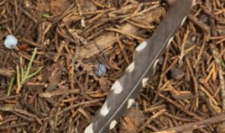
“Obviously, the law is not intended to prosecute kids for keeping a Blue Jay ( Cyanocitta cristata ) feather found in their yard, although it is technically illegal to do so,” says the website of the Atlanta-based Fernbank Science Center .

The Fish & Wildlife Service is permitted to use discretion in enforcing the act, meaning it may choose not to prosecute apparent technical violations.

How did the act come about?

The MBTA, which took effect in 1918, implements international conservation treaties the U.S. reached in 1916 with Canada, in 1936 with Mexico, in 1972 with Japan and in 1976 with Russia, according to the Fish & Wildlife Service .

The act was initially targeted at protecting birds at a time when some species were being hunted nearly to extinction to satisfy the demand for big, wide women’s hats adorned with exotic bird plumes.

The act includes bans on possessing “feathers in your yard, a dead bird on the road or even a bird nest on your front porch,” the Fernbank Center website says.

“The law was made very strict, with few or no loopholes, so that ‘plume hunters’ as they were called at the time, could not simply say, ‘I found these feathers’ or, ‘The bird was already dead,'” it says. “Such proclamations would not matter since it is illegal to possess or sell any part of a bird, no matter how it was obtained. The strictness of the law gave it some teeth when it came time to prosecute offenders.”

The MTBA outlived the popularity of feathered hats

Feathered hats eventually went of style, due largely to the MBTA, the Fernbank Center website said.

“Unfortunately, the MBTA is still quite relevant today as wildlife officials deal with the overwhelming problem of illegal trade of wild birds and other animals,” it said.

The MBTA has been interpreted to cover any bird that can be proven to naturally occur in the United States or its territories, according to the Fernbank Center website .

“Several conventions and amendments to the original Act have been added over the years and with the Migratory Bird Treaty Reform Act of 2004 all species native to the United States or its territories, which are those that occur as a result of natural biological or ecological processes were added to the official list of protected species,” it said.

Which native species are protected?

The Fish & Wildlife Service website offer a list of birds for which the MTBA bans the public from possessing their feathers without authorization.

Species on that list include cuckoos, loons, falcons, woodpeckers and perching birds , which are the most common order.

Legally hunted waterfowl that include species of geese and swans are among species on the government’s list of birds to which the act does not apply .

The feathers possession ban also doesn’t extend to non-native birds such as peacocks .

Possessing feathers shed by a peacock is legal, though killing peacocks for their feathers is not.

What other exceptions are there?

The government also allows exceptions to the MTBA for the authorized use of feathers by Native Americans.

Registered members of federally recognized tribes may possess the feathers of native birds for cultural and religious use, the Fish & Wildlife Service website says.

Such feathers may not be sold or traded, it adds.

“People or institutions wishing to use bird feathers, bones, or whole specimens for educational or research purposes must apply for permits from the U.S. Fish and Wildlife Service and their state wildlife or natural resource agency,” the Fish & Wildlife Service website says .

Lacey Act was violated in 2009 in Lawrence

The MBTA’s enactment came 18 years after the passage in 1900 of the Lacey Act, which makes it illegal to transport or sell a bird in one state that was illegally hunted in another.

Federal officials said an Oklahoma man violated the Lacey Act in 2009 when he tried to sell an undercover Fish and Wildlife Service agent parts of a bald eagle, a gold eagle and a crested caracara, as well as a Native American dance bustle containing hawk feathers.

The man was sentenced in 2013 in Wichita to a year on federal probation

Feathers seized in the case were sent to the Fish and Wildlife Service’s National Eagle Repository in Colorado, which provides eagle feathers to Native Americans for use in Indian religious and cultural ceremonies..

How is the MTBA ban worded?

The MBTA specifically says that the public, unless permitted by regulations, may not “pursue, hunt, take, capture, kill, attempt to take, capture or kill, possess, offer for sale, sell, offer to purchase, purchase, deliver for shipment, ship, cause to be shipped, deliver for transportation, transport, cause to be transported, carry, or cause to be carried by any means whatever, receive for shipment, transportation or carriage, or export, at any time, or in any manner, any migratory bird or any part, nest, or egg of any such bird.”

As reported in the Topeka Capital Journal
Lettuce Eat Local: Tahini Fits To A T

0

Amanda Miller
Columnist
Lettuce Eat Local

Many years ago, I formulated a personal food-compatibility theory: give me any food, and either — if not both — peanut butter or black pepper could go with it. (Or chocolate, but that’s a given.)

It might not be a match made in heaven every time, and the food might not be actually enhanced by the addition, but it could still work. You try it — salmon (pepper), marshmallows (peanut butter), celery (either). Something like mangos could still seem a little tricky, until I think of any Asian-style coleslaw with mangos and peppery peanut dressing, and there we are. 

You have to really like pepper and peanut butter for the hypothesis to ring true, of course, but if you’ve noticed my email address or seen me unscrew the top of the pepper shaker at a meal, you can guess how I feel. 

I still maintain my theory’s reliability, although I have to admit with only a slight cringe that my devotion to peanut butter has shifted to a different nutty spread in the past years…hello tahini. Tahini, though it tastes nutty, is not made from nuts, but rather from sesame seeds. The seeds are hulled, lightly toasted, and ground into a creamy, thickly pourable paste. It’s earthy, savory, toasty, and somehow addictively appealing to me. 

Brands definitely differ in quality, and if you’ve had a not-so-good experience, I completely understand. Some tahinis I’ve sampled can have a pasty mouthfeel, or can leave you with a bitter aftertaste. Many are unsalted, and like many good things in life, seriously benefits from a proper addition of salt (I typically stir some right into my whole jar, and then garnish whatever I’m eating with more coarse salt). 

But good tahini, mmm, it speaks my language. Maybe it’s the sign of some sort of nutritional deficiency or mental unsteadiness, but often if I get the thought of tahini in my head, it’s very hard to shake; I will put it into or with or on anything, including simply a spoon. Tahini is my new peanut butter.

Add it to the title of any recipe, and I suddenly want to make that. A quick search on my Pinterest serves as an illustration of my appreciation of this sesame paste, with pages of pins on anything from dijon tahini dressing and roasted vegetable tahini curry to tahini date milkshakes and sriracha tahini fudge. It’s so distinct and yet so versatile; I want it in all the ways.

I liken my response to tahini-related stimuli as to the contagion of yawns. Some people are particularly susceptible to catching a yawn when they see someone else yawning, and I have it so bad that even typing this I’ve had to yawn multiple times. I’ve heard it said that there is a positive correlation between empathy and yawning contagion, and I try very hard to be empathetic — and apparently I am also tahini-pathetic, without trying at all. I see tahini; I need tahini. 

Great, now I’m afraid I’ve done something very unhelpful to myself. Now I have to yawn when I think about tahini. Now pardon me while I go *yawn* get a snack….

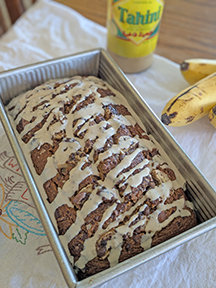
Tahini Banana Bread 

How appropriate — I didn’t think about it until just now, but I literally did replace the original recipe’s peanut butter with tahini here. This is a good starter recipe for those of you newer to tahini, as you can taste it but it isn’t overpowering at all; plus it’s very different from hummus, which is the most common American experience with tahini. Spread slices with more tahini, of course, or cream cheese.

Prep tips: bake in muffin cups if you prefer, reducing the baking time to about 20 minutes. 

½ cup tahini, plus more

12 oz [1 ½ cups] mashed extra-ripe bananas (about 4)

¼ cup ricotta or sour cream

¼ cup local honey

2 eggs

a good splash vanilla

1 ½ cups (freshly-ground) whole wheat flour

1 ½ teaspoons baking soda

½ teaspoon salt

4 oz chopped chocolate of choice

Toss the tahini, bananas, ricotta, honey, eggs, and vanilla into a blender, and process until smooth. Add remaining ingredients and pulse until combined. Transfer to a buttered bread loaf pan, and bake at 350° for 45-60 minutes, until edges are pulling away from sides and center is just set. Finish with a good drizzle of tahini (and some coarse salt if tahini is unsalted).

Preparation for 2025 Kansas Spring Turkey Season

0

Well, March is about to show us whether she will go out like a lion or a lamb, which means the 2025 Kansas spring wild turkey season is in the “wings” (you see what I did there?) If you haven’t already, now is the time to begin preparations. Check out your camo, which seems to shrink each year as you get older. Camouflage is important in hunting most everything, but is probably most important when hunting wild turkeys, as they have eyesight like no other, and can spot suspicious movement from an unbelievable distance.

I’ve never been much of a “purist” in anything I do, but especially not when hunting wild turkeys. The guys that make the videos and sell the calls and other turkey hunting gear often park themselves against a tree next to a clearing. They put their decoy directly in front of them in the clearing and attempt to call the birds into the decoy in the clearing. That makes for really good videos, but doesn’t work for me, as I can’t hold still enough or be quiet enough, long enough to make it work. It was either adapt to my weaknesses or go “turkeyless.” So, I have learned to set myself in some cover along the route I hope the turkeys will travel and put the decoy in front of me but well off to one side or the other, which draws the gobbler’s attention away from me as they hone in on the decoy. This amounts to more of an ambush, but has harvested me more turkeys that trying to be something I’m just not. Also, if morning hunting, be careful NOT to set up too close to their roost, and choose a spot where you can come-and-go without being seen.

Also take your shotgun out and shoot a few shells through it so you know just where it is shooting. That sounds funny, since after all, you are using a shotgun, but trust me when I say, turkeys can be missed. Shells recommended for turkey hunting contain big BB’s so there are way fewer of them in a shell, and they can only wound a turkey all miss altogether because you are shooting at the neck and head, which are relatively small targets. The rule of thumb I have read, is to aim at the point on a turkey’s neck where the feathers begin, that should put BB’s in its head as well as its neck and kill the bird cleanly.

Turkey calling is another contentious subject, especially to the more purist hunters. In my opinion, its good and helpful to study and learn basic turkey calling techniques, but don’t let fear of making the wrong sounds keep you from hunting. While its good to know enough so you are not screaming out bad things about a gobbler’s mother, I feel its much more important to be camouflaged correctly at the right location, be quiet, be still and have confidence in your shooting than it is to be a champion turkey caller.

There you have it as KS spring turkey season is almost here. Turkey numbers in some parts of the state have been on the decline the last few years, but good turkey hunting can still be found. So, get your permit and take a friend or a kid turkey hunting this year. It’s a great way to introduce someone to hunting and to Explore Kansas Outdoors.

Steve can be emailed at [email protected].