Saturday, February 14, 2026
Home Blog Page 426

Kansas wheat crop deteriorates due to lack of moisture

0

April showers bring May flowers, but an April without showers brings disappointment to a wheat crop that had a lot of promise coming out of the winter.

According to Ross Janssen, Chief Meteorologist for Storm Team 12 in Wichita, the precipitation in Dodge City last month was 0.02 inches, tying the 1909 record for the driest April on record.

What’s even worse than a continuing multiyear drought is the loss of hope being felt throughout central and southern Kansas for a crop that, in January and February, was one of the better-looking wheat crops they’d seen in the past ten years.

The condition of the crop has been deteriorating rapidly, especially over the past few weeks, going from 57 percent good to excellent on February 25 to only 31 percent good to excellent by April 28, according to USDA’s National Agricultural Statistics Service.

It has suffered from lack of moisture for much of the growing season, especially during the spring green-up. The Kansas wheat crop is also ahead of schedule, with one-third already headed, well ahead of 9 percent last year and 6 percent average. A March 26-27 freeze event took a toll on it, as there was not enough snow cover, and the plants were more advanced than they typically are at the end of March.

Mike Hubbell, a farmer from the Spearville area in Ford County, said his wheat came up good last fall, received a decent snow in February, was pretty wet in late January and February, and was looking pretty good. However, the last decent moisture it received was on February 5. Since then drought has killed off some tillers and it’s going downhill pretty rapidly.

A field of T158, planted on September 28, 2023, showed drought stress and freeze damage. Hubbell said most of the fields in the area were the same, with brown parts across the fields, mostly due to the drought. He reports that wheat in the area still has some potential — if the weather starts to cooperate from here on out and provides decent grain fill conditions.

In Rice County, Brian Sieker, who farms near Chase, said, “Wheat is just such a good thing in our rotation.” His early planted fields suffered the most from the freeze but are still his best fields despite that fact. Some of the late-planted wheat didn’t come up until January. His best-looking field was planted to KS Providence on September 18, 2023, but even it was only knee-high because of the drought. Sieker credited improved genetics for giving it the ability to weather the drought as well as it has.

“In February, we had some of the best wheat we’d seen in years,” Sieker said. “Hope’s not a good thing.” This year will be his third year in a row with an insurance claim on wheat, making him seriously question whether he can justify the cost of applying a fungicide.

In McPherson County, Derek Sawyer says his wheat had a lot more hope in February than it does now.

“It needs a rain,” he said. His area received 0.5 inch of moisture in April, but that’s 2.5 inches less than normal.

He said he wasn’t overly excited about planting last fall, but with fall rains in October and some moisture through the winter, it looked like his wheat showed promise. After freeze damage and drought, that promise is withering away, much like his wheat.

“There was not enough snow when the cold snap hit,” said Sawyer. “There’s always a storm that wipes out our hopes. It’s all too common lately.”

He reports that his wheat is going downhill very rapidly, and some is even having trouble shooting a head.

The loss of potential for the 2024 Kansas wheat crop has been a disappointment to all who saw promise this winter. There’s still time for Mother Nature to salvage what’s left with some optimal grain fill conditions. Participants in the Wheat Quality Council’s annual hard winter wheat tour will have a chance to take a closer look at this year’s crop during the week of May 13.

Marsha Boswell is vice president of communications for Kansas Wheat
Kansas Beekeeper Works To Improve Urban Removal Of Colonies

0

Sheridan Wimmer
Kansas Living
Magazine


One thing you don’t expect as a homeowner is the possibility of a swarm of bees entering your home and taking residence. While they aren’t necessarily eating your food or using your utilities, these sorts of freeloaders can be a bit bothersome.

Instead of calling an exterminator, a Lawrence man suggests a different method of evacuation due to the decline in honeybee populations.

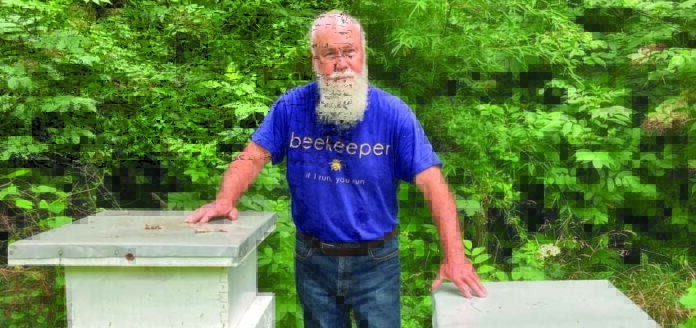
“I noticed bees in Lawrence were being killed by homeowners and with the steep decline of honeybees, I wanted to help provide a solution to both problems,” says Robert Brooks, who has a doctorate in entomology from University of Kansas and has been working with honeybees for more than 30 years.

A BEELINE FOR BOXES

Brooks is now in his second year of a two-year grant from the United States Department of Agriculture’s (USDA) Sustainable Research and Education Program to place swarm rescue boxes in 32 city parks in Lawrence.

“I had a swarm box every square mile of Lawrence’s 35-square miles,” Brooks says. “I caught 26 swarms in 2023 and 23 swarms the year before.”

The boxes in Lawrence’s city parks, which the City of Lawrence Parks and Recreation Department is supportive of, are aimed at having bees swarm there instead of between the floorboards or in the siding of Lawrence homes. When Brooks gets to a swarm box and sees bees, they are relocated to rural areas where they can pollinate sunflower or lavender fields and be made available to local beekeepers.

To keep the bees at a safe distance from people visiting the city parks, Brooks places the swarm boxes 12 to 15 feet up in trees. They are checked weekly and once a swarm arrives it is relocated to a double-walled insulated hive.

He wants to extend the program to other cities, and he has gained approval in Ottawa, a town about 30 miles south of Lawrence.

THE MOST FERAL OF THEM ALL

Where bumble bees and carpenter bees hibernate over the winter, honeybees don’t; they stay active inside their hives. Typically, when temperatures fall below 50 degrees, they’ll cluster together for warmth. Worker bees make sure to protect the queen by placing her in the middle of the cluster. But Kansas winters can get brutally cold, and some bees can’t acclimate as well.

“Most honeybees are not overwintering well with 30 to 80 percent dying each winter in Kansas for various reasons,” Brooks says. “The bees I work with are considered “mostly feral” and can survive the Kansas winters better than honeybees purchased from southern states.”

Winter loss is one cause of honeybee population decline over the years, but there’s been a steady decline since 2006. Honeybees represent an irreplaceable pollinator so researchers across the nation are working to improve populations and Brooks is providing part of the solution. Just in the U.S. honeybees pollinate $15 billion in agricultural products each year including more than 130 types of fruits, nuts and vegetables.

Kansas has seen the highest average colony loss rate between 2015 and 2022, losing one-fifth of state honeybee colonies each season. There are many causes for the decline, including mainly the parasite Varroa mite, which debilitates the overwintering bees. The only permanent solution is to find mite resistance in feral colonies.

The efforts made by passionate individuals like Brooks help to keep the agricultural economy running, one urban square mile at a time.

The next time a swarm of bees enters your home, consider reaching out to Brooks before you call an exterminator. They may not be the best roommates, but they’re vital to the many products they pollinate (plus honey).

Get more information about Brooks and his project at www.brookswildbees.com.Kansas Beekeeper Works To Improve Urban Removal Of Colonies

https://kansaslivingmagazine.com/articles/2024/04/01/kansas-beekeeper-works-to-improve-urban-removal-of-colonies

Property and taxes (2)

0
john marshal

People can be inclined to view taxes this way: Impose them on someone else – the “fair share” principle of human nature. But our system of property taxation at times has lacked all fairness.

In the 1980s, property assessments in Kansas seemed a product of throwing darts at a board in the courthouse boiler room. The system lacked practical reasoning. Assessments (thus, taxes) were often wildly out of line with the actual market values of most property, from housing and businesses to farmland, factories and inventories.

Gov. John Carlin, a Democrat, recognized this distress and offered a cure, its centerpiece a constitutional amendment. The plan would classify property by use and assign it a value; assessment rates were fixed in various categories – utilities, agriculture, residential, businesses and so forth.

Carlin convinced (Republican) legislators that an amendment would accomplish two things:

‒ A massive, statewide reappraisal of all property;

‒ A fresh listing of property classifications with their assessment rates. The key classifications and rates included residential, assessed at 11.5 percent of market value; mobile homes, 11.5 pct.; personal property, 25 pct.; businesses, 25 pct.; utilities, 33 pct., and others.

One property classification was crucial: Farmland would be appraised by its ability to produce income and assessed at 30 percent. The political and economic impact of this section was so significant that the entire amendment, covering a dozen classifications, came to be known simply as the “use-value amendment.”

This is because the amendment – approved by voters in November 1986 – protects farmland assessments through use-value appraisal; taxes were (and are) determined by the income derived from the land, not by its market value. The amendment was to prevent owners from being forced to sell land simply to pay the taxes on it. It was a critical reform, exposing a glaring issue with property taxes, the chief component in funding local schools.

*

The property tax was bound in the Territorial Constitution in 1859 but the state income tax was not adopted until the early 1930s.

Although the income tax is a state charge, property taxes are tied to local control on the premise that friends and neighbors can manage their towns more reasonably than troublesome and costly bureaucracies. But today’s friends and neighbors are no longer apt to be tomorrow’s. Consider the disparities in property values across Kansas and the transience of Kansans today.

In contrast, income and sales taxes have supported on a state basis many programs such as welfare, Medicaid, and higher education. This ran counter to Gov. Brownback’s dream in 2011 of a state with no income tax, and with heavier reliance on the property tax.

The school finance reforms of 1992 had created a statewide uniform property tax for schools, a central pool for allocating the revenue and an aid formula to resolve wide disparities among districts’ property values. It ordered the burden of finance to be shared more equitably and revived the quest for a more balanced network of state finance.

Twenty years later, Gov. Brownback countered those reforms with his “Glide Path to Zero”, massive income tax cuts ultimately financed by heavy borrowing and by looting state agency funds, especially those at the Department of

Transportation (highways). Big business and high-bracket earners were delighted.

The Glide Path, embraced by the legislature’s heavy Republican majority, brought the state nearly to bankruptcy with billion dollar deficits and a quadrupling of state debt. The state corrected course in 2017 with the departure of Brownback and the election of pragmatic legislators who saw the difference between trickle-down dogma and reality.

(Next: rural schools)

Horse Whisperers May Be Able To Help Engineers Build Better Robots

0
Frank J Buchman
Frank Buchman

New research shows that age-old interactions between people and their horses can teach us something about building robots designed to improve our lives.
Humans and horses have enjoyed a strong working relationship for nearly 10,000 years. It was a partnership that transformed how food was produced, people were transported, and even how wars were fought and won.

Today, horses are more for ranch work, companionship, recreation, and as teammates in competitive activities like racing, dressage, and showing.
Can these age-old interactions between people and their horses teach us something about building robots designed to improve our lives?

“There are no fundamental guiding principles for how to build an effective working relationship between robots and humans,” said Eakta Jain at the University of Florida.

“As we work to improve how humans interact with autonomous vehicles and other forms of AI, it occurred to me that we’ve done this before with horses,” Jain said. “This relationship has existed for millennia but was never leveraged to provide insights for human-robot interaction.”

Like horses did thousands of years before, robots are entering human lives and workplaces as companions and teammates.

They vacuum floors, help educate and entertain children, and studies are showing that social robots can be effective therapy tools to help improve mental and physical health.

Increasingly, robots are found in factories and warehouses, working collaboratively with human workers and sometimes even called co-bots.
Cars and trucks can observe nearby vehicles and keep an appropriate distance from them as well as monitor the driver for signs of fatigue and attentiveness. However, the horse has had these capabilities for a long time.

Looking at history with animals to help shape the future with robots is not a new concept, though most studies have been inspired by the relationship humans have with dogs.
University of Florida engineers are the first to bring together engineering and robotics researchers with horse experts and trainers to conduct on-the-ground field studies with the animals.

Data collected through observations and analyses resulted in findings that can be applied by human-robot interaction researchers and robot designers.
Some of the findings are concrete and easy to visualize, while others are more abstract.

For example, when a horse speaks with its body, its ears point to where something caught its attention.

Similar types of nonverbal expressions in robots, like ears that point when there is a knock on the door or something visual in the car when there’s a pedestrian on that side of the street.

A more abstract and groundbreaking finding is the notion of respect. When a trainer first works with a horse, he looks for signs of respect from the horse for its human partner.

“We don’t typically think about respect in the context of human-robot interactions,” engineers said. “What ways can a robot show you that it respects you? Can we design behaviors similar to what the horse uses? Will that make the human more willing to work with the robot?”

+++30+++

Cowboy Code Of Conduct

0

The West has long been associated with honor, bravery, and the pioneer spirit of heading into the unknown to make a better life.

Today, the West continues to celebrate that “cowboy spirit” of adventure and entrepreneurial pursuits.

However, it seems that to call someone a “cowboy,” in some circles, is an insult. Yet, cowboys’ principled behavior became codes of conduct that many of America’s heroes promoted for viewers of early days Western movies and television shows.

Second in a four-part series, the inspirational philosophies of movie cowboys, unknown to many today, are being shared.

Roy Rogers, nicknamed the King of the Cowboys, was an American singer, actor, and rodeo performer.

Riding his Palomino stallion Trigger, Roy appeared in more than 100 motion pictures, as well as his self-titled radio and television programs. In most of them, Roy entertained with his wife, Dale Evans, riding her buckskin horse Buttermilk.

There were Roy Rogers action figures, cowboy adventure novels, play-sets, comic book series, and a variety of marketing successes. Roy Rogers was second only to Walt Disney in the number of items featuring his name.
Highlight of childhood memories was seeing Roy Rogers in person when he had his family show at the Mid-America Fair in Topeka.

Of course, Roy rode and did tricks with Trigger, shot plates thrown into the air, and sang cowboy songs with his wife and some of their children.

Glenn Randall, who trained most cowboy movie horses, was in attendance with six matching palomino horses that performed at liberty.

Years later, Roy Rogers was seen in person again at the American Royal in Kansas City. He borrowed a Palomino horse to ride around the arena for his introduction before entertaining with his songs including “Happy Trails.”

Roy Rogers Riders Club Rules
1. Be neat and clean.
2. Be courteous and polite.
3. Always obey your parents.
4. Protect the weak and help them.
5. Be brave but never take chances.
6. Study hard and learn all you can.
7. Be kind to animals and care for them.
8. Eat all your food and never waste any.
9. Love God and go to Sunday school regularly.
10. Always respect our flag and country.
Reminded of First Peter 2:17: “Show proper respect to everyone: Love the brotherhood of believers, fear God, honor the King.”
+++ALLELUIA+++
XVIII–19–5-6-2024