Monday, January 19, 2026
Home Blog Page 4663

Viburnums shine into Fall

0
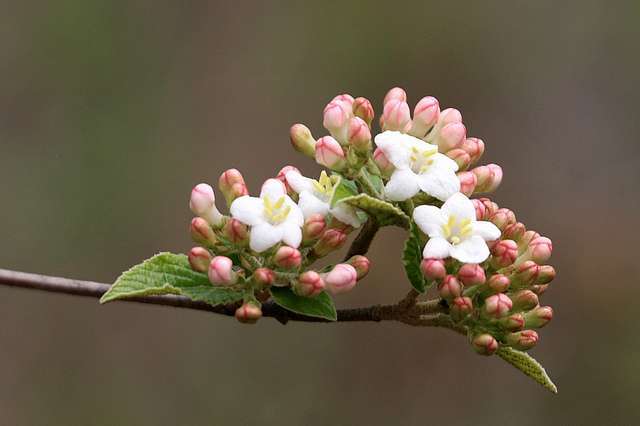
Burkwood Viburnum Blossom

LINCOLN, Neb. — There’s a lot to love about viburnums. Though they are known for their large, showy (and sometimes fragrant) spring blossoms, their ornamental characteristics extend far beyond that. Many produce magnificent berries late summer into fall, most have outstanding fall color and some have foliage that persists all winter.


In the face of recent drought, viburnums have fared far better than more commonly-planted shrubs like hydrangea and burning bush. And if deer are a problem in your locale, another great quality is that viburnums are rarely bothered by them. Ornamental characteristics really vary within this species and new varieties are being developed all the time, but here’s a few that really shine.


The fruits of Siebold viburnum (Viburnum sieboldii) change from rose to red to black. It’s one of the largest viburnums, growing to 20 feet or higher. It has a rigid growing habit and is worth planting alone as a specimen.


American cranberrybush viburnum (V. trilobum) gets yellow to reddish purple fall foliage and bright red fruits that may hold from September into February. It is similar to European cranberrybush, but has better fall color and is more resistant to aphids. A dwarf cultivar, ‘Compactum’, grows to 5 feet by 5 feet.


Nannyberry viburnum (V. lentago), a Nebraska native, is tolerant of almost any conditions; sun or shade, moist or dry soils, planted in a border or as a specimen. Fruits go through a series of color changes. Green when they first appear in September, they may turn yellow, rose and pink before becoming bluish black. They often persist into December. Fall foliage may be red, but often the leaves fall off while they are still green. Its one weakness is susceptibility to mildew, so it should be planted where there is good air movement.


The fruits of arrowwood viburnum (V. dentatum)are also bluish black September through October and are favored by birds. Plantsman Michael Dirr calls this viburnum “possibly [the] most durable viburnum for midwest… in Nebraska it withstands the high pH, heavy soils and the vagaries of that climate.” The dark green leaves are glossy and turn yellow to red in the fall.


On wayfaringtree (V. lantana) the fruits go from yellow to red to black, often with all three colors present at the same time, making it showy in fall even though its leaves rarely develop good fall color. Planting several varieties in close proximity will increase fruiting. It can also withstand difficult, clayey soils. The cultivar ‘Mohican’ is slightly smaller, 8.5 feet by 8.5 feet, than the mature size of 13 by 13 feet for the species.


Another viburnum outstanding for its fruits is linden viburnum (V. dilatatum). Drupes are bright, cherry red September through October, sometimes drying and persisting into December when they look like withered red raisins.  Its leaves also hold late and can turn a bronze or burgundy color.


Mapleleaf viburnum (V. acerifolium)is one of the smaller viburnums, growing 5 feet by 3.5 feet. Fall foliage is beautiful, ranging from pink to orange to purple. Fruits are black, often remaining into the winter. It can grow in almost full shade and, unlike most viburnums, can also tolerate dry conditions.


Viburnum ‘Copper Ridges’ also has beautiful fall foliage; it begins copper and changes to a deep maroon.


Though its foliage doesn’t tend to take on fall color, the dark green, leathery leaves of lantanaphyllum viburnum, (V. x rhytidophylloides)persist into winter. The cultivar ‘Alleghany’ has somewhat smaller and even more persistent foliage. Fruits turn from bright red to black. The deeply ridged foliage of ‘Willowwood’ also may persist into the spring.


Leatherleaf viburnum (V. rhytidophyllum) is aptly named for its sturdy leaves with deep wrinkles. Planted in a protected micro-climate, it may remain green all winter. Fruits are red to black and hold into December. This species is tolerant of hot, dry, sunny locations.


Here’s a few other characteristics and preferences you might want to keep in mind in selecting a viburnum. If the site is in heavy shade, mapleleaf and arrowwood viburnum are good choices. For dry soils, possibilities include nannyberry and mapleleaf. Arrowwood viburnum can withstand heat better than most varieties and if the site is wet, European cranberrybush viburnum will do well.


To attract wildlife, the fruits of nannyberry, Koreanspice, arrowwood, Sargent and American cranberrybush
Laugh tracks in the dust

0
Thayne Cozart
Milo Yield

Well, Mother Nature is making up for the late killing frost — big time. The last two days have seen night time temperatures in the low teens and day time temps in the high 20s — and the wind has constantly pumped in the frigid air from the northwest. And, it’s supposed to stay this way for at least another week, with a high possibility for snow Saturday.

However, prior to the plunge into winter, the hunting season opened and I hunted some of our pen-raised quail with my buddies Rollin Birdz and Dusty Farmer. The scenting conditions — dry and windy — weren’t the best, but we had good morning hunts over the weekend and on Monday and got the dogs back in the swing of hunting.

Then, Sunday and Monday afternoons, Dusty and I decided to get in a last few hours of fall fishing in the Flint Hills. We scored around 20 bass and bluegills on Sunday and 11 filleting-size crappie on Monday. We were fishing around 4 p.m. on Monday and we knew the Polar Express wuz gonna roll in soon. We saw it coming over the hill and headed for the pickup. And, by the time we got loaded up, the wind wuz blowing so hard we could scarcely close the pickup doors. And, by the time we drove 15 miles home, the temperature had dropped 25 degrees. Now that’s what you call squeezing every last minute out of the fishing season.

***

I’ve got a good friend, ol’ R. R. Mann, whose string of bad luck — not catastrophic, but funny and sad at the same time — this month reached near epic proportions.

First, he accidentally rolled a wheel over the favorite house dog of the family and grandkids. That’s bad enuf, but when he tried to help the injured pup, it bit him hard enough to leave his hand and arm bandaged up.

The second incident involved a skunk getting into his man cave/shop. When it got scared, it ran under the refrigerator and got itself entangled in the compressor. In the process of trying to extricate the skunk, R. R. got sprayed a few times. His man cave now has a lingering pungent odor about it.

And, the third incident involved R. R.’s first attempt to get involved in the poultry bizness. First, he built a nice chicken coop to house the mature birds. Then he borrowed a neighbor’s incubator and hatched a dozen fluffy new “laying” chicks. He augmented his new poultry flock by buying 25 “meat chicks” at the local farm store’s last “chick day” of the year.

For the baby chicks, he build a plywood pen two-feet high in his man cave/shop, equipped it with heat lamps, feeders and waterers and enjoyed a few days of watching his new chicks and envisioning tasty fried chicken meals this winter.

Alas, R. R. has a red heeler dog that — as it turned out — shares R. R.’s appetite for chicken, but it didn’t wait for winter. The dog easily hopped over the pen fence and helped itself to all but four of R. R.’s new chicks. I guess he got full before he could devour the entire flock.

Now that’s what I call a string of bad/sad luck. The only good thing that could possibly come to R. R. of all that bad luck is that experience is usually the best teacher. I’ll bet he does better next time.

***

A part-time farmer is at work one day at the welding shop when he notices that his co-worker is wearing an earring. The farmer knows his co-worker to be a normally conservative fellow and is curious about his sudden change in “fashion sense.” So, he walks up to his fellow welder and says, “I didn’t know you were into earrings.”

“Don’t make such a big deal, it’s only an earring,” the co-worker replies sheepishly.

The farmer falls silent for a few minutes, but then his curiosity prods him to ask, “So, how long have you been wearing one?”

“Ever since my wife found it in my truck,” his co-worker admitted.

I always wondered how the men with ear-ring trend got started!

***

Two grain farmers from the same rural community finished combining soybeans the same day and that night meet for a cool one at the local watering hole — the Dew Drop Inn.

Eventually their conversation turns to the subject of making love. The first farmer volunteered, “Did you know that lions make love 10 to 15 times a night?”

“Dang,” says his friend, “and I joined the Elks just last week!”

***

From Colorado comes this story. A farm wife and her five year old daughter were in a checkout line at a grocery store, when the young one became upset

about something.  The rambunctious youngster announced, “As soon as we get home I’m going to run away.”

Well, of course, the best thing for the mother to do was to let her child come to her own realization that it wouldn’t work. So she asked her daughter, “Why wait until you get home. Why don’t you just run away from here?”

The child was ready with an answer, “Because I don’t know my way to grandma’s house from here.”

***

And a few wise words about grandmothers in closing. Baseball Hall of Fame member George Brett once said: “If a tie is like kissing your sister, losing is like kissing your grandmother with her teeth out.” Have a good ‘u

Haven Library Thanksgiving Event

0

The Friends of the Haven Public Library is  hosting a thanksgiving story time on Thursday November 20 at 6:30!

Head on over for some stories and a craft!

Cold temperatures expected to affect wheat in Kansas

0

Cold Temperatures Expected To Affect Wheat in Kansas


Drought-stressed plants more likely to suffer from cold temperatures.


MANHATTAN, Kan. – The sudden sharp drop in temperatures across Kansas during the week of Nov. 10-15 will certainly cause the wheat crop to go into dormancy. Whether it will injure the wheat to any degree depends on several factors, said Jim Shroyer, K-State Research and Extension crop production specialist.


“The moisture level in the topsoil will be important. Soil moisture was generally good in most of the state going into October. But the warm temperatures in October caused some of the wheat in the state to put on excessive amounts of topgrowth, which dried out the soil,” Shroyer said.


The cold weather will be more likely to cause injury to wheat if the plants were showing drought stress symptoms, he said. Also, dry soils will get colder more easily than wet soils.


Another important factor in wheat’s response to the cold is whether the wheat had time to become properly cold hardened, he added.


“Although the weather was warm overall in October and early November, there may have been enough cold nights to have allowed the wheat to develop cold hardiness,” Shroyer said.


The extent of the unusually large and rapid drop in temperatures from well above normal to well below normal is a concern, he added. If the wheat did not develop sufficient cold hardiness, it would become more susceptible to injury from the recent cold snap.


“We likely won’t know for sure about cold injury until next spring as the wheat comes out of dormancy,” he said.


The first thing producers will be seeing is a lot of burndown of the wheat from these cold temperatures, Shroyer explained. If the wheat was bigger than normal, the plants may look “rough” with a lot of brown dead-looking foliage on the soil surface, he said.


“That doesn’t mean the plants are dead, however. The important factor will be whether the crown below the soil surface remains alive. Having a well-developed secondary root system will help the plants survive,” Shroyer said.

Message from Haven High School

0

Special thanks to all the students involved in the Veteran’s Day presentation today. The brass ensemble performed the National Anthem and the steel drum band performed three numbers for the veterans. Thanks also to all the students and faculty that served food, helped with the program, and all the other tasks that were involved. You make Haven High School very proud.