Wednesday, February 18, 2026
Home Blog Page 484

KU News: Study shows news organizations still lead in sharing difficult information on social media

0

From the Office of Public Affairs | http://www.news.ku.edu

Headlines

Study shows news organizations still lead in sharing difficult information on social media

LAWRENCE — As media organizations across the country fold and news deserts grow, it remains to be seen who will ask difficult questions traditionally posed by journalists. While social media provides an opportunity for community organizations and leaders to take that role, a new study co-written by a University of Kansas researcher shows that in the case of difficult conversations regarding racial disparities and the COVID-19 pandemic, news outlets still lead the way.

KU welcomes Ukrainian food anthropologist, historian as visiting professor

LAWRENCE — A historian from Lviv, Ukraine, with expertise in the cultural exchange and culinary traditions of Eastern Europe has joined the University of Kansas faculty for the 2024-25 calendar year as part of the Scholars at Risk Network. Ihor Lylo will deliver a public talk at 7 p.m. April 15 titled “Food as Power: Between Decolonization and Nationalism of the Gastronomic Culture.”


Full stories below.

————————————————————————

Contact: Mike Krings, KU News Service, 785-864-8860, [email protected], @MikeKrings

Study shows news organizations still lead in sharing difficult information on social media


LAWRENCE — As media organizations across the country fold and news deserts grow, it remains to be seen who will tell the tough stories and ask difficult questions traditionally posed by journalists.

Social media provides an opportunity for community organizations and leaders to take that role, but a new study shows that in the case of difficult conversations regarding racial disparities and the COVID-19 pandemic, news outlets still take the lead in sharing such information.

The pandemic saw pronounced health disparities and negative outcomes falling disproportionately on communities of color. That happened around the same time as the murder of George Floyd and resulting protests for racial justice across the country. Those concurrent events provided an opportunity to examine how organizations discussed a difficult topic, said Christopher Etheridge, assistant professor of journalism & mass communications at the University of Kansas.

“This raises some interesting questions like, ‘What civic conversations are taking place online as organizations become increasingly reliant on social media to communicate?’” said Etheridge, a contributor to the project. “If everyone has their own Facebook page to control the message, are the difficult conversations necessary to a healthy community taking place?”

Researchers from the Civic Infrastructure Lab at Michigan State University and colleagues conducted two studies to examine the question. They analyzed more than 1,250 Facebook posts made by civic organizations, including news outlets, nonprofits, community organizations, public libraries, universities and local public Facebook groups from March of 2020 to September 2021. They also interviewed 17 communications managers from the organizations about what they posted and the strategy behind those decisions.

Data showed that 14.5% of posts mentioned the pandemic and 2.5% mentioned racism and/or Black Lives Matter, though only .06 percent of posts from across the organizations mentioned racial or health disparities pertaining to COVID-19. Of those, nearly 70% were made by news organizations, followed by nonprofits at 29.7%, health organizations with about 5%, government officials at 1.7%, educational organizations with 1.2%, politicians at 1% and civic service organizations at .31%. Libraries and neighborhood groups made no such posts.

The post analysis and interviews were conducted within six communities in the Great Lakes region: Flint and Lansing, Michigan; Bemidji and Duluth, Minnesota; and Gary and South Bend, Indiana. The communities were chosen for a high variation of racial diversity of residents, number of local news outlets and metrics of economic equality.

“We didn’t see a ton of conversations about health disparities even among organizations where that might be a part of their mission,” Etheridge said. “We thought the summer of 2020 might be an opportunity for these organizations to raise topics connected to health and race, but we found people hesitant in part because of the perception that there is already so much negativity, trolling and unpleasant comments already out there.”

The paper, published in the Annals of the American Academy of Political and Social Science, was co-written by Ava Francesca Battocchio, Kjerstin Thorson, Dan Hiaeshutter-Rice, Marisa Smith, Hyesun Choung, Chuqing Dong and Moldir Moldagaliyeva of Michigan State University; Yingying Chen of Renmin University of China; Stephanie Edgerly of Northwestern University; and Kelley Cotter of Pennsylvania State University.

The researchers also conducted interviews with storytellers on how they decide the content to share via their social media channels. The communications managers indicated they were aware of racial health disparities and COVID-19, but outside of news organizations, they understood their role in creating content regarding race and health disparities in different ways. Interviewees said they were concerned about their organization’s reputation and that their financial well-being could be negatively affected if their reputation suffered from posting about controversial issues. They also indicated hesitancy to impugn the reputation of their community by implying social inequity was a problem there, the study found.

And while managers indicated they were aware of racial disparities in health outcomes, few respondents indicated they saw it as a problem in their own community, the study found.

Interviewees from news organizations said that they saw their role differently and that they had a responsibility to share information about disparities in health and injustice, even if it was uncomfortable or difficult to accept, the study found.

“Non-news organizations didn’t say, ‘We need to be leading public thinking on these topics,’” Etheridge said. “A lot of people were craving engagement but didn’t want to have conversations online that could turn nasty or negative. News organizations recognized that having tough conversations was part of their mission, shining light on these issues in a public way. So this leads us to wonder what happens if these news organizations go away or shrink in size.”

The pandemic coinciding with renewed attention to systemic racism in the wake of Floyd’s murder provided a unique opportunity to “stress test” local civic information infrastructure, the researchers wrote, and the findings validate the importance of local journalism to facilitate difficult, yet necessary conversations.

-30-

————————————————————————

The official university Twitter account has changed to @UnivOfKansas.

Refollow @KUNews for KU News Service stories, discoveries and experts.

————————————————————————

Contact: Wyatt Haywood, Department of Slavic, German & Eurasian Studies, [email protected]

KU welcomes Ukrainian food anthropologist, historian as visiting professor

LAWRENCE — An anthropologist and historian from Lviv, Ukraine, with expertise in the cultural exchange and culinary traditions of Eastern Europe has joined the University of Kansas for the 2024-25 calendar year.

The departments of Slavic, German & Eurasian Studies and History are supporting Ihor Lylo as a visiting assistant professor as part of the Scholars at Risk Network’s initiative to protect scholars in crisis.

As part of his appointment, Lylo will deliver a public talk titled “Food as Power: Between Decolonization and Nationalism of the Gastronomic Culture,” which will take place at 7 p.m. April 15 at the Hall Center for the Humanities Conference Hall, with an option for audiences to watch online.

The event will explore the cultural significance and influence of Eastern European gastronomic traditions, particularly on Ukrainian cuisine. Lylo argues that traditional gastronomic practices of social and religious groups play a crucial role in shaping collective memory. This poses a danger to totalitarian regimes that use food and supply security as a tool of terror or political propaganda.

During his time at KU, Lylo also teaches the SGES course REES 110: Understanding Russia and Eastern Europe as well as HIST 390/SLAV 379: Cultural Heritage of Ukraine while continuing his own research.

Lylo recently served as a visiting professor of history as part of the Scholar at Risk program at the University of California, San Diego. He was a researcher and educator at the King John III Palace Museum in Warsaw and held professorships at Jagiellonian University in Kraków, Poland, and the Ivan Franko National University in Lviv, Ukraine.

Lylo’s publications include the co-written “Lviv Cuisine” (in Ukrainian), published by Znak Krakow in 2023 and “UKRAINE: Food and History” (in English, French, Italian and German), published in 2021. He has written several travel guides of Ukraine.

Lylo’s appointment has been made possible through contributions from various university units, including the SGES and history departments, Office of Research, College of Liberal Arts & Sciences, the Hall Center, the Institute for Policy & Social Research and Institute for Global & International Engagement, as well as the Scholars at Risk Network.

-30-

————————————————————————

KU News Service

1450 Jayhawk Blvd.

Lawrence KS 66045

Phone: 785-864-3256

Fax: 785-864-3339

[email protected]

http://www.news.ku.edu


Erinn Barcomb-Peterson, director of news and media relations, [email protected]


Today’s News is a free service from the Office of Public Affairs

“Sexual function and aging”

0

As husband and wife urologists, we talk a lot about sex (mainly at work). There are several issues that commonly arise in our patients that can lead to a less than satisfactory sex life. The great news is many treatment options exist.

There are many factors affecting men and women as they age that can interfere with sexual relations. In women, vaginal dryness, prolapse and incontinence are most common. A decrease in circulating estrogen in peri and post-menopausal women leads to atrophy, or dryness, of the vagina that can result in pain. Symptomatic pelvic organ prolapse can create physical barriers to intercourse. Embarrassing urinary incontinence is another reason some shy away from intimacy.

Nearly all women who are experiencing painful vaginal dryness or dyspareunia (pain with intercourse) can be safely treated with a vaginal estrogen cream. Unlike hormone replacement therapy (HRT), vaginal estrogen poses few risks and can safely be administered without fear of cancer, stroke or clotting problems. The cream is placed in the vagina several times weekly at night, helping to improve tissue quality and relieve symptoms of pain and dryness.

For women who struggle with a vaginal bulge, many options exist to maintain sexual function. A pessary can be fitted in some women who are able to remove it themselves. More often, outpatient surgery is used to restore normal anatomy and maintain sexual function if desired.

Incontinence, the involuntary leakage of urine, has many causes and several treatment options exist depending on the type.

Diagnosing and treating male urologic factors are also key to maintaining intimacy. Erectile dysfunction (ED) is common in aging men for a variety of reasons including but not limited to vascular, hormonal and psychologic issues. Certain treatments for an enlarged prostate or prostate cancer can also lead to ED. The backbone of therapy for erectile dysfunction includes pills like Viagra or Cialis. For some men who do not respond well to these medications or have side effects that are intolerable, penile injections provide a simple and effective solution. As a last resort, surgical options are also available.

Peyronies disease is another issue we frequently see in men that affects sexual quality of life. This is caused by deposits of scar tissue in the penis. This scar tissue can frequently cause curvature with erection, which makes sex difficult or painful. Excellent non-operative and operative treatments exist which can restore a couple’s sexual quality of life.

Whether sexual intercourse remains a priority in your relationship as you age is a very personal decision and is ultimately up to you. If you are suffering from conditions interfering with your ability to be sexually active, many treatment options exist and we encourage you to speak with your doctor about these issues.

-D. Joseph Thum and Lauren Wood Thum are both board certified Urologists at Urology Specialists in Sioux Falls, SD. Dr. Joseph Thum also sees patients in Worthington. In their free time, they enjoy the outdoors and spending time with their sons and German Shepherds. Follow The Prairie Doc® at www.prairiedoc.org and on facebook featuring On Call with the Prairie Doc a medical Q&A show providing health information based on science, built on trust, streaming live on Facebook most Thursdays at 7 pm central.

“The Nagging Cough”

0

“I’ve got this cough that just won’t go away,” my patient says, and I know this story all too well. Chronic cough, a cough that lasts more than two months, is a common ailment which in most cases is benign. But for the patient it is both bothersome and worrisome.

If your cough has lasted for less than two months it may just be the residual effect of an upper respiratory infection. Dry cough after having one of many viruses can last for weeks and weeks, and the only cure is time.

In patients who do have chronic cough, my first task is taking a good history. Are or were they a heavy smoker? If so I will be more apt to rule out cancer and consider lung imaging. I will also be suspicious of chronic obstructive pulmonary disease (COPD) which can be diagnosed by breathing tests. But many of these patients have no or little smoking history so are at low risk for those things. Why are they coughing? I can think of a few common reasons.

Mild asthma often causes cough at nighttime, in the cold, or with activity; it isn’t always accompanied by wheezing. Simple breathing tests in the office can help us diagnose asthma, and it can be greatly helped with inhaled medications.

Post-nasal drip is extremely common, and we have probably all experienced it with a cold or allergies. For patients who have this chronically, the mucous produced in the nose drains down the throat, causing irritation to the upper airway and an annoying cough. If this seems likely, I suggest the patient tries a steroid nasal spray every day for a month or two, and if that resolves the cough we have our answer.

Gastroesophageal reflux disease, or GERD, doesn’t always cause classic heartburn. As the stomach acid creeps up the esophagus, especially when lying flat at night, it can get high enough to irritate the upper airway and cause cough. As with post-nasal drip, sometimes we just try treating this ailment with an acid reducing medication for a couple months to see if this cures the cough.

Finally, a commonly used type of medication can actually cause benign cough as a side effect. ACE inhibitors like lisinopril are excellent drugs for hypertension and heart disease, but around 5-10% of people will get a dry cough with it. If so, the cough resolves when we stop the med.

Back to my patient. “Tell me more about your cough,” I say. “I’m confident we can figure out what is going on, even if it takes a little time.”

Kelly Evans-Hullinger, M.D. is part of The Prairie Doc® team of physicians and currently practices internal medicine in Brookings, South Dakota. Follow The Prairie Doc® at www.prairiedoc.org and on Facebook featuring On Call with the Prairie Doc® a medical Q&A show providing health information based on science, built on trust, streaming live on Facebook most Thursdays at 7 p.m. central.

How to manage garden plants that break dormancy early

0

A warm February is causing concern for Iowans with gardens and outdoor plants

Recent warm temperatures across Iowa have many gardeners concerned as they see buds on trees and shrubs swell and break, and foliage of perennials and spring bulbs emerge in February, much sooner than they normally would. This puts plants at higher risk of damage if below-freezing temperatures return in March or April. In this article, horticulturists with Iowa State University Extension and Outreach advise on what to do in your garden when plants break dormancy earlier than expected.

What causes plants to break dormancy early?

Garden plants enter dormancy in the fall in response to day length and temperature. As temperatures cool and nights get longer, hormones within the plant change, causing plants to gradually acclimate to cold winter temperatures and go dormant. Plants will remain dormant until specific temperature requirements (measured using “chilling hours” and “degree days”) are met. This relatively complicated and not yet fully understood system helps prevent plants from coming out of dormancy too early during a mid-winter warm-up.

Each plant species has its own chilling requirement that must be met before it will break dormancy. A mild winter can allow plants to meet their dormancy requirements earlier than usual. This makes them more likely to break bud sooner when abnormally warm temperatures occur in February or March, leading to a higher likelihood that they will experience cold damage.

What will happen to spring bulbs that emerge too early in the season?

Tulips, daffodils and other spring-flowering bulbs typically begin emerging from the ground early in the growing season. Mild winter weather can encourage even earlier emergence of these plants. This early emergence is most often seen in areas that are warmer than the rest of the yard, such as on the south and west sides of homes.

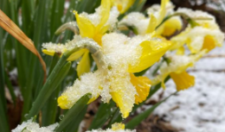
While premature emergence of foliage is undesirable, the danger is not as great as it may seem. The foliage of spring bulbs can tolerate cold temperatures. If below-freezing temperatures return after the foliage emerges, no extra protection is typically needed. Cold temperatures will delay growth and leaves usually have little to no damage. If leaves are damaged, it is often no more than a few brown tips and leaf edges, which is unsightly but not a problem for overall plant health. A blanket of snow is especially helpful in protecting leaves from extreme cold.

If the flower buds emerge early, they can be damaged or destroyed if temperatures are colder than the low 20s Fahrenheit. A layer of organic mulch, such as straw or pine needles, can be applied around the base of the emerging plants to help protect flower buds and slow further growth by insulating the soil and regulating temperature fluctuations. Remove the mulch once normal temperatures return.

What can I do to help perennials that are emerging too early?

When below-freezing temperatures occur after a warm winter period, the extent of plant damage depends on temperature, plant species, exposure and stage of plant growth. Many perennials will see little to no damage to foliage, especially early-emerging, cold-tolerant perennials such as bleeding heart, daylily, catmint and columbine. If temperatures get too cold, damage may occur, causing leaf tips, edges or entire leaves to turn white, brown and/or collapse.

If temperatures are predicted to drop into the mid-20s or teens, perennials can be protected with a layer of organic mulch, such as wood mulch, straw or pine needles, spread several inches thick. Mulch will help insulate the soil, regulate temperature fluctuations, slow growth and prevent frost heaving. Watering if the soil is dry and unfrozen will also be beneficial.

Most well-established perennials damaged by freezing temperatures should survive with no long-term damage. Plants with light damage will continue to grow, and the damage will be masked or can be trimmed out. The roots and crowns of severely damaged perennials will send up a second flush of growth, but plants will be smaller than usual this summer. Good care this spring and summer (for example, watering weekly during dry weather) should help plants recover.

How can I prevent damage to trees and shrubs that break dormancy too early?

There are no practical or effective efforts home gardeners can take to prevent freeze damage to early emerging flowers or foliage on woody plants. It is impossible to prevent plants from “waking up” too early. Flower buds that begin to swell or flowers that emerge earlier than normal due to unseasonably warm temperatures may be disfigured or destroyed when cold temperatures return. This is particularly true for early flowering species like magnolia, forsythia, rhododendrons and azaleas.

Foliage that emerges early is also susceptible to freeze damage. Symptoms include shriveling and browning or blackening of leaf tissue. Damaged growth often becomes limp and eventually drops from the tree or shrub. Damage appears to be more severe on species such as Japanese maple, hackberry, ginkgo, hydrangea, oaks and black locust.

Thankfully, below-freezing temperatures will have no long-term damage to the overall health of a healthy tree or shrub. The loss of flowers for the season is unfortunate, but provided the weather is not abnormal again, blooms can be enjoyed next year. Trees and shrubs can leaf out again if the initial growth is damaged or destroyed, and new growth will emerge later in the spring when normal temperatures return. Good care during the remainder of the year, such as watering during dry periods, should aid the recovery of woody plants planted within the past three to five years. Fertilizer is not recommended to aid in recovery from cold damage.

How will abnormally warm temperatures in February and March affect my fruit trees?

Unseasonably warm temperatures early in the growing season can cause premature bud swelling, flowering or leaf emergence in fruit trees, especially apricots and peaches, which bloom earlier than apples, pears and tart cherries. As flower buds swell, they become increasingly vulnerable to cold temperatures. They are most susceptible just before, during and after bloom.

If freezing temperatures return after a warm winter period, the amount of damage depends on the amount of premature growth. The colder the temperature and the further developed the buds and blooms are, the more likely they will be damaged or destroyed. If flowers are damaged, this year’s fruit crop may be smaller than usual. However, the trees themselves should not be seriously harmed. There are no practical efforts home gardeners can take to prevent freeze damage. (Commercial fruit growers may use wind turbines or spray water to prevent frost damage, but these efforts are not practical for home gardeners.)

While the loss of most of the fruit crop for the year is disappointing, good care during the remainder of the year will help trees recover and potentially produce a bountiful harvest the following growing season.

Can I still prune?

In a year with more typical weather conditions, February and early March (late dormant season) is an ideal time to prune. Even with warm temperatures, plants can still be pruned until bud break. However, as trees and shrubs show signs of breaking dormancy, such as swollen buds, emerging foliage, or flowering, pruning should be delayed until new growth has fully expanded (mid- to late-May). Late spring/summer pruning is perfectly acceptable in all cases except for oaks, which should only be pruned during the dormant season.

In rare cases, late cold snaps can damage branch tips. Dead branches can be removed once they are noticed, but be sure they are dead (i.e., dry and brittle) before making any pruning decisions.

Soil temperature is important for germination in the garden

0

Home gardeners can take their own soil temperature measurements, says K-State expert

Just in case home gardeners have not really considered the importance of soil temperature, Kansas State University horticulture expert Cynthia Domenghini says you should. Soil temperature, she says, affects germination of many garden foods.

Domenghini said peas can sprout in soil that is 40 degrees Fahrenheit, while lettuce can germinate in 35 F.

“Crops — such as tomatoes, corn and other warm-season veggies — need the soil to be at least 55 F for success,” Domenghini said. “Peppers, cucumbers and melons need even warmer soil.”

The Kansas Mesonet is a resource for guidance on what’s happening below the ground. Domenghini said gardeners can also take their own soil temperature measurements using a soil thermometer, and measuring the soil at least 2.5 inches deep during late morning.

“Find the average soil temperature over five days to determine when the time is right for planting,” Domenghini said. “It is still important to watch the forecast for late season frosts and freezes.”

Domenghini and her colleagues in K-State’s Department of Horticulture and Natural Resources produce a weekly Horticulture Newsletter with tips for maintaining home landscapes and gardens. The newsletter is available to view online or can be delivered by email each week.

Interested persons can also send their garden and yard-related questions to Domenghini at [email protected], or contact your local K-State Research and Extension office.