Sunday, February 22, 2026
Home Blog Page 544

Keeping The Peace

0

As my wife and I approach our 50th wedding anniversary I know there are readers who are wondering what the secret is to our long and happy marriage and I am happy to share my wisdom in this column which I subtitled, “A Dozen Things To NEVER Do With Your Spouse”.

There were several “honorable mentions” that didn’t make the final cut such as never go on a trail ride together, roof the barn, pick out Christmas cards, shop for clothes, pack a suitcase, work in the same office or set the presets on your radio together. All good advice but here are 12 MORE important things to NEVER EVER do with your spouse.

#12- NEVER do your taxes together. You’ll end up in several skirmishes and eventually one BIG war because your wife will want to pay the IRS way too much just to be on the safe side while the husband will want to write off a “business trip” to Tahiti that could land you both in prison. Save your marriage, just hire H & R Block.

#11- NEVER get body piercings together. The wife will end up with an expensive diamond in her belly button and the man will get a nose ring so he can be lead around like a bull.

#10- NEVER cull cows together. The man, being more practical, will insist on culling every open cow while the wife will want to keep the 15 year old toothless open cow she bottle-raised as a calf.

#9- NEVER take a vacation together. For a brief vacation (which always helps the marriage) the man should go fishing in Alaska for a week with his buddies while the wife pampers herself at a spa. The wife should never go hunting with her husband because they’ll never get a deer because the expression on the deer’s face will never be right for a mount. The man should never go to Las Vegas for his vacation because what happens in Vegas never stays in Vegas.

#8- NEVER buy cattle at an auction together. Brief arguments will turn into all-out wars as the wife attempts to stop the man from bidding by holding his hands down. In front of your peers this can be embarrassing and humiliating, believe me.

#7- NEVER check the home defibrillator together. There is just too much temptation!

#6- NEVER castrate bulls together. I did this once many years ago and I’m still paying off the dental bills. It’s true that if the tail of a bull is held up and over its back the bull can’t kick the person kneeling directly behind the bull. Whenever you’re working cattle there’s always a lot of tension in the air and the wife could retaliate by easing up a little on the tail.

#5- NEVER homeschool your child together. This task should be done entirely by the wife and the child will be well-schooled in reading and writing. If the man participates at all the child will be well versed in drinking beer, hunting, welding and the history of the NFL.

#4- NEVER hook up trailer lights together. In the end the wife will get a fix-it ticket and the man will get electrocuted.

#3- NEVER attend your 50th class reunion together. If you ever see or hear of a couple getting divorced after 50 years of marriage you’ll know it’s because they went to a 50th school reunion together and old flames were fanned and fueled.

#2- NEVER watch TV together. The women will always hogs the remote control and channel surf between HGTV, TMZ, Entertainment Tonight and some sappy movie, while the man just wants to watch one game and leave it on the same channel.

#1- NEVER ride in the same vehicle together if one of the couple is driving. The passenger of the vehicle will tell the driver every little thing to do like, go slower, go faster, slow down, watch out for that pothole, don’t ride the brake, there’s not enough room to pass, stop at the next rest stop and so forth. Talk about road rage! In my humble opinion riding together as driver and passenger is the number one cause of divorce. So do what some friends of ours do and always ride in separate vehicles, even if you’re going to the same place.


Storing Fruit and Nut Gifts

0

Fruits and nuts are traditional gifts during the holiday season. Their shelf life can be extended with a few simple steps.

Nuts should be stored in the refrigerator or freezer to avoid water loss. Fats and oils in nuts can spoil and negatively change the flavor. However, even when stored in the refrigerator, the taste of nuts can be altered by strong flavors of other stored products. It is best to store nuts in a tightly sealed plastic container or quality grade resealable plastic bag.

Fruit baskets are often wrapped in cellophane. After gifting or receiving a fruit basket, remove the wrapping to prevent the trapped ethylene gas from speeding up ripening. Tree fruits such as apples, pears, oranges and grapefruit can be stored in the refrigerator or another cool location, ideally around 40 degrees F. Bananas and other tropical fruits (aside from citrus) should be stored separately.

Cynthia Domenghini, Extension Agent


What to Do With the Christmas Tree After Christmas

0
Removing all the branches from your old tree can leave you with some springy protective mulch that is the perfect covering from spring bulb beds. (Thinkstock)

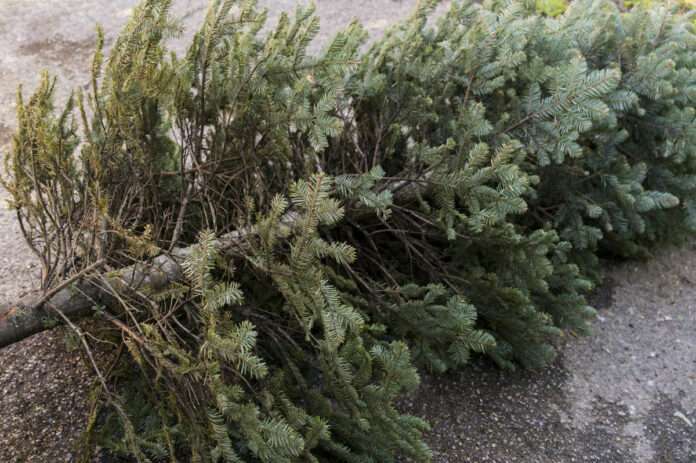
After the holidays, many municipalities allow old Christmas trees to be placed curbside. Trees are then collected and ground up for mulch or burned. If you miss the designated date, or your trash collector doesn’t accept trees, there are several options to prolong the useful life of the tree.

An old Christmas tree can be used to benefit birds, fish, and the landscape by placing it in a corner of your deck, and spreading some birdseed nearby, or tying it to a deciduous tree or post near a bird feeder. The birds benefit from having escape cover nearby when hawks or cats threaten, and the dense boughs reduce the wind chill on a cold night.

Sinking your Christmas tree in a pond is an easy way to improve fish habitat and fishing. The tree serves as a coral reef, in that the branches provide substrate for water plants to grow, and cover for minnows and other forms of small aquatic life. Larger fish are drawn by the shade and the presence of prey.

How do you sink a tree? Tie the base to a cinder block with a short, stout rope, and toss it in. Just be sure to get permission from the pond owner first! Using the little tree around the landscape requires clipping off all of the branches. Use the boughs to add extra insulation around semi-hardy perennials or to trees and shrubs that were recently planted. The leftover trunk may be used as a garden stake next spring.

You may also cut and let the tree dry for a few weeks providing some easy lighting firewood. Just beware that most conifer species tend to spark and pop more than hardwoods, as resin pockets in the wood make tiny explosions. This can delight the youngsters, but for safety’s sake, keep an eye on the fire when burning Christmas tree logs!

Charlie Barden, Extension Agent

Where does roadkill end up in Kansas? Can I take it? What happens after you hit an animal

0

Last year, more than 10,000 car accidents in Kansas involved a collision with an animal, according to data from the Kansas Department of Transportation. So far this year, the state has seen just more than 8,000.

While data from KDOT indicates the majority of these crashes don’t end in the death of the animal, it’s always a possibility, especially when driving in the dark near tree lines and fields. So, what exactly happens when an animal dies due to a collision?

In an email to the Wichita Eagle, KDOT said they handle roadkill incidents in a case-by-case basis. Sometimes roadkill is taken by the agency to an offsite storage area and buried. Other times, the animal is simply moved to a ditch on the side of the road.

There is another option, however, according to Capt. Larry Hastings with the Kansas Department of Wildlife and Parks. If the roadkill is big game, turkeys or if its an animal subject to an active hunting season, people have the option to get a salvage tag and take the animal with them.

Hastings said one important thing to remember is if you do decide to get a tag, is you are then responsible for the whole animal. For example, if you just want the tag to keep antlers, it’s your responsibility to dispose of the rest of the deer.

The salvage tag can be given to you by a police officer when filing the accident report, and it allows you to take one animal. In similar cases, if you see roadkill but were not involved in the accident, you can call the sheriff’s department or an officer in the area to get a salvage tag to take that animal.

Those with a valid Kansas hunting license don’t need a salvage tag to pick up in-season animals off roadways.

Avoiding animal collisions on the road

While deer collisions are most common in October through December, animal collisions are possible year-round.

It’s important to keep a watchful eye for possible encounters while on the roads, especially if you’re driving after sunset. Here are some tips for avoiding animal collisions , from the Humane Society of the U.S.:

  • Don’t speed
  • Slow down when driving on a two-lane road bordered by trees or fields
  • When possible, use your brights
  • Dim your interior lights
  • Keep a close eye on the roads and your surroundings, watching for wildlife