

Plan for health during the holidays

It’s not always so clear-cut – or easy to follow-through – but being healthy and improving one’s quality of life can be summed up in three small phrases.
Build a better meal.
Boost your physical activity.
Balance stress.
“So, the three B’s are really important,” said Chelsea Reinberg, a nutrition, food safety and health agent in K-State Research and Extension’s Johnson County office. “I frame good health that way because it’s easy to remember…but sometimes doing all three is difficult. Doing all three is important and they all affect our health.”
The three B’s, Reinberg said, can provide a valuable road map for people heading into holidays or considering New Year’s resolutions.
Build a better meal
Reinberg said the USDA provides a visual reminder to help Americans make healthy choices from each of the five food groups. The graphic is called MyPlate, and can be viewed online.
“MyPlate gives us a great image of how all of our meals – breakfast, lunch and dinner – should be built,” Reinberg said. “Half of your plate should be fruits or vegetables, a quarter should be grains – focusing on whole grains – and a quarter should be protein. Then, maybe a side of dairy, for those who consume dairy products.”
Fruits and vegetables contain fiber, which may help to manage weight, prevent constipation, enhance gut health and reduce the risk of heart disease and type 2 diabetes, among other benefits.
“The great thing about food and nutrition is that we can be creative,” Reinberg said. “Some people like to eat the same meals…but diversifying our plate is also healthy. As nutritionists, we say, ‘eat the rainbow,’ because each color had different nutrients, antioxidants, phytonutrients, vitamins and minerals.”
Boost your physical activity
“When people think about physical activity, often they thing about going to the gym or going out and running a mile or a marathon or whatever it may be,” Reinberg said.
Instead, physical activity may mean a steady 15-20 minute walk, or another activity that reduces sitting time and gets you away from screens or other technology.
“Being more physically active has some immediate benefits; for example, you may feel like your stress is reduced after a short walk. It reduces your blood pressure, at least temporarily,” Reinberg said.
Long-term benefits include a decreased risk of heart disease or diabetes; lower blood pressure; stronger bones and muscles; and better coordination and balance.
“Some studies have shown that no matter how healthy you are in terms of eating, if you sit for a majority of your day, and then you go home and just sit on the couch, that can actually negate some of the other health benefits that you’re trying to get by maybe eating an apple in the morning for breakfast.”
Balance stress
Physical activity also helps to reduce stress, but colder weather can limit the opportunity to get outside and move. Reinberg said it’s important to acknowledge stress and “have a game plan as we go into the holidays.”
“If you know that finances or family dynamics are going to be points of stress, make sure you think about it and prepare a plan so that you know that if you’re in certain situations, you will know how to handle them,” she said. “Your plan of action should help to assure that stress doesn’t get the best of you.”
Chronic stress can increase the risk of heart disease, stroke or high blood pressure.
“Keeping stress in is not a good thing,” Reinberg said. “People handle stress differently, which I think is important to acknowledge that you and I are going to react differently to stressful situations. But to really make sure that you know what your triggers are and that you know how to resolve those… is very important.”
Regarding the three B’s, Reinberg said “you don’t have to tackle all three at the same time.”
“Maybe you start with building a better meal first, and develop a goal for that. Then, once you feel like you’re at a good place there, you can move on to setting a goal for boosting your physical activity or balancing your stress, or whatever order works for you.”
More information on living healthfully is available at local extension offices in Kansas.
Feedlots show increase in cattle inventory
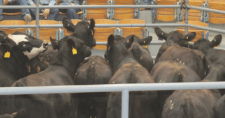
The United States Cattle on Feed report indicated an increase in inventory, as reported Nov. 17 by the U.S. Department of Agriculture’s National Agricultural Statistics Service.
The report comes from feedlots with capacities of 1,000 head or more as of Nov. 1. With a total of 11.9 million head the inventory was 2% above the Nov. 1, 2022, findings.
“This report was largely in line with pre-report expectations,” said Glynn Tonsor, a professor in the department of agricultural economics at Kansas State University.
Texas, Nebraska and Kansas were the top three states in inventory with 2.9 million head, 2.54 million head and 2.52 million head, respectively. Kansas was up 8% over the same counting period in 2022 as the Sunflower State showed 2.33 million head on Nov. 1, 2022. Texas was up 4% as the Longhorn State had 2.86 million on Nov. 1, 2022. Nebraska had a 2% decline as the Cornhusker State was at 2.6 million head on Nov. 1, 2022.
In Kansas, Tonsor said drought conditions in 2022 explained lower numbers meanwhile the conditions improved and feed costs were lower in 2023.
“I also think several operations have tried to procure animals when they could have been hedged at a positive margin,” he said.
Placements in feedlots total 2.16 million head, 4% above 2022. Net placements were 2.11 million head. During October, placements of cattle and calves weighing less than 600 pounds were 55,000 head, 600 to 699 pounds were 470,000 head, 700 to 799 pounds were 465,000 head, 800 to 899 pounds were 394,000 head, 900 to 999 pounds were 205,000 head, and 1,000 pounds or more were 80,000 head.
Marketings of fed cattle during October totaled 1.76 million head, 3% below 2022. The marketings fell 3% compared to the October report.
“The marketings declined versus Nov. 1, 2022, is a near-term help, but I’d argue it is offset by Nov. 1, 2023 inventories being above both Oct. 1, 2023, and Nov. 1, 2022 inventories,” Tonsor said. “That said, this very much is a near term versus long-term timing matters issue. Over the next three- to six-months we are likely to have more domestic beef production than was expected a few months back.
“However, the longer term (the second half of 2024 and beyond) situation is still one that domestic beef production is slated for notable declines corresponding with notable lower calf crops.,” he said.
According to Tonsor although lower feed costs have helped feedlot operators, there is an expectation of lower expected fed cattle sales prices, too, and that has been a change from previous forecasts.
Over the next two to four months feeders could see more headwinds. A primary concern is likely going to be “keeping volumes up” as obtaining feeder cattle placements will increasingly be a challenge, Tonsor said.
Michael Langemeier, associate director for commercial agriculture and professor in the department of agricultural economics at Purdue University, in a web posting said that while operators were able to take advantage of lower corn prices they have faced challenges that will continue into 2024.The average fed cattle prices increased from an average price of $161 in the first quarter of 2023 to $180 in the third quarter, or 12%. Moreover, feeding cost of gain had declined from its peak earlier this year.
“These two phenomena represent the good news. Now for the not so good news,” Langemeier said. “Feeder steer prices have increased substantially from their levels earlier this year.”
Net returns to cattle finishing depend on fed cattle prices, feeder cattle prices and feeding cost of gain, he said. Fed cattle prices have strengthened the last few months. At the same time, due to lower corn prices, feeding cost of gain has also declined. Partially in response to these two phenomena, feeder prices and breakeven prices have increased substantially.
Breakeven prices for the fourth quarter of this year are expected to be $10 per hundredweight higher than those for the third quarter. Breakeven prices in early 2024 are expected to be $10 per hundredweight higher than the projected breakeven prices for the fourth quarter of this year.
“These large increases in breakeven prices increase the uncertainty related to net return prospects for the next few months,” Langemeier said.
Other disappearance totaled 55,000 head during October, 2% above 2022, the NASS report stated.
Definitions
Cattle on feed is defined as steers and heifers being fed a ration of grain, silage, hay or protein supplement for slaughter market that are expected to produce a carcass that will grade select or better. It excludes cattle being “backgrounded only” for later sale as feeders or later placement in another feedlot.
Cattle on feed is defined as steers and heifers being fed a ration of grain, silage, hay or protein supplement for slaughter market that are expected to produce a carcass that will grade select or better. It excludes cattle being “backgrounded only” for later sale as feeders or later placement in another feedlot.
Marketings are steers and heifers shipped out of feedlots to a slaughter market.
Other disappearance includes death loss, movement from feedlots to pasture and shipments to other feedlots for further feeding.
As reported in the High Plains Journal

Why a tree along K-96 has adoring fans…and a Facebook page

Discover how a lone Kansas cottonwood became a folk legend.
There is a tradition among travelers on K-96 between the Bentley and Maize Road exits: Honk as you go by “the Lucky Tree.”
It’s a custom thought to have been started decades ago by Hutchinson High School students.
“I had the privilege of working there when there was an outstanding football season and basketball season, as well as debate and other activities,” said Kathleen Foster, now retired and living near Pawnee Rock.
“The students that I worked with taught me that when we go by the Lucky Tree, outside of Maize, we honk four times, and everyone lifts their feet off the floorboard,” Foster said. “And repeatedly, we did that year after year, season after season.”
Go by the tree today and the sounds are deafening.
Semitrucks, cars and even Kansas Department of Transportation tractors and mowers provide constant movement and sound.
The tree is unwavering.
It’s a massive cottonwood that’s nearly 150 years old. Its leaves tremble in the spring and autumn breezes and sway with summer storms as vehicles pass by.
If you listen long enough, there is occasionally a honk of adoring affection.
You’ve undoubtedly passed it if you’ve traveled the road. But did you honk?
The tree stands between mile markers 276 and 275.8 on the west side of the road.
Unlike most cottonwoods, the Lucky Tree has its own Facebook page — “We always honk at the lucky tree outside Wichita” — with more than 5,800 followers.
According to information on its Facebook page, through the years, it has been called the Lucky Tree, the good luck tree, honking tree and the memory tree.
When she was in high school, Marci Penner — co-director of the Kansas Sampler Foundation near Inman — said she remembers climbing on an Inman school bus and riding it into Wichita for the annual state track meet.
“I remember everybody talking about the tree — only they didn’t call it the Lucky Tree … there was something about that tree, and I would just start honking at it. But I didn’t know others were honking at it.”
Sarah Green, the other co-director of the Kansas Sampler Foundation, said she also learned about the tree when she was in high school and visiting friends in Halstead. They would honk.
So, she started honking.
And now, even her dad honks at the Lucky Tree.
“My dad doesn’t use his horn at all except to honk at the Lucky Tree,” she said.
Through the years, blue and gold ribbons — the colors of the Hutchinson High Salthawks — have adorned its branches. In times of war, people have tied yellow ribbons around its massive trunk to commemorate lost or missing loved ones.
More than two decades ago — shortly after 9/11 — it proudly wore the American flag.
In the 1990s, when officials threatened to reroute K-96 and cut the tree down, adoring fans urged the Kansas Department of Transportation to save it.
Honking styles
The custom of honking may have started on the spur of the moment, Penner said.
“I think it has to be noticed and someone makes a deal out of it. And then, it starts to spread,” she said.
Back in the 1970s, Penner attended a track meet for three years as a high school student.
“That was where I would start to get nervous — or psyched up — at that tree,” Penner said. “It triggers something in people. And it’s not just about luck … it just feels like it’s always been there for you.”
So, what happens if you don’t honk when you pass the tree?
“I feel bad,” Penner said. “I feel like I had a chance to wish somebody good luck or put some good vibes out — and I missed it. I missed the opportunity.”
Foster said she isn’t surprised the custom has brought good luck to so many people.
“[Hutchinson] High has many, many traditions, and the lucky tree is one of them,” she said. “It brought us great luck and state championships many times over.”
Each person who travels the highway and gives a nod to the Lucky Tree has their own personal style of honking:
Those who honk once.
Those who honk multiple times.
Some honk and do a backward wave.
Many more simply drive by.
“We honk four times,” Foster said of the Hutchinson High tradition. “I was the van driver many times for the students, particularly for the scholars bowl and math relays. We honked four times … and everyone lifted their feet off and cheered.
“It was very methodical and very much a tradition.”
But if she is in her personal vehicle, Foster said she has yet another honking style that takes over:
“I honk one time, and I do not lift my feet off the gas pedal.”
As reported in the Hutchinson News
