Monday, February 23, 2026
Home Blog Page 564

Lettuce Eat Local: Dirty diapers, dirty laundry, dirty dishes. Real life is back.

0

Amanda Miller
Columnist
Lettuce Eat Local


My mom and dad were staying with us but have driven home to Ohio; Brian’s brother and family were also visiting Kansas for the week, and have also traveled home. The days of having my parents do my housework or of spending all our free time up at the in-laws’ with a houseful of family are over. No more playing games with my parents in the afternoon while my kids nap, no more endless supply of willing arms to hold baby Kiah, no more horde of cousins to entertain Benson. 

Our first two weeks of newborn life were very full, full of family and helping hands, but now we’ll leave that alternate reality to find our new normal. Thanksgiving is over. The fairytale is over. 

But then again, is it? 

I’m sitting here on the recliner with a snuggly baby wearing the softest knot gown, and as I gazed down at her she literally just did this incredibly adorable chuckling thing in her sleep. She’s making all those funny faces and snuffly squirms babies do while they’re sleeping; I’m delightfully distracted. Benson is going to have a hard few days recuperating from all the stimulation and transitions of the last couple weeks, yet in the midst of his angry stomping and over-reactive breakdowns, he gives us the sweetest and most hilarious moments — and even if he didn’t, he’d still have my heart. 

I get to stay home with my TWO children, living on a farm that has my husband working so near to us, solidly connected and supported by community that shows up in all different forms. The fairytale is not over; it just continues. 

I threw a line into last week’s article without providing much background, about Brian starting to die again five years ago at Thanksgiving. That was a month into the saga of his farming accident, and things started going so far downhill again. The calendar dates of this week now were when he contracted both sepsis and an often-fatal lung disease, on top of all his other injuries and complications, and was put into a three-day medically induced coma to try and help his body heal itself. Let’s just say his chances of mere survival were very slim, and I said goodbye to him, not knowing if he’d ever wake up again, or if he’d be himself if he did. But he did, and he is.

That experience is a constant reminder that my life is actually better than a fairytale, that the holiday of Thanksgiving comes and goes but that I can never let go of giving thanks. We’re polishing off the turkey and sweet potato casserole leftovers from out of the fridge, yet we’ll never clear the table of gratitude or finish up thanksgiving. 

On a simple physical level, even the leftovers are a great place to keep feeling thankful. Christmas is my favorite holiday, but I think Thanksgiving’s food is the best. And I love the leftovers as much as I love the original spread — which is good, since my husband smoked a 23-pound turkey. I made bone broth and picked the meat off for soups, and now that winter has officially shown up, the timing could not be better. While Brian works close by outside, the littles and I will stay warm and cozy inside, cooking up simple, comforting pots of soup as we find our place as a family of four. 

Sounds like a return to real life won’t be so bad after all. 

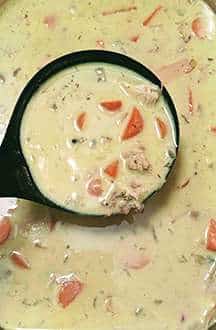
Leftover Turkey Lemon Dill Soup

This is a really interesting take on chicken soup — it is classic, and yet simultaneously completely different. It borrows a lot of flavors from the country of Georgia, capitalizing on dill and lemon, and utilizes egg yolks to make this creamy soup surprisingly cream-less. If you still have turkey bones to deal with and want an accompanying Georgian spin on bone broth that gives this soup extra depth, I’d be happy to share the recipe with you. 

Prep tips: we got our turkey from Phil’s Farm & Butchery, but often groceries run specials on turkeys before and after Thanksgiving, so load up wherever. If you have leftover cooked carrots (or other roasted veg), throw those in here too!

a knob of butter

1-2 yellow onions, chopped

1 pound carrots, halved lengthwise and sliced

good pinch salt

2 tablespoons flour

½ tablespoon dried dill seed

1 teaspoon coriander seeds

about 2 quarts turkey (or chicken) broth

a couple cups of leftover turkey, shredded

6 egg yolks

juice of 2 lemons (about ¼ cup)

fresh dill or parsley, chopped

In a large kettle over medium-high heat, cook onions and carrots in butter with salt until browned. Stir in flour, dill, and coriander, and slowly whisk in a cup or two of broth, cooking until thickened. Stir in the remaining broth and turkey and bring to a simmer. 

Separately, whisk the egg yolks and lemon juice. Whisk in a cup of the hot broth from the soup, and then pour this into the soup — remove from heat and do not let the broth simmer after the eggs are added, since they might curdle. Toss in the fresh herbs and season to taste with salt, pepper, and red pepper. 

You can reach Amanda at [email protected].

Christmas Creep

0
lee pitts

You may have heard of the “Christmas creep.” NO, IT’S NOT ME. It refers to the trend by merchants who are putting out their Christmas crud earlier and earlier each year. It creeps me out to see Santa Claus, LED tree lights and Christmas cards covered in snow when it’s 100 degrees outside. There ought to be a law that stores can’t sell cheap Chinese Christmas crud before July 4th.

It’s been a year of attrition as far as our Christmas card list is concerned and it’s a sign of the moral decay in this country that fewer and fewer people are sending out the traditional cards along with the requisite holiday letter bragging about all the familial accomplishments like new additions, subtractions and any new tattoos in the family.

Last year the average American family sent out 28 Christmas cards whereas my wife and I sent over 100, but I’m sure this number will be greatly reduced this Christmas and it’s not just because some of our elderly friends checked out early. With the Post Office raising the price of stamps yet again to 66 cents and the shortage of paper and glitter making the cards more expensive, one really has to cut out the waste in their list. So far it’s been a beans-and-weiners-year here at the Pitts’ place and when the cost of sending a Christmas card exceeds a buck apiece you have to ask yourself if everyone on your list is really that card-worthy.

I notice there aren’t as many Hallmark stores around any more and I think it’s better not to send anything at all rather than send out cards you bought at a dollar store. What does that say about your friendship? That you’re sending this card only because you expect to get one in return? If that’s the case shouldn’t there be an intervention where both parties agree to cease and desist sending out tidings of great joy?

I think the day is fast approaching when the traditional Christmas card will be thrown on the trash heap of history and it’s not only because the Post Office is so busy delivering Amazon stuff that they don’t have time to get the first class mail out in a timely manner. In their stead you’ll get a Christmas email or text. But a Christmas email just doesn’t say Merry Christmas as good as those wonderful Christmas photo cards you used to get and put on the door of the refrigerator with a magnet. My wife saves those photo cards in scrap books for future reference when we’re trying to figure out if so and so is on their third or fourth marriage, or if one of the kids is a different sex than they were a year ago.

In years past 93% of all Christmas cards were purchased by women but I insist on having a say because sending them out to customers of my syndicated column can be tricky. You don’t want to send one that’s so big you have to pay extra postage because what does that say, that you’re getting rich at their expense? Then again, if you send out one too chintzy they’ll think you really are a greedy tightwad.

Taking people off your list because you haven’t heard from them in ages can be tricky too because, sure enough, the day before Christmas you’ll get a card from them and you don’t have time to retaliate. I have some friends (and they know who they are) who solve this problem by waiting until April to send out their Christmas cards. But what does this say about your friendship, that they like you too, but not so much it didn’t stop them from waiting until after Christmas to buy their cards at half-price before expressing their undying love?

This Christmas I have a couple suggestions on how to save money. It’s NOT tacky to recycle those free cards sent out by charities begging for money, even though you didn’t give them one red cent. Another option is making your own cards like you did in kindergarten. As for me, I have the added option of wishing everyone Merry Christmas in my column. Perhaps my customers might even fancy it up with some bells and holly just to show how well we’re all doing.

Choked Universities

0
john marshal

A university education in Kansas is soon to get a bit more expensive. The Board of Regents, which oversees the state’s six universities, is reviewing proposals to increase annual dorm fees and meal plan costs. The proposed increases range from 2.5 percent (Wichita State) to 6 percent (Pittsburg State).

The increases in room and board would follow tuition hikes of five to seven percent approved in June, the first general tuition increase in five years.

Dorm fee and meal plans are listed in two categories: a base cost double-occupancy room with limited dining; and a higher priced renovated or new room with unlimited dining.

The planned dorm and dining costs at each school:

‒ University of Kansas: $10,922 (up $519); and $14,652 (up $696), both up 5 percent.

‒ Kansas State: $10,290 (up $440 or 4.5 percent); and $15,360, up 5.3 percent ($770);

‒ Wichita State: $11,620, up $270 or 2.4 percent; and $13,430, up 3 percent ($390);

‒ Pittsburg State: $8,964, up six percent ($508); pricier, $9,964, up 5.4 percent ($508);

‒ Emporia State: $10,310, up 4.1 percent ($408); pricier, $10,950, up 3.9 percent ($408);

‒ Fort Hays State: $9,079, up 4.5 percent ($307); pricier, $9,429, up 3.5 percent ($319).

*

Attending class also costs more.

At KU, K-State, Pittsburg and Emporia State, undergraduate tuition is up five percent; at Wichita State, six percent and at Ft. Hays State, seven percent.

In the past five years, the Consumer Price Index has increased 20 percent and the Higher Education Price Index is up 14 percent..

Student tuition payments will outrun state aid by more than $60 million. State aid to the universities is estimated to drop $43 million this year, from $742.2 million to $699.1 million. Tuition is estimated to increase from $753 million to $760.4 million.

Here are tuition rates per semester, approved in mid-June by the Board of Regents:

Kansas University, increased from $5,046 to $5,298; K-State, from $4,744 to $4,981; Wichita State, from $3,421 to $3,623; Emporia State from $2,639 to $2,770; Pittsburg State, from $2,918 to $3,064; and Fort Hays State, from $2,073 to $2,218.

Against this, state aid to the universities is expected to drop six percent.

*

State legislators have acknowledged the pattern in recent years and seem unlikely to reverse course, although the starvation policy set during the Brownback years has been pulled back slightly.

Last spring the Regents had requested about $25 million to counter inflation. It seemed reasonable, given the state’s estimated $4.5 billion in budget surplus and savings. The Legislature said no. The Republican priority is tax cuts for business and high-income individuals.

Many legislators remain proud of the disparities in education finance; a four-year college is no longer necessary, they say. The trend in post-secondary education is toward trade schools, technical colleges and the quicker, less costly

two-year associate’s degree. This is important, given the increasing press of student debt and the questions about the job market returns on investment in schooling.

These are real concerns. But we also need a climate of longer-term learning, an environment that says history has something to tell us, that the Earth is round, that happenings abroad are of consequence in our lives, and that character is still as precious, if not more, than specialized knowledge.

Ignoring or dismissing this foreshadows a state that weakens attempts to get in touch with civilization, a legislature that dismisses the pursuit of understanding and reason, that views experimenting with ideas as a needless frill. A place of sagging education is a place that fails to give the life of every day a certain dignity and purpose.

Students are the state’s most valuable asset. We should offer them the broadest opportunity to embrace learning, with adequate state assistance. The cost of education one thing. The price of stifling it is quite another.

“Medicare Advantage”

0


TV is flooded these days with commercials encouraging everyone to sign up for Medicare Advantage(MA). What is MA and why are they doing this?

First of all, a bit of history. For more than 30 years Congress has debated whether the private insurance industry could deliver Medicare benefits more efficiently than the federal government. In 2003 these efforts evolved into what is now known as Medicare Part C or, more commonly, Medicare Advantage (MA).

MA plans, operated by private insurance companies, cover services provided by Parts A & B of traditional fee-for-service Medicare (FFS) as well as most of the costs traditionally covered by Medicare supplement policies. Many, but not all, include drug coverage traditionally covered by Medicare Part D plans. Some MA plans include services not usually provided by Medicare such as dental and vision coverage.

How is MA financed? Each MA plan receives from the government a fixed payment to cover the services provided. The amount of this payment, known as the “benchmark”, is determined on a county-by-county basis. The amount of the benchmark is based on data indicating what traditional fee-for-service Medicare would expect to spend providing care for the residents of that particular county. MA plans consider the amount of the benchmark and then decide if they will offer a plan in that area. This is why the ads always ask you to provide your zip code when you are looking for an MA plan. If they decide to offer a plan but decide the benchmark payment will not cover the full cost of the care they may charge the enrollee an additional premium.

In recent years MA plans have grown rapidly. They now cover more than 50% of the Medicare eligible population. A broader range of benefits and lower out of pocket costs have been the primary drivers of this growth. Additionally, more MA plans have become available, some in areas where plans were not previously offered. In the original planning for MA it was hoped that providing a profit incentive would lead plans to find less costly ways to provide care and thereby save the government money. Unfortunately, that has not happened and, for most of its history, MA has cost the government more than traditional FFS Medicare.

So, what is the downside? Broader benefits and decreased out-of-pocket costs would seem to be powerful incentive to switch from FFS to MA. In fact that is what has happened. Many enrollees have been pleased with the switch. There are, however, reasons to be cautious.

Fixed limits on what they will be paid provide an incentive for plans to limit what they spend. In general they have been successful in doing this and for most plans MA has been a highly profitable undertaking – a fact which accounts for the multitude of TV ads we see.

To control costs some plans cover only limited networks of medical providers. This has meant that enrollees had to leave familiar doctors, hospitals, etc. Medical providers have complained that MA plans were much harder to work with than FFS. Some have complained about delayed and insufficient payment, frequent requirements for pre-authorization for procedures, etc. This has especially been a

problem for small rural hospitals. Most of these are enrolled in the Critical Access Hospital (CAH) program which provides special payment procedures to aid in their survival. In many cases MA plans have refused to recognize these special payments leaving CAH facilities even more financially stressed than before. Overall frustration with inadequate MA payment has caused at least one mid-sized hospital in South Dakota to totally withdraw from participation in the program.

Selecting health care coverage is both difficult and very important. We are now in the “open enrollment” period for Medicare. This is a time when eligible folks can decide if they want traditional FFS Medicare or a MA plan. If they choose the latter they then have to select the plan that best fits their needs. Many people have been well served by MA plans but they need to ask about network requirements, extent of coverage, additional premiums, etc. This is an important decision and one that should receive careful thought and attention.

Tom Dean, MD of Wessington Springs, South Dakota is a contributing Prairie Doc® columnist who has practiced family medicine for more than 38 years. He served as a member of the Medicare Payment Advisory Commission. For free and easy access to the entire Prairie Doc® library, visit www.prairiedoc.org and follow Prairie Doc® on Facebook featuring On Call with the Prairie Doc® a medical Q&A show streaming on Facebook most Thursdays at 7 p.m. central.

Colorful Leaves of Fall

0


Well the leaves are just about finished falling from our deciduous trees! I love this time of year with the cool crisp air of fall and the color of leaves from yellow to red to purple and orange!

I am always amazed at how many leaves can fall from one tree. And what is the value of those leaves in the landscape? The leaves of one large shade tree can be worth as much as $50 of plant food and humus. Pound for pound, the leaves of most trees contain twice as many minerals as manure. For example, the mineral content of a sugar maple leaf is over five percent, while even common pine needles have 2.5 percent of their weight in calcium, magnesium, nitrogen and phosphorus, plus other trace elements.

One nutrient in high quantity in fallen leaves is carbon. Most people are familiar with nitrogen as the main ingredient in most fertilizers, being unaware that plants use carbon in much higher quantities than nitrogen. Typically, plants readily take in carbon dioxide from the air, but root uptake of carbon from the soil also happens. A soil with an abundance of carbon will be dark and earthy, providing spaces for plant roots. Shredded leaves are an excellent addition to soils for vegetable and annual flower gardens, as well as preparation for new gardens. Giving the garden a quick rough turn with the potato fork will incorporate leaves and begin them in the process of decomposition.

Composting is an easy process and doesn’t require any expensive bins or tumblers, just a good mix and time. The compost pile can be any size but we have found that a 5 ft X 5 ft size bin is the minimum, and can be loose or fenced in with some chicken wire, just make sure you can access it from one side to turn your pile every so often. Turning your pile will allow oxygen to help the decomposition process.

Start with a 6 inch layer of leaves that are either shredded or not, and then add a two inch layer of something green that contains more nitrogen such as manure, grass clipping, green weeds, or vegetable waste from the kitchen. If you don’t have green waste, then add a little nitrogen such as dried blood, cottonseed meal, or bone meal. You can also spread a little native soil between the layers which will add some bacteria, fungi and other organisms that will help decompose the organic waste. Turn your pile every three weeks or sooner if you want. If you turn the pile three or four times before spring, you can have some fine compost ready for spring planting.

Once you have compost, use it in your garden or landscape by incorporating into planting soils or topdressing a planting bed or garden. The compost will improve soil structure, loosening compacted clay soils that have trouble draining or helping sandy soils hold moisture and nutrients.