Wednesday, February 25, 2026
Home Blog Page 585

There is Still Time to Plant Spring-Flowering Bulbs   

0
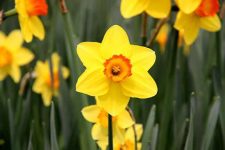
Credit: Kham Tran, CC BY-SA 3.0

If you haven’t gotten bulbs in the ground yet, don’t despair. As long as the soil temperature stays above 40 degrees F roots still have time to develop. This means you should still have success if you plant bulbs into early November. Check soil temperature readings for the previous week at our Weather Data Library:  http://mesonet.k-state.edu/agriculture/soiltemp/

Healthy bulbs should be large, firm and dormant. Do not choose bulbs that have sprouted. Bulbs need well-drained soil. Incorporate peat moss, well-rotted manure or compost into the soil to prepare for planting.

Test the soil for fertility and follow recommendations from the results. You may see high phosphorus levels if you test the soil in an area that is fertilized regularly. This can be problematic because phosphorus can hinder the uptake of other essential micronutrients. In these situations, use a fertilizer that is relatively high in nitrogen such as 29-5-4 or 27-3-3. Although these are lawn fertilizers, they are suitable for this purpose as long as they don’t have a weed preventer or killer incorporated. Apply at the rate of 2/3 pounds (3 cups) per 100 square feet.

Blood meal is an organic fertilizer that is low in phosphorus and can be applied at a rate of 2 pounds of 12-0-0 per 100 square feet (1 tsp per square foot). Cottonseed meal (6-0.4-1.5) can be applied at 3 pounds per 100 square feet (2 tsp/square foot) or soybean meal (7-2-1) can be applied at 3 pounds per 100 square feet (2 tsp/square foot).

If a soil test is not available use a balanced fertilizer such as 5-10-5 or 6-10-4 at a rate of 3 pounds (6 cups) per 100 square feet (2 tsp/square foot). Fertilizer supplements need to be thoroughly integrated with the soil prior to planting.

The depth bulbs should be planted is typically two to three times the size of the bulb. This varies depending on the species so check planting instructions for more accurate recommendations.

Cynthia Domenghini, Extension Agent

If the wells run dry

0

CSU researchers analyze what could happen if Colorado fails to meet river compact deadline

In the 1940s, Colorado, Nebraska and Kansas signed the Republican River Compact, an agreement on exactly how much water each would receive from the Republican River basin. But in recent years, there’s been some dispute about Colorado’s compliance. Now the state is being tasked with a looming deadline: either voluntarily retire 25,000 acres of irrigated land in the basin area by 2029 or face the mandated shutdown of wells, potentially impacting several hundred thousand acres of irrigated ag land — and the surrounding communities.

Earlier this year, state legislators tasked Colorado State University’s College of Agricultural Sciences and its Colorado Water Center with researching the potential impact to the Republican River Basin region if we don’t meet the deadline.

John Tracy is director of the Colorado Water Center and a professor in the Department of Ecosystem Science and Sustainability in the Warner College of Natural Resources. Jordan Suter is a professor in the Department of Agricultural and Resource Economics in the College of Agricultural Sciences.

They recently spoke with The Audit podcast about the study and the complicated history of the compact.

By Stacy Nick │ Colorado State University

Kansas Corn: Cooperative effort leads to progress on Rattlesnake/Quivira issue

0
K-State's Southeast Research and Extension Center in Parsons will host its 2017 Spring Crops Field Day on May 23.

Encouraged by the work to manage water use in the Rattlesnake Creek Basin, the United States Fish and Wildlife Service has announced it will withdraw the call for water for the 2024 growing season for the Quivira National Wildlife Refuge.

The call for water would have decimated the local economy surrounding the wildlife refuge, agricultural industry officials say. Kansas Corn Growers Association leaders said the development is encouraging and builds momentum for continued work with local partners such as Groundwater Management District No. 5 and WaterPACK to seek voluntary water conservation efforts to remedy the impairment.

In a letter to the Kansas Department of Agriculture’s Division of Water Resources, the Fish and Wildlife Service thanked DWR for its leadership and acknowledged input and efforts from elected officials and stakeholders. The service asked to withdraw its call for water for 2024, to allow a working group to collaborate on developing options to be implemented in 2025.

Kansas Corn, WaterPACK, GMD5 and other stakeholders have worked closely on this issue to protect agricultural producers on more than 452,000 irrigated acres in the basin.

“This has become a cornerstone issue for the Kansas Corn Growers Association. We are working to protect access to water on nearly half a million irrigated acres in our state. Using our expertise and connections, we were able to help the leadership of GMD 5 to successfully apply for and receive funding for a watershed plan. We also worked closely with Kansas Gov. Laura Kelly who requested expansion of funding for water conservation projects in our state and encouraged the USFWS to allow this process to continue,” Kansas Corn CEO Josh Roe said. “While today’s news is positive, we remain more laser focused than ever to help craft solutions to permanently remedy this situation.”

WaterPACK President Pat Janssen said Kansas Corn and other agriculture groups provided needed assistance.

“Kansas Corn opened doors for the GMD and helped with the process of getting federal support to help farmers in the basin implement conservation efforts that are key to maintaining the economic backbone that irrigated ag provides to our communities and schools.” Janssen said. “We look forward to partnering with Kansas Corn to seek additional funding for water conservation projects that will benefit all water users in the basin.”

Iuka corn grower Kent Moore, who serves on the KCGA board said this recent announcement was the culmination of efforts on the private, local, state, and federal levels.

“These cooperative efforts are leading to meaningful progress in this area and are being recognized by the U.S. Fish and Wildlife Service,” Moore said. “We look forward to continuing to work with the Kelly administration using private, local, state and federal funding to facilitate and implement needed water conservation projects that benefit Kansas farmers, our environment, and our state’s economy.”

Kansas Corn Growers Association leaders look forward to continued participation in this issue, and plan to be active in the working group going forward. The Kansas Corn Growers Association represents its members in legislative and regulatory issues and promotes Kansas corn, the state’s top-producing crop.

As reported in the High Plains Journal


Connection with nature linked to longer and healthier lives

0

Horticulture, health experts promote the ‘power of nature’

Nature is the daily pill we all need to live healthier lives, and Texas A&M University is laying the groundwork to lead the nation toward its healing powers.

The conversation about nature, green spaces, even houseplants’ abilities to wash away stress, anxiety and heal physical ailments has been gaining momentum for years, but Charlie Hall, Ph.D., professor and Ellison Chair in International Floriculture in the Texas A&M Department of Horticultural Sciences, is organizing to bring it to the forefront for a nation in crisis.

Mental and physical health in the U.S. is at crisis levels, he said. Hall and a growing number of scientists, health care professionals and green industry leaders hope to change individual behaviors and stakeholder attitudes related to nature and natural spaces.

Focus on growing human-nature disconnect

Jay Maddock, Ph.D., Regents professor in the Texas A&M School of Public Health and director of the Center for Health and Nature, presented at the 24th Ellison Distinguished Chair lecture and focused his talk on the impacts of a growing human-nature disconnect. Maddock, a psychologist, researches the social ecological ways to promote physical activity and engagement with nature.

Maddock’s presentation coincided with a brainstorming session among faculty from departments across Texas A&M University, professionals within the green industry, and public health officials and program specialists with the Texas A&M AgriLife Extension Service, including Texas Master Gardeners and early childhood development.

Attendees met to identify action items for these entities to use in promoting the concept and mobilizing activities around it.

“I’m encouraged by the range of fields that came together to discuss this topic because nature’s impact on our body and mind is a message we need to effectively deliver to policymakers and the public at large,” Hall said. “Implementing nature and plants into our daily lives may not sound like innovative thinking, but research has shown that it is an answer for a sustainable and healthy society, to address the economic impact of illnesses and to improve the overall quality of our lives.”

Connecting with nature improves health

During his presentation, Maddock cited “an incredible need for a better approach to mental and physical health in the U.S.” The high and rising rates of chronic diseases and diabetes, depression, substance abuse and deaths of despair, such as suicide or overdoses, are all related to our disconnect from nature.

“We cannot treat ourselves out of the mental health crisis,” he said. “And we can’t spend our way out of the health care crisis by pumping money into reactive medicine. We need to address the roots of these societal problems.

“Humans are innately connected to the natural world and when removed from nature, bad things happen.”

Eight out of 10 Americans feel stressed at least once every two weeks, and stress is a precursor to many of these problems, he said. Meanwhile, the money Americans spend on health as a share of the U.S. gross domestic product has quadrupled since 1960 from 5% to 20%, Maddock said.

This disconnect grew from the introduction of television, but the advent of hand-held minicomputers that hold our attention in a variety of ways throughout the day has deepened the human-nature divide, he said.

In 2012, American adults spent just over four hours a day consuming digital media, including television and desktop/laptop computers, according to a survey by eMarketer. Adults consumed six hours of digital media, across television, computers and mobile devices like smart phones by 2018, and that total exceeded eight hours by 2022.

Urbanization is also fueling the disconnect, he said. The percentage of Americans living in urban areas has steadily risen since the 1930s, and now more than 80% of residents live in cities instead of the countryside.

Maddock said stakeholders including civic leaders, industry and the public, need to understand how these rapid shifts in behavior affect wellness. Understanding the benefits of nature and natural features should inform short- and long-term changes that could radically change public health.

Daily exposure to nature provides a long list of benefits to human health. Stress reduction, better sleep, lower anxiety, greater happiness and life satisfaction, improved immune function, lower blood pressure, better birth outcomes and childhood development, reduced obesity and diabetes, improved eyesight and an overall longer life are all directly related to the frequency and scale at which a person engages with nature.

“I want to create a daily placebo pill and tell patients that this pill only works if you take a 30-minute walk in nature,” he said. “It would make a huge difference in all these health issues.”

A new approach to public health

The spectrum of nature contact can range from passive exposure such as potted plants in the home or office and windows with a view of the outdoors to interactive activities like hiking or gardening and wilderness adventures. Several days in remote natural areas provide a richer quantitative effect on a person’s health than potted plants or a room with a view, Maddock said.

For instance, one study showed that hospital patients with a view of a park from their hospital bed resulted in a speedier post-operation recovery time with less need for pain medication and fewer complications than patients without a view of nature.

Urban dwellers brought into a natural environment reported less mental fatigue, less irritability and saw their concentration and ability to problem solve increase.

Even virtual reality nature has been shown to provide a measurable positive impact to patients, he said.

Hall and Maddock hope policymakers and decision-makers recognize this opportunity and begin to rethink how green spaces, natural features and parks can be implemented in urban environments both indoors and outdoors.

Houston’s Bayou Greenway approach to a park system is the type of project they hope can be duplicated around the country on various scales. Bayou Greenway is a 3,000-acre, $220 million public-private partnership that provides 150 miles of trails in and around the city’s bayou system.

Maddock said access to trails and green spaces that promote activity in urban settings is important because a study from his research team showed that obesity-related hospital admissions dropped 93% in Houston zip codes within a 10-minute walk of the Bayou-Greenway trail system. Ischemic heart disease admissions dropped 77% and heart attack admissions dropped 71% in those same zip codes.

“Having trails near your home is connected to a reduction in hospitalizations,” he said. “That’s a huge effect, and of course we know it’s a correlational study, but from this large scale we are highly encouraged that it made a difference. That type of data is what has me geeked out about this effect of nature. It extends life, and you can’t have a better outcome than that.”

Hall and Maddock said they hope institutions like hospitals and universities will consider employing methods that provide access to or deliver nature to spaces like hospital rooms and classrooms in ways that enhance healing and learning, respectively.

Hall said the leadership team will follow through on recommendations and ideas developed by the initial “brainstorming group,” which plans to meet again next year. He and Maddock hope to see signs of momentum within the Department of Horticultural Sciences and among the various internal and external stakeholders by then.

“This is such an important message,” Hall said. “I think we can call it a mission now, and I believe Texas A&M is uniquely positioned to be a leader, a facilitator and partner within this movement to reconnect people with the healing power of nature and greenscapes.”

By Adam Russell │ Texas A&M AgriLife

Fall is ideal time to set home landscape up for spring success

0

Crisp, fall temperatures may signal a step away from warmer summer weather, but Johnson County horticulture extension agent Dennis Patton says it’s not a time to completely put away summer work.

Patton says several fall chores can set up lawns and gardens for success next spring.

Home lawns

Leaves from trees can create a barrier to healthy lawns by blocking sunlight that the grass receives – creating dead areas in the lawn next spring.

“You need to get those leaves off the grass so that you’ll have a healthy lawn next spring,” Patton said.

“I like mulch mowing,” he said. “After you get a thin layer of leaves on the layer – not 6-8 inches, but just a thin layer – take the bagger off your mower and mow over the leaves. The mower will chop and shred those leaves and they will filter back to the soil surface.”

Listen to an interview by Jeff Wichman with Dennis Patton on the weekly radio program, Sound Living

Mulch mowing, Patton notes, breaks leaves down as compost to the soil level, releasing organic matter. He said homeowners should consider mulch mowing when a thin layer of leaves covers the grass.

“You know that you’re safely mulch-mowing when you look behind you and what you see is a majority of grass and a few little pieces of leaves here and there,” Patton said. “If you look behind you and you see mostly leaves, then you probably waited too long between those mulch mowings.”

Leaves can be added to a compost pile to mulch gardens next spring, or Patton says they can be spread at the base of shrubs and other areas this fall as soil amendments.

Lawns should be mowed to their summer length before putting the mower away for the winter. Cool season lawns – tall fescue and Kentucky bluegrass – may still be growing as late as Thanksgiving; warm-season lawns – zoysia and bermuda – are usually done once the first frost hits.

Gardens

Patton suggests a full cleanup of gardens this fall, including removing remaining vines and weeds. He said gardeners should also consider spading or tilling the soil.

“Do a ‘rough till’ in the fall,” he said. “Leave it looking chunky. Then in March or April, hit it with a rake and you’re ready to plant.”

Cleaning up and tilling the soil in the fall saves gardeners a common dilemma of waiting for wet soils to dry up before doing work in the spring.

Lawnmower maintenance

Patton said modern gasoline tends to be a little more stable than older products, but it’s still important to decide whether to run the mower dry before winter, or to add a stabilizer before storing the mower.

“Either way is fine; it depends on your preference,” Patton said. “Also, do a tune-up of your mower before winter hits; change the oil and air filter and sharpen the blade. Many people wait until March to do this, but you can do this in fall and when spring comes, you’re ready to go.”

Patton said one thing most overlook is the tires on a lawnmower. “Just like on your car, tires wear down, so mowing heights aren’t true,” he said. “Putting new wheels on your lawnmower might add ½ inch to the mowing height.”

Garden hoses

Patton said homeowner should remember to unhook garden hoses from outdoor faucets. Leaving them attached may cause backup pressure, leading to frozen pipes.

Also, he said, drain hoses after unhooking them. Water expands as it freezes, which could rupture the hose.

“Ideally, you should store the hose inside or in a container out of the sunlight,” Patton said. “Drain them, roll them up, tie with twine and hang in the garage. A good hose is an expensive investment, and you want to be sure you treat it with kindness.”

Watering trees

In most winters, Kansas gets adequate rain or snowfall for trees. “But if we get one of those dry winters with not a lot of precipitation, you might want to check soil moisture around trees in January or February, and give the trees a drink of water on a warm day when the soil is not frozen,” Patton said.

Houseplants

When kept outside during the warmer months of the year, houseplants are exposed to many elements and insects. Homeowners should routinely check houseplants for insect development – aphids, white flies, spider mites or others – once plants are moved inside.

“Once they are in the home around 70 degrees Fahrenheit, (insects) love to multiply really fast,” Patton said. “Insecticidal soaps work really well for taking care of most indoor problems.”

Houseplants should not be fertilized during the winter months, he said. “Keep them on the dry side, and watch for insects.”

It is normal for houseplants to lose leaves while inside. “The goal is to keep them alive, then give them a haircut when you put them out next May. They’ll soon get bushy again and start the process all over.”

More information on taking care of home landscapes is available online or from local K-State Research and Extension offices in Kansas.

By K-State Research And Extension News Service